
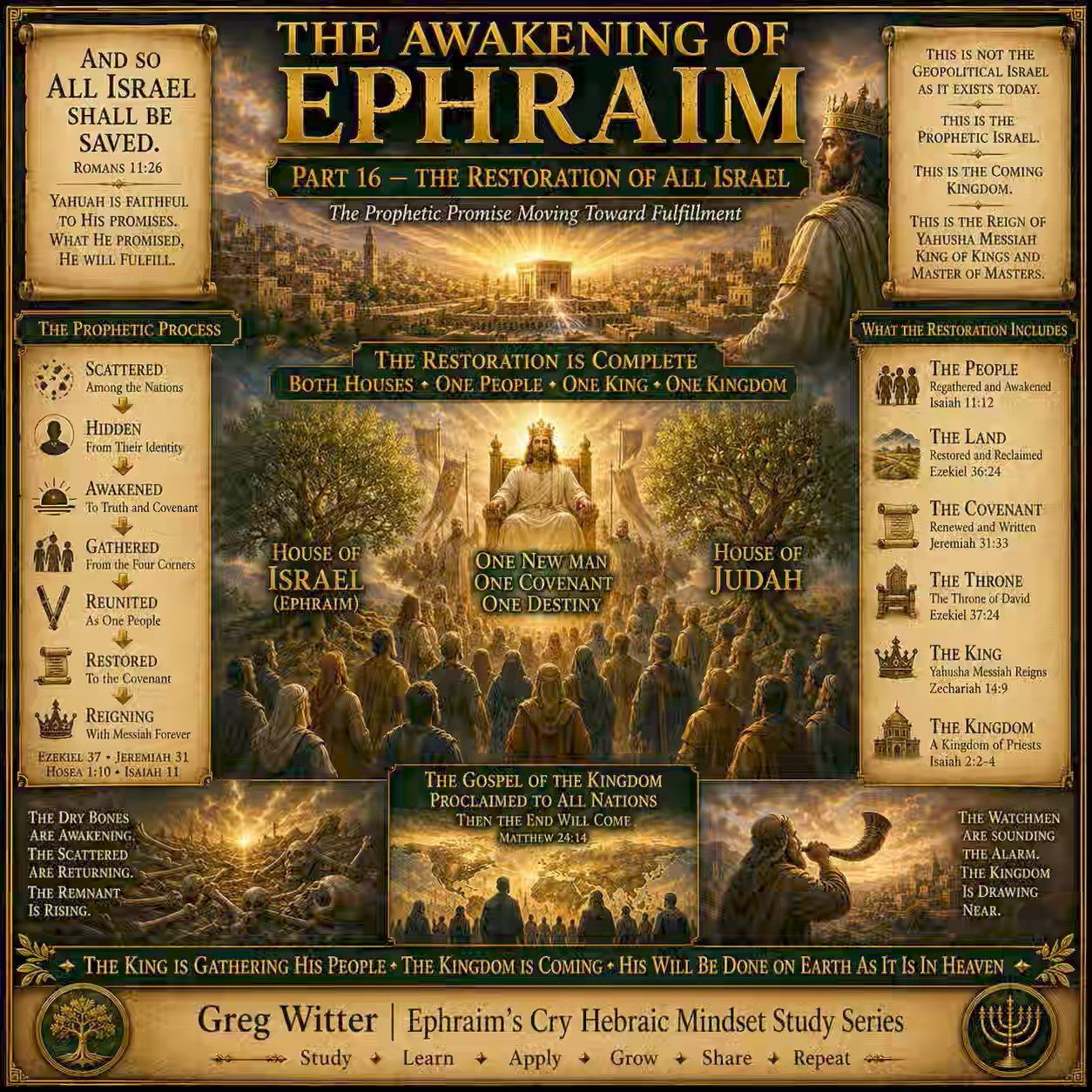
HE AWAKENING OF EPHRAIM
PART 16 — THE RESTORATION OF ALL ISRAEL
The Prophetic Promise Moving Toward Fulfillment
One of the most debated statements in all of Scripture is found near the conclusion of Romans 11.
After discussing the olive tree.
After discussing the natural branches.
After discussing the wild branches.
After discussing the fullness of the Gentiles.
Paul declares:
“And so all Israel shall be saved.” (Romans 11:26)
For centuries people have argued over what this means.
Who is Israel?
What does “all Israel” mean?
When does this occur?
How does it happen?
Yet when we allow Scripture to interpret Scripture, the answer becomes much clearer.
Paul is not abandoning the prophets.
Paul is not creating a new doctrine.
Paul is not introducing a new people.
Paul is drawing the restoration story toward its prophetic conclusion.
To understand Romans 11, we must understand the story that began long before Romans was written.
The story begins with Abraham.
The promises were given to Abraham.
The covenant was established with Abraham.
The promises were passed to Isaac.
The promises were passed to Jacob.
The promises were inherited by Israel.
From the beginning, Yahuah declared that Israel would become a great people.
Yet from the beginning, He also warned what would happen if covenant was abandoned.
Blessing for obedience.
Judgment for rebellion.
Restoration through repentance.
This pattern appears throughout Torah.
This pattern appears throughout the Prophets.
This pattern appears throughout the Writings.
This pattern appears throughout the Apostolic Witnesses.
Israel sins.
Israel is warned.
Israel refuses.
Israel is judged.
Israel is scattered.
Israel repents.
Israel is restored.
Again and again the cycle repeats.
This becomes especially important when we examine the division of the kingdom.
The House of Israel became divided.
The Northern Kingdom became Ephraim.
The Southern Kingdom became Judah.
The division created two houses.
Yet Yahuah never intended two houses to remain forever.
The division was judgment.
The restoration would be redemption.
This is why nearly every major prophet speaks about restoration.
Isaiah speaks about restoration.
Jeremiah speaks about restoration.
Ezekiel speaks about restoration.
Hosea speaks about restoration.
Amos speaks about restoration.
Zechariah speaks about restoration.
The restoration story is one of the central themes of Scripture.
Yet many people have been taught to read the prophets through a fragmented lens.
One passage is separated from another.
One prophecy is separated from another.
One witness is separated from another.
The result is confusion.
But when the Four Witnesses are brought together, the picture becomes remarkably clear.
The scattered are gathered.
The divided are reunited.
The covenant is restored.
The Kingdom is established.
The King reigns.
This is the destination toward which all restoration prophecy moves.
One of the most powerful restoration prophecies appears in Jeremiah 31.
Most people know Jeremiah 31 because of the renewed covenant.
Few notice who the covenant is made with.
The covenant is made with the House of Israel and the House of Judah.
Not one house.
Both houses.
The prophecy assumes restoration.
The prophecy assumes reunification.
The prophecy assumes regathering.
The prophecy assumes covenant renewal.
The very existence of the renewed covenant prophecy proves that Yahuah never abandoned either house.
This same reality appears in Ezekiel 37.
The valley of dry bones becomes alive.
Then the two sticks become one.
The progression is intentional.
Life.
Awakening.
Gathering.
Reunification.
Kingdom.
This is the restoration process.
The dry bones are not raised merely to exist.
The dry bones are raised to become a people.
The sticks are not joined merely for symbolism.
The sticks are joined because division is ending.
The scattered are not gathered merely to return to geography.
The scattered are gathered because the Kingdom is approaching.
One of the greatest misunderstandings in modern prophecy is the assumption that biblical Israel and the modern geopolitical State of Israel are automatically identical in every prophetic context.
They are not.
This is not an attack on the modern nation.
This is not opposition to the Jewish people.
This is not hostility toward the land.
It is simply a recognition that the biblical restoration prophecies are larger than a modern political state.
The prophets were not merely speaking about political sovereignty.
They were speaking about covenant restoration.
They were speaking about spiritual awakening.
They were speaking about the reunification of the House of Israel and the House of Judah.
They were speaking about the restoration of the Kingdom under the authority of the King.
The restoration described by the prophets cannot be reduced to borders.
It cannot be reduced to governments.
It cannot be reduced to political movements.
It cannot be reduced to citizenship.
The restoration described by the prophets culminates in the reign of Messiah.
The restoration culminates in the Kingdom of Elohim.
The restoration culminates in the gathering of the covenant people under one Shepherd and one King.
The prophets consistently look beyond earthly governments toward the coming Kingdom.
Isaiah looks beyond earthly governments.
Jeremiah looks beyond earthly governments.
Ezekiel looks beyond earthly governments.
Daniel looks beyond earthly governments.
Zechariah looks beyond earthly governments.
Their eyes are fixed upon the coming reign of Messiah.
Their eyes are fixed upon the Kingdom that will fill the earth.
Their eyes are fixed upon the day when the King Himself rules from Zion.
This is why the restoration of all Israel cannot be viewed merely through a political lens.
The ultimate fulfillment is Kingdom.
The ultimate fulfillment is covenant.
The ultimate fulfillment is Messiah.
The ultimate fulfillment is the restoration of all things spoken by the prophets.
This brings us directly back to Paul’s statement.
“And so all Israel shall be saved.”
Paul has spent three chapters discussing restoration.
Romans 9.
Romans 10.
Romans 11.
He discusses the promises.
The covenants.
The patriarchs.
The olive tree.
The natural branches.
The wild branches.
The fullness of the Gentiles.
The restoration of the broken branches.
Then he concludes:
“And so all Israel shall be saved.”
The statement is the culmination of the discussion.
Not the introduction of a new topic.
Paul is describing the fulfillment of restoration.
The fulfillment of regathering.
The fulfillment of covenant promises.
The fulfillment of prophetic expectation.
This does not mean every individual who ever lived is automatically saved.
Scripture never teaches that.
Nor does it mean ethnic identity alone guarantees salvation.
Scripture never teaches that.
Salvation has always required faith.
Salvation has always required repentance.
Salvation has always required covenant relationship.
Salvation has always required the work of the Redeemer.
The restoration of Israel therefore does not bypass Messiah.
The restoration of Israel occurs through Messiah.
The restoration of Israel occurs through the King.
The restoration of Israel occurs through the covenant promises fulfilled in Yahusha.
This is why the Gospel of the Kingdom remains central.
The Gospel is the mechanism of restoration.
The Gospel is the call to repentance.
The Gospel is the call to return.
The Gospel is the call to covenant.
The Gospel is the call to Kingdom citizenship.
The Gospel is the call to prepare for the reign of the King.
The restoration of all Israel therefore cannot be separated from the proclamation of the Gospel of the Kingdom.
The King gathers His people through the message of the Kingdom.
The Shepherd gathers His sheep through the message of the Kingdom.
The scattered hear His voice through the message of the Kingdom.
The remnant responds through the message of the Kingdom.
This is why Yahusha declared:
“And this Gospel of the Kingdom shall be proclaimed in all the world as a witness to all the nations, and then the end shall come.” (Matthew 24:14)
The Gospel is not merely information.
The Gospel is a summons.
A summons to return.
A summons to repent.
A summons to covenant.
A summons to Kingdom.
A summons to restoration.
This restoration must also be viewed within the larger prophetic timeline.
The prophets repeatedly point toward the Day of Yahuah.
They repeatedly point toward the coming Kingdom.
They repeatedly point toward the reign of Messiah.
The restoration of all Israel is not an isolated event.
It is part of the preparation for the return of the King.
The scattered are awakened before the Kingdom.
The remnant is gathered before the Kingdom.
The Gospel of the Kingdom is proclaimed before the Kingdom.
The watchmen sound the alarm before the Kingdom.
The Two Sticks move toward reunification before the Kingdom.
The olive tree continues its restoration before the Kingdom.
The fullness of the Gentiles approaches completion before the Kingdom.
All of these prophetic streams converge toward the same destination.
The millennial reign of Messiah.
The Sabbath rest of the seventh day.
The Kingdom age anticipated throughout Scripture.
The restoration age foretold by the prophets.
The reign of Yahusha as King of Kings and Master of Masters.
This is why the restoration of all Israel is not merely about the past.
It is about the future.
It is about the coming Kingdom.
It is about the fulfillment of promises.
It is about the faithfulness of Elohim.
It is about the restoration of what was broken.
It is about the gathering of what was scattered.
It is about the reunification of what was divided.
It is about the establishment of the Kingdom under the reign of Messiah.
This is why the restoration of all Israel is not merely a future event.
The process is already underway.
The dry bones are awakening.
The scattered are returning.
The watchmen are sounding the alarm.
The remnant is responding.
The Gospel of the Kingdom is advancing.
The covenant is being restored.
The awakening is spreading.
The olive tree is growing.
The two sticks are moving toward reunification.
The fullness of the Gentiles is approaching completion.
The restoration process is unfolding before our eyes.
Not because of human effort.
Not because of organizations.
Not because of denominations.
But because Yahuah promised it.
What He promised through Moses.
What He promised through Isaiah.
What He promised through Jeremiah.
What He promised through Ezekiel.
What He promised through Hosea.
What He promised through the apostles.
He is bringing to fulfillment.
This is why the restoration of all Israel matters.
Because it demonstrates the faithfulness of Yahuah.
The same Elohim who scattered is gathering.
The same Elohim who judged is restoring.
The same Elohim who warned is redeeming.
The same Elohim who promised is fulfilling His word.
The story of Israel is not ultimately a story of failure.
It is a story of redemption.
It is a story of restoration.
It is a story of covenant faithfulness.
It is a story of a King gathering His people.
And it is moving steadily toward the day when the restoration of all Israel reaches its appointed fulfillment under the reign of Yahusha Messiah, King of Kings, Master of Masters, and rightful ruler of the coming Kingdom of Elohim.
Greg Witter | Ephraim’s Cry Hebraic Mindset Study Series
Study • Learn • Apply • Grow • Share • Repeat
#EphraimsCry#GregWitter#HebraicMindset#HebraicMindsetStudySeries#TheAwakeningOfEphraim#Part16#TheRestorationOfAllIsrael
#Romans11#Jeremiah31#Ezekiel37#HouseOfIsrael#HouseOfJudah#KingdomOfElohim#YahushaMessiah#GospelOfTheKingdom
#KingdomRestoration#CovenantRestoration#OneKing#OnePeople#PrepareTheWay#ReturnToYahuah#WholeCounselOfElohim
#KingdomCitizens#Remnant#Watchman
