
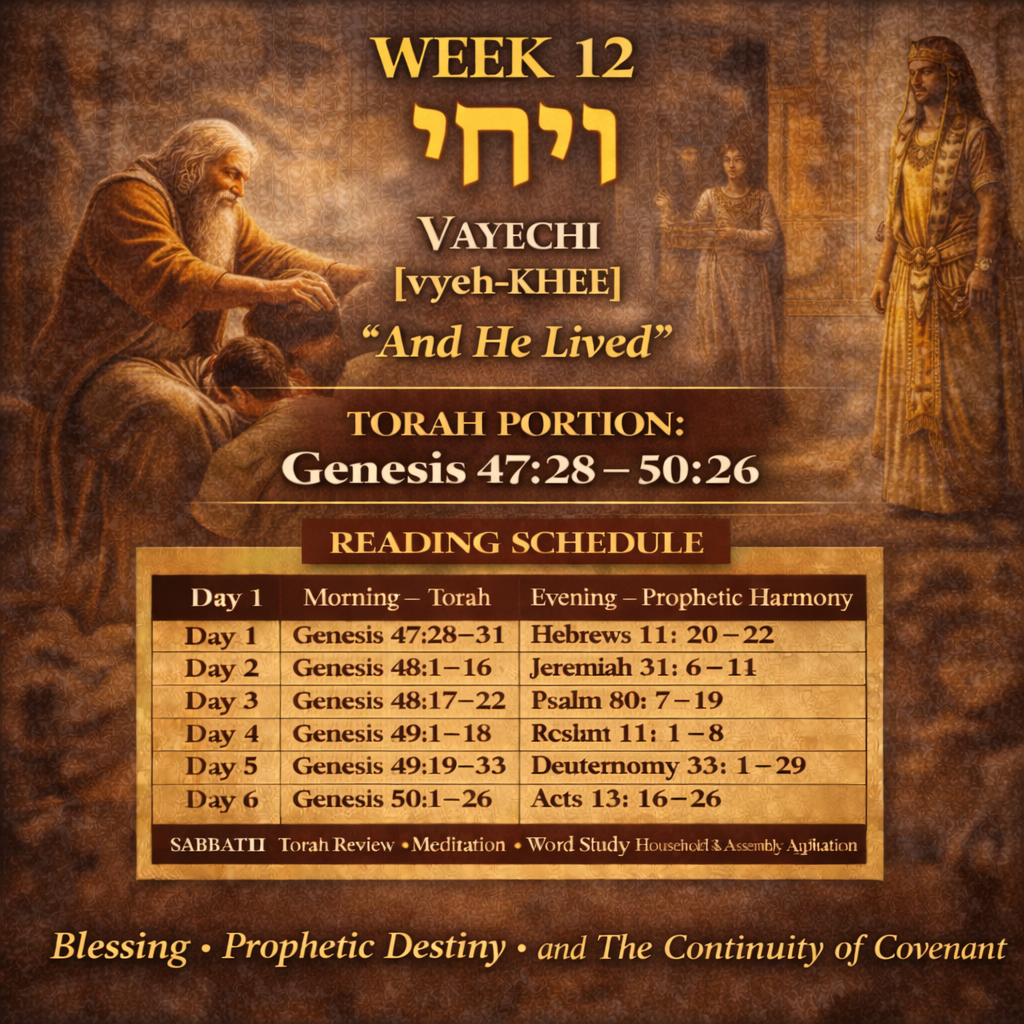
WEEK 12 — וַיְחִי (Vayechi) [vyeh-KHEE] — “And He Lived”
Torah Portion: Genesis 47 : 28 – 50 : 26
READING SCHEDULE
| Day | Morning — Torah | Evening — Prophetic Harmony |
|---|---|---|
| Day 1 | Genesis 47 : 28 – 31 | Hebrews 11 : 20 – 22 |
| Day 2 | Genesis 48 : 1 – 16 | Jeremiah 31 : 6 – 14 |
| Day 3 | Genesis 48 : 17 – 22 | Psalm 80 : 1 – 19 |
| Day 4 | Genesis 49 : 1 – 18 | Revelation 7 : 1 – 8 |
| Day 5 | Genesis 49 : 19 – 33 | Deuteronomy 33 : 1 – 29 |
| Day 6 | Genesis 50 : 1 – 26 | Acts 13 : 16 – 26 |
SABBATH | Torah Review · Meditation · Word Study | Household & Assembly Application
THEMATIC FLOW — BLESSING, PROPHETIC DESTINY, AND THE CONTINUITY OF COVENANT
“And Jacob lived in the land of Egypt seventeen years…” (Genesis 47 : 28)
Vayechi — “and he lived” — marks the closing of Genesis, yet it is not a chapter about death but about the fulfillment and transmission of covenant life. Jacob, nearing the end of his earthly journey, strengthens himself for one final act: to bless, to prophesy, and to establish the future identity of the tribes of Israel.
Jacob adopts Ephraim and Manasseh as his own sons, elevating Joseph’s lineage and giving a double portion. In crossing his hands, Jacob places his right hand on Ephraim, the younger, declaring the divine pattern of reversal: Yahuah chooses whom He wills, not according to human expectation.
In Genesis 49, Jacob speaks prophetic destinies over each of his twelve sons. These are not mere blessings but covenant declarations shaping the character, future, and role of each tribe. Judah receives leadership and the promise of kingship; Joseph receives fruitfulness and strength; Levi receives dispersion yet future priesthood; Dan receives judgment; Zebulun, Issachar, Naphtali, and others receive geographical and spiritual identity.
Joseph demonstrates covenant faithfulness in Egypt, honoring his father and preserving unity among the brothers. His statement — “You planned evil against me, but Elohim planned it for good” — anchors the entire Genesis narrative in divine sovereignty.
The portion closes with the deaths of Jacob and Joseph, yet both command that their bones not remain in Egypt. They point toward the Exodus, the promised land, and the unbroken covenant with Abraham, Isaac, and Jacob.
Vayechi affirms that covenant life does not end with the patriarchs—it continues through the tribes, through destiny, and through the faithfulness of Yahuah across generations.
HEBREW WORD STUDY — וַיְחִי (Vayechi)
Block: ויחי Paleo: 𐤅 𐤉 𐤇 𐤉 Root: חיה (chayah) — to live, to revive, to give life
| Letter | Symbol | Meaning | Prophetic Role |
|---|---|---|---|
| 𐤅 Vav | Nail | Connection | Connection of covenant life across generations |
| 𐤉 Yod | Hand | Work / Action | Yahuah’s sustaining hand |
| 𐤇 Het | Fence | Life / Breath | Life preserved and guarded by Elohim |
| 𐤉 Yod | Hand | Continuity | Ongoing action of divine preservation |
Paleo Meaning:
“Yahuah sustains life, guarding it and extending it through His continual action.”
PROPHETIC PALEO-HEBREW WORD PICTURE
Vayechi reveals that life in covenant is not measured by years but by faithfulness. Jacob’s final acts — blessing, prophesying, adopting, commanding — become the foundation stones of Israel’s identity. The life Yahuah gives extends beyond death into generational purpose.
SABBATH MEDITATION
Sabbath calls us to reflect on legacy. Jacob’s final years were his most fruitful spiritually; he sowed identity, destiny, and unity into his family. What we speak, what we bless, and what we establish in our homes reverberates for generations.
The crossing of hands challenges us: Yahuah’s ways are not our ways. He exalts the unlikely, advances His purposes through reversal, and writes destinies that confound human logic.
The command regarding bones reminds us that our hope is not in Egypt — not in the world system — but in the promise of resurrection, redemption, and the land of inheritance.
REFLECTION AND DISCUSSION QUESTIONS
Heart (Individual)
-
What legacy am I building through my words, actions, and faithfulness?
-
Am I willing to accept Yahuah’s unexpected choices and reversals?
-
How can I anchor my identity in His covenant rather than circumstances?
Household (Family)
4. How can we speak blessings and destiny over our children like Jacob did?
5. What traditions or practices can help our family maintain covenant identity?
Assembly (Corporate)
6. Are we cultivating generational discipleship and blessing within the assembly?
7. How can we prepare the next generation to carry the covenant forward?
PRAYER / DECLARATION FOR SABBATH
Yahuah,
You are the Elohim who gives life,
who blesses,
who establishes destiny through generations.
Teach us to speak life,
to walk in faith,
and to pass on covenant truth to our children.
Strengthen our hearts to trust Your choices
and to anchor our hope in Your promises.
May our lives testify that You are faithful from generation to generation.
In Yahusha’s Name — Amein.
JOTS & TITTLES
| Reference | Marker | Description | Prophetic Meaning |
|---|---|---|---|
| Genesis 48 : 14 | Crossing of hands | Reversal of expectation | Yahuah chooses according to purpose, not order |
| Genesis 49 : 1 | “Gather yourselves” | Prophetic call | Revelation of future destiny of Israel |
| Genesis 49 : 10 | Scepter | Promise of kingship | Messianic authority from Judah |
| Genesis 50 : 25 | Oath of bones | Promise of Exodus | Hope anchored in future redemption |
FOOTNOTES
-
Genesis 48 — adoption and blessing of Ephraim and Manasseh.
-
Jeremiah 31 — restoration of the northern tribes.
-
Psalm 80 — plea for the Shepherd of Israel to restore.
-
Genesis 49 — prophetic destinies of the tribes of Israel.
-
Deuteronomy 33 — Moses’ parallel blessings over the tribes.
-
Acts 13 — Joseph and the patriarchs in covenant history.
