
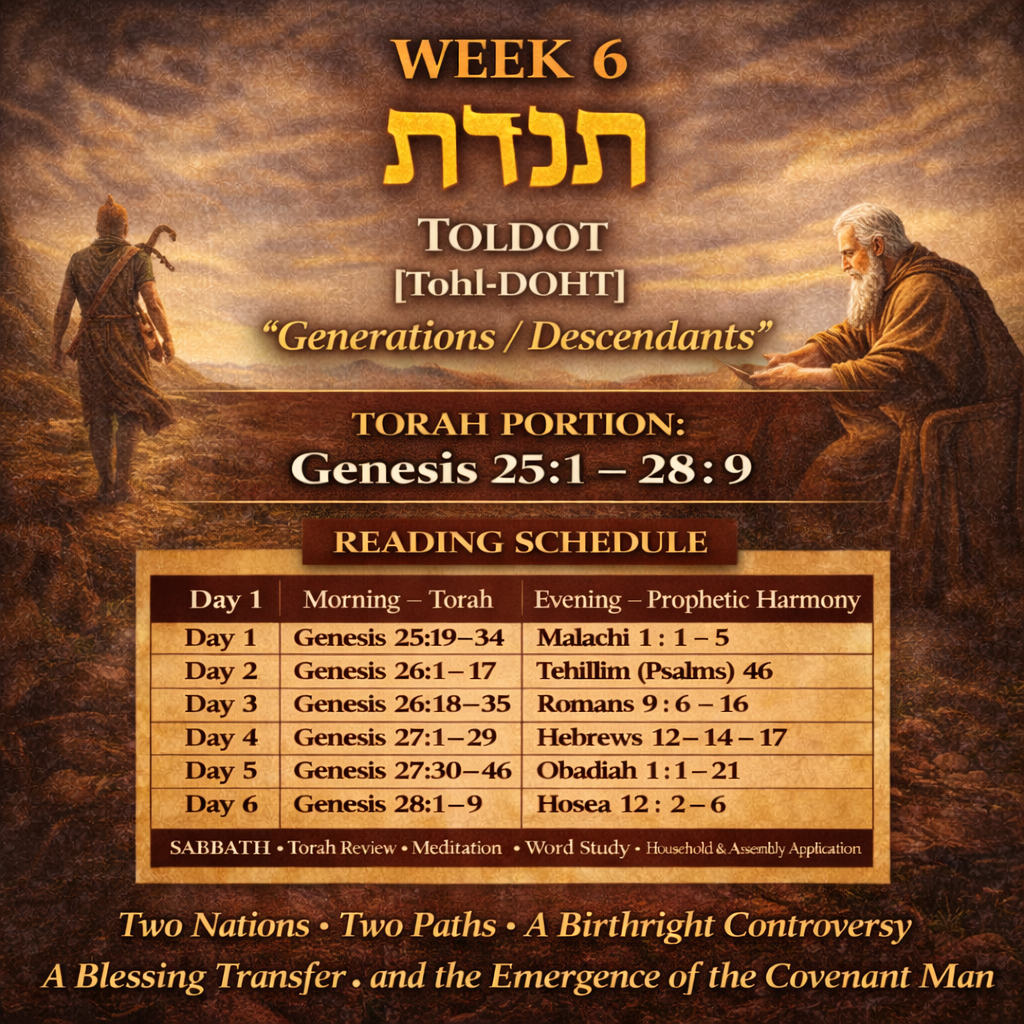
WEEK 6 — תּוֹלְדֹת (Toldot) [Tohl-DOHT] — “Generations / Descendants”
Torah Portion: Genesis 25 : 19 – 28 : 9
READING SCHEDULE
| Day | Morning — Torah | Evening — Prophetic Harmony |
|---|---|---|
| Day 1 | Genesis 25 : 19 – 34 | Malachi 1 : 1 – 5 |
| Day 2 | Genesis 26 : 1 – 17 | Tehillim (Psalms) 46 |
| Day 3 | Genesis 26 : 18 – 35 | Romans 9 : 6 – 16 |
| Day 4 | Genesis 27 : 1 – 29 | Hebrews 12 : 14 – 17 |
| Day 5 | Genesis 27 : 30 – 46 | Obadiah 1 : 1 – 21 |
| Day 6 | Genesis 28 : 1 – 9 | Hosea 12 : 2 – 6 |
SABBATH | Torah Review · Meditation · Word Study | Household & Assembly Application
THEMATIC FLOW — TWO NATIONS, TWO PATHS, A BIRTHRIGHT CONTROVERSY, A BLESSING TRANSFER, AND THE EMERGENCE OF THE COVENANT MAN
Toldot opens with a generational announcement marking the transition of covenant leadership to Yitsḥaq. Rivqah’s barrenness and Yitsḥaq’s intercession reveal that covenant lineage depends on divine intervention, not human effort. The struggling twins within her womb introduce the prophetic conflict between two nations, with Yahuah declaring that the elder will serve the younger, establishing covenant destiny before birth.
Esau grows into a man of the field, driven by appetite and impulse, while Ya’aqov becomes a man dwelling in tents, aligned with the covenant household. The birthright exchange exposes their hearts: Esau despises the covenant inheritance, trading eternal blessing for temporary satisfaction, while Ya’aqov values what Elohim values. This divergence sets the prophetic distinction between Israel and Edom.
Genesis 26 parallels the journeys of Avraham. Yitsḥaq receives the same promises, faces famine, remains obedient, and redigs his father’s wells. Each well—Esek, Sitnah, and Rehovot—reveals a pattern of conflict, hostility, and enlargement. Yitsḥaq’s perseverance, humility, and trust secure divine blessing and recognition even from hostile neighbors.
Genesis 27 records the transfer of the covenant blessing. Rivqah acts according to the prophetic word she received, ensuring Ya’aqov receives the blessing destined for him. The blessing includes fruitfulness, dominion, and covenant continuity. Esau’s bitter cry exposes the heart posture that disqualified him from carrying covenant responsibility, and his desire for revenge reveals the spiritual divide between the two brothers.
Genesis 28 begins Ya’aqov’s journey toward the fulfillment of covenant destiny. Yitsḥaq commands him not to marry from the surrounding nations, preserving covenant purity. Esau, trying to recover favor without repentance, adds another wife from Ishmael’s line, revealing misalignment despite his intentions. Toldot closes with two diverging paths—one aligned with covenant obedience, the other driven by human reaction.
HEBREW WORD STUDY — תּוֹלְדֹת (Toldot)
Block: תולדות Paleo: 𐤕 𐤅 𐤋 𐤃 𐤕 Root: ילד (yalad) = to bring forth, to beget, to produce generations
| Letter | Symbol | Meaning | Prophetic Role |
|---|---|---|---|
| 𐤕 Tav | Mark | Sign / Covenant | Generational covenant markings |
| 𐤅 Vav | Hook | Connection | Linking generations together |
| 𐤋 Lamed | Staff | Teach / Authority | Covenant instruction passed down |
| 𐤃 Dalet | Door | Entrance | Access into covenant destiny |
| 𐤕 Tav | Mark | Completion | Covenant fulfillment through lineage |
Paleo Meaning:
“The covenant sign connects generations through instruction, opening the way toward fulfillment.”
Prophetic Paleo-Hebrew Word Picture:
“Toldot reveals that destiny unfolds through lineage marked by covenant signs, connected through obedience, and directed by divine instruction.”
SABBATH MEDITATION
Sabbath invites us to examine our generational legacy. Are we passing down covenant faithfulness or worldly appetite? As Yitsḥaq restored the wells of Avraham, we also restore the ancient paths by reestablishing covenant rhythms in our homes.
REFLECTION AND DISCUSSION QUESTIONS
Heart (Individual)
-
Do I value the covenant birthright above temporary desires?
-
Where am I resisting Elohim’s shaping?
-
Which ancient “wells” must I reopen in my life?
Household (Family)
4. Are we teaching covenant identity intentionally?
5. Do our rhythms and choices preserve generational blessing?
Assembly (Corporate)
6. Are we guarding covenant identity as a community?
7. Do we honor the prophetic destiny of Yahuah’s chosen line?
PRAYER / DECLARATION FOR SABBATH
Yahuah Elohim,
Keeper of generations,
Teach us to honor the birthright You have given.
Strengthen our desire for covenant blessing.
Restore the ancient wells in our homes.
Guide our steps in obedience and truth.
Establish our families in Your purposes.
In Yahusha’s Name — Amein.
JOTS & TITTLES
Prophetic Oracle — Genesis 25:23
Words: וְרַב יַעֲבֹד צָעִיר
Meaning: “The elder shall serve the younger”
Feature: Reversal of expectation
Meaning: Covenant destiny established before birth
Birthright Exchange — Genesis 25:34
Word: וַיִּבֶז
Meaning: “He despised”
Feature: Moral emphasis
Meaning: Esau disqualified himself through contempt for covenant
Boundary Command — Genesis 26:2
Word: אַל־תֵּרֵד
Meaning: “Do not go down”
Feature: Covenant boundary
Meaning: Obedience preserves inheritance
Well Names — Genesis 26:20–22
Words: עֵשֶׂק ; שִׂטְנָה ; רְחֹבוֹת
Feature: Name sequence
Meaning: Opposition → Hostility → Enlargement
Blessing Formula — Genesis 27:28–29
Feature: Covenant wording
Meaning: Transmission of Avrahamic promises
Esau’s Cry — Genesis 27:38
Word: בְּכִי
Meaning: Weeping
Feature: Emotional marker
Meaning: Heart unqualified for covenant destiny
Marriage Instruction — Genesis 28:1
Word: לֹא־תִקַּח
Meaning: “Do not take”
Feature: Purity command
Meaning: Covenant lineage must remain undefiled
Counterfeit Alignment — Genesis 28:9
Feature: Esau’s action
Meaning: Attempted correction without transformation
KEY THEMATIC INSIGHTS
Sovereignty Establishes Destiny
Yahuah chooses covenant lineage according to His purpose.
Birthright Is Sacred
Despising it reveals spiritual unfitness.
Opposition Precedes Enlargement
Yitsḥaq’s wells show perseverance leads to expansion.
Blessing Transfers Through Alignment
Rivqah safeguards prophetic destiny.
Heart Determines Qualification
Esau’s bitterness reveals inner disalignment.
Purity Protects Inheritance
Marriage choices shape generational stability.
Generations Carry Prophetic Weight
Toldot reveals destiny embedded in lineage.
Week Summary
Week 6 (Genesis 25 : 19 – 28 : 9) contrasts Ya’aqov and Esau, reveals the prophetic struggle between two nations, shows Yitsḥaq’s restoration of covenant wells, displays the transfer of blessing through prophetic alignment, and underscores generational obedience as the key to covenant destiny.
FOOTNOTES
-
Toldot marks generational covenant structure.
-
Prophecy reveals destiny before birth.
-
Birthright exchange exposes covenant values.
-
Yitsḥaq’s wells reveal struggle and enlargement.
-
Blessing formula transmits Avrahamic promises.
-
Esau’s bitterness reveals spiritual misalignment.
-
Rivqah aligns actions with prophecy.
-
Marriage purity preserves covenant lineage.
-
Generational choices determine prophetic future.
-
Covenant obedience preserves inheritance.
HASHTAGS
#GregWitter, #EphraimsCry, #HebraicMindsetStudySeries, #Toldot, #GenesisStudy, #CovenantReadingCycle, #Birthright, #JacobAndEsau, #WellsOfIsaac, #CovenantBlessing, #PropheticPatterns, #HebraicRoots, #AncientPaths, #SetApartLife, #CovenantDestiny, #RemnantRising, #EndTimesWatchmen, #ScriptureStudy, #TorahPortion, #WalkInObedience, #InheritanceAndPromise, #FaithfulGenerations, #SpiritualWarfare, #BiblicalTruth, #IdentityInYahusha, #ReturnToTorah, #KingdomCalling, #CovenantPurity, #PrepareTheRemnant, #TruthInLove
