
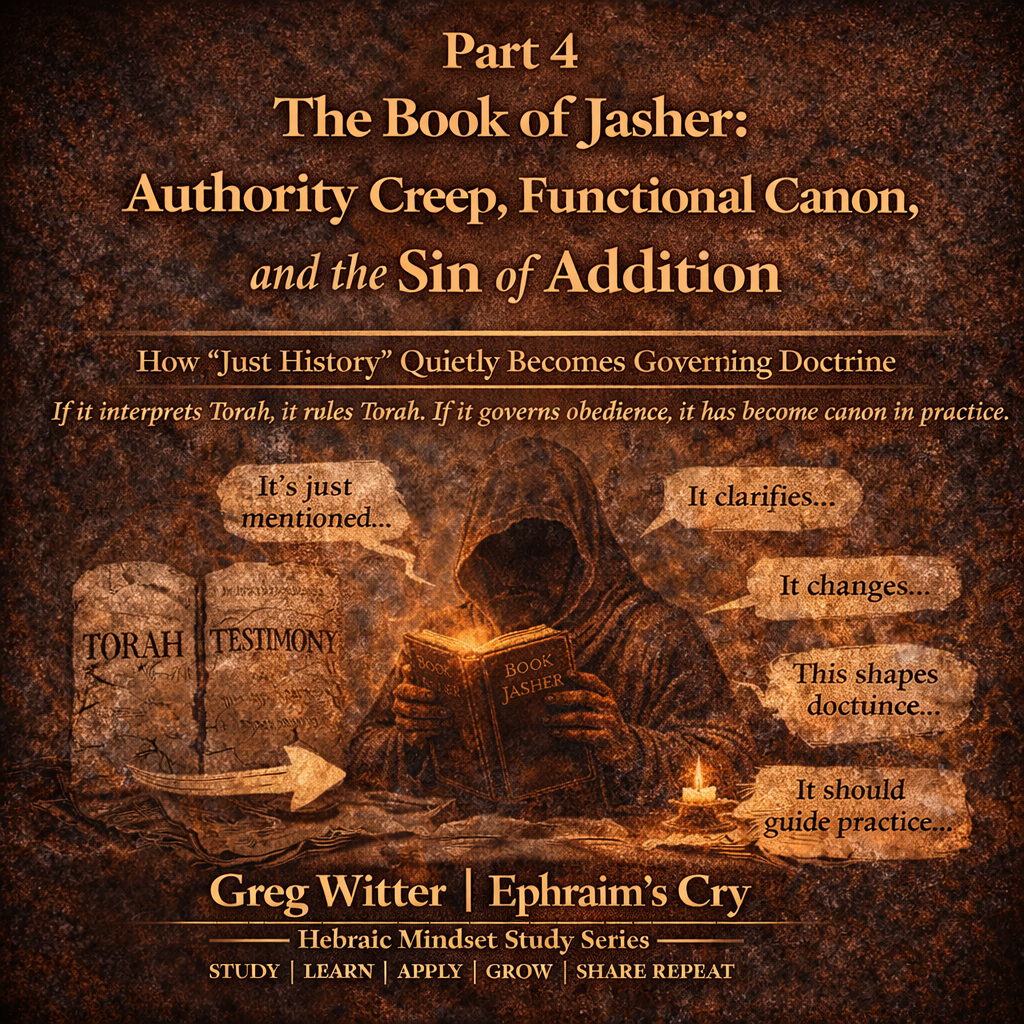
PART 4
The Book of Jasher: Authority Creep, Functional Canon, and the Sin of Addition
How “Just History” Quietly Becomes Governing Doctrine
If it interprets Torah, it rules Torah. If it governs obedience, it has become canon in practice.
Greg Witter | Ephraim’s Cry
Hebraic Mindset Study Series
Study Learn Apply Grow Share Repeat
The most dangerous phase in the Jasher issue is not curiosity.
It is authority creep.
Authority creep does not begin with a declaration. It begins with disclaimers.
“It’s not Scripture.”
“I don’t put it on the same level.”
“It’s just historical background.”
“It’s just helpful context.”
That language feels safe. It sounds humble. It sounds careful.
But authority is not defined by what you say about a text. Authority is defined by what a text is allowed to do in your system.
If Jasher is allowed to interpret Torah, it has authority.
If Jasher is allowed to clarify doctrine, it has authority.
If Jasher is allowed to reshape narrative understanding, it has authority.
If Jasher is allowed to influence practice, it has authority.
You can deny it verbally. But if it governs interpretation, it governs you.
That is functional canon.
And functional canon is addition, even if you refuse to use the word “Scripture.”
Now understand the covenant boundary in explicit legal terms.
Deuteronomy 4:2: Do not add to what I command you, nor take from it.
Deuteronomy 12:32: You shall not add to it or take from it.
Proverbs 30:5–6: Do not add to His words lest you be found a liar.
Isaiah 8:20: To the Torah and to the testimony.
1 Corinthians 4:6: Do not go beyond what is written.
Jude 3: Contend for the faith once delivered.
These are not suggestions. They are constitutional guardrails.
Addition is not limited to writing new Scripture. Addition includes installing any secondary interpretive authority that shapes doctrine or practice beyond what the covenant writings establish.
And that is precisely what happens with Jasher when it moves beyond literature into influence.
Let’s break down the progression clearly.
Stage 1 — Curiosity
“It’s mentioned in Scripture.”
Stage 2 — Legitimization
“It’s ancient and respected.”
Stage 3 — Supplemental Framing
“It fills in missing details.”
Stage 4 — Interpretive Shift
“This helps us understand the passage correctly.”
Stage 5 — Doctrinal Impact
“This changes how we see the event.”
Stage 6 — Practical Consequence
“This affects how we apply the text.”
At Stage 6, the shift is complete.
Jasher is no longer background.
It is a governing influence.
And once something governs, it is authority.
The covenant structure does not permit parallel authority streams.
Israel had one Torah.
Not Torah plus supplements.
Not Torah plus lost expansions.
Not Torah plus interpretive upgrades.
The Prophets reinforced Torah.
They did not install new constitutions.
The Apostolic witness testified to Yahusha in continuity with Torah.
They did not install rival interpretive systems.
Parallel authority streams produce fragmentation.
One teacher uses Jasher one way.
Another uses it differently.
One assembly accepts certain sections.
Another rejects them.
Now the community divides over a text that has no covenant authorization.
That is the fruit of authority creep.
And here is the deeper problem: once addition is normalized, boundaries erode.
If Jasher is allowed to interpret Torah, why not Enoch?
If Enoch is allowed, why not Jubilees?
If Jubilees is allowed, why not any other so-called lost writing?
Once the principle of sufficiency is compromised, there is no limiting mechanism.
That is why Scripture commands contentment with what has been delivered.
The faith was once delivered (Jude 3).
The servant of Elohim is made complete through Scripture (2 Timothy 3:16–17).
You are not missing what is required for obedience.
The authority creep narrative whispers something else:
“You’re missing something.”
“You don’t have the whole picture.”
“You need this to fully understand.”
That whisper is the same spirit as, “Did Elohim really say?”
Because it plants distrust in what was preserved.
Now let us address jurisdiction directly.
Jurisdiction is the right to govern.
Torah has jurisdiction over covenant obedience.
The Prophets have jurisdiction to prosecute covenant breach.
The Writings have jurisdiction as covenant memory and wisdom.
The Apostolic witness has jurisdiction as testimony aligned with Torah.
Jasher has no jurisdiction.
It was not preserved in the covenant corpus.
It was not commanded for public reading.
It was not placed beside the Ark.
It was not transmitted as covenant law.
So when it is used to interpret Torah in a binding way, it is operating outside its jurisdiction.
And operating outside jurisdiction is rebellion.
You may read literature.
You may study history.
You may examine comparative texts.
But you may not enthrone them.
You may not let them rule interpretation.
You may not let them define doctrine.
You may not let them govern obedience.
Because once they do, you have added.
And addition subtracts.
It subtracts trust in sufficiency.
It subtracts clarity.
It subtracts stability.
It subtracts unity.
Authority creep is not loud rebellion. It is quiet displacement.
Covenant faithfulness requires boundary enforcement.
The standard remains:
Torah first.
Testimony aligned.
Nothing added.
Nothing subtracted.
No rival standards.
No parallel constitutions.
If Jasher influences your doctrine or obedience beyond what Torah and testimony establish, it has exceeded its place.
And covenant people do not permit unauthorized rulers.
#GregWitter, #EphraimsCry, #HebraicMindset, #TorahFirst, #BookOfJasher, #CovenantAuthority, #FunctionalCanon, #DoNotAdd, #DoNotTakeAway, #Isaiah820, #TestEverything, #HoldFast, #SoundDoctrine, #Discernment, #RefuseRivalStandards, #ExposeDeception, #WindsOfDoctrine, #WholeCounselOfElohim, #ObedientFaith, #StandFirm, #ReturnToTorah
