
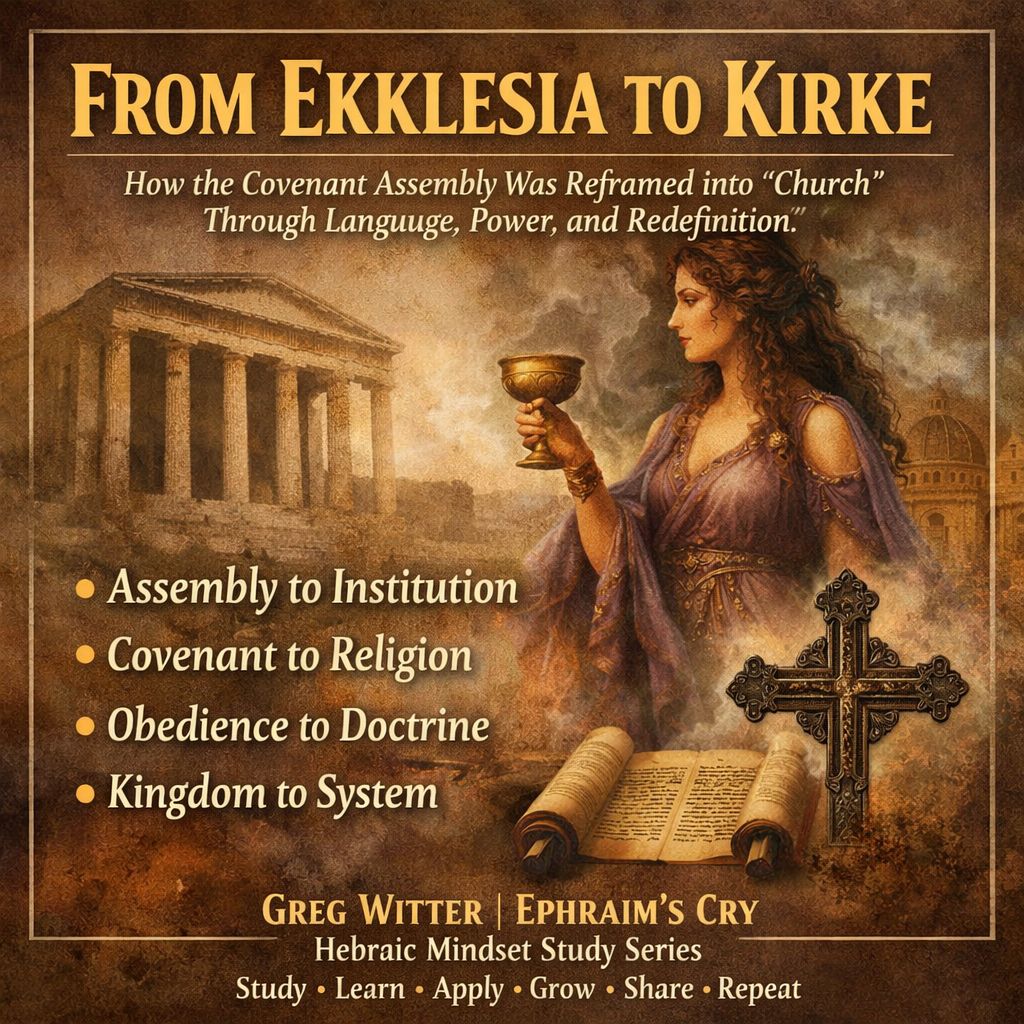
FROM EKKLESIA TO KIRKE
How the Covenant Assembly Was Reframed into “Church” Through Language, Power, and Redefinition
A full exposure of the linguistic, historical, and theological shift that transformed a people into a system
Greg Witter | Ephraim’s Cry
Hebraic Mindset Study Series
Study Learn Apply Grow Share Repeat
There are moments in study where the issue is no longer whether Scripture is clear, but whether we have been trained to read it through a framework that already altered its meaning before we ever engaged it. That is where this teaching begins—not with argument, but with recognition. Recognition that something does not fully align. Recognition that what has been inherited does not completely reflect what is written. Recognition that the difference is not small, and it is not accidental.
Because if the language changes, the meaning can be redirected. If the meaning is redirected, identity begins to shift. And if identity shifts, people can continue forward believing they are aligned, while the structure they are operating in has already been redefined.
That is not speculation.
That is how systems replace truth without announcing themselves.
The word in the New Testament is ekklesia (ἐκκλησία). This is not debated. It is the consistent term used throughout the apostolic writings. And its meaning is not abstract. It is concrete, functional, and covenantal. It means a called-out assembly, a summoned people, a body gathered under authority and bound by obligation. It is a people defined by calling, not by location. It is a body defined by covenant, not by institution.
This is not interpretation layered onto the word. This is the word itself.
And Scripture anchors this meaning in a way that cannot be undone.
Acts 7:38 states:
“This is he that was in the ekklesia in the wilderness with the messenger which spake to him in the mount Sina…”
That is Sinai. That is Israel. That is the giving of Torah. That is the moment where Yahuah called His people, gathered them, and bound them to covenant instruction.
So the ekklesia did not begin in the New Testament. It did not begin after the cross. It did not begin with the apostles. It existed as the covenant assembly of Israel. This connects directly to the Hebrew word qahal (קהל)—the assembly, the gathered people under Yahuah’s authority.
This means the apostles were not creating something new.
They were calling people back into something already established.
They were proclaiming the continuation and fulfillment of the covenant assembly through Messiah, not the invention of a new religious system.
Once that foundation is established, the next question cannot be avoided.
If ekklesia is clearly defined in Scripture, how did it become something else in practice?
Because what is described in the text does not match what developed historically.
The ekklesia described in Scripture is:
relational
covenant-bound
Torah-rooted
decentralized
Spirit-governed
built through people, not controlled through structure
Yet as history progresses, especially into the third and fourth centuries, the function of that assembly begins to change. Slowly at first, then decisively.
Leadership becomes centralized. Authority becomes hierarchical. Oversight becomes territorial. What was once a people governed by covenant becomes a structure governed by administration. The shift is not immediate, but it is undeniable.
Servant leadership becomes institutional authority.
Covenant accountability becomes organizational control.
Obedience becomes doctrinal compliance.
This is not accusation. This is recorded development.
By the time Rome fully integrates the faith into its framework, the ekklesia has already been restructured into something that no longer resembles its original form.
And when structure changes, language follows.
The English word “church” does not come from ekklesia. It does not come from qahal. It does not originate from covenant language. It follows a different linguistic path tied to the term kyriakon, meaning “that which belongs to a lord or master.” This is a possession-based term. It does not describe an assembly. It does not describe a people. It describes something owned.
Over time, this term became associated with places of gathering, then with sacred space, and eventually with institutional structure.
That shift matters.
Because ekklesia is a people.
Kyriakon evolves into something that can be attached to a place, a structure, a system.
That is the redirection.
From people → to property
From assembly → to structure
From covenant identity → to institutional belonging
And once that shift is embedded in language, it begins to reshape thought automatically. Now when someone hears “church,” the default understanding is no longer a covenant assembly. It is a building, a service, a system, an organization.
That is not what Scripture defined.
That is what developed.
This is where the deeper pattern must be understood.
The reference to kirke / Circe is not being used as a fragile linguistic derivation, but as a diagnostic pattern that mirrors what took place historically. The pattern is transformation without destruction. Identity altered without outward collapse. Systems absorbed, renamed, and redirected while maintaining the appearance of continuity.
In the Circe narrative, men are not eliminated. They are changed. They still exist, but they are no longer what they were. That is the pattern.
Rome operated the same way.
It did not destroy belief systems. It absorbed them. It renamed them. It redirected allegiance. It preserved outward form while altering internal structure.
This is not mythology being forced into history.
This is a pattern that aligns with historical method.
The ekklesia was not destroyed.
It was redefined.
The translation history exposes this even further.
William Tyndale translated directly from the Greek text. He refused the word “church.” He used the word “congregation.” This was not stylistic preference. This was intentional alignment with the meaning of ekklesia as a people.
Congregation preserves:
assembly
gathering
people-centered identity
Church carries:
institutional implication
structural association
inherited authority framework
The response to Tyndale was execution.
That is not incidental.
That is exposure.
This was not about translation accuracy alone.
This was about control.
Earlier English developments also reflect this tension. The Wycliffe translation, coming through the Latin Vulgate, carried forward institutional language that had already been shaped by Roman structure. By that point, the term had already absorbed layers of meaning beyond the original ekklesia. What appears in English is not a neutral translation—it is a continuation of an already redefined framework.
Later, the King James translation preserved ecclesiastical terminology under explicit instruction not to disrupt established authority. This was not hidden. It was directed.
Language was preserved to maintain structure.
And once that language became fixed, it shaped generations of interpretation.
This is where the connection to Replacement Theology becomes unavoidable.
Because once ekklesia is reframed into “church” as an institution, the following shifts become not only possible, but inevitable:
covenant becomes religion
obedience becomes optional
Torah becomes obsolete
Israel becomes replaced
Messiah becomes detached from His own walk
the assembly becomes a system
the Kingdom becomes an institution
This is not merely doctrinal development.
This is structural replacement carried through language.
Scripture itself never supports this shift.
1 John 2:6 states:
“He that saith he abideth in Him ought himself also so to walk, even as He walked.”
That is not symbolic. That is instructional.
Messiah did not walk in separation from Torah. He walked in obedience to it. So any system that redefines obedience as unnecessary has already departed from the pattern it claims to follow.
The house language of Scripture reinforces this further.
1 Peter 2:5:
“You also, as living stones, are being built up a spiritual house…”
Ephesians 2:19–22:
“Built upon the foundation… in whom all the building fitly framed together groweth unto an holy temple…”
This is not describing a building people attend.
This is describing a people being built.
A dwelling formed from living stones.
A covenant structure that exists within the people, not outside of them.
This brings the issue into focus.
Because now the question is no longer about terminology.
It is about alignment.
Are you part of a system, or are you part of a people being built?
Are you participating in an institution, or are you living as part of a covenant assembly?
Are you defending inherited language, or are you returning to what Scripture actually defines?
The distinction between people and system must remain clear.
This is not an attack on individuals. Many sincere people exist within institutional structures. Scripture itself acknowledges that Yahuah’s people can be found within systems that do not fully align with His design.
Revelation 18:4:
“Come out of her, My people…”
The instruction itself proves the condition.
His people can be inside something that must be exited.
That is not condemnation.
That is invitation.
The issue is not whether people are sincere.
The issue is whether the structure they are operating in reflects what was established.
And once that question is asked honestly, the answer becomes unavoidable.
The ekklesia was:
a covenant assembly
a people called out
Torah-rooted
Messiah-centered
being built into a dwelling
The church system became:
an institution
a structure of authority
a religious framework
a redefinition of identity
Rome did not destroy the faith.
It redefined it.
The call is not to argument.
The call is to return.
Return to covenant.
Return to Torah.
Return to walking as Messiah walked.
Return to ekklesia—not kirke.
The ekklesia was never meant to become a system.
It was always meant to remain a people—
called out, set apart, and walking in covenant with Yahuah.
#GregWitter#EphraimsCry#HebraicMindset#EkklesiaNotChurch#ReplacementTheologyExposed#ReturnToTorah
#CovenantFaithfulness#KingdomNotReligion#ComeOutOfHer
