
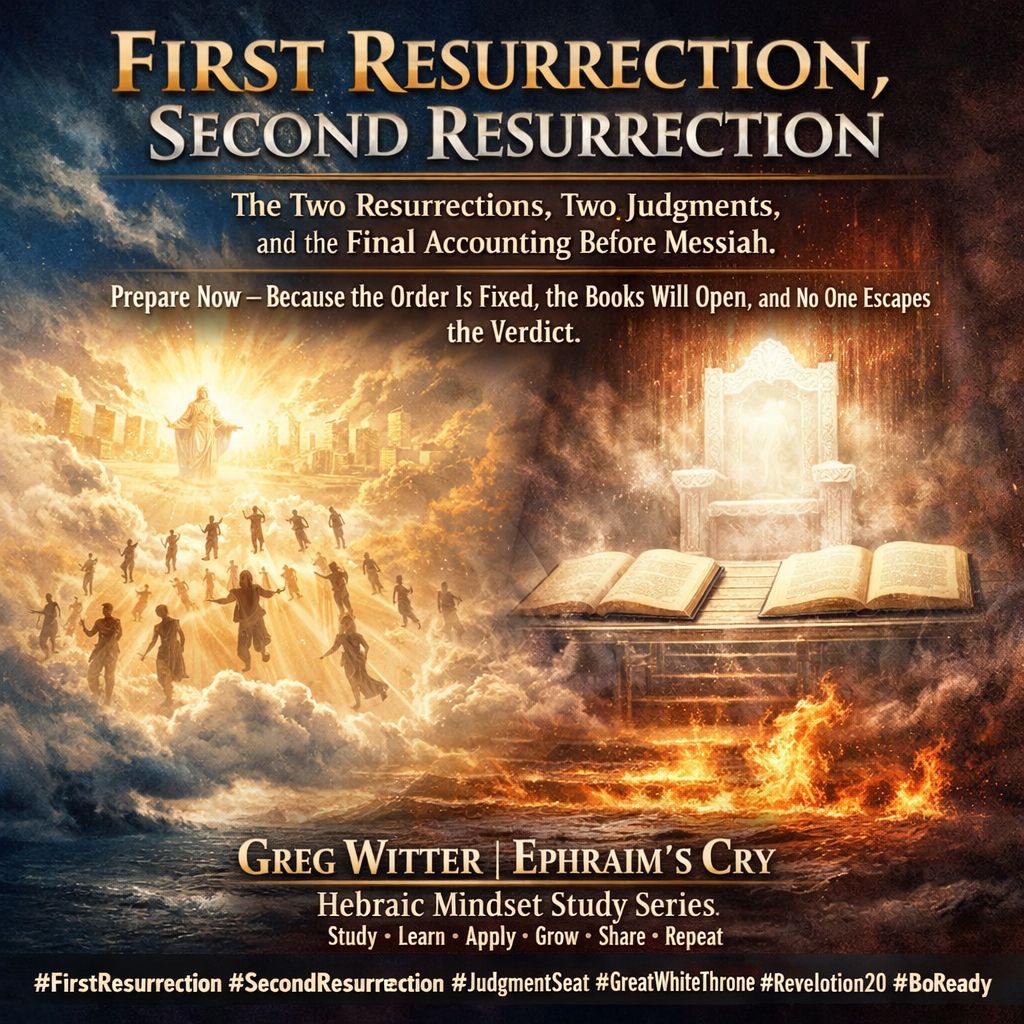
First Resurrection, Second Resurrection
The Two Resurrections, Two Judgments, and the Final Accounting Before Messiah
Prepare Now — Because the Order Is Fixed, the Books Will Open, and No One Escapes the Verdict
Greg Witter | Ephraim’s Cr
Hebraic Mindset Study Series
Study Learn Apply Grow Share Repeat
Introduction — This Is Not Symbolic, and It Is Not Optional
There are a few subjects that strip away religious games instantly. The resurrections and the judgments are one of them. Scripture does not present resurrection as poetic imagery. It presents it as the unavoidable future of every human being. And judgment is not an emotional concept. It is legal. It is covenantal. It is the opening of books, the weighing of deeds, the rendering of verdict, and the carrying out of sentence.
Yes — we will all stand before Messiah and give an account. But Scripture also shows something most people either do not know or refuse to face: there is more than one resurrection, and there is more than one phase of judgment. There is the judgment of the righteous, and there is the judgment of the wicked. There is the resurrection to life, and there is the resurrection to condemnation. There is the reign of Messiah, and there is the final court.
This teaching will lay out the full structure as Scripture presents it — Torah foundations, Prophetic framework, Writings clarity, and Apostolic witness continuity — and it will expose the lies that keep people comfortable in sin.
I. The Foundation — Resurrection Is a Core Scriptural Doctrine
Resurrection is not a New Testament invention. It is anchored in the Scriptures from beginning to end.
Daniel states plainly:
“And many of those who sleep in the dust of the earth shall awake, some to everlasting life, and some to shame and everlasting contempt.” (Daniel 12:2)
Job testified to bodily resurrection:
“For I know that my Redeemer lives, and He shall stand at last on the earth; and after my skin is destroyed, this I know, that in my flesh I shall see Elohim.” (Job 19:25–26)
Isaiah declares resurrection hope:
“Your dead shall live; together with my dead body they shall arise. Awake and sing, you who dwell in dust.” (Isaiah 26:19)
So when people talk like resurrection is a “Christian concept,” they are revealing they do not know the text. Resurrection is covenant justice. The Judge must raise the dead because the story is not finished in the grave.
II. The Central Claim — There Are Two Resurrections
Scripture distinguishes the resurrections. It does not blur them together.
Messiah Himself taught a resurrection to life and a resurrection to judgment:
“…for the hour is coming in which all who are in the graves shall hear His voice and come forth — those who have done good, to the resurrection of life, and those who have practiced evil, to the resurrection of condemnation.” (John 5:28–29)
Revelation states explicitly that there is a “first resurrection” and then a resurrection after the thousand years:
“And I saw thrones, and they sat on them, and judgment was given to them… and they lived and reigned with Messiah for a thousand years. But the rest of the dead did not live again until the thousand years were finished. This is the first resurrection.” (Revelation 20:4–5)
Blessedness is attached to the first resurrection:
“Blessed and set-apart is the one having part in the first resurrection. Over such the second death has no power…” (Revelation 20:6)
That means the resurrections are not the same event. They are separated in time, order, and outcome.
III. The First Resurrection — The Resurrection of the Righteous
The first resurrection is the raising of the faithful — those who belong to Messiah, who endure, who overcome, who are found in covenant loyalty at His coming.
Paul lays it out:
“For the Master Himself shall descend… and the dead in Messiah shall rise first.” (1 Thessalonians 4:16)
And the living who are His will be changed:
“We shall not all sleep, but we shall all be changed… the dead shall be raised incorruptible, and we shall be changed.” (1 Corinthians 15:51–52)
This resurrection is unto immortality for the righteous:
“…to those who by persistence in doing good seek for glory, honor, and immortality — eternal life.” (Romans 2:7)
And Messiah Himself defines the “sons of the resurrection”:
“…those who are considered worthy to attain that age and the resurrection from the dead… neither can they die anymore, for they are equal to the angels and are sons of Elohim…” (Luke 20:35–36)
This is not a casual hope. It is the reward of overcoming faithfulness.
And the first resurrection is not merely “going to heaven.” Scripture repeatedly places the reign of Messiah and His set-apart ones on the earth:
“And they shall reign on the earth.” (Revelation 5:10)
“Do you not know that the set-apart ones shall judge the world?” (1 Corinthians 6:2)
If people are taught a vague afterlife and never taught resurrection order and kingdom rule, they were taught a system, not the Scriptures.
IV. The Judgment of the Righteous — Evaluation, Reward, and Crown
The righteous are judged — not to determine whether Messiah’s blood is sufficient, but to evaluate faithfulness, assign reward, and expose what is real.
Paul says plainly:
“For we must all appear before the judgment seat of Messiah, so that each one may receive according to what he has done in the body, whether good or bad.” (2 Corinthians 5:10)
That word “receive” is not mere punishment language. It is reward language too.
Messiah said:
“For the Son of Man is coming… and then He shall reward each according to his works.” (Matthew 16:27)
And again:
“See, I am coming speedily, and My reward is with Me, to give to each according to his work.” (Revelation 22:12)
This is where false grace collapses.
Grace does not erase accountability. Grace provides redemption and empowers obedience. Judgment reveals whether someone actually walked in the faith they claimed.
Paul warns that works will be tested by fire:
“Each one’s work shall become manifest… the fire shall prove each one’s work.” (1 Corinthians 3:13)
If someone’s work is burned, they suffer loss:
“If anyone’s work is burned, he shall suffer loss; but he himself shall be saved, yet so as through fire.” (1 Corinthians 3:15)
This is not license. It is sober warning. Many will be saved “barely,” stripped of reward, exposed as careless, undisciplined, and compromised.
So yes — there is judgment for the righteous. But it is not condemnation. It is evaluation under the King.
V. The Thousand Years — The Reign of Messiah and the Sabbath Shadow Fulfilled
The thousand-year reign is not a side note. It is a massive prophetic marker tied to the Sabbath theme of rest, reign, and restoration.
Revelation says:
“They lived and reigned with Messiah for a thousand years.” (Revelation 20:4, 6)
This reign is the period in which Messiah rules, His enemies are restrained, and the earth experiences governance under His authority. The adversary is bound during this time:
“And he seized the dragon… and bound him for a thousand years…” (Revelation 20:2)
This is a direct overthrow of the “present age” rule system. It is the visible reality of the Kingdom.
This is why the Sabbath matters prophetically. It is a weekly witness of the coming Kingdom order. It declares that this age is temporary and that Messiah’s reign is coming.
VI. The Second Resurrection — The Rest of the Dead Raised After the Thousand Years
Revelation is explicit:
“But the rest of the dead did not live again until the thousand years were finished…” (Revelation 20:5)
After the thousand years, the rest are raised. This is where many teachers distort the text. They either deny a second resurrection or turn the entire chapter into allegory. That is not faithful interpretation. It is avoidance.
This second resurrection leads into the final court scene:
“And I saw a great white throne, and Him who sat on it… And I saw the dead, small and great, standing before Elohim, and books were opened…” (Revelation 20:11–12)
This is not “the same judgment seat” of believers being evaluated for reward. This is the final judicial session where the wicked are exposed, sentenced, and destroyed in the second death.
VII. The Judgment of the Wicked — Books Opened, Deeds Exposed, Verdict Rendered
Revelation shows the structure:
“And the dead were judged according to their works, by the things which were written in the books.” (Revelation 20:12)
The standard is righteousness — and righteousness is defined by Elohim, not by human opinion.
The outcome is stated:
“And anyone not found written in the Book of Life was thrown into the lake of fire.” (Revelation 20:15)
This is not about “good people vs bad people.” This is about covenant loyalty vs rebellion. Those who refuse repentance, refuse truth, refuse submission, and cling to lawlessness will face the second death.
Messiah Himself warned:
“And these shall go away into everlasting punishment, but the righteous into everlasting life.” (Matthew 25:46)
Daniel’s two outcomes match it: life or contempt (Daniel 12:2). Messiah’s words match it. Revelation matches it. There is no escape hatch. The wicked will be judged.
VIII. The Second Death — Final Destruction of the Wicked
Revelation defines the lake of fire as the second death:
“This is the second death.” (Revelation 20:14)
The second death is the end. It is not “eternal life in torment” language in the text of Revelation. It is death — final destruction. That is why it is called death. And it is contrasted with eternal life given to the righteous (John 5:29; Matthew 25:46).
The wicked do not inherit the Kingdom. They are removed.
IX. The Lie That Must Be Exposed — “Everyone Is Fine”
The most dangerous deception in this age is comfort theology. People have been trained to believe:
If I said words once, I’m fine. If I felt something once, I’m fine. If I belong to a group, I’m fine. If I’m not “as bad as others,” I’m fine.
Messiah destroys that lie.
“Not everyone who says to Me, ‘Master, Master,’ shall enter… but he who does the desire of My Father…” (Matthew 7:21)
“Depart from Me, you workers of lawlessness.” (Matthew 7:23)
John says:
“He who says, ‘I know Him,’ and does not guard His commandments, is a liar, and the truth is not in him.” (1 John 2:4)
The resurrections prove it. The judgments prove it. The books prove it. This is not a game.
X. The Truth That Must Be Restored — Repentance, Obedience, Endurance
Scripture does not call people to an emotional experience. It calls them to covenant fidelity.
Repentance is commanded:
“…unless you repent you shall all likewise perish.” (Luke 13:3)
Obedience is the fruit:
“If you love Me, you shall guard My commandments.” (John 14:15)
Endurance is required:
“But he who endures to the end shall be saved.” (Matthew 24:13)
And the end-time remnant is defined as those who hold both commandments and testimony:
“Those guarding the commandments of Elohim and holding the testimony of Yahusha.” (Revelation 12:17)
“Those guarding the commandments of Elohim and the faith of Yahusha.” (Revelation 14:12)
This is the road that leads to the first resurrection.
XI. The Accounting — What Will You Say When You Stand Before Him?
You will not argue your way out. You will not blame your pastor. You will not blame your parents. You will not blame your denomination. You will not blame your ignorance.
You will give an account.
“And there is no creature hidden from His sight, but all are naked and laid open to the eyes of Him to whom we must give account.” (Hebrews 4:13)
That is why the fear of Yahuah matters. Not panic. Not terror. But reverent, sober awareness that He is Judge, King, and Lawgiver.
“Therefore, since we receive an unshakable reign, let us hold the favor, by which we serve Elohim acceptably with reverence and fear.” (Hebrews 12:28)
Conclusion — Choose the First Resurrection
Scripture gives a choice, not by human preference, but by covenant outcome.
There is a first resurrection — blessed and set-apart. There is a second resurrection — the final court and the second death. There is a judgment of the righteous — evaluation and reward. There is a judgment of the wicked — exposure and sentence.
And yes — every one of us will stand before Messiah.
So the only sane response is this: Repent now. Submit now. Guard His commandments now. Hold the testimony of Yahusha now. Endure now. Because delay is not denial — but the door shuts.
If you’ve been blessed by this teaching and want access to the full, in-depth version with expanded Scripture study, covenant framework, and detailed breakdowns, you can support and unlock full teachings through my subscription page. Join here:
#GregWitter#EphraimsCry#HebraicMindset#Resurrection#FirstResurrection#SecondResurrection#JudgmentSeatOfMessiah#GreatWhiteThrone#BookOfLife#SecondDeath#CovenantFaithfulness#TorahAndTestimony#EndureUntilTheEnd#KingdomOfElohim#BeReady
