
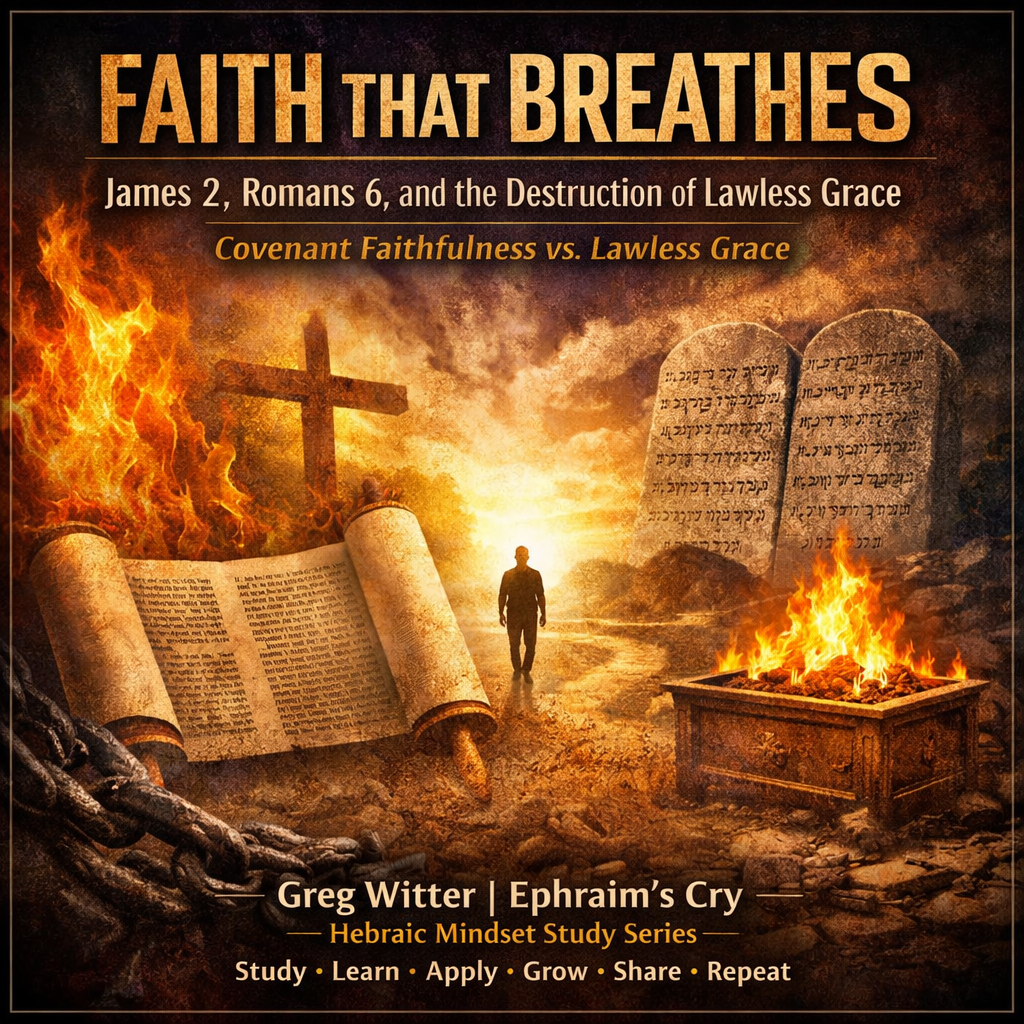
Faith That Breathes
James 2, Romans 6, and the Destruction of Lawless Grace
James does not defend institutional performance. Romans does not excuse lawlessness. Scripture exposes barren confession, destroys counterfeit grace, and calls the set-apart people of Yahuah into living covenant faithfulness.
Greg Witter | Ephraim’s Cry
Hebraic Mindset Study Series
Study Learn Apply Grow Share Repeat
Grace has been hijacked. Churchianity has taken the language of grace and stripped it of its covenant function. Grace is preached as exemption instead of transformation. Forgiveness is presented as immunity. Faith is reduced to agreement. Obedience is treated as suspicion. Torah is dismissed while sin is still discussed. Repentance is reduced to a moment instead of a life. Words have replaced substance, confession has replaced covenant reality, and profession has replaced fruit. That is not the testimony of Scripture. That is churchianity redefining the terms so a man can remain unchanged while still claiming that he has been redeemed.
Scripture presents grace as power, not permission. “For the grace of Elohim that brings salvation has appeared to all men, teaching us that, denying ungodliness and worldly lusts, we should live soberly, righteously, and set-apart in the present age” (Titus 2:11–12). Grace teaches. Grace trains. Grace disciplines. Grace forms. Grace does not leave a man where it found him. The word “teaching” in Titus 2:12 carries the sense of training, disciplining, and bringing someone into formed maturity. Grace is not passive. Grace is not sentimental. Grace is not an emotional blanket thrown over rebellion. Grace is the active, discipling work of Yahuah that turns a man away from ungodliness and toward covenant life. If what is called grace does not train a man out of lawlessness, it is not the grace of Elohim. It is churchianity’s counterfeit—comfort without correction, assurance without transformation, mercy detached from holiness.
This is why the definition of sin cannot be removed. “Everyone who practices sin also practices lawlessness; and sin is lawlessness” (1 John 3:4). The Greek word there is ἀνομία, anomia. It is built from the negative prefix ἀ-, “without,” and νόμος, nomos, law. Sin is not undefined. Sin is not vague. Sin is not merely imperfection in the abstract. Sin is lawlessness—life outside Yahuah’s instruction, life against covenant order, life that throws off the boundaries He established. Churchianity wants to keep using the word “sin” while removing its definition. Once sin is undefined, repentance becomes optional. Once repentance is optional, obedience becomes negotiable. Once obedience becomes negotiable, covenant is replaced with preference, and the flesh is given room to reign while still speaking religious language. That is not a mistake. That is structural deception.
James does not begin by affirming faith. James begins by exposing a claim. “What does it profit, my brothers, if someone says he has faith but does not have works? Can that faith save him?” (James 2:14). The wording matters. The issue is not proven faith. The issue is claimed faith. The verb translated “says” is λέγῃ, legē—he says, he claims, he declares, he professes. James does not hear the claim and automatically validate it. He hears the claim and puts it on trial. Churchianity hears the word “faith” and assumes that the matter is settled. James hears the claim of faith and asks whether the claim has substance.
That distinction governs everything that follows. James is not attacking faith. James is exposing empty profession. He is not asking whether a man can speak correctly. He is asking whether what the man speaks corresponds to covenant reality. James does not begin with “What does it believe?” He begins with “What does it profit?” The Greek word behind “profit” is ὄφελος, ophelos—advantage, gain, benefit, fruit, result. James is asking a practical covenant question. What good is this claimed faith if it produces nothing? What advantage does it carry if it never becomes visible? What kind of faith is it if it remains trapped in the mouth and never reaches the hands?
Then James pushes the question into real life. “If a brother or sister is naked and lacking daily food, and one of you says to them, ‘Go in peace, be warmed and filled,’ but you do not give them the things needed for the body, what does it profit?” (James 2:15–16). The example is deliberate. It is not institutional. It is not ceremonial. It is not organizational. It is not, “He stopped attending our gathering.” It is not, “He stopped serving our system.” It is not, “He stopped supporting our structure.” Need stands in front of you. Words respond. Action is absent. The claim is exposed. Churchianity replaces covenant response with institutional participation and then calls that obedience. James destroys that substitution. The test in James 2 is not program loyalty. The test is whether faith moves into embodied covenant response when reality stands in front of you.
“So also faith by itself, if it does not have works, is dead” (James 2:17). The phrase “by itself” matters. The Greek carries the sense of being alone, isolated, separated, standing disconnected. Faith standing in isolation, faith cut off from visible expression, faith sealed inside profession, is the condition James is diagnosing. He is not constructing a mathematical formula for salvation. He is exposing the state of a claimed faith that remains alone. Churchianity takes this verse and runs in two false directions. One direction says works are unnecessary because only inward belief matters. The other direction says works must mean institutional performance. James does not permit either lie. He is exposing faith in isolation.
Now the word “dead” must be handled with intelligence, not with slogans. In James 2:17 and James 2:26 the word is νεκρά, nekra, from νεκρός, nekros. It can describe literal death, but it also carries the sense of lifeless, inactive, inoperative, without animating force. James himself defines the way he is using it when he says, “For as the body without the spirit is dead, so faith without works is dead also” (James 2:26). A body can still have structure, form, outline, and recognizability, yet lack the breath that animates it. It has not ceased to be a body in shape, but it is not functioning as living. That is the analogy James chose. He did not say faith without works is like a house burned to ash. He did not say it is like a tree uprooted and gone. He said it is like a body without breath. That means the issue is not mere disappearance. The issue is lack of animation, lack of life in operation, lack of functional vitality.
That matters because churchianity often abuses this word. It either softens it into meaninglessness or weaponizes it into control. But James is precise. He is saying that a man can carry the form of faith, the vocabulary of faith, the appearance of faith, and yet if that faith never moves into embodied obedience, what he is calling faith is lifeless in function. The claim is there. The life is not.
But James does not stop with one term. In James 2:20 the textual tradition points to another word that sharpens the diagnosis: ἀργή, argē, from ἀργός, argos. This word means idle, inactive, barren, unproductive, not working, without result. It is built from the negative prefix ἀ- and the root ἔργον, ergon, work. In other words, it literally carries the idea of “without work.” That is crucial. Faith without works is not only called dead in the analogy; it is described as idle and barren in function. It produces nothing. It yields nothing. It moves nowhere. James is not repeating himself carelessly. He is diagnosing the same false profession from multiple angles. It is lifeless in one sense and unproductive in another. It has no breath and no yield. It has no animation and no fruit. That is why James opened with the question of profit. No profit means no fruit. No fruit means the claim has been exposed.
Now the word “works” must be brought out and protected from churchianity’s abuse. The Greek word is ἔργα, erga, from ἔργον, ergon. It can refer broadly to deeds, actions, work, what is done, what is produced, what is brought outward into visible expression. James himself defines its meaning through context. Providing what is needed for the naked and hungry (James 2:15–16). Abraham offering Isaac on the altar (James 2:21; Genesis 22:9–12). Rahab receiving the messengers and sending them out another way (James 2:25; Joshua 2:4–6). These are not institutional checklists. They are not performance metrics handed down by a religious system. They are acts of obedience, covenant response, visible alignment, inward conviction moving outward into the world.
That is why the misuse of “works” must be cut off at the root. Churchianity hears “works” and immediately substitutes attendance, volunteering, visibility, activity, and usefulness to the machine. But that is not what James is doing. He is not defending religious output. He is exposing the emptiness of profession that never becomes action. Ergon in this context is not system performance. It is inward conviction expressed outwardly. Abraham’s act was not a church program. Rahab’s act was not organizational loyalty. The needy brother or sister is not a religious role. Works in James 2 are the visible expression of what a person truly believes.
This is confirmed in James 2:22. “You see that faith was working together with his works, and by works faith was made complete.” The phrase “working together” is συνήργει, synergei. Faith and works are not enemies. They are not rival systems. They are not master and proof in a shallow institutional sense. They operate together. Faith is not replaced by works. Works are not added on as a different path to righteousness. Faith cooperates with works. What is inward moves outward. What is believed becomes visible. Then James says that by works faith was made complete. The word is ἐτελειώθη, eteleiōthē, from τελειόω, teleioō—to bring to completion, to bring to intended maturity, to carry through to the designed end. James is not saying faith was invalid until a human institution certified it. He is saying living faith reaches its full form in embodied expression. It does not remain abstract. It does not remainmerely verbal. It moves toward completion.
That destroys the false war between faith and obedience. It also destroys the false war between Paul and James. Paul is not in conflict with James. Paul confronts works used as grounds of boasting, self-righteousness, and justification by human merit (Romans 3:20, 27–28; Ephesians 2:8–9). James confronts a claim of faith that produces no obedience and no covenant fruit (James 2:17). Paul removes boasting. James removes hypocrisy. Paul says salvation is not earned by works. James says faith without works is dead. Then Paul himself says, “For we are His workmanship, created in Messiah Yahusha for good works, which Elohim prepared beforehand that we should walk in them” (Ephesians 2:10). There is no contradiction. There are two different enemies. One enemy says, “I will earn my standing.” The other says, “I can claim standing while remaining barren.” Scripture destroys both.
Now Romans 6 must be brought into full force, because this is where lawless grace is exposed without mercy. “What shall we say then? Shall we continue in sin that grace may abound? Certainly not!” (Romans 6:1–2). The Greek expression there is μὴ γένοιτο, mē genoito—may it never be, let it not come to pass, absolutely not. Paul is not leaving room for theological games. He is not saying grace reduces the seriousness of sin. He is not saying grace changes the definition of sin. He is not saying grace makes ongoing rebellion acceptable. He rejects the thought entirely.
Then the lie of churchianity must be confronted directly. Churchianity hears Romans 6:14—“You are not under law but under grace”—and immediately rewrites it to mean, “You are no longer obligated to obey.” But that is not Paul’s argument. “Under law” in this context is not the same as “walking in obedience to Torah.” Paul is talking about position under condemnation, under the reign and verdict of sin, under the sentence that sin brings. “Under grace” is not lawlessness. It is not freedom to transgress. It is freedom from sin’s dominion and condemnation so that one may live in obedience. Paul explains himself in the chapter. “For sin shall not have dominion over you, for you are not under law but under grace” (Romans 6:14). The issue is dominion. The issue is mastery. The issue is slavery.
Then he says it plainly: “Do you not know that to whom you present yourselves slaves to obey, you are that one’s slaves whom you obey, whether of sin leading to death, or of obedience leading to righteousness?” (Romans 6:16). Grace does not remove obedience. Grace changes masters. Grace does not free a man from all obligation. Grace frees him from the tyranny of sin so that he may obey from the heart. Paul says exactly that: “But Elohim be thanked that though you were slaves of sin, yet you obeyed from the heart that form of teaching to which you were delivered” (Romans 6:17). Then: “Having been set free from sin, you became slaves of righteousness” (Romans 6:18). That is not lawlessness. That is transfer of allegiance.
This must be tied directly back to 1 John 3:4. If sin is anomia, lawlessness, then grace cannot be permission to continue in anomia. Grace cannot produce what Yahusha came to destroy. Titus 2:14 says He gave Himself for us “that He might redeem us from every lawless deed and purify for Himself His own special people, zealous for good works.” Redeem us from lawlessness, not leave us in it. Purify a people, not merely excuse a crowd. Zealous for good works, not allergic to obedience. Churchianity wants pardon without purification, mercy without mastery, forgiveness without formation. Scripture does not give that option.
Yahusha Himself confirms the same standard. “If you love Me, keep My commandments” (John 14:15). Love is not abstraction. Love is not emotional language detached from covenant. Love is obedient fidelity. Again, “He who has My commandments and keeps them, it is he who loves Me” (John 14:21). Churchianity turns love into sentiment. Yahusha defines it as covenant obedience. Then in Matthew 7:21–23 He destroys empty profession with terrifying clarity. “Not everyone who says to Me, ‘Master, Master,’ shall enter the kingdom of heaven, but he who does the will of My Father in heaven” (Matthew 7:21). There it is again—speech on one side, obedience on the other. Profession on one side, doing on the other. Then the judgment: “Depart from Me, you who practice lawlessness” (Matthew 7:23). Not, “Depart from Me, you who lacked religious branding.” Not, “Depart from Me, you who failed institutional metrics.” Lawlessness. Anomia. The same issue remains. Churchianity removes the category. Yahusha restores it.
The New Covenant does not abolish instruction. It internalizes it. “I will put My laws in their mind and write them on their hearts” (Hebrews 8:10; Jeremiah 31:31–33). Churchianity teaches replacement. Scripture teaches inscription. Ezekiel says the same: “I will give you a new heart and put a new spirit within you… and cause you to walk in My statutes, and you will keep My judgments and do them” (Ezekiel 36:26–27). Grace and Spirit do not eliminate obedience. They produce it. The heart of the New Covenant is not freedom from Torah. It is Torah written within, obedience flowing from transformation rather than external compulsion.
This is also where the Hebraic foundation must be made explicit. Faith in the Hebraic sense is not mere agreement with facts. It is trust that obeys. It is allegiance that remains. It is fidelity. Abraham did not merely affirm a proposition in Genesis 15:6. His belief was counted as righteousness, and then in Genesis 22 that same faith moved into visible obedience. James brings both together. The issue is not that Abraham had inward belief first and then later added something unrelated called works. The issue is that true faith showed itself in covenant obedience. What was reckoned in Genesis 15 was expressed in Genesis 22. Faith did not change categories. It came to visible completion.
That is why James 2:22 matters so much. Faith worked together with his works, and by works faith was made complete. The cooperation is ongoing. The movement is organic. Living faith does not remain hidden forever. It reaches its intended telos, its intended completion, in embodied obedience. Churchianity says, “Faith alone means inward agreement is enough.” James says faith by itself, in isolation, is dead. Churchianity says, “Works threaten grace.” James says works reveal faith. Churchianity says, “Obedience risks legalism.” Scripture says lawlessness risks judgment.
Then Revelation seals the matter at the end of the age. “Here is the endurance of the saints; here are those who keep the commandments of Elohim and the faith of Yahusha” (Revelation 14:12). The remnant is not defined by speech alone. The remnant is not defined by profession without fruit. The remnant is not defined by a grace that excuses lawlessness. The remnant keep the commandments of Elohim and the faith of Yahusha. Revelation 12:17 says the same: they keep the commandments of Elohim and have the testimony of Yahusha. Faith and obedience remain together to the end because they were never meant to be torn apart in the first place.
The line is clear.
If your grace excuses lawlessness, it is not grace.
If your faith does not act, it is not living.
If your doctrine removes obedience, it is not truth.
If your system replaces covenant fruit with institutional performance, it is churchianity.
If your confession produces no fruit, it is exposed.
If your profession never reaches your hands, your profession stands condemned by the very text you claim.
If your gospel leaves a man comfortable in sin, it is not the gospel preached by the apostles.
If your theology treats Torah as the enemy while still preaching against sin, it has already collapsed under its own contradiction.
The question is not whether a man speaks. The question is not whether a man claims belief. The question is whether what he claims actually lives. Does his faith move? Does his faith obey? Does his faith produce? Does grace train him? Does truth transform him? Does covenant reach the visible life? Because if it does not, James has already named the condition. It is dead. It is idle. It is barren. It is lifeless in operation and useless in result. It will not stand.
Grace trains (Titus 2:11–12).
Faith acts (James 2:17–22).
Sin is lawlessness (1 John 3:4).
Love obeys (John 14:15).
The New Covenant writes Torah on the heart (Hebrews 8:10; Jeremiah 31:33).
The saints keep the commandments of Elohim and the faith of Yahusha (Revelation 14:12).
This is the whole counsel. Anything else is churchianity’s counterfeit.
#FaithThatBreathes #LawlessGrace #GraceThatTrains #James2 #Romans6 #CovenantFaithfulness #HebraicMindset
#WholeCounselOfElohim #TorahProphetsWritingsApostolicWitness #SinIsLawlessness #LivingFaith
#ObedientTrust #EndTimeRemnant #TruthOverTradition #ExposeChurchianity #GregWitter #EphraimsCry
