
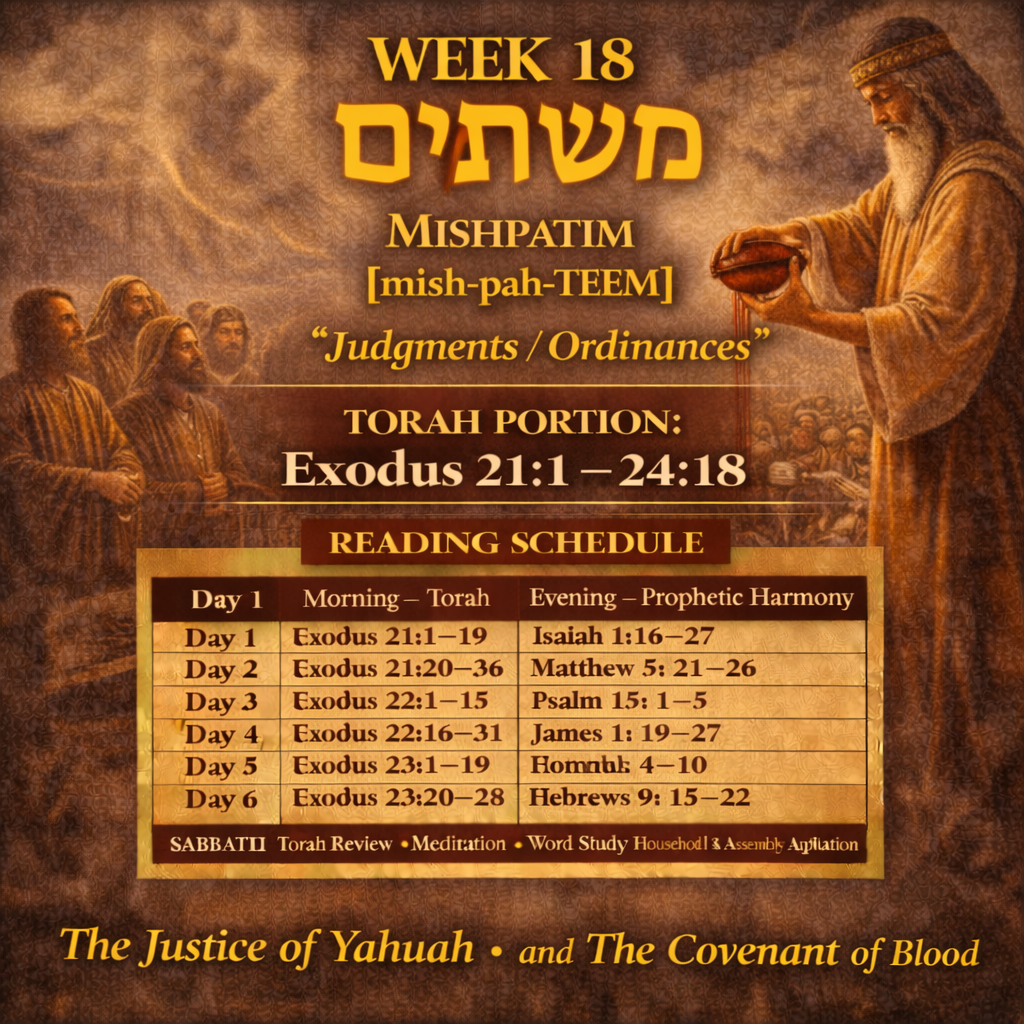
WEEK 18 — מִשְׁפָּטִים (Mishpatim) [mish-pah-TEEM] — “Judgments / Ordinances”
Torah Portion: Exodus 21 : 1 – 24 : 18
READING SCHEDULE
| Day | Morning — Torah | Evening — Prophetic Harmony |
|---|---|---|
| Day 1 | Exodus 21 : 1 – 19 | Isaiah 1 : 16 – 27 |
| Day 2 | Exodus 21 : 20 – 36 | Matthew 5 : 21 – 26 |
| Day 3 | Exodus 22 : 1 – 15 | Psalm 15 : 1 – 5 |
| Day 4 | Exodus 22 : 16 – 31 | James 1 : 19 – 27 |
| Day 5 | Exodus 23 : 1 – 19 | Hosea 4 : 1 – 10 |
| Day 6 | Exodus 23 : 20 – 24 : 18 | Hebrews 9 : 15 – 22 |
SABBATH | Torah Review · Meditation · Word Study | Household & Assembly Application
THEMATIC FLOW — THE JUSTICE OF YAHUAH AND THE COVENANT OF BLOOD
“And these are the judgments (mishpatim) which you are to set before them.” (Exodus 21 : 1)
Mishpatim reveals the heart of Yahuah’s justice. After the thunder and fire of Sinai, Yahuah moves from revelation to regulation — teaching Israel how to live as a redeemed, covenant-governed people. These laws are not random rules; they are the practical outworking of the Ten Words.
The portion begins with instructions regarding servants, injuries, restitution, theft, property, and social responsibility. Yahuah’s justice is relational — protecting the weak, restraining the strong, restoring what is broken, and ensuring equity. Every command reveals His character: righteousness, compassion, order, holiness.
Israel learns that holiness is not mystical; it is ethical. It governs daily life, community interactions, and economic behavior. Mishpatim also establishes protections for strangers, widows, orphans, and the poor — reminding Israel that they too were oppressed in Egypt.
In chapter 23, Yahuah describes the blessings attached to covenant obedience: protection, provision, victory, and guidance through His Messenger. Israel is warned not to follow the practices of the nations nor bow to their gods.
The portion culminates in Exodus 24 — the ratification of the covenant. Blood is sprinkled upon the altar and upon the people. Israel declares: “All that Yahuah has spoken we shall do and obey.” Moses ascends the mountain, entering the cloud of glory for forty days.
Mishpatim teaches that covenant is not emotional experience alone — it is obedience, justice, loyalty, and submission to Yahuah’s order.
HEBREW WORD STUDY — מִשְׁפָּטִים (Mishpatim)
Block: משפטים Paleo: 𐤌 𐤔 𐤐 𐤕 𐤉 𐤌 Root: שׁפט (shafat) — to judge, govern, rule rightly
| Letter | Symbol | Meaning | Prophetic Role |
|---|---|---|---|
| 𐤌 Mem | Water | Chaos / Flow | Order emerging from chaos through divine law |
| 𐤔 Shin | Teeth | Fire / Consume | Refining justice that removes wickedness |
| 𐤐 Pe | Mouth | Speech / Command | Judgment spoken with authority |
| 𐤕 Tav | Mark | Covenant | Justice anchored in covenant relationship |
| 𐤉 Yod | Hand | Deed / Action | Righteous deeds that follow righteous laws |
| 𐤌 Mem | Water | People / Nations | Justice applied within community life |
Paleo Meaning:
“From chaos Yahuah refines, speaks covenant truth, and forms a community shaped by righteous deeds.”
PROPHETIC PALEO-HEBREW WORD PICTURE
Mishpatim reveals that Yahuah’s kingdom is built through justice. His people become distinct from the nations not only by worship but by how they treat one another. Covenant identity is inseparable from covenant conduct.
SABBATH MEDITATION
Sabbath invites us to examine whether our lives reflect the justice of Yahuah. Holiness is not an abstract idea — it is revealed in how we speak, act, protect, and restore. The heart of covenant is love expressed through obedience.
Yahuah’s laws are not burdensome; they are protective boundaries rooted in mercy. Mishpatim shows that righteousness requires more than avoiding evil — it requires active good toward others.
REFLECTION AND DISCUSSION QUESTIONS
Heart (Individual)
-
Does my life reflect Yahuah’s justice in daily decisions?
-
How do I treat those who cannot repay me?
-
Am I living under the fear of Yahuah or under the influence of the world?
Household (Family)
4. How can we cultivate righteousness, responsibility, and restoration in our home?
5. Do we treat others with compassion, fairness, and integrity?
Assembly (Corporate)
6. Are we a community where justice, mercy, and accountability are visible?
7. Do we uphold the covenant together with a unified “We shall do and obey”?
PRAYER / DECLARATION FOR SABBATH
Yahuah,
You are righteous and just in all Your ways.
Teach us to walk in Your mishpatim —
to treat others with fairness, mercy, and honor.
Write Your judgments on our hearts
and shape us into a people who reflect Your character.
Strengthen our homes and assemblies
to live faithfully within Your covenant.
In Yahusha’s Name — Amein.
JOTS & TITTLES
| Reference | Marker | Description | Prophetic Meaning |
|---|---|---|---|
| Exodus 21 : 2 | Release in the seventh year | Sabbatical rhythm | Freedom embedded in covenant law |
| Exodus 22 : 1–15 | Restitution laws | Restoration | Justice restores what sin damages |
| Exodus 23 : 20 | Messenger sent | Divine guide | Covenant obedience brings protection |
| Exodus 24 : 7–8 | Blood of the covenant | Sprinkling | Israel bound to Yahuah through blood |
FOOTNOTES
-
Exodus 21–22 — justice, injury, restitution, ethical life.
-
Exodus 23 — covenant blessings, warnings, and angelic guidance.
-
Exodus 24 — covenant sealed by blood and national agreement.
-
Hebrews 9 — mediatorship and blood covenant themes.
-
Isaiah 1 — righteousness, justice, and repentance.
-
James 1 — true religion expressed in action.
