
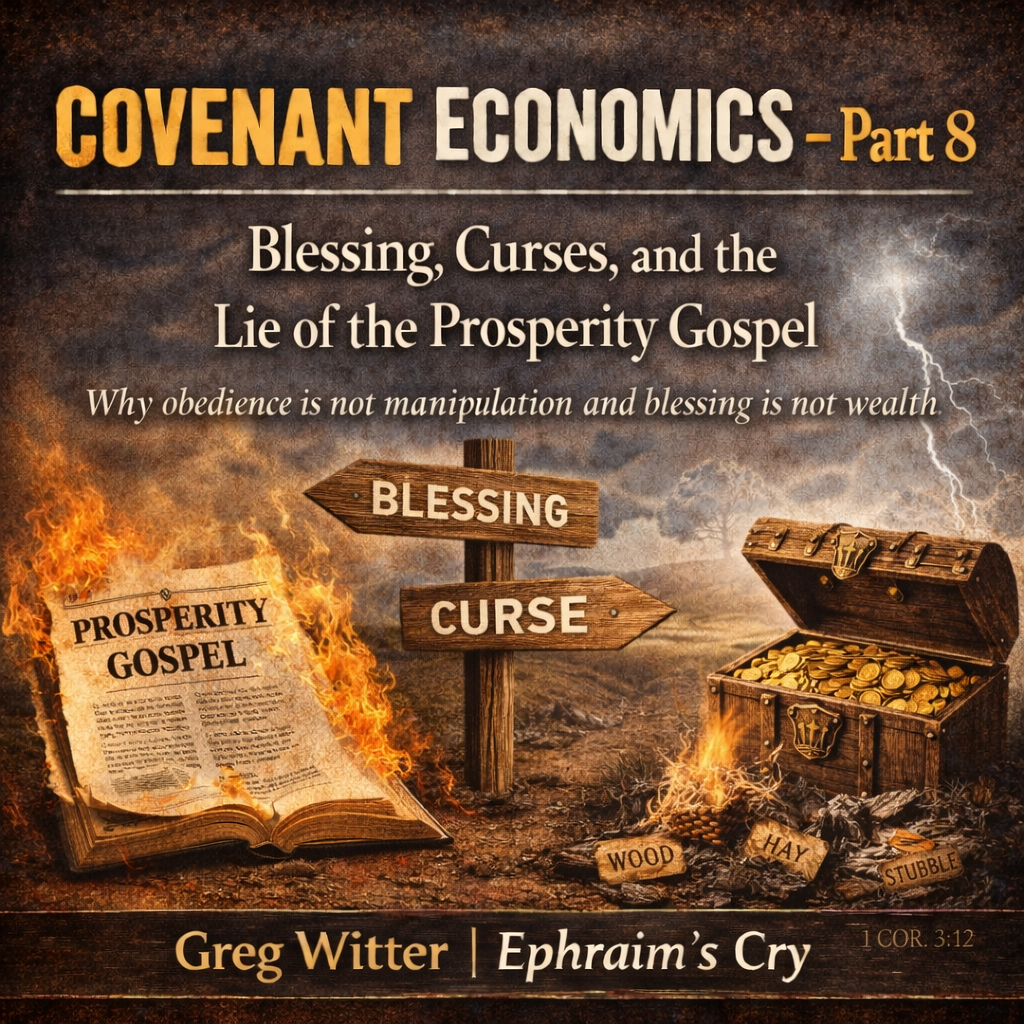
ECONOMICS – Part 8
Blessing, Curses, and the Lie of the Prosperity Gospel
Why obedience is not manipulation and blessing is not wealth
Greg Witter | Ephraim’s Cry
Hebraic Mindset Study Series
Study • Learn • Apply • Grow • Share • Repeat
INTRODUCTION: WHY THIS MUST BE ADDRESSED DIRECTLY
Any teaching on obedience, provision, and giving must eventually confront a distortion that has deeply damaged many believers: the prosperity gospel. If it is not named and dismantled clearly, it will be assumed, misapplied, or falsely attached to what is being taught.
Covenant economics is not prosperity theology. It never has been.
Scripture does speak of blessing and curse. It does speak of obedience and consequence. But it does not present Yahuah as a transactional deity who can be manipulated through giving, nor does it define blessing primarily as health, wealth, or comfort.
This teaching exists to draw a hard, biblical line between covenant obedience and prosperity deception.
WHAT THE PROSPERITY GOSPEL CLAIM COVENANT IS
At its core, prosperity theology teaches that:
obedience guarantees financial success
giving produces material return
faith is measured by abundance
hardship signals failure or lack of faith
This framework turns Yahuah into a formula and obedience into leverage. It subtly teaches people to give not because Yahuah is worthy, but because they expect a return.
Scripture never teaches this.
WHAT SCRIPTURE ACTUALLY TEACHES ABOUT BLESSING
In Scripture, blessing is not narrowly defined. Yahuah blesses His people in many ways, often unrelated to material wealth.
Biblical blessing includes:
provision sufficient for the season
protection from destruction
endurance through hardship
peace of mind and heart
wisdom and understanding
legacy and fruit that outlasts the individual
“You shall remember Yahuah your Elohim, for it is He who gives you power to get wealth, that He may establish His covenant.”
(Deuteronomy 8:18)
Wealth, when mentioned, is always subordinate to covenant purpose. It is never the goal. It is never guaranteed. It is never universal.
OBEDIENCE DOES NOT GUARANTEE COMFORT
Scripture consistently shows that obedience often leads to difficulty rather than ease.
Abraham obeyed and wandered.
Moses obeyed and was rejected.
The prophets obeyed and were persecuted.
Yahusha obeyed and suffered.
The apostles obeyed and were imprisoned, beaten, and martyred.
None of these were cursed. All were faithful.
This alone dismantles the prosperity framework.
BLESSING AND CURSES IN TORAH CONTEXT
Torah does speak clearly of blessing and curse, particularly in Deuteronomy 28. But these are covenantal outcomes, not individual guarantees of comfort.
Blessing in Torah is tied to:
national obedience
communal order
alignment with Yahuah’s instructions
Curses result from:
rebellion
injustice
idolatry
covenant violation
These passages are not personal vending machines. They describe how alignment or rebellion affects a people over time.
To isolate these texts and apply them as personal wealth promises is a misuse of Scripture.
WHY THE PROSPERITY GOSPEL IS DANGEROUS
The prosperity gospel:
shifts focus from obedience to outcome
measures faith by circumstances
shames the poor and suffering
manipulates giving through expectation
replaces discipleship with consumption
It produces followers, not disciples. Consumers, not servants. And when hardship comes—as Scripture promises it will—many abandon the faith altogether, believing they were lied to.
In many cases, they were.
COVENANT ECONOMICS REDEFINED
Covenant economics does not ask: “What will I get?”
It asks: “What has Yahuah commanded, and am I faithful?”
Obedience is not a tool to secure blessing. Obedience is the proper response to covenant relationship.
When blessing comes, it is received with gratitude.
When hardship comes, it is endured with trust.
Neither condition defines faithfulness.
OBEDIENCE, CONSEQUENCE, AND DISCIPLINE
Scripture also teaches that disobedience brings consequence. This is not punishment in a transactional sense, but the natural outworking of rebellion against divine order.
Disobedience produces:
disorder
instability
loss of peace
fractured relationships
compromised witness
Yahuah disciplines those He loves, not to destroy them, but to restore them (Proverbs 3:11–12; Hebrews 12:6).
This is covenantal correction, not prosperity calculus.
WHY THIS MATTERS FOR GIVING AND SUPPORT
Giving rooted in prosperity theology is unstable. When expectations are not met, resentment follows.
Covenantal giving is stable because it is not outcome-driven. It is obedience-driven.
People give:
not to get
not to manipulate
not to secure comfort
But because Yahuah is worthy, His work matters, and obedience is right.
That posture survives both abundance and lack.
COVENANTAL CLARITY VS PROSPERITY CONFUSION
Covenantal understanding:
obedience is faithfulness
blessing is defined by Yahuah
hardship does not equal failure
giving is not leverage
Prosperity distortion:
obedience is transactional
blessing equals wealth
hardship equals lack of faith
giving is an investment strategy
One produces disciples.
The other produces disillusionment.
CLOSING ORIENTATION
Covenant economics rejects both poverty guilt and prosperity deception. It restores a sober, faithful, enduring framework rooted in Scripture.
Yahuah does not promise comfort.
He promises faithfulness.
He does not promise wealth.
He promises provision for His purposes.
Blessing flows from alignment, not manipulation. Obedience flows from trust, not expectation.
With this guardrail firmly established, the series now turns outward again to covenant responsibility beyond the individual.
The next teaching will address:
The poor, the stranger, and the fatherless — and why covenant economics is never self-centered.
That will be examined in COVENANT ECONOMICS – Part 9
The Poor, the Stranger, and the Fatherless.
HASHTAGS
#EphraimsCry #GregWitter #HebraicMindset #CovenantEconomic
#CovenantalTithing #RejectProsperityGospel #TorahTruth
#ScriptureOverTradition #KingdomOrder #Faithfulness
#ObedienceOverOutcome #BlessingDefinedByYahuah
