
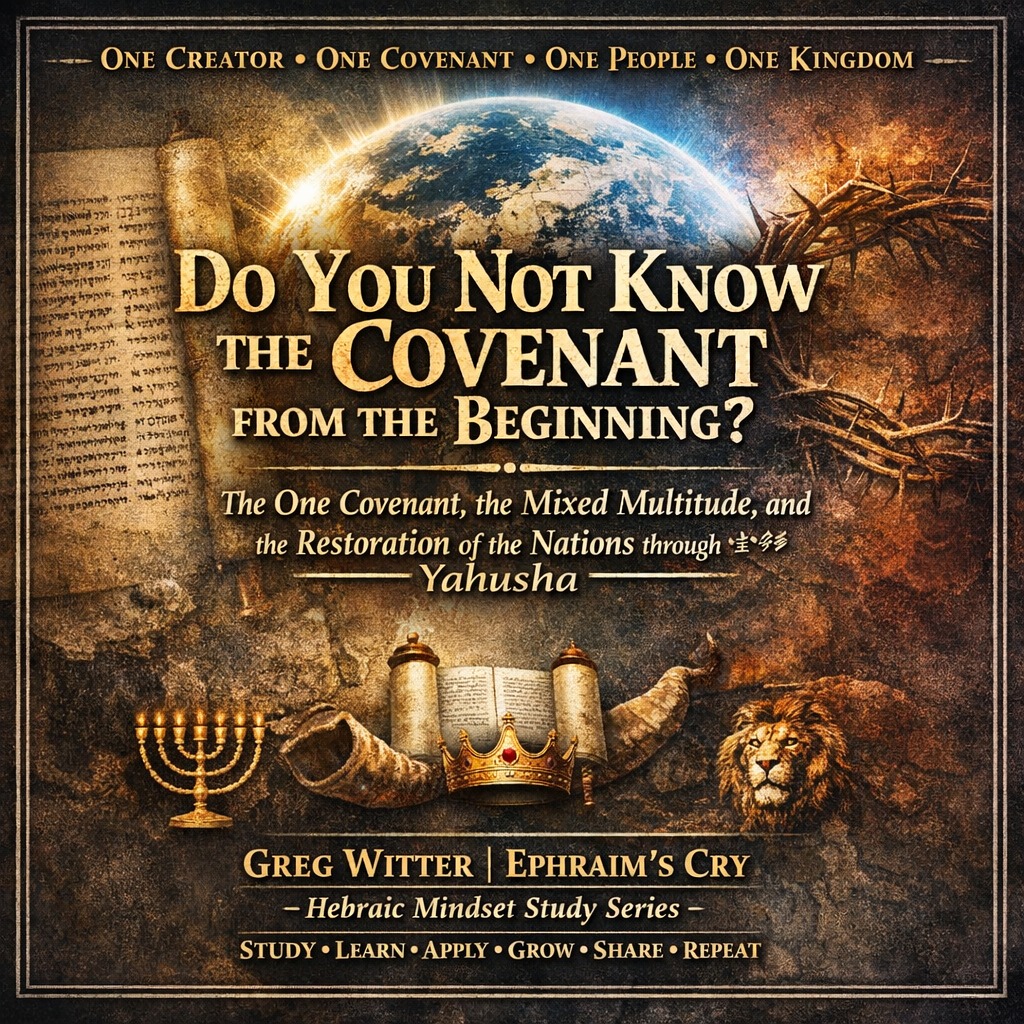
Do You Not Know the Covenant from the Beginning?
The One Covenant, the Mixed Multitude, and the Restoration of the Nations through 𐤉𐤄𐤅𐤔𐤏 (Yahusha)
There has never been another path to life: one Creator, one covenant, one people, one kingdom, and one way of redemption through obedient faith.
Greg Witter | Ephraim’s Cry
Hebraic Mindset Study Series
Study Learn Apply Grow Share Repeat
From the beginning, confusion has entered because men keep starting in the middle of the Book instead of at the beginning. They start at Sinai and pretend covenant begins there. They start with Moses and act as though nothing came before him. They start with Israel in the wilderness and speak as if Yahuah suddenly invented relationship, obedience, holiness, law, and kingdom at Mount Sinai. This is not a small error. This is a foundational fracture. When the foundation is wrong, everything built on top of it leans, twists, distorts, and ultimately collapses under the weight of its own contradiction. If the root is corrupted, the fruit will never be right.
The covenant did not begin at Sinai. The covenant did not begin with national Israel in the wilderness. The covenant did not begin when commandments were written on stone. The covenant begins with the Creator Himself—His authority, His word, His order, His boundaries, His dominion, and His claim over all creation from Genesis 1 onward. Covenant is not first a document. Covenant is relationship established by the sovereign decree of the King, defining life, order, authority, blessing, responsibility, inheritance, boundaries, and accountability. Genesis establishes covenant structure before Sinai ever exists. Genesis 1:1 declares ownership. Genesis 1 establishes order. Genesis 2:16–17 establishes command, obligation, and consequence. Genesis 3 reveals transgression, curse, separation, and the need for redemption. From the opening chapters, covenant is already in force. Therefore, anyone who claims covenant begins only at Sinai has already stepped outside the structure of the Scriptures.
Genesis is not introduction—it is constitution. Yahuah creates, speaks, separates, names, blesses, assigns function, and establishes dominion. Humanity is placed under authority, not self-defined, not autonomous, not independent. The first man is placed within a governed world with instruction and consequence. That is covenant. Genesis 3:15 then introduces the first prophetic declaration of redemption—the seed who will crush the serpent. The covenant is not abandoned at the fall; it is preserved and carried forward through promise. Genesis 6–9 expands this further with Noah. Yahuah establishes covenant not only with Noah, but with all flesh (Genesis 9:9–10). This is critical. The covenant scope is global before Israel even exists. Genesis 10–11 then shows the nations formed and scattered. Covenant reality exists before Israel, outside Israel, and beyond Israel. Israel will later become the vessel—but never the limitation.
The Abrahamic covenant must be fully understood or everything after it will be misunderstood. Genesis 12:3 declares, “In you all families of the earth shall be blessed.” Genesis 17 establishes Abraham as the father of many nations. This is not tribal language. This is global covenant expansion. Abraham was not a Jew in the later sense—he was called out from the nations. Israel does not create covenant. Covenant creates Israel. Promise forms the people. Election gathers the people. The Word governs the people. This destroys the false idea that covenant belongs exclusively to a closed ethnic system. Scripture itself rejects that idea. Romans 4:11–16 makes it explicit—Abraham is the father of all who believe, both circumcised and uncircumcised. The covenant is accessed by faith, not secured by flesh.
When Israel comes out of Egypt, Scripture makes something unmistakably clear: they did not come out alone. Exodus 12:38 records that a mixed multitude went up with them. This is not a minor detail. This is structural evidence. From the moment Israel is formed as a nation, the nations are already present within it. Covenant identity is not merely biological—it is relational and covenantal. This is reinforced in Torah itself. Numbers 15:15–16 declares one law for the native and the stranger. Leviticus 24:22 confirms the same standard applies to both. Exodus 12:48 establishes that the foreigner who keeps Passover is counted as native-born. Joshua 8:33 shows the stranger standing with Israel under covenant hearing. The pattern is undeniable: covenant is not exclusionary—it is invitational, but only on Yahuah’s terms.
The prophets expand this reality beyond dispute. Isaiah 2:2–3 declares that in the latter days the nations will stream to the mountain of Yahuah to learn His ways and walk in His Torah. Isaiah 42:6 identifies Israel as a light to the nations. Isaiah 49:6 goes further—salvation is extended to the ends of the earth. Jeremiah 31:31–33 defines the renewed covenant, and what does it say? “I will write My law on their hearts.” Not a new law. Not a replacement law. The same Torah, internalized. Ezekiel 36:26–27 declares that Yahuah will give a new heart and put His Spirit within His people so that they will walk in His statutes. The prophets do not teach the removal of Torah—they teach the transformation of the people so they can finally walk in it.
𐤉𐤄𐤅𐤔𐤏 (Yahusha) does not come to abolish covenant. He comes to confirm, fulfill, and restore it. Matthew 5:17–19 is explicit—He did not come to abolish the Torah or the Prophets. The word “fulfill” (plēroō) means to bring to fullness, to complete in meaning, not to cancel. He immediately reinforces that not one jot or tittle will pass until all is accomplished. Then He warns that those who break the commandments and teach others to do so will be least in the kingdom. That is not abolition—that is reinforcement. Matthew 7:21–23 drives it further. Many will claim Him, call Him Master, perform works in His name—and He will reject them as workers of lawlessness. Lawlessness is not ignorance—it is rejection of Torah (1 John 3:4). John 14:15—“If you love Me, keep My commandments.” John 15—abide, remain, bear fruit through obedience. He does not redefine covenant. He enforces it.
Paul is the most misused voice in this entire discussion. When read correctly, he does not oppose Torah—he defends it. Romans 3:31—do we make void the law through faith? Absolutely not. We establish it. Romans 7:12—the law is holy, righteous, and good. Romans 8:3–4—the righteous requirement of the law is fulfilled in those who walk not according to the flesh but according to the Spirit. Galatians 3:29—if you belong to Messiah, you are Abraham’s seed and heirs according to the promise. Ephesians 2 must be read completely. Gentiles were once strangers to the covenants—but now they are brought near, joined to the commonwealth of Israel, forming one new man. Romans 11 seals it—you are grafted into the same olive tree. Not a new tree. Not a replacement. The same covenant root. There has never been two covenant systems.
Hebrews is where many stumble because they read it through a lens of replacement instead of fulfillment. Hebrews 8:8 says Yahuah found fault with them—not with His law. Hebrews 10:16 defines the renewed covenant—His laws written on the heart. Hebrews 7 discusses priesthood change, not law removal. Hebrews 10:1 describes the sacrificial system as a shadow—not the abolition of obedience. Hebrews 10:26 warns that willful sin still brings judgment. If sin still exists, then the definition of sin still stands. 1 John 3:4—sin is lawlessness. Messiah redeems from the curse of the law (death), not from the standard of righteousness.
The Two Adams framework must be understood. The first Adam brought sin and death into the world (Romans 5:12–19). The last Adam, 𐤉𐤄𐤅𐤔𐤏 (Yahusha), restores life, righteousness, and covenant alignment (1 Corinthians 15:45–49). Redemption is not license to sin—it is restoration to obedience. Grace is not permission—it is empowerment. Titus 2:11–12 declares that grace teaches us to deny ungodliness and live righteously. Romans 6:1–2—shall we continue in sin? Absolutely not. Grace leads to obedience, not rebellion.
Covenant is legal, binding, and structured. Deuteronomy 28 establishes blessings for obedience and curses for disobedience. Messiah redeems from the curse—not from obedience. He restores us to rightful covenant standing so that we can walk as originally intended. Covenant is not theoretical—it is lived. 1 John 2:6—whoever says he abides in Him must walk as He walked.
This brings us to the Kingdom. Exodus 19:6 declares Israel a kingdom of priests. Revelation 1:6 and 5:10 confirm that identity continues—we are made a kingdom, called to reign on the earth. Covenant is citizenship. Obedience is function. The Kingdom is not abstract—it is governed, structured, and lived out through alignment with the King.
In the end, Scripture leaves no ambiguity. Revelation 12:17 identifies the remnant as those who keep the commandments of Elohim and hold to the testimony of 𐤉𐤄𐤅𐤔𐤏 (Yahusha). Revelation 14:12 repeats it. Daniel 7:25 warns of an attack against times and law. The final conflict is not about belief alone—it is about obedience versus lawlessness. Those who reject Torah will stand outside covenant. Those who walk in obedience will stand within it.
This ends the argument. There has never been two covenants. There has never been two peoples. There has never been two systems. There is one Creator, one covenant, one people being formed, one path of redemption, and one Kingdom. The nations were always intended to be brought in. They are grafted in by faith, through grace, as a gift from the Kinsman-Redeemer, but that redemption restores them to obedience—not away from it.
And 𐤉𐤄𐤅𐤔𐤏 (Yahusha) Himself makes the final distinction: many will say “Master, Master,” but He will say, “Depart from Me, you who practice lawlessness” (Matthew 7:23). Not because they didn’t speak His name. Not because they didn’t claim belief. But because they did not walk in covenant. They lived without Torah. They lived without obedience. They lived outside the structure of the Kingdom.
There is no excuse left. The covenant has been declared from the beginning, carried through the patriarchs, revealed through Israel, proclaimed by the prophets, confirmed by Messiah, explained by the apostles, and fulfilled in the remnant.
The question is no longer what the covenant is.
The question is whether you will walk in it.
#GregWitter#EphraimsCry#HebraicMindset#CovenantTruth#OneCovenant#Torah#KeepTheCommandments
#FaithAndObedience#KingdomOfYahuah#Yahusha#SecondAdam#KinsmanRedeemer#GraftedIn#IsraelAndTheNations
#EndTimesTruth#Remnant#Revelation1217#Revelation1412#Matthew723#LawlessnessExposed
#TruthOverTradition#ReturnToTorah#WholeCounsel#ScriptureAligned#CovenantRestored#WalkAsHeWalked
