
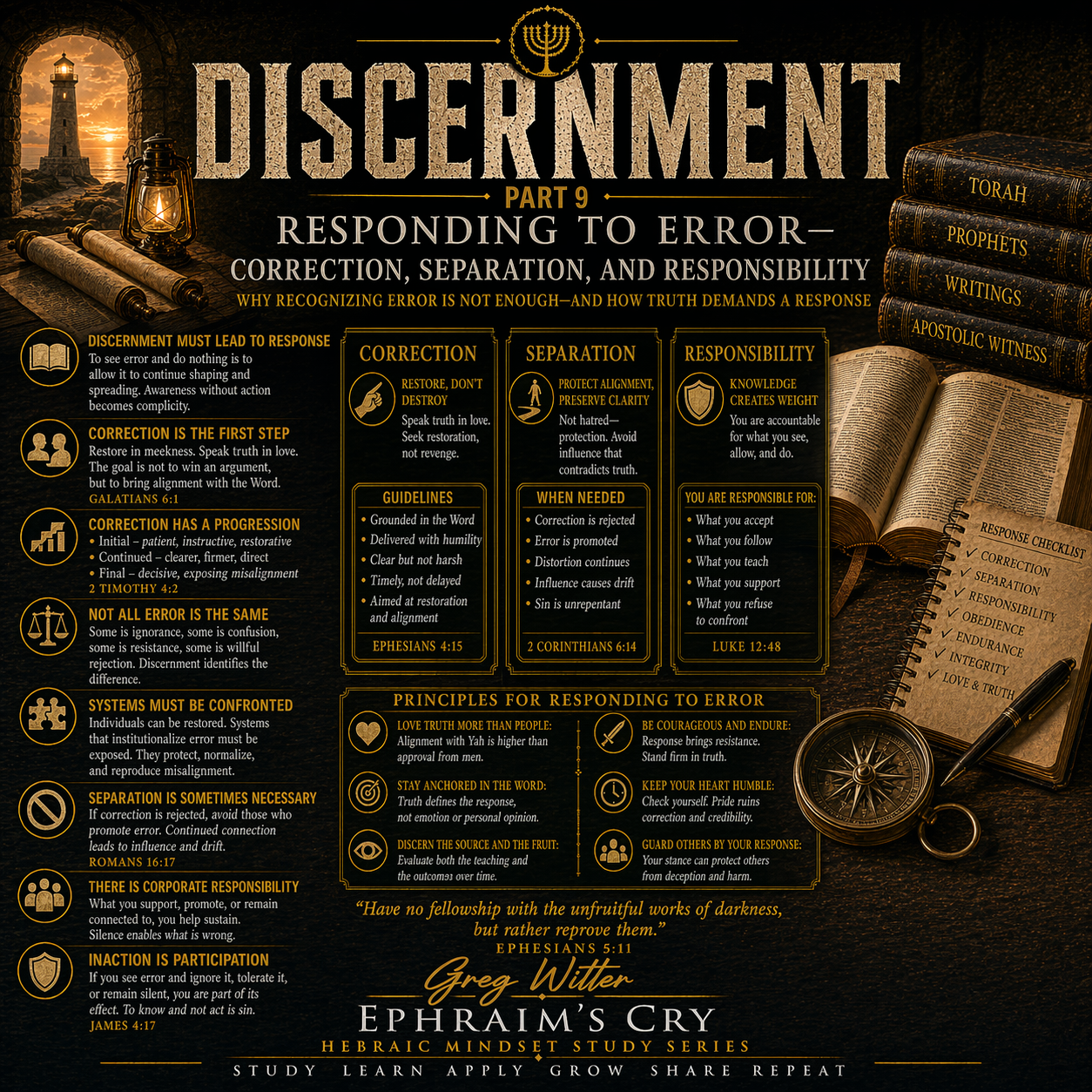
Discernment Part 9: Responding to Error — Correction, Separation, and Responsibility
Why recognizing error is not enough—and how truth demands a response
Greg Witter | Ephraim’s Cry
Hebraic Mindset Study Series
Study Learn Apply Grow Share Repeat
Discernment does not end with recognition. It does not stop at identifying deception, spotting distortion, or exposing what is misaligned. If Part 8 established how deception operates—through mixture, omission, emphasis shift, and subtle alteration—then Part 9 must confront the unavoidable reality: once error is recognized, it must be responded to. Discernment that does not lead to response is incomplete. It is awareness without action. And awareness without action does not remain neutral—it becomes participation.
This is where the weight increases.
Because it is one thing to see error.
It is another to act on what you see.
And this is where many stop.
They recognize misalignment.
They see distortion.
They identify what is wrong.
But they do not respond.
They remain connected.
They remain silent.
They remain passive.
And in doing so, they allow what they have discerned to continue shaping them.
And more than that—they allow it to continue spreading.
This is why discernment must move beyond recognition.
It must move into response.
Because what is not confronted will continue.
What is not corrected will multiply.
What is not separated from will influence.
And what is seen but not acted upon becomes something you are now responsible for.
This is why response is not optional.
It is required.
And that response takes three primary forms:
- correction
- separation
- responsibility
All three are necessary.
All three are progressive.
And all three must be understood in order.
Correction is the first response.
When error is identified, it must be addressed.
Not emotionally.
Not reactively.
But according to truth.
“Brethren, if a man be overtaken in a fault, you which are spiritual, restore such an one in the spirit of meekness…” (Galatians 6:1). Correction is not condemnation. It is not personal attack. It is not self-elevation. It is restoration. It is the attempt to bring what is misaligned back into alignment with the Word.
But correction must still be clear.
It must still be direct.
It must still be grounded in the standard.
Because correction that avoids truth is not correction.
It is compromise.
And compromise protects error.
This is why correction must follow a progression.
There is:
- initial correction — patient, instructive, restorative
- continued correction — clearer, firmer, more direct
- final correction — decisive, exposing the misalignment plainly
This progression is necessary because not all error is the same.
Some is ignorance.
Some is confusion.
Some is resistance.
Some is willful rejection.
And discernment must recognize the difference.
But regardless of the source, correction must be attempted.
Because silence allows error to remain unchallenged.
And unchallenged error does not remain contained—it spreads.
This is where the next layer must be understood.
There is a difference between correcting individuals and confronting systems.
An individual may be corrected and restored.
A system that is built on misalignment must be exposed.
Because systems institutionalize error.
They protect it.
They normalize it.
They reproduce it.
And once error is embedded in a system, correction alone is no longer sufficient—exposure becomes necessary.
This is why discernment must not only address what is said—but where it is coming from and how it is sustained.
But correction is not always received.
And this is where the next response becomes necessary.
Separation.
When correction is rejected, alignment cannot be maintained through continued connection.
“Mark them which cause divisions and offences contrary to the doctrine… and avoid them” (Romans 16:17).
This is not suggestion.
It is instruction.
And it exists for a reason.
Because continued exposure to misalignment does not remain neutral.
It influences.
It conditions.
It normalizes.
It slowly reshapes perception.
This is why separation is not harsh—it is protective.
Not emotional separation.
Not personal hatred.
But functional separation from influence.
It is the refusal to remain under what does not align with the Word.
And this is where many hesitate.
Because separation costs something.
It may cost:
- relationships
- community
- familiarity
- comfort
- acceptance
But discernment requires alignment over attachment.
Truth over comfort.
Standard over familiarity.
This is where the line becomes real.
Because once you see, you cannot remain where you once stood without consequence.
This leads directly into the third response.
Responsibility.
Once discernment is given, responsibility increases.
You are no longer unaware.
You are no longer untrained.
You are no longer able to claim ignorance.
You are responsible.
“Therefore to him that knows to do good, and does it not, to him it is sin” (James 4:17).
This is where the weight must land.
Because once you see error, your response determines your alignment.
If you ignore it—you tolerate it.
If you tolerate it—you allow it.
If you allow it—you participate in its effect.
This is the progression.
This is why inaction is not neutral.
It is agreement through silence.
It is alignment through passivity.
It is participation without confrontation.
This is why discernment must lead to movement.
Not reaction.
Not impulse.
But intentional, aligned response.
This also raises the level of accountability beyond the individual.
There is both personal and corporate responsibility.
Personal—what you accept, follow, and allow to influence you.
Corporate—what you support, promote, or remain connected to.
Because what you remain connected to, you are helping sustain.
This is why response cannot stop at personal alignment.
It must consider broader impact.
What is being supported?
What is being enabled?
What is being allowed to continue through silence?
This is where discernment becomes costly.
Because responding to error will require standing against:
- majority opinion
- established systems
- trusted voices
- relational pressure
- cultural acceptance
It will require endurance.
Because response does not always bring agreement.
Often it brings resistance.
Opposition.
Rejection.
Misunderstanding.
This is why discernment must be anchored in conviction.
Not preference.
Not emotion.
But truth.
Because without endurance, response will weaken.
And when response weakens, compromise begins.
This is also where the danger of tolerating error must be fully understood.
Tolerated error does not remain contained.
It expands.
It influences.
It reshapes thinking.
Over time, what was once clearly rejected becomes accepted.
This is how drift occurs.
Not through sudden change.
But through tolerated misalignment.
This is why responding to error is not optional.
It is necessary for preserving discernment itself.
Because discernment that does not act begins to dull.
It begins to weaken.
It begins to justify what it once exposed.
And eventually, it begins to align with what it once rejected.
This is the danger.
This is why response must be consistent.
Not occasional.
Not selective.
But constant.
This also requires humility.
Because responding to error does not place a person above others.
It places them under the same standard.
It requires self-examination.
It requires awareness of one’s own alignment.
Because correcting externally while remaining misaligned internally produces hypocrisy.
And hypocrisy destroys discernment.
This is why response must remain grounded.
Firm—but not prideful.
Clear—but not self-exalting.
Aligned—but not isolated from accountability.
This balance is necessary.
But the responsibility remains.
Discernment must lead to response.
Because without response, discernment is incomplete.
And incomplete discernment does not produce transformation.
This is the dividing line.
Recognizing error is the beginning.
Responding to it is the function.
Maintaining alignment through that response is the goal.
And refusing to respond is participation.
That is where this must land.
Because once you see, you are responsible.
And what you do next determines whether your discernment continues to sharpen—or begins to decline.
This is the reality.
This is the weight.
This is the responsibility.
And this is what prepares the next step.
Because discernment must now be maintained.
Guarded.
Strengthened.
Endured over time.
Not just applied once—but sustained continuously.
That is where we move next.
Discernment does not end with recognition—it demands response. What has been established here makes it clear that once error is seen, it must be addressed, corrected, or separated from. To see and not respond is not neutral; it is participation. This is where many stop—not because they cannot discern, but because they are unwilling to act on what they see. But once you know, you are responsible. What you tolerate, you allow. What you allow, you become influenced by. This is the line where discernment either matures or begins to decline. This is exactly why Ephraim’s Cry Academy exists: to train you not only to recognize error, but to respond correctly, consistently, and without compromise—so that alignment is not theoretical, but enforced in how you live. If you are serious about standing in truth, separating from what is misaligned, and not shrinking back when action is required, then you must commit to a process that builds the conviction, clarity, and endurance to follow through on what discernment reveals.
https://EphraimsCry.com/academy
Discernment — Part 10: Maintaining Discernment — Guarding, Growing, and Enduring

#GregWitter, #EphraimsCry, #HebraicMindset, #Discernment, #BiblicalDiscernment, #TruthVsError,
#SoundDoctrine, #Galatians61, #Romans1617, #James417, #2Timothy42, #StudyTheWord,
#TorahFoundation, #WholeCounselOfElohim, #ScriptureAlignment, #SpiritualGrowth, #TruthOverTradition
