
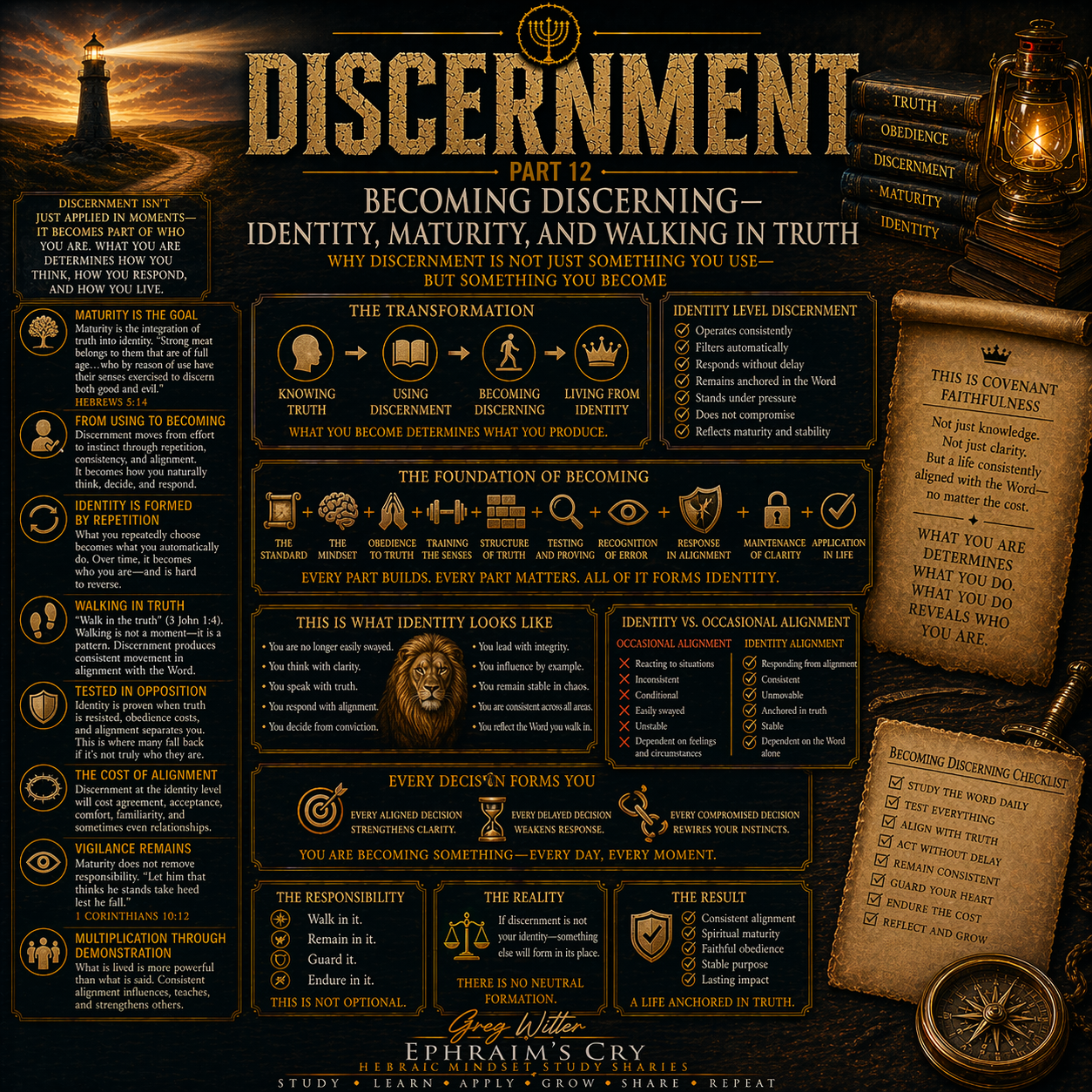
Discernment Part 12: Becoming Discerning — Identity, Maturity, and Walking in Truth
Why discernment is not just something you use—but something you become
Greg Witter | Ephraim’s Cry
Hebraic Mindset Study Series
Study Learn Apply Grow Share Repeat
Discernment, when fully developed, no longer operates as a separate function. It is no longer something you consciously turn on or deliberately apply in isolated moments. It becomes integrated. It becomes constant. It becomes part of how you think, how you respond, how you decide, and ultimately—who you are. If Parts 1 through 11 established what discernment is, how it is built, how it is trained, how it is structured, how it is tested, how it is maintained, and how it is applied, then Part 12 brings the final and unavoidable conclusion: discernment must become identity.
Because if discernment remains something external—something you use occasionally—it will never reach its full strength. But when it becomes internal—when it becomes part of how you operate—it becomes consistent, stable, and enduring.
This is the transition.
From using discernment
To becoming discerning
And that transition changes everything.
Because what you become determines how you live.
This is why maturity is the goal. Not information. Not awareness. Not even correct understanding alone. Maturity is the integration of truth into identity. It is when the Word is no longer something you reference—it is something you walk in.
“But strong meat belongs to them that are of full age… who by reason of use have their senses exercised to discern both good and evil” (Hebrews 5:14). Notice the progression. Use leads to exercise. Exercise leads to training. Training leads to formation. Formation leads to maturity. And maturity produces consistent discernment.
This is not theoretical.
This is formed.
This is lived.
This is practiced until it becomes natural.
This is where discernment moves from effort to instinct.
Not because effort is no longer required—but because alignment has been established so consistently that response becomes immediate.
This is what it means to become discerning.
Your responses begin to reflect your training without hesitation.
Your decisions begin to align without delay.
Your perception begins to filter without confusion.
This is not automatic.
It is formed.
And what is formed repeatedly becomes fixed.
This must be understood clearly:
Identity is not declared.
It is developed.
It is built through repetition.
It is established through consistency.
And once it is established, it becomes increasingly difficult to reverse.
This is why what you are becoming matters.
Because repeated alignment produces stable identity.
But repeated compromise produces distorted identity.
Both are formed the same way.
Through repetition.
Through consistency.
Through what is chosen over time.
This is why every part of this series matters.
Because each part contributes to formation.
- the standard defines truth
- the mindset establishes perspective
- obedience aligns action
- training builds capacity
- structure stabilizes understanding
- testing refines judgment
- recognition exposes deception
- response enforces alignment
- maintenance preserves clarity
- application proves reality
And now—identity integrates all of it.
This is where everything converges.
Because once discernment becomes identity, something changes.
You are no longer reacting to situations.
You are responding from alignment.
You are no longer evaluating everything from scratch.
You are filtering through what has already been established.
This is why maturity produces stability.
Not because life becomes simple—but because the standard remains fixed.
This is also where identity is tested.
Not in understanding.
But in pressure.
Because identity is not proven in comfort.
It is proven when:
- truth is resisted
- obedience costs you
- alignment isolates you
- conviction is challenged
This is where identity is revealed.
Not in agreement.
But in opposition.
Not when it is easy.
But when it is costly.
This is where many fall back into inconsistency.
Because they have learned discernment—but have not become it.
They can apply it—but do not live in it.
And when pressure comes, they revert.
This is the difference between:
- knowing truth
- using discernment
- becoming discerning
Becoming is stable.
Using is conditional.
Knowing is incomplete.
This is why identity must be formed.
Because identity does not adjust under pressure.
It holds.
It remains.
It endures.
This is also where walking in truth becomes continuous.
Not situational.
Not occasional.
But consistent.
“Walk in the truth” (3 John 1:4).
Walking is not a moment.
It is a pattern.
It is sustained movement in alignment.
This is what discernment produces when it becomes identity.
Consistency.
Stability.
Clarity.
But this also introduces cost.
Because identity-level discernment will not align with everything around you.
It will separate you.
It will distinguish you.
It will set you apart.
And that separation will cost:
- agreement
- acceptance
- comfort
- familiarity
Sometimes even relationship.
This is the cost of alignment.
This is the cost of remaining set apart.
This is the cost of walking in truth.
This is also where responsibility reaches its highest level.
Because once discernment becomes identity, it is no longer optional.
It governs.
It directs.
It defines.
And everything that flows from you reflects it.
This is why identity-level discernment affects:
- how you think
- how you speak
- how you respond
- how you decide
- how you lead
- how you influence
Because what you are determines what you produce.
This is why discernment at this level becomes visible.
Not because it is announced.
But because it is demonstrated.
This is also where multiplication begins.
Because what is lived becomes transferable.
Not by force.
Not by control.
But by consistency.
Because people see stability.
They see clarity.
They see alignment.
And they recognize something different.
This is how discernment reproduces.
This is how maturity multiplies.
This is how covenant faithfulness becomes visible.
Because this is what this ultimately is.
Not just maturity.
Not just clarity.
Not just understanding.
But covenant alignment lived consistently over time.
This is why humility must remain.
Because identity without humility becomes pride.
And pride distorts discernment.
This is why Scripture warns: “Let him that thinks he stands take heed lest he fall” (1 Corinthians 10:12).
Because no level removes responsibility.
No maturity removes vigilance.
No identity removes the need to remain aligned.
This is why discernment must continue to be:
- guarded
- tested
- aligned
- maintained
Even at identity level.
This is the reality.
Because identity can still drift if it is not sustained.
This is why the process does not stop.
It continues.
Refines.
Deepens.
Strengthens.
This is how discernment remains alive.
This is how alignment remains intact.
This is how maturity continues to grow.
This leads to the unavoidable conclusion.
Discernment is not something you have.
It is something you become.
And once you become it, it governs everything.
But if you do not become it—
something else will form in its place.
This is the final line.
This is the final weight.
Because identity is always forming.
Every day.
Every decision.
Every response.
You are becoming something.
- aligned or misaligned
- stable or unstable
- discerning or undiscerning
There is no neutral formation.
There is no static identity.
And if discernment is not your identity—
something else is.
That is where this must land.
This is the completion.
This is the culmination.
This is the responsibility.
Walk in it.
Remain in it.
Guard it.
Endure in it.
Because this is not just about knowing truth.
It is about becoming aligned with it.
Completely.
Consistently.
Without compromise.
Discernment at this level is no longer something you apply—it is something you become. What has been established throughout this series leads to one unavoidable reality: identity is being formed through what you consistently choose, align with, and walk out. You are not waiting to become discerning—you are becoming something right now, and if discernment is not being formed intentionally, something else is forming in its place. This is where the weight of responsibility reaches its highest level, because this is not just about clarity—it is about covenant faithfulness lived out consistently over time. To walk in truth, to remain aligned, and to endure without compromise requires more than understanding—it requires ongoing formation, accountability, and disciplined growth. This is exactly why Ephraim’s Cry Academy exists: not to provide more information, but to cultivate identity-level discernment that is stable, mature, and able to stand, endure, and remain faithful in this time and season. If you are serious about becoming the kind of disciple who does not fall away, who is not led astray, and who holds fast to the covenant and the testimony of 𐤉𐤄𐤅𐤔𐤏 (Yahusha) even unto the end, then you must commit to a process that forms you at the level of identity—not just knowledge.
https://EphraimsCry.com/academy
#GregWitter, #EphraimsCry, #HebraicMindset, #Discernment, #BiblicalDiscernment, #TruthVsError,
SoundDoctrine, #Hebrews514, #1Corinthians1012, #3John14, #SpiritualGrowth, #WalkInTruth,
#Maturity, #IdentityInTruth
