
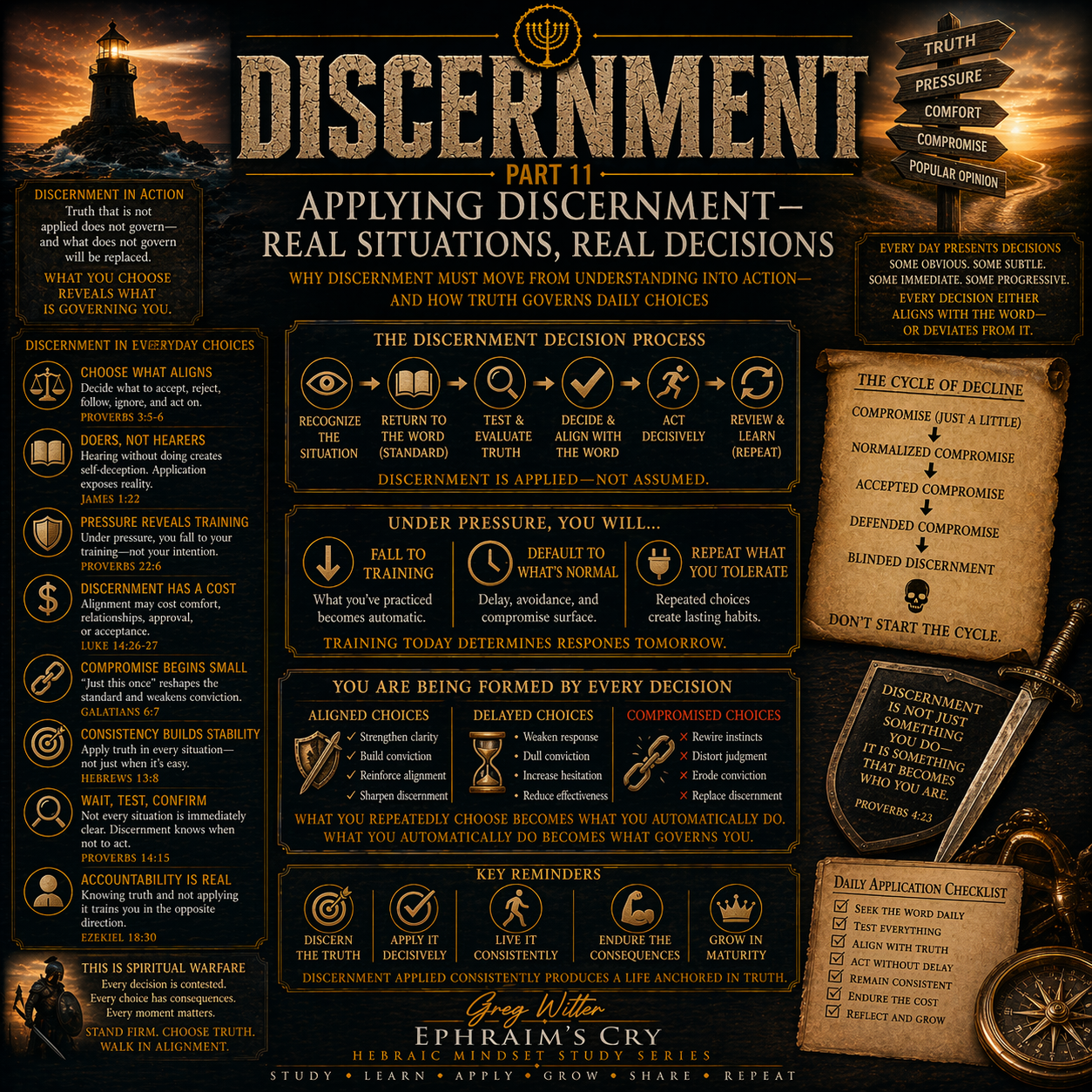
Discernment Part 11: Applying Discernment — Real Situations, Real Decisions
Why discernment must move from understanding into action—and how truth governs daily choices
Greg Witter | Ephraim’s Cry
Hebraic Mindset Study Series
Study Learn Apply Grow Share Repeat
Discernment is not complete until it is applied. It does not reach its purpose in understanding, nor does it fulfill its function in recognition alone. If Part 10 established that discernment must be maintained—guarded, grown, and endured—then Part 11 brings it into its most practical and demanding expression: discernment must be applied in real situations, in real time, under real pressure. Because truth that is not applied does not govern, and what does not govern will eventually be replaced.
This is where discernment proves itself.
Not in what is known.
But in what is chosen.
Because every day presents decisions.
Some obvious.
Some subtle.
Some immediate.
Some progressive.
And every decision reveals what is actually governing the individual.
This is why discernment must move from theory into function, because life does not pause for evaluation. Situations arise, voices speak, choices present themselves, and in those moments discernment must already be active. There is no time to construct it in the moment—it must already be present, already trained, already aligned. Every moment of life is not just a situation—it is a point of testing.
Every decision is contested.
Truth is present.
Influence is present.
Pressure is present.
And discernment must determine which governs.
This is why application requires readiness.
Not delayed response.
Not after-the-fact reflection.
But immediate alignment with the standard.
This is where many struggle. They understand truth in principle but hesitate in application. They know what is right but delay acting on it. They recognize misalignment but allow circumstances, relationships, or pressure to override response. This is where discernment fails—not because it was absent, but because it was not applied.
Because hesitation creates space.
And space invites influence.
And influence, when not tested, begins to shape decision.
This is the reality of daily life. You are constantly choosing what to accept, what to reject, what to follow, what to ignore, and what to act on. Every one of those decisions either aligns with the Word or deviates from it. There is no neutral ground.
This is why discernment must function in everyday situations—not only in major decisions, but in small ones. Because small decisions accumulate. They establish direction. They form patterns. And patterns determine outcome.
This is how alignment is lived.
Not in isolated moments.
But in repeated decisions.
Not in intention.
But in action.
This is why Scripture emphasizes doing—not just knowing. “Be doers of the word, and not hearers only, deceiving your own selves” (James 1:22). Hearing without doing does not leave a person unchanged—it creates self-deception. Because it produces the appearance of alignment without the reality of it.
Application exposes reality.
It reveals what is actually governing your life.
This is also where pressure must be addressed, because discernment is often tested under pressure:
- time pressure
- emotional pressure
- relational pressure
- situational pressure
And pressure reveals what is truly established.
Because under pressure, a person does not rise to intention.
They fall to training.
- what has been practiced becomes automatic
- what has been delayed becomes avoided
- what has been compromised becomes repeated
This is why discernment must be trained before pressure arrives. Because once pressure is present, it does not build discernment—it reveals it.
Training forms it.
Maintenance sustains it.
Application reveals it.
This is the sequence.
This is also where the cost of discernment must be faced.
Because applying discernment will require decisions that are not easy.
Situations where:
- truth will cost you something
- obedience will create tension
- alignment will separate you from others
- clarity will require action you would rather avoid
Discernment is not tested in comfort.
It is tested in conflict.
It is tested in cost.
It is tested where alignment requires sacrifice.
This is where many hesitate—not because they do not know, but because they do not want the cost. And this is where compromise enters—not through rejection of truth, but through adjustment of it.
A person may know the standard.
But begins to shift it:
- “just this once”
- “this situation is different”
- “this doesn’t fully apply here”
And each adjustment weakens conviction.
Each exception reshapes the standard.
Until what was once firm becomes flexible.
This is how discernment begins to fail.
Not through denial.
But through modification.
This is why application must remain anchored in the Word.
Not in:
- emotion
- convenience
- pressure
- outcome
Because once outcome becomes the measure, truth becomes negotiable.
And once truth becomes negotiable, discernment is no longer functioning.
This is why conviction is required.
Not preference.
Not opinion.
But conviction rooted in the Word.
Because conviction holds alignment when pressure increases.
This is also where consistency becomes critical. Discernment cannot be applied in one situation and ignored in another. If a person applies truth when it is easy but compromises when it is difficult, their discernment becomes conditional—and conditional discernment is unstable.
Consistency builds stability.
Consistency produces clarity.
Consistency reinforces alignment.
This is also where discernment must function in situations that are not immediately clear. Not every situation presents itself with full clarity. Some require waiting, testing, seeking, and refusing to act until alignment is confirmed.
Discernment is not only acting quickly.
It is knowing when not to act prematurely.
- waiting instead of reacting
- testing instead of assuming
- confirming instead of concluding
This is where maturity is revealed.
This is also where accountability becomes unavoidable.
Because once truth is known, it must be applied.
Not selectively.
Not occasionally.
But consistently.
Knowing truth and not applying it does not leave you unchanged.
It trains you in the opposite direction.
- delayed obedience becomes tolerated delay
- tolerated delay becomes repeated delay
- repeated delay becomes disobedience
Delay is not neutral.
It is training disobedience.
This is how compromise becomes habit.
Not through rejection—but through hesitation.
This is why application must be immediate where truth is clear.
Delayed obedience weakens conviction.
Repeated delay reshapes response.
And over time, what was once resisted becomes accepted.
This is how drift begins.
This is also where real-life pressure becomes unavoidable.
Discernment will require you to make decisions that:
- cost you relationships
- remove you from familiar environments
- separate you from accepted systems
- place you in positions where you stand alone
This is where discernment becomes visible.
Not in agreement.
But in separation.
Not in comfort.
But in conviction.
This is where it becomes real.
This is also where humility must remain present. Because application is not about proving correctness—it is about maintaining alignment. It is not about controlling others—it is about governing yourself under the Word.
This protects discernment from becoming prideful.
Because pride distorts application.
It shifts focus from truth to self.
This is why humility keeps discernment anchored.
Teachable.
Correctable.
Submitted.
This is also why discernment must remain under evaluation. Every decision must still be tested. Every response must still be measured. Because growth does not stop in application—it continues through it.
This is why discernment is not a one-time function.
It is a continual process:
- built
- trained
- structured
- tested
- maintained
- applied
- refined
And then repeated.
This is how maturity develops.
This is how stability forms.
This is how alignment becomes consistent.
And this is where the final layer must be understood.
Every decision you make is not only revealing your discernment—it is forming it.
You are not stepping into neutral moments.
You are stepping into shaping moments.
- every aligned decision strengthens clarity
- every delayed decision weakens response
- every compromised decision rewires your instincts
Over time, what you repeatedly choose becomes what you automatically do.
And what you automatically do becomes what governs you.
This is how discernment moves from conscious effort to instinctive response.
But the same process works in reverse.
- repeated hesitation becomes normal hesitation
- repeated compromise becomes accepted compromise
- accepted compromise becomes defended compromise
And once compromise is defended, discernment is no longer functioning—it has been replaced.
This is why there is no neutral application.
Every decision is training you.
Every response is forming you.
Every moment is moving you toward alignment—or away from it.
You are not waiting to become discerning.
You are becoming discerning—or undiscerning—by what you repeatedly choose.
This is the reality.
And this is where the weight must land.
Because if discernment is not governing your decisions—
your decisions are shaping something else to govern you.
That is the dividing line.
That is the function.
That is the responsibility.
That is the lived reality of discernment.
And this prepares the final step.
Because discernment must now move from practice into identity.
Not just something you do.
But something you become.
Discernment is proven in application. What has been established here makes it clear that knowing truth is not enough—what matters is whether it governs your decisions in real time. Every situation, every response, and every choice is shaping what you are becoming. You are not stepping into neutral moments; you are stepping into moments that are forming your discernment through what you choose to do. Many understand truth but hesitate to act on it, and in that hesitation, they begin to train themselves in compromise rather than alignment. This is where discernment is either strengthened or weakened—not in theory, but in practice. This is exactly why Ephraim’s Cry Academy exists: to move beyond understanding into consistent, disciplined application, where discernment is not left to occasional effort but becomes a governed way of living. If you are serious about making decisions that consistently align with the Word, not drifting under pressure, and not allowing compromise to take root through inaction, then you must commit to a process that trains you to apply truth correctly, immediately, and consistently in every area of life.
https://EphraimsCry.com/academy
Discernment — Part 12: Becoming Discerning — Identity, Maturity, and Walking in Truth
#GregWitter, #EphraimsCry, #HebraicMindset, #Discernment, #BiblicalDiscernment, #TruthVsError, #SoundDoctrine,
#James122, #SpiritualGrowth, #ConsistencyIsKey, #ApplyTheWord, #TruthOverTr
