
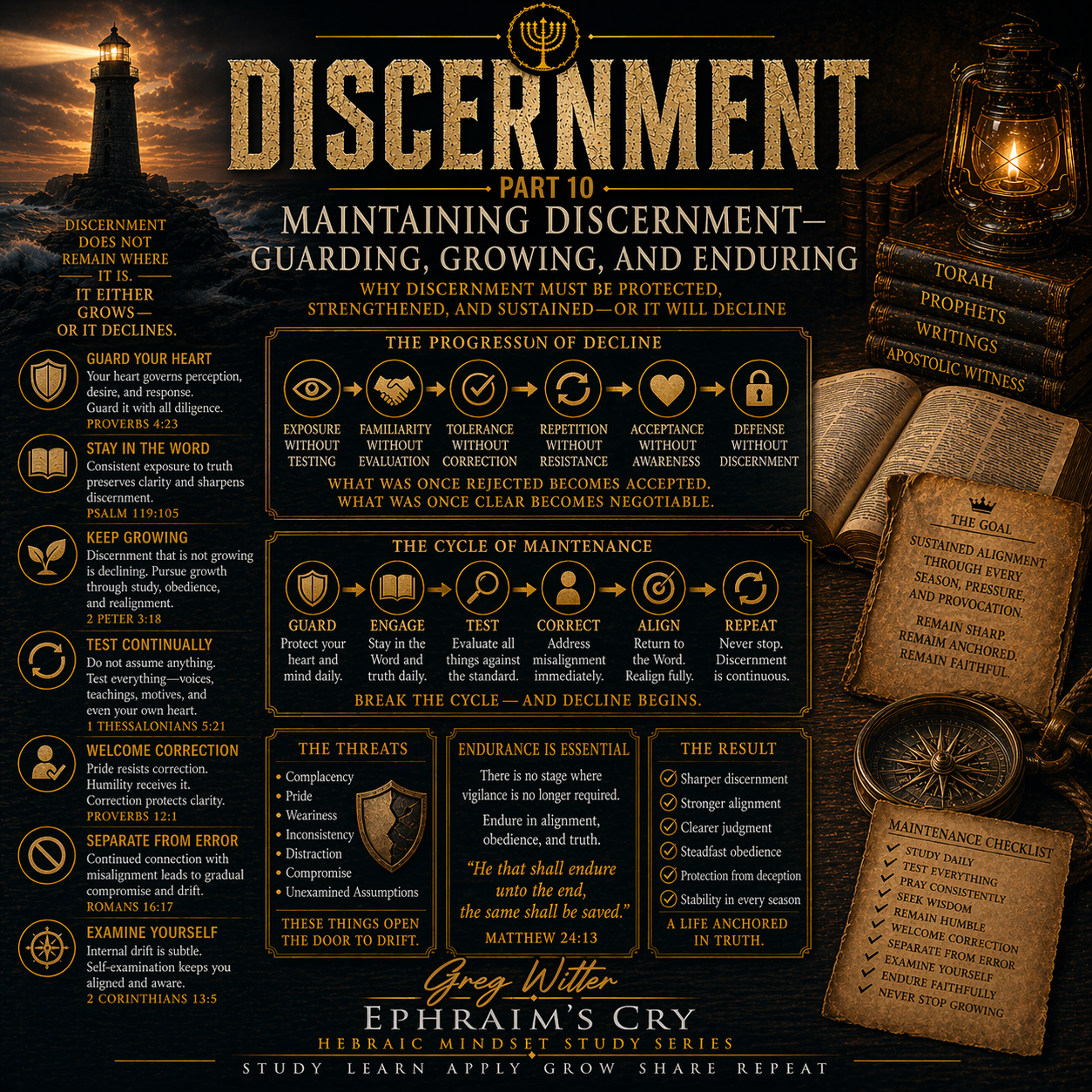
Discernment Part 10: Maintaining Discernment — Guarding, Growing, and Enduring
Why discernment must be protected, strengthened, and sustained—or it will decline
Greg Witter | Ephraim’s Cry
Hebraic Mindset Study Series
Study Learn Apply Grow Share Repeat
Discernment is not something you build once and keep indefinitely. It is not a level you reach and remain at, and it is not a condition that stabilizes on its own. If Part 9 established that discernment must lead to response—correction, separation, and responsibility—then Part 10 confronts the next unavoidable reality: discernment must be maintained. What has been built must now be guarded. What has been formed must now be strengthened. What has been sharpened must now endure. Because discernment does not remain where it is—it either grows or it declines.
There is no neutral state.
This must be understood clearly and without compromise.
- If discernment is not actively maintained, it will weaken
- If it is not strengthened, it will dull
- If it is not guarded, it will be compromised
- If it is not pursued, it will regress
Discernment does not hold its position.
It moves.
And if it is not being intentionally strengthened, it is already beginning to decline.
This is the nature of it, because discernment depends on continued alignment, and alignment requires consistency. This is why Scripture repeatedly calls for vigilance. “Keep your heart with all diligence; for out of it are the issues of life” (Proverbs 4:23). The heart governs perception. It governs desire. It governs response. And whatever governs the heart will ultimately govern discernment.
This is where many lose what they once had.
Not suddenly.
Not dramatically.
But progressively.
They stop guarding.
They relax discipline.
They reduce engagement.
They tolerate what they once rejected.
And over time, what was once sharp begins to dull.
This is how decline happens.
Quietly.
Subtly.
Incrementally.
- exposure without testing
- familiarity without evaluation
- tolerance without correction
- repetition without resistance
And over time:
- what was once rejected becomes acceptable
- what was once clear becomes negotiable
- what was once firm becomes flexible
This is why maintaining discernment requires intentional guarding—not occasional awareness, not reactive attention, but consistent vigilance. Because what you allow into your life will shape your perception, and what shapes your perception will ultimately shape your judgment.
What you entertain will influence you.
What you revisit will normalize.
What you tolerate will take root.
And once it takes root, it begins to reshape how you see.
This is why guarding matters—not from everything, but from anything that does not align with the Word.
This also requires continued exposure to truth. Discernment is maintained through sustained engagement with the Word—not occasional reading, not periodic study, but consistent, disciplined return. Because the Word is not only the standard—it is the source of clarity. Remove consistent exposure, and clarity begins to fade. Return to it, and clarity is restored. Remain in it, and clarity deepens.
This is the pattern.
This is why growth must continue.
Discernment that is not growing is declining.
Because the environment around you is not neutral. Influence continues. Voices continue. Messages continue. Deception continues. And if discernment is not being strengthened, it will be affected.
This is why growth must be intentional.
- continued study
- continued testing
- continued correction
- continued obedience
- continued realignment
This is how discernment remains sharp.
This is also where the cycle of maintenance must be understood clearly, because discernment is not maintained in a straight line—it is maintained through repetition:
- Guard
- Engage
- Test
- Correct
- Align
- Repeat
Break the cycle—and decline begins.
Not eventually.
Immediately.
This is why endurance becomes necessary. Because maintaining discernment is not a short-term effort—it is a lifelong responsibility. There is no stage where vigilance is no longer required. There is no level where testing is no longer necessary. There is no point where correction is no longer needed.
Discernment must endure.
“He that shall endure unto the end, the same shall be saved” (Matthew 24:13).
Endurance is not passive waiting.
It is sustained alignment.
It is continued obedience.
It is remaining under the authority of the Word over time.
This is where many grow weary—not because they lack understanding, but because they stop sustaining what they have built. Fatigue sets in. Discipline weakens. Consistency breaks. And once consistency breaks, maintenance collapses.
This is why spiritual fatigue must be recognized.
Because weariness does not remove responsibility—it weakens response.
And weakened response leads to compromised alignment.
This is where decline accelerates.
- discipline weakens
- consistency breaks
- vigilance softens
- testing slows
And when testing slows, deception accelerates.
This is why discernment must be maintained even when it is difficult—especially when it is difficult. Because difficulty is where decline begins for those who stop sustaining.
This is also where complacency becomes dangerous. Complacency assumes stability. It assumes that what has been built will remain without effort. It assumes that clarity will continue without engagement.
But discernment is not preserved by what you built yesterday.
It is preserved by what you maintain today.
Complacency says:
- “I already know”
- “I’m already grounded”
- “I’ve already built this”
But discernment does not operate on past alignment.
It operates on present maintenance.
This is why humility must remain present, because pride is one of the greatest threats to maintaining discernment. Pride assumes arrival. Pride resists correction. Pride reduces testing. Pride elevates personal judgment above the standard.
And once that happens, discernment begins to distort.
Humility protects discernment because it keeps a person:
- teachable
- correctable
- anchored
- submitted
Discernment is not something you possess independently.
It is something you maintain through alignment.
This is also where consistency across all areas becomes necessary. Discernment cannot be maintained in one area while neglected in another. Because inconsistency creates exposure, exposure creates vulnerability, and vulnerability allows influence.
Partial discipline produces partial discernment.
Partial discernment produces unstable judgment.
This is why maintenance must be comprehensive.
Not selective.
Not compartmentalized.
But complete.
This also requires continued separation from misalignment—not once, but continually. Because influence does not stop. New voices arise. New teachings emerge. New distortions develop.
And if separation is not maintained:
- exposure increases
- testing decreases
- influence expands
This is how drift begins.
This is also where internal drift must be confronted. Because internal decline is more subtle than external influence. It is easier to identify error outside than compromise within.
Internal drift begins when:
- self-examination stops
- correction is resisted
- small compromises are justified
- alignment is assumed instead of tested
And once internal drift begins, external discernment weakens.
This is why self-examination must continue.
Not occasionally.
But consistently.
Am I still aligned?
Am I still testing?
Am I still guarding?
Am I still submitting?
Because the moment these questions stop being asked, decline begins.
This is how discernment is lost—not through one failure, but through repeated neglect.
This brings the reality into full clarity.
Discernment is not a moment.
It is a condition that must be maintained.
It is a function that must be sustained.
It is a responsibility that must be carried.
Because without maintenance, everything built begins to weaken.
- the standard becomes less clear
- the mindset becomes less aligned
- obedience becomes less consistent
- training becomes less active
- testing becomes less frequent
- recognition becomes less sharp
- response becomes less decisive
And over time, discernment declines.
This is the progression.
This is the warning.
This is the responsibility.
Discernment must be:
- guarded
- grown
- sustained
- endured
Because if it is not maintained, it will not remain.
It will move backward.
This is where it must land.
If you stop maintaining discernment:
- you will not stay where you are
- you will not hold your position
- you will not remain stable
You will decline.
Because decline is the default of neglect.
This is the reality that cannot be avoided.
What you maintain—you keep.
What you neglect—you lose.
This is the function.
This is the responsibility.
This is the endurance of discernment.
And this is what prepares the next step.
Because discernment must now move into full application—not in theory, not in concept, but in real, lived situations where decisions must be made consistently and correctly.
Discernment that is not maintained will not remain—it will decline. What has been established here makes it clear that discernment is not something you reach and keep without effort; it must be guarded, strengthened, and sustained over time. Many build clarity for a season, but lose it through inconsistency, fatigue, or complacency. What is not actively maintained begins to weaken, and what weakens eventually becomes vulnerable to influence again. This is where discernment is either preserved or lost—not in what was built, but in what is continually upheld. This is exactly why Ephraim’s Cry Academy exists: to provide the structure, accountability, and ongoing formation necessary to maintain discernment so it does not fade, drift, or collapse under pressure. If you are serious about not losing what has been built, not drifting back into confusion, and not becoming unstable over time, then you must commit to a process that guards, strengthens, and sustains discernment consistently until the end.
https://EphraimsCry.com/academy
Discernment — Part 11: Applying Discernment — Real Situations, Real Decisions

#GregWitter, #EphraimsCry, #HebraicMindset, #Discernment, #BiblicalDiscernment, #TruthVsError,
#SoundDoctrine, #Proverbs423, #Matthew2413, #SpiritualGrowth, #GuardYourHeart, #ConsistencyIsKey,
#Endurance, #TruthOverTradition
