
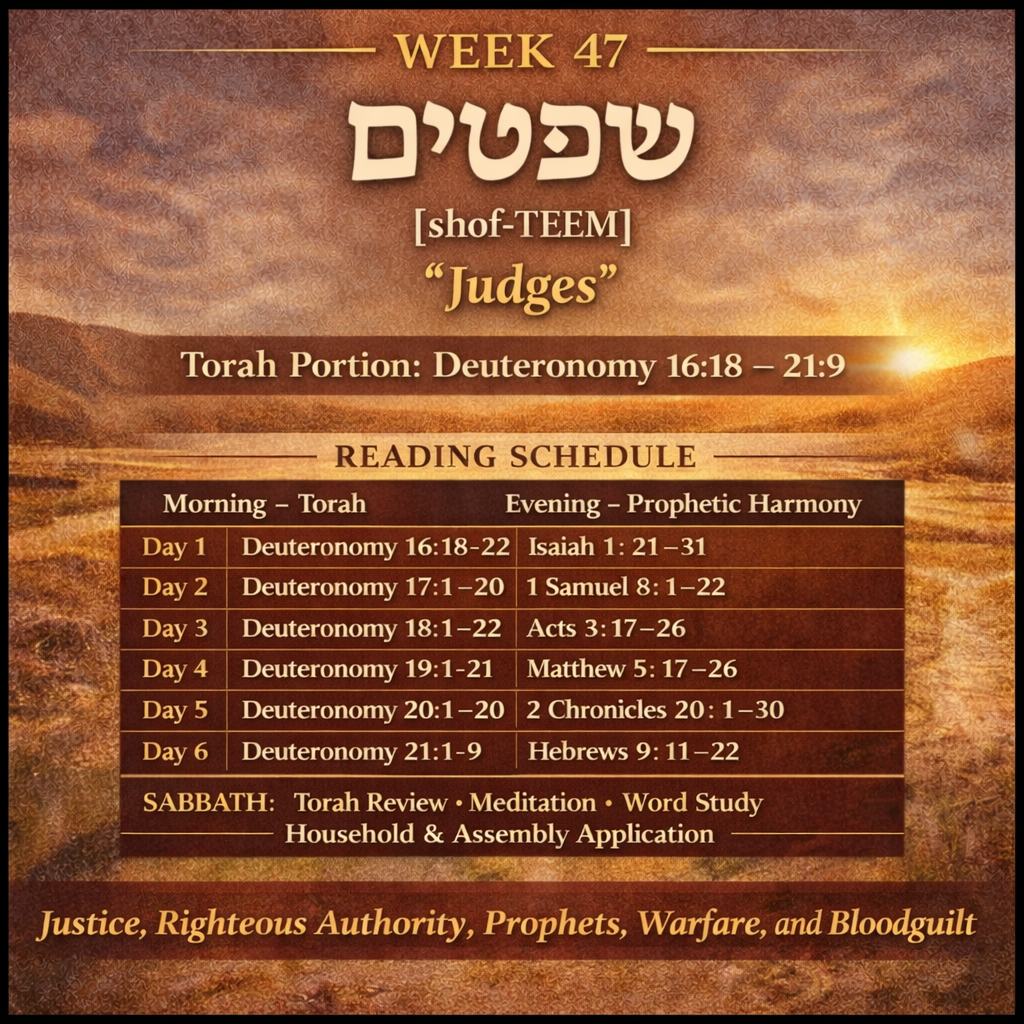
WEEK 47 — שֹׁפְטִים (Shoftim) [shof-TEEM] — “Judges”
Torah Portion: Deuteronomy 16:18 – 21:9
READING SCHEDULE
| Day | Morning — Torah | Evening — Prophetic Harmony |
|---|---|---|
| Day 1 | Deuteronomy 16 : 18 – 22 | Isaiah 1 : 21 – 31 |
| Day 2 | Deuteronomy 17 : 1 – 20 | 1 Samuel 8 : 1 – 22 |
| Day 3 | Deuteronomy 18 : 1 – 22 | Acts 3 : 17 – 26 |
| Day 4 | Deuteronomy 19 : 1 – 21 | Matthew 5 : 17 – 26 |
| Day 5 | Deuteronomy 20 : 1 – 20 | 2 Chronicles 20 : 1 – 30 |
| Day 6 | Deuteronomy 21 : 1 – 9 | Hebrews 9 : 11 – 22 |
| SABBATH | Torah Review · Meditation · Word Study | Household & Assembly Application |
THEMATIC FLOW — JUSTICE, RIGHTEOUS AUTHORITY, PROPHETS, WARFARE, AND BLOODGUILT
Shoftim establishes the entire judicial framework for Israel as they enter the land. Justice is not optional — it is the foundation of covenant society: “Justice, justice you shall pursue.”
Deuteronomy 16:18–22 commands the appointment of judges and officers in every gate. Bribery, partiality, and corruption are forbidden. Altars and pillars borrowed from pagan worship are condemned — righteousness and purity must govern both judgment and worship.
Deuteronomy 17 addresses difficult cases brought before priests and judges, the execution of justice, and the laws concerning kings. A king must not multiply horses, wives, or silver but must write his own copy of the Torah and read it daily. Authority is legitimate only when submitted to Torah.
Deuteronomy 18 establishes the portion of the Levites, condemns witchcraft, divination, and sorcery, and promises a Prophet like Moshe who will speak Yahuah’s words. This prophet becomes a messianic expectation in Israel.
Deuteronomy 19 outlines the Cities of Refuge, laws against false witnesses, and the principle of equal justice — “life for life, eye for eye, tooth for tooth.” Justice protects the innocent and restrains evil.
Deuteronomy 20 instructs Israel in warfare — do not fear, for Yahuah goes with them. Cities far away may be offered peace; cities within the land must be devoted to destruction to prevent idolatry. Even trees are to be treated with discernment in siege.
Deuteronomy 21:1–9 describes the ritual for unsolved murder, cleansing the land from bloodguilt. Innocent blood pollutes the land, and atonement must be sought publicly and sincerely.
Shoftim reveals that covenant society rests on righteous judgment, Torah-aligned leadership, true prophecy, disciplined warfare, and the removal of bloodguilt.
HEBREW WORD STUDY — שֹׁפְטִים (Shoftim)
Block: שפטים Paleo: 𐤔𐤐𐤕𐤉𐤌
Root: שפט — “to judge,” “to govern,” “to render a verdict”
| Letter | Symbol | Meaning | Prophetic Role |
|---|---|---|---|
| 𐤔 Shin | Teeth | Consume / judge | Judgment that removes evil |
| 𐤐 Pe | Mouth | Speech / command | Rendering verdicts through spoken decree |
| 𐤕 Tav | Mark | Covenant / sign | Judgment anchored in covenant law |
| 𐤉 Yod | Hand | Work / action | Justice carried out in action |
| 𐤌 Mem | Water | Nations / chaos | Justice brings order to chaos |
Paleo Meaning:
“A covenantal decision spoken with authority that removes evil and restores order among the people.”
PROPHETIC PALEO-HEBREW WORD PICTURE
Shoftim depicts justice as covenant action. The Paleo letters show judgment (shin) proclaimed with authority (pe), marked by covenant law (tav), enacted by faithful action (yod), and bringing order out of societal chaos (mem). Justice is the backbone of a holy nation.
SABBATH MEDITATION
Reflect on the call to pursue justice. Covenant faithfulness is not only personal righteousness but also creating structures that protect the innocent, restrain the wicked, and uphold truth. Yahuah’s kingdom is built on righteousness and justice.
REFLECTION AND DISCUSSION QUESTIONS
Heart (Individual)
-
Do I judge situations according to Yahuah’s standards or my own?
-
Are there areas where I tolerate injustice or compromise?
-
Am I submitted to righteous authority?
Household (Family)
-
Is justice practiced in our home with fairness, truth, and compassion?
-
Do we reject all forms of pagan influence and counterfeit spirituality?
Assembly (Corporate)
-
Are we equipping leaders who submit to Torah and reject corruption?
-
Do we practice church discipline with righteousness, compassion, and truth?
PRAYER FOR SABBATH
Yahuah,
Teach us to pursue justice.
Make our judgments righteous, impartial, and faithful to Your Torah.
Raise up leaders who fear You,
reject corruption,
and walk in humility.
Guard our hearts from deception,
grant us discernment in warfare,
and cleanse our land from all bloodguilt.
In Yahusha’s Name — Amein.
KEY THEMATIC INSIGHTS
Justice Is the Foundation of Covenant Society
Shoftim demands integrity, impartiality, and rejection of corruption (Deut 16:18–20).
Leadership Must Be Submitted to Torah
Kings must write and read the Torah daily to govern righteously (Deut 17:14–20).
True Prophets Speak Yahuah’s Words Alone
Deut 18 contrasts true prophecy with forbidden occult practices.
Justice Protects the Innocent and Restrains Evil
Cities of Refuge and laws of witnesses preserve righteousness (Deut 19).
Warfare Requires Courage, Discernment, and Obedience
Deut 20 teaches fearlessness rooted in Yahuah’s presence.
Innocent Blood Must Be Atoned For
Bloodguilt pollutes the land unless cleansed (Deut 21:1–9).
FOOTNOTES
-
Deuteronomy 16 — judges, officers, and pure worship.
-
Deuteronomy 17 — kingship and judicial authority.
-
Deuteronomy 18 — prophets and forbidden practices.
-
Deuteronomy 19 — justice principles and refuge.
-
Deuteronomy 20 — warfare regulations.
-
Deuteronomy 21 — cleansing bloodguilt.
