
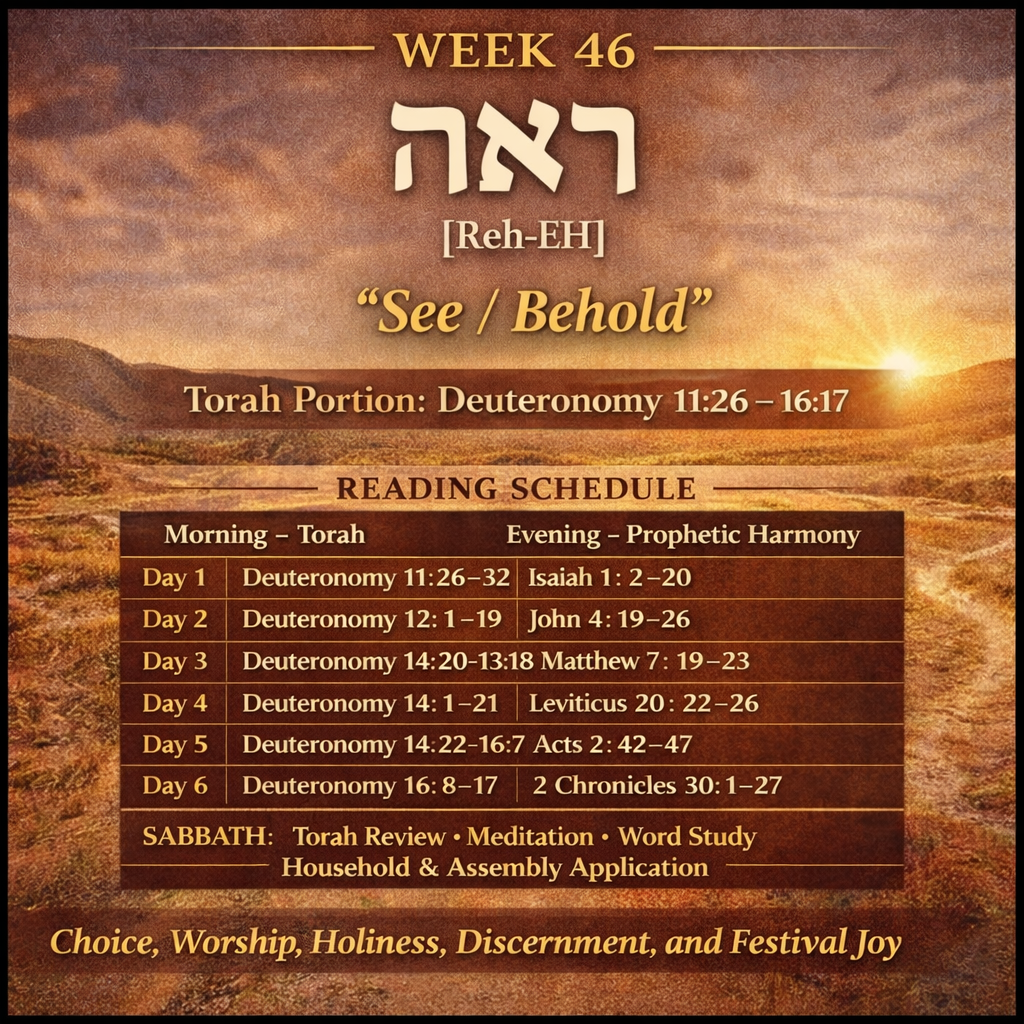
WEEK 46 — רְאֵה (Re’eh) [reh-EH] — “See / Behold”
Torah Portion: Deuteronomy 11:26 – 16:17
READING SCHEDULE
| Day | Morning — Torah | Evening — Prophetic Harmony |
|---|---|---|
| Day 1 | Deuteronomy 11 : 26 – 32 | Isaiah 1 : 2 – 20 |
| Day 2 | Deuteronomy 12 : 1 – 19 | John 4 : 19 – 26 |
| Day 3 | Deuteronomy 12 : 20 – 13 : 18 | Matthew 7 : 13 – 23 |
| Day 4 | Deuteronomy 14 : 1 – 21 | Leviticus 20 : 22 – 26 |
| Day 5 | Deuteronomy 14 : 22 – 16 : 7 | Acts 2 : 42 – 47 |
| Day 6 | Deuteronomy 16 : 8 – 17 | 2 Chronicles 30 : 1 – 27 |
| SABBATH | Torah Review · Meditation · Word Study | Household & Assembly Application |
THEMATIC FLOW — CHOICE, WORSHIP, HOLINESS, DISCERNMENT, AND FESTIVAL JOY
Re’eh opens with the call to “See” — a command to perceive the choice set before Israel: blessing for obedience or curse for disobedience. Covenant life is a daily choice, rooted in seeing reality through Yahuah’s eyes.
Deuteronomy 12 commands Israel to destroy all pagan sites and centralize worship in the place Yahuah chooses. Worship is not defined by personal preference but by divine instruction. Israel must not imitate the nations.
Deuteronomy 13 warns against false prophets and enticers — even family members — who attempt to lead Israel into idolatry. Love for Yahuah must surpass all earthly ties, and discernment is essential.
Deuteronomy 14 revisits dietary laws, tithing, and generosity. Holiness extends to eating, giving, and caring for the poor. Israel is a set-apart people whose daily life reflects covenant identity.
Deuteronomy 15 commands release every seventh year, generosity toward the poor, and freedom for Hebrew servants. Covenant economics are rooted in mercy, justice, and compassion.
Deuteronomy 16:1–17 outlines the three pilgrimage festivals — Pesach, Shavuot, and Sukkot — commanding Israel to rejoice and to appear before Yahuah with offerings proportionate to His blessing.
Re’eh reveals that covenant life is about seeing rightly, choosing well, worshiping as commanded, and walking in holiness, discernment, generosity, and joy.
HEBREW WORD STUDY — רְאֵה (Re’eh)
Block: ראה Paleo: 𐤓𐤀𐤄
Root: ראה — “to see,” “to perceive,” “to understand”
| Letter | Symbol | Meaning | Prophetic Role |
|---|---|---|---|
| 𐤓 Resh | Head | Leadership / authority | Seeing with discernment |
| 𐤀 Aleph | Ox | Strength / leader | Perceiving Yahuah’s authority |
| 𐤄 Hey | Window | Revelation / behold | Receiving revealed truth |
Paleo Meaning:
“To see with discernment what Yahuah reveals and to respond in obedience.”
PROPHETIC PALEO-HEBREW WORD PICTURE
Re’eh commands Israel to “see” not merely with physical eyes but with spiritual perception. The Paleo imagery shows a leader (resh) perceiving the strength and authority of Yahuah (aleph) through revelation (hey). Covenant life begins with seeing truth clearly and responding accordingly.
SABBATH MEDITATION
Meditate on the choices before you. Re’eh teaches that blessing and curse stand open — and we choose by what we see, believe, worship, and obey. Ask Yahuah to refine your sight so you see as He sees.
REFLECTION AND DISCUSSION QUESTIONS
Heart (Individual)
-
Do I see my choices clearly through Yahuah’s word?
-
Are there areas where I imitate the nations instead of obeying Yahuah?
-
Am I discerning about influences, voices, and teachings?
Household (Family)
-
Are we destroying “high places” — patterns or habits that oppose holiness?
-
Does our home practice generosity, joy, and obedience?
Assembly (Corporate)
-
Are we guarding against false teaching and idolatrous influence?
-
Do we celebrate Yahuah’s festivals with joy, unity, and obedience?
PRAYER FOR SABBATH
Yahuah,
Open our eyes to see
the choices, blessings, and warnings before us.
Teach us to worship as You command,
to reject idolatry and false voices,
to walk in holiness and discernment,
and to rejoice in Your festivals with generous hearts.
Give us clarity, humility, and covenant loyalty.
In Yahusha’s Name — Amein.
KEY THEMATIC INSIGHTS
Seeing Rightly Determines Choosing Rightly
Re’eh calls Israel to perceive blessing and curse with spiritual clarity (Deut 11:26–32).
Worship Must Follow Yahuah’s Pattern, Not Ours
Deuteronomy 12 forbids imitation of pagan worship and reveals His chosen place.
False Prophets and Emotional Enticers Must Be Rejected
Deuteronomy 13 teaches that loyalty to Yahuah surpasses all social bonds.
Holiness Shapes Daily Life and Generosity
Dietary laws, tithes, and mercy reflect covenant identity (Deut 14–15).
Festivals Anchor Israel in Covenant Joy
Pesach, Shavuot, and Sukkot command remembrance, rejoicing, and thanksgiving (Deut 16:1–17).
FOOTNOTES
-
Deuteronomy 11 — blessing and curse.
-
Deuteronomy 12 — commanded worship.
-
Deuteronomy 13 — discernment against false prophets.
-
Deuteronomy 14–15 — holiness, provision, and mercy.
-
Deuteronomy 16 — pilgrimage festivals.
