
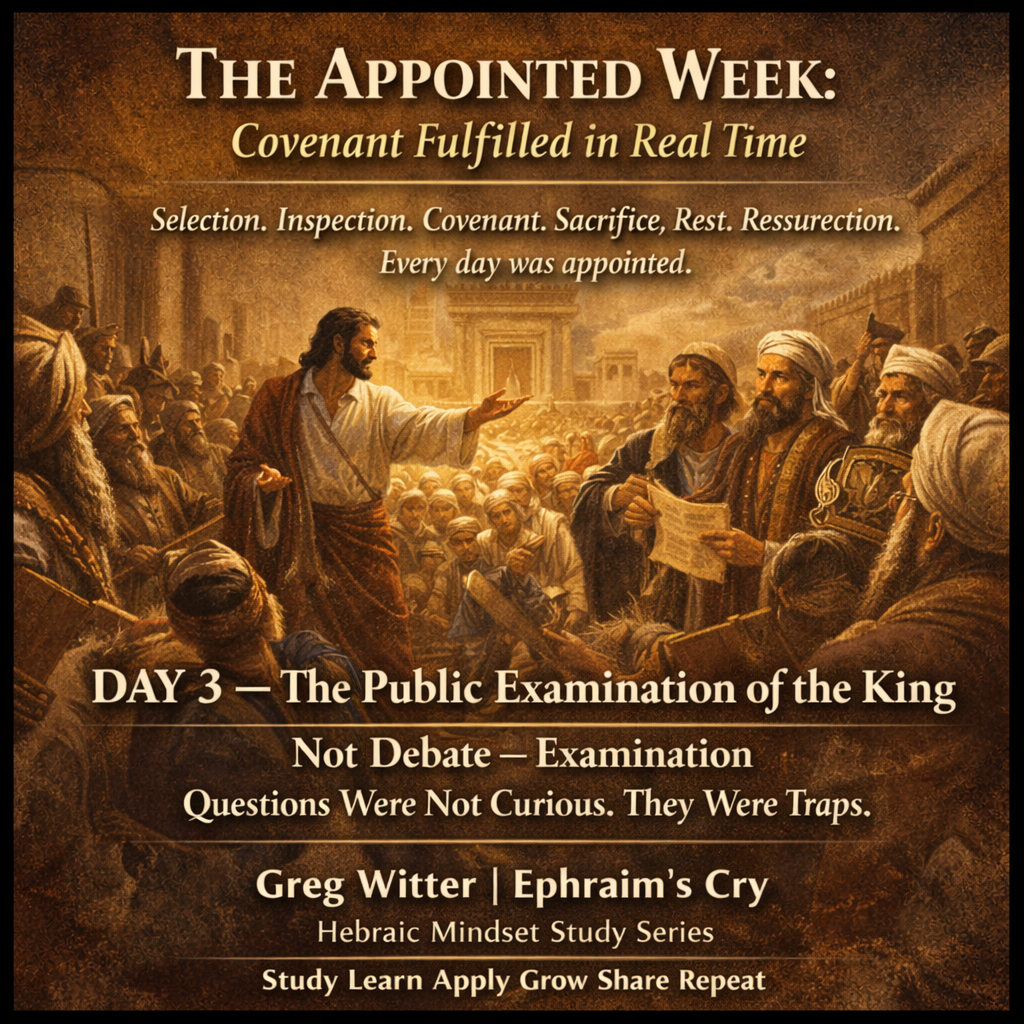
Appointed Weeks:DAY 3 — The Public Examination of the King
Not Debate — Examination
Questions Were Not Curious. They Were Traps.
Greg Witter | Ephraim’s Cry
Hebraic Mindset Study Series
Study Learn Apply Grow Share Repeat
Yesterday, the Temple was confronted.
Today, the King is examined.
Day 3 is the 12th of Aviv, and it sits inside the inspection window of Exodus 12. The Passover lamb was selected on the 10th and kept until the 14th. Those days were not filler. They were inspection. The lamb was kept in view. Watched. Examined. If any defect appeared, it was disqualified. That means Day 3 is not “Jesus answered questions.” Day 3 is covenant qualification happening in public.
He returns to the Temple courts openly. He does not avoid the arena. He teaches in the place where authority is challenged, where leadership claims jurisdiction, and where the nation can hear. A lamb that hides cannot be examined. A lamb that remains in full view invites testing.
The first wave is an authority trap.
The chief priests and elders ask: “By what authority are You doing these things, and who gave You this authority?” This is not sincere curiosity. It is jurisdiction. If He cannot establish legitimate authority, they will dismiss Him. If He claims authority from Yahuah directly, they will accuse Him. They are not seeking truth. They are seeking a charge.
He answers with a question about John’s immersion: “Was it from heaven or from men?” Their response exposes them. They reason among themselves. If they say “from heaven,” they condemn themselves for rejecting John. If they say “from men,” they fear the crowd. They choose the safe lie: “We do not know.”
That moment is part of the inspection. It proves something about them: they fear people more than they fear Yahuah. Their authority is already compromised because it is ruled by optics and control, not truth.
Then He immediately presses the covenant point with parables that force the issue of obedience.
First, the two sons. One says, “I will,” and does not. The other says, “I will not,” and later repents and obeys. The point is not speech. The point is submission. Covenant is not validated by religious talk. Covenant is validated by obedience. The leadership has the vocabulary. The outcasts respond to repentance. The parable indicts the system in front of the nation.
Then, the vineyard. A man plants a vineyard and leases it to tenants. He sends servants to receive fruit. They beat one, kill another, stone another. He sends more. They do the same. Finally, he sends his son, saying they will respect him. The tenants say, “This is the heir. Come, let us kill him and have his inheritance.”
This is not a vague illustration. It is covenant history brought into the present. Israel is the vineyard. The servants are the prophets repeatedly sent. The tenants are the stewards entrusted with responsibility. The son is the rightful heir standing in front of them. The motive is declared openly: control. The inheritance they seek is authority over the people, over the house, over the covenant narrative itself.
He asks what the owner will do. The answer condemns them. The tenants will be destroyed. The vineyard will be given to others who will render fruit. That is not abolishing the covenant. That is removing corrupt stewardship.
Then comes the cornerstone. “The stone the builders rejected has become the cornerstone.” Builders evaluate stones. Leadership thinks they are evaluating Him. But this rejection is not because the stone is flawed. It is because the stone threatens their structure. The cornerstone becomes the foundation of what comes next, whether they approve or not.
Then comes the third parable that belongs on this day and cannot be skipped: the wedding feast.
A king prepares a feast for his son. He sends servants to call the invited. They refuse. He sends more servants. They ignore, go to their farms and businesses, and others seize the servants, mistreat them, and kill them. The king responds in judgment. Then he sends servants to the highways to gather all, both bad and good, and the hall is filled.
This is covenant indictment at national scale. The invitation was real. The refusal is deliberate. The mistreatment of servants mirrors the mistreatment of prophets. The judgment language is not sentimental. It is warning. And then the invitation extends outward — not because covenant became weak, but because covenant will produce fruit and a people prepared for the king.
Then the king sees a man without a wedding garment. He is confronted and is speechless. He is cast out. The point is not “anyone can come however they want.” The point is the opposite: invitation does not erase requirement. Entrance does not cancel covenant order. Being present in the hall is not the same as being properly prepared. The garment is righteousness and fitness for the King — not self-defined, not casual, not lawless. It is an indictment of those who want the benefits of the kingdom without submission to the King’s order.
That parable sits inside Day 3 for a reason: it answers the question of authority and legitimacy before the traps begin. It declares that the King’s invitation is real, rejection is judged, and those who come must come rightly.
Now the trap questions begin in full force.
First, the political trap: Pharisees and Herodians together. That alliance is not normal. It is strategic. Religious faction and political faction coordinate because they have one shared aim: find a charge.
“Is it lawful to pay tribute to Caesar?” This is not about taxes. It is about allegiance and accusation. If He rejects tribute, they can hand Him to Rome as a rebel. If He affirms tribute without covenant boundaries, they can discredit Him before the people.
He asks for a denarius. “Whose image and inscription?” Caesar’s. “Render to Caesar what is Caesar’s, and to Elohim what is Elohim’s.”
The coin bears Caesar’s image. The human bears Elohim’s image. This is not compromise. It is jurisdictional clarity. Earthly authority has limited claims. Yahuah’s claim is total because you belong to Him. He does not incite rebellion. He does not surrender allegiance. The trap collapses. They marvel and leave.
Second, the theological trap: the Sadducees. They deny resurrection. They present a scenario meant to make resurrection look ridiculous. A woman marries seven brothers in succession. In the resurrection, whose wife is she?
He answers with two blades. First, they do not know the Scriptures. Second, they do not know the power of Elohim. Then He anchors resurrection in covenant identity: “I am the Elohim of Abraham, Isaac, and Jacob.” Present tense. Covenant relationship does not terminate at death. He is Elohim of the living. Resurrection is not a philosophical preference; it is covenant faithfulness and divine power. The trap fails.
Third, Torah testing: a scribe asks which commandment is greatest. This is not merely devotional. It is a test of Torah understanding. If He mishandles Torah, He can be exposed. If He diminishes Torah, He can be charged as lawless.
He answers with the Shema: love Yahuah with all heart, soul, and mind, and love your neighbor as yourself. He does not reduce Torah to emotion. He establishes Torah’s ordering principle: covenant loyalty to Yahuah expressed through faithful action toward others. This is not “love replaces commandments.” This is “love is the covenant posture that produces obedience.” The scribe affirms Him. The test fails.
Then Yahusha turns the table and asks them about Messiah. “What do you think about Messiah? Whose son is He?” They answer: David’s. He then cites David calling Messiah “Lord” and asks how Messiah can be David’s son if David calls Him Lord.
This is not side trivia. This is the pivot. Their messianic expectation is incomplete and politically convenient. They want a Messiah they can frame, manage, and leverage. Yahusha exposes that Messiah is greater than their categories. They cannot answer. The text says no one was able to answer Him a word, nor from that day did anyone dare question Him anymore.
That line is the inspection gavel. The questioning ends because the traps have failed. The King remains unblemished under public scrutiny.
Now the day moves into open covenant prosecution.
He warns the crowds and His disciples about the scribes and Pharisees. They speak but do not do. They lay heavy burdens and will not lift them. They do their works to be seen. They love honor, titles, and recognition. This is not personality critique. This is leadership disqualification. Torah demands shepherds who serve and teach faithfully. These use Torah language to secure power.
Then the woes begin. “Woe to you, scribes and Pharisees, hypocrites.”
They shut up the kingdom of heaven in people’s faces. They do not enter and they hinder others. They are gatekeepers of obstruction, not guardians of truth.
They strain out a gnat and swallow a camel. They obsess over the smallest technicalities while tolerating massive covenant violations. Precision becomes a mask for rebellion.
They tithe mint, dill, and cumin but neglect the weightier matters: justice, mercy, and faithfulness. Those are not “soft virtues.” They are covenant requirements rooted in Torah itself. A system that can measure herbs but cannot practice justice is not righteous. It is fraudulent.
They clean the outside of the cup while inside is greed and self-indulgence. They appear clean while the inner life is corrupt. External religion hides internal rot.
They are like whitewashed tombs: beautiful outwardly, full of deadness inwardly. Their righteousness is performative. Their core is unclean.
They build tombs for the prophets and decorate monuments to the righteous and claim they would never have participated in their fathers’ violence — yet they are actively plotting the death of the One the prophets testified of. They honor dead prophets because dead prophets cannot confront them. Living correction is rejected.
Then the generational indictment falls: the righteous blood from Abel to Zechariah. This is covenant-history language. From the first righteous blood shed to the culmination of prophetic rejection, the pattern is being filled. The leadership is not merely mistaken. They are completing an inherited rebellion.
Then the lament: “O Jerusalem, Jerusalem…” This is not sentimental poetry. It is covenant grief. “How often I would have gathered your children as a hen gathers her chicks under her wings, but you were not willing.” The issue is will. Not lack of information. Not lack of evidence. Refusal.
Then the sentence: “Your house is left to you desolate.” House means the Temple system, the structure they trust in. Desolation is covenant consequence. A building does not override covenant. Structure cannot substitute for obedience.
Immediately after this, He watches the treasury and highlights the widow. A poor widow gives two small coins — all she has. This is not random. It is the living contrast to leaders who “devour widows’ houses.” The system consumes the vulnerable while pretending holiness. The widow embodies sincerity and sacrifice while leadership embodies exploitation. Day 3 exposes the moral inversion of the House.
Then He departs the Temple. The disciples point out the buildings. He declares: “Not one stone will be left upon another.”
This is not theatrics. It is covenant inevitability. When leadership rejects correction and the house becomes corrupt, judgment follows.
They go to the Mount of Olives, and the disciples ask about timing and signs. He begins where covenant always begins in crisis: deception. “See that no one leads you astray.” False messiahs will come. Wars and rumors of wars will occur. Persecution will rise. Betrayal will increase. Lawlessness will increase. Love will grow cold. Endurance will be required.
This is not speculative entertainment. It is preparation for covenant upheaval. The Temple will not stand forever in hypocrisy. Systems collapse. Only covenant faithfulness endures.
By the close of Day 3, the record is established.
The King has been publicly examined.
Authority trap — failed.
Scripture trap — failed.
Political trap — failed.
Theological trap — failed.
Torah trap — failed.
He answered from Scripture, not emotion, not philosophy, not compromise.
No blemish found.
And the central danger is now visible: when a system cannot disqualify you legitimately, it will move to eliminate you illegitimately. Day 3 proves He was not condemned for error. He was condemned for authority. He was condemned because the King’s presence exposes counterfeit leadership, and counterfeit leadership will always choose preservation of control over submission to the King.
This was not debate.
This was covenant inspection.
Inspection intensifies.
And the King remains without blemish.
If you want the full reconstruction, join here:
https://www.facebook.com/greg.witter/subscribenow?surface=pinned_comments
#GregWitter #EphraimsCry #HebraicMindset #AppointedWeek #PublicExamination #TorahAuthority
#CovenantInspection #PassoverPattern #KingExamined #TempleJudgment #Psalm118 #OlivetDiscourse
#WholeCounselOfElohim
