
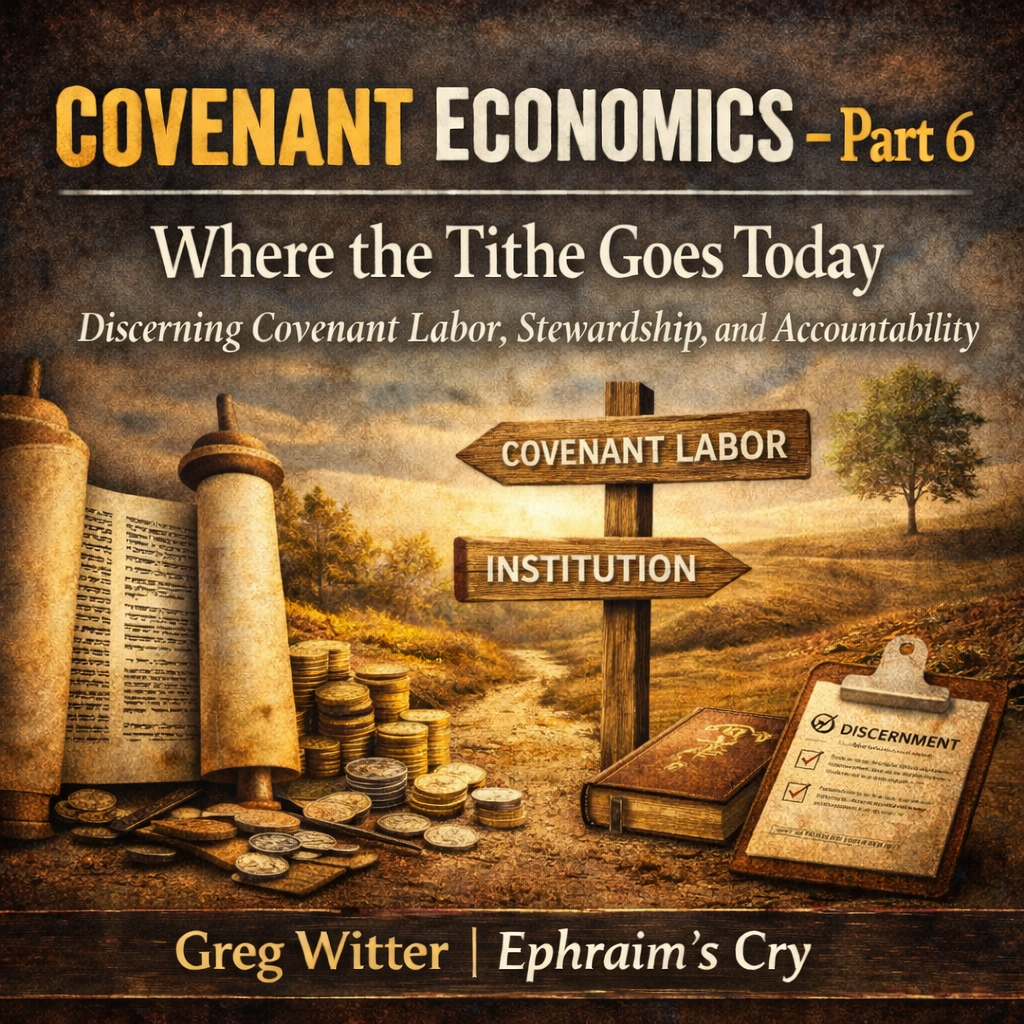
COVENANT ECONOMICS – Part 6
Where the Tithe Goes Today
Discerning Covenant Labor, Stewardship, and Accountability
Greg Witter | Ephraim’s Cry
Hebraic Mindset Study Series
Study • Learn • Apply • Grow • Share • Repeat
INTRODUCTION: A QUESTION MODERN RELIGION AVOIDS
Once it is understood that the tithe belongs to Yahuah, that it is tied to increase, and that it is distinct from offerings, a final practical question must be faced honestly:
Where does the tithe go today?
Modern religion often answers this question by default: to the church. Scripture never does. Torah does not assign the tithe to buildings, brands, or institutional systems. It assigns the tithe to covenant labor.
If covenant labor can be identified, stewardship can be discerned. If it cannot, obligation does not exist.
THE BIBLICAL PRINCIPLE: PROVISION FOLLOWS LABOR
Throughout Scripture, provision follows labor. Yahuah provides for those who are set apart to serve Him and His people in specific, identifiable ways.
“You shall not muzzle the ox while it treads out the grain.”
(Deuteronomy 25:4)
“The laborer is worthy of his wages.”
(Luke 10:7)
These passages establish a consistent principle: those who labor in covenant work are to be sustained so the work does not cease.
However, Scripture never teaches indiscriminate support. Provision is not automatic. It is tied to what kind of labor is being done.
WHAT QUALIFIES AS COVENANT LABOR
Covenant labor is not defined by a title, a pulpit, or a tax status. It is defined by function and fruit.
Biblically, covenant labor includes:
faithful teaching of Torah and Scripture
instruction that leads to obedience
guarding truth against error
discipling believers into covenant living
caring for the flock rather than exploiting it
Paul makes this clear when he speaks of those who labor in teaching and doctrine being worthy of support (1 Timothy 5:17–18).
The tithe follows function, not form.
WHY INSTITUTIONAL CLAIMS FAIL SCRIPTURAL TESTING
Many modern institutions assume entitlement to the tithe without meeting biblical criteria. Scripture never grants such entitlement.
There is no covenant obligation to support:
false teaching
diluted doctrine
entertainment-driven religion
unaccountable leadership
systems that enrich a few while burdening many
Yahuah does not fund rebellion against His own instructions.
Where covenant labor is absent, obligation disappears.
ACCOUNTABILITY AND TRANSPARENCY
Scripture consistently demands accountability from those who handle provision.
Those who receive support must:
handle resources faithfully
remain accountable
avoid self-enrichment
prioritize the flock over themselves
The prophets repeatedly condemned leaders who took provision but failed to serve, protect, or teach faithfully (Ezekiel 34; Micah 3).
Blind support is never commanded. Discernment is.
HOUSEHOLD PRIORITY IN GIVING
Scripture places household responsibility above external giving.
“If anyone does not provide for his own, especially those of his household, he has denied the faith.”
(1 Timothy 5:8)
No covenant obligation exists that requires neglecting one’s family to fund religious activity. Any system that pressures people to give at the expense of their household is operating outside biblical order.
Covenantal giving protects the home first.
SEASONS, DISCERNMENT, AND FREEDOM
Scripture acknowledges seasons. There are times of abundance and times of lack. There are moments when support is possible and moments when it is not.
Paul himself refused support at times to avoid burdening others, even though he had a right to it (1 Corinthians 9).
This demonstrates a critical truth: the right to receive does not override love for the people.
COVENANTAL DISCERNMENT VS RELIGIOUS PRESSURE
Covenantal approach:
evaluates labor by Scripture
demands accountability
protects households
gives freely and wisely
Religious pressure:
assumes entitlement
discourages questioning
exploits guilt
prioritizes institutions over people
One aligns with Yahuah’s heart.
The other distorts it.
WHY THIS MATTERS
Many believers want to be obedient but do not know where obedience applies. Scripture does not leave them without guidance.
Yahuah is not honored by funding error, abuse, or disobedience. He is honored by supporting truth, teaching, and faithful covenant labor.
When discernment is restored, giving becomes purposeful rather than pressured.
CLOSING ORIENTATION
The tithe belongs to Yahuah.
It follows covenant labor.
It requires accountability.
Where these conditions are met, support is appropriate. Where they are not, obligation does not exist.
The final installment will now address the concluding question of this series:
How does this apply today, and why does Ephraim’s Cry meet the biblical criteria for covenant labor?
That will be examined in COVENANT ECONOMICS – Part 7
Application, Discernment, and Covenant Responsibility.
HASHTAGS
#EphraimsCry #GregWitter #HebraicMindset #CovenantEconomics #CovenantalTithing #BiblicalStewardship
#TorahTruth #ScriptureOverTradition #KingdomOrder #Discipleship #Accountability #ProvisionFollowsLabor
#BlessingNotBurden
