
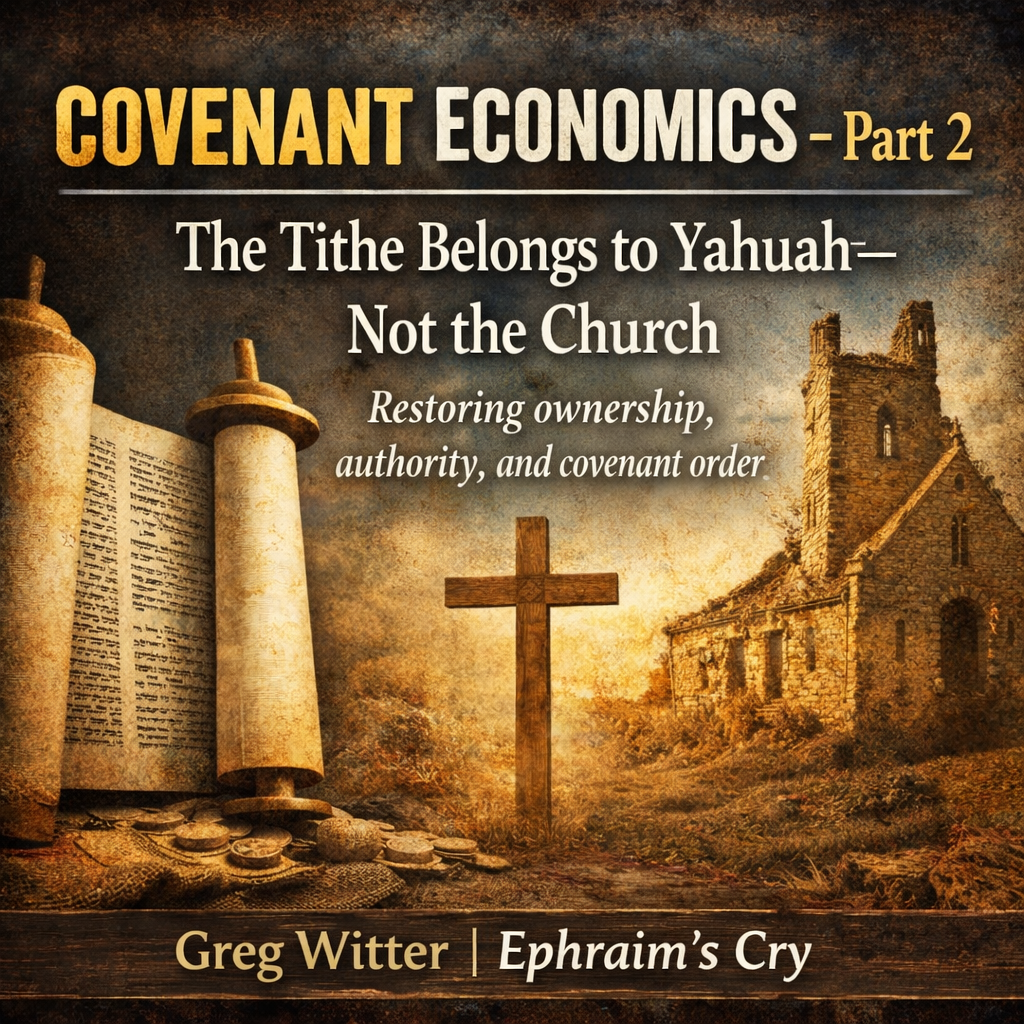
Restoring ownership, authority, and covenant order
Greg Witter | Ephraim’s Cry
Hebraic Mindset Study Series
Study • Learn • Apply • Grow • Share • Repeat
INTRODUCTION: THE QUESTION THAT CHANGES EVERYTHING
Once covenantal tithing is separated from religious tradition, one unavoidable question must be answered:
If the tithe exists, who does it belong to?
Modern religion answers this question quickly and incorrectly: the church. Scripture answers it clearly and consistently: Yahuah Himself.
This distinction is not minor. Ownership determines authority. Authority determines purpose. Purpose determines whether tithing functions as a blessing or becomes a burden.
Until ownership is restored, everything downstream of tithing remains distorted.
OWNERSHIP PRECEDES DISTRIBUTION
Scripture does not begin the discussion of tithing with percentages or recipients. It begins with ownership.
“The tithe belongs to Yahuah.” (Leviticus 27:30)
This declaration is absolute. The tithe is not presented as a donation, suggestion, or institutional resource. It is set apart because it belongs to Yahuah. Holiness here means designated for a specific purpose under divine authority.
If the tithe belongs to Yahuah, no man, ministry, denomination, or organization can claim ownership over it. At most, they may act as stewards, and stewardship must always be defined by the Owner.
WHY “TITHE TO THE CHURCH” IS A NON-BIBLICAL IDEA
The phrase “tithe to the church” does not appear anywhere in Scripture. It is a post-biblical concept that arose alongside institutional Christianity, centralized religious economies, and clerical hierarchies.
In Scripture:
there is no church budget model
there is no clergy salary mandate
there is no building-maintenance tithe
there is no membership-based obligation
Instead, Scripture presents covenant function.
Yahuah never assigned the tithe to an institution. He assigned it to people performing specific covenant labor.
THE ORIGINAL COVENANT FUNCTION OF THE TITHE
Under Torah, the tithe was assigned to the Levitical priesthood for one reason: they were set apart to carry Torah instruction, maintain covenant order, and serve the people of Yahuah full-time.
The Levites were denied land inheritance so they could devote themselves to service. The tithe was not payment for services rendered. It was provision so the work of Torah would not cease.
“Behold, I have given the children of Levi all the tithe in Yasharal as an inheritance, in return for the service which they perform.” (Numbers 18:21)
The tithe existed to free those laboring in Torah from economic distraction so instruction, justice, and obedience could continue uninterrupted.
STEWARDSHIP, NOT ENTITLEMENT
Even the Levites did not own the tithe. They were stewards of what already belonged to Yahuah. That is why they themselves were required to tithe from what they received.
This establishes a central covenant principle: no one is exempt from accountability simply because they receive provision.
Religious systems reverse this principle. They treat the tithe as institutional property and leadership as beyond scrutiny. Scripture never does this.
Where stewardship is absent, abuse follows.
PROPHETIC WARNINGS AGAINST MISUSED PROVISION
Scripture directly confronts leaders who mishandle provision.
Through Ezekiel, Yahuah condemns shepherds who feed themselves instead of the flock, fail to strengthen the weak, and exploit rather than protect. Ezekiel 34
Through Malachi, Yahuah rebukes a corrupt priesthood that treated holy things casually while demanding obedience from the people. Malachi 1–3
These rebukes are not anti-tithe. They are anti-abuse. They reinforce that the tithe belongs to Yahuah and must be handled according to His purposes, not human agendas.
THE TRANSITION TO THE MELCHIZEDEK PRIESTHOOD
The Apostolic Writings do not abolish tithing. They reframe priesthood.
Hebrews explains that the Levitical priesthood was temporary and pointed forward to a greater priesthood, the order of Melchizedek. Messiah Yahusha serves as High Priest in this order, and those who labor in teaching, instruction, and proclamation now function within this framework.
The principle remains unchanged:
Yahuah owns the tithe
provision supports covenant labor
stewardship requires faithfulness
What changes is who carries the labor, not who owns the provision.
WHAT THIS MEANS TODAY
If the tithe belongs to Yahuah, it cannot be claimed by default by any church, ministry, or organization. Support must be evaluated by function, not by name, popularity, or status.
Covenantal questions must be asked:
Is Torah being taught accurately?
Is the labor advancing obedience and truth?
Is provision handled transparently?
Are the vulnerable protected?
Is the work aligned with Scripture?
Where these criteria are absent, obligation does not exist.
COVENANTAL ORDER VS RELIGIOUS CLAIMS
Covenantal understanding:
the tithe belongs to Yahuah
stewards are tested by Scripture
accountability is required
provision follows covenant function
Religious distortion:
the tithe belongs to the institution
authority is assumed rather than proven
questioning is discouraged
obligation replaces discernment
One restores order.
The other enables abuse.
CLOSING ORIENTATION
Before discussing how much or from what, one truth must be settled:
The tithe does not belong to the church.
The tithe belongs to Yahuah.
Only when ownership is restored can stewardship be evaluated rightly.
The next installment addresses the practical question that follows naturally:
What qualifies as increase?
That will be examined in COVENANT ECONOMICS – Part 3
Defining Increase: Wages, Work, and Provision.
HASHTAGS
#EphraimsCry #GregWitter #HebraicMindset #CovenantEconomics #CovenantalTithing #BiblicalStewardship #TorahTruth #ScriptureOverTradition #MelchizedekPriesthood #KingdomOrder #Discipleship #GiftNotGreed #BlessingNotBurden #TrueGospelOfTheKingdom
