
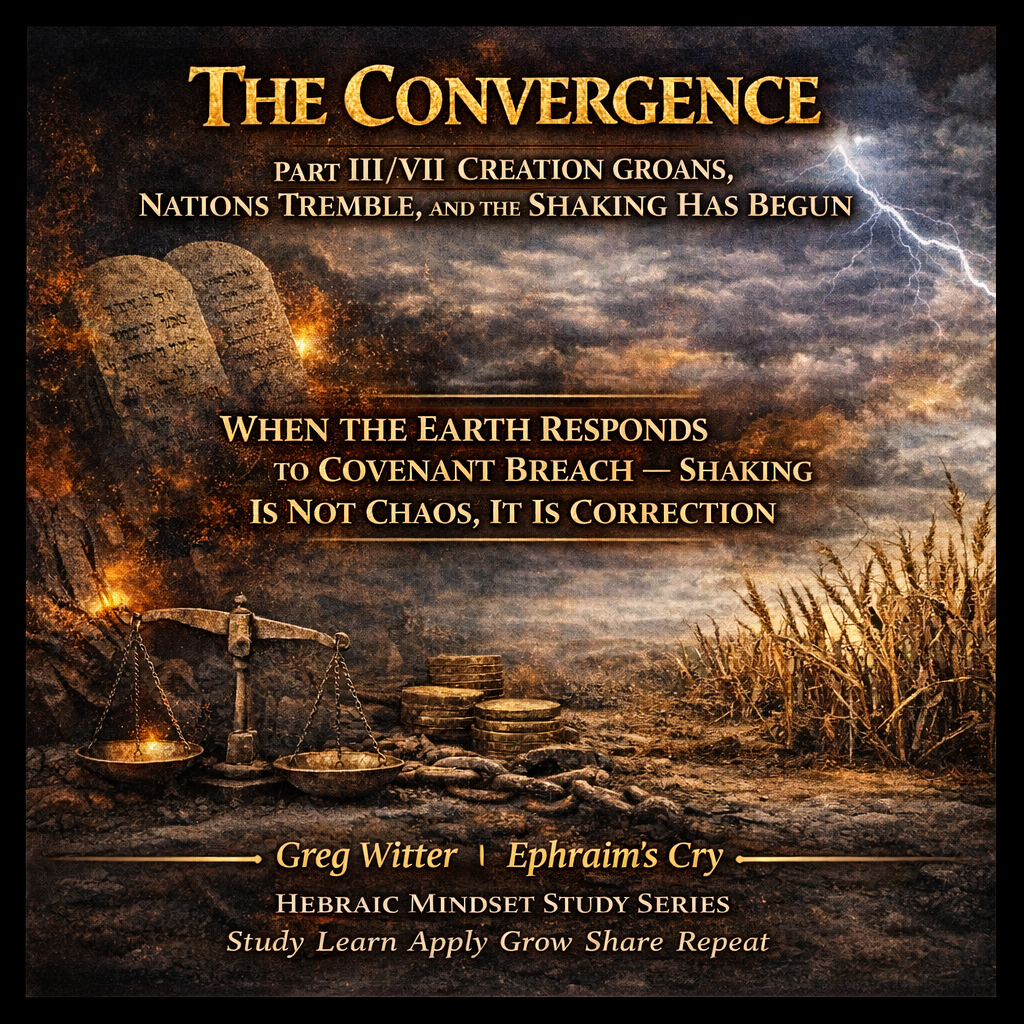
Convergence
Part III/VII Creation Groans, Nations Tremble, and the Shaking Has Begun
The Compression of Covenant History at the Edge of Kingdom Arrival
When the Earth Responds to Covenant Breach — Shaking Is Not Chaos, It Is Correction
Greg Witter | Ephraim’s Cry
Hebraic Mindset Study Series
Study Learn Apply Grow Share Repeat
Part I established structural alignment. Part II exposed economic allegiance. Part III now turns to the physical and geopolitical realm—because Scripture never treats the physical world as spiritually irrelevant. If dominion aligns and commerce confesses, creation itself responds. And when creation responds, nations tremble, systems strain, and the agebegins to compress under pressure.
Scripture does not present upheaval as random chaos detached from covenant. It presents it as witness, as testimony, as consequence, and as correction. The earth is not a passive stage upon which history plays out; it is covenant territory. It is the arena of obedience and rebellion. When covenant is honored, the land yields. When covenant is violated, the land withholds. When rebellion becomes structural, creation convulses. And when the age approaches judgment, shaking increases.
This is not superstition. This is covenant cosmology—Torah established, Prophets prosecuted, Writings reinforced, Apostolic confirmed. Shaking is not chaos. Shaking is correction.

I. THE LAND AS WITNESS — COVENANT COSMOLOGY FROM TORAH
From Genesis forward, the land is not neutral. When Adam transgresses, the ground is cursed because of him. The curse is not only internal guilt; it is external consequence. The soil responds to covenant breach because man was placed within a governed order. The created order is not merely a backdrop. It is structured under authority, and when authority is rejected, order destabilizes.
Genesis also establishes that violence is not “just human behavior.” When Cain murders Abel, Yahuah does not treat it as merely interpersonal sin. He declares that Abel’s blood cries out from the ground. The earth is portrayed as a witness that receives testimony and then participates in consequence. Cain is not merely “guilty.” He becomes alienated from stability. The ground resists him. His labor is frustrated. This is a foundational legal principle: bloodshed defiles land, and defiled land responds.
Torah develops this principle further. Murder and injustice are not only moral offenses—they are land-defilement offenses. Covenant people cannot normalize violence and pretend the land will remain stable. When violence fills a culture, shaking is not surprising. It is covenant response. A land that absorbs bloodguilt without repentance does not remain quiet forever. In that sense, “creation groans” is not abstract. Creation groans under accumulated bloodguilt, corruption, exploitation, and lawless dominion.
Leviticus 18 intensifies this: abomination defiles the land, and the land “vomits out” its inhabitants when defilement persists. That language is deliberate. It portrays expulsion as territorial enforcement. When covenant boundaries are violated long enough, the land itself becomes an agent of removal. Leviticus 26 then adds escalation logic: if correction is refused, discipline increases, and the land will enjoy its Sabbaths while the people are removed. That means the land’s rest is enforced even if man refuses to honor it.
Deuteronomy 28 ties obedience to rain in season, harvest abundance, stability in territory, and national peace. Disobedience produces drought, blight, famine, siege, economic collapse, and exile. Provision and stability are not disconnected from covenant fidelity. They are integrated within it. The land is covenant territory, and covenant territory responds to covenant loyalty or covenant breach.
This is why modern categories fail when they try to separate “social breakdown” from “environmental instability.” Scripture treats them as connected. When a society normalizes violence and inverts righteousness, the land does not merely “suffer.” The land bears witness. Shaking becomes one mode of testimony.
II. TORAH CASE STUDIES — YAHUAH SHAKES CREATION WHEN REBELLION CROSSES THRESHOLDS
If Part III is going to be proven without gaps, it must be established by Torah case studies, not only by later prophetic descriptions. Torah repeatedly shows Yahuah intervening through the physical and structural order when rebellion reaches thresholds.
The Flood is not merely a “natural disaster story.” It is creation-level judgment that responds to corruption filling the earth. When violence becomes normalized and man’s imagination becomes continually evil, the response is not only moral warning—it is creational collapse and reset. That establishes a foundational pattern: when covenant breach becomes structural and pervasive, Yahuah judges in ways that shake the entire created environment.
Babel establishes another pattern: unified rebellion produces forced dispersion. The shaking there is not earthquake; it is language fracture and civilizational scattering. It is a social and structural shaking that prevents lawless unity from achieving full dominion. This matters because it proves that “shaking” is not only geological. It can be systemic. When rebellion consolidates, Yahuah disrupts the consolidation.
Sodom and Gomorrah confirm covenant response to defilement and injustice. The judgment is not framed as random. It is framed as response to multiplied transgression, and the land itself becomes a recurring witness in later Scripture. When nations take pride in what Yahuah condemns, the record shows that judgment can manifest physically and suddenly.
Egypt confirms another pattern: when a power structure enslaves, hardens, and mocks Yahuah’s authority, creation itself becomes a weapon of judgment—water, insects, livestock, darkness, death. Those plagues are covenant confrontation. The created order becomes the stage and the instrument because the Creator is Judge.
Sinai is essential. When Torah is given, the mountain trembles. Thunderings, voices, smoke, and trembling accompany covenant enthronement. That is not theatrics. That is government. Covenant is not private spirituality; it is kingdom reality. The giving of covenant law is accompanied by creational trembling because the King is establishing terms with His people.
Korach’s rebellion shows another dimension: the earth opens and swallows. The land participates in removing covenant rebellion from the camp. Again, not random. Judicial. Torah is clear: when covenant order is challenged in pride, the earth itself can become part of the removal.
Put these together and Torah becomes unmistakable: when covenant order is established, creation trembles; when covenant order is violated, creation responds; when rebellion becomes systemic, shaking escalates. That is the root logic of end-time shaking.
III. SABBATH VIOLATION AND LAND REST — WHEN THE LAND CLAIMS ITS SABBATHS
Leviticus 25 and 26 are structural. Sabbath is not merely weekly worship; it is covenant time-order. The land Sabbath is covenant agriculture-order. Yahuah explicitly warns that if His people refuse covenant discipline, the land will enjoy its Sabbaths while the people are removed. This is one of the most direct places where Scripture states that land rest is enforced even if people refuse it.
2 Chronicles 36 reinforces this historically: exile is tied to the land enjoying its Sabbaths. Covenant time and covenant agriculture are connected. The land is not merely property. It is covenant territory under covenant law. When a people refuse rest, they don’t merely become tired—they become lawless in rhythm. They train themselves into perpetual production, perpetual consumption, perpetual striving. That produces instability. Not instantly, but cumulatively. It erodes humility, dependence, restraint, and boundary.
So when ecological strain and agricultural instability intensify, it is not faithful to Scripture to treat it as purely natural. It may be natural in mechanism, but covenantal in meaning. A civilization that cannot rest is a civilization moving toward slavery—because slavery is the inability to stop.
This belongs here because shaking is not only about earthquakes. It is also about the land enforcing boundaries when humans refuse to honor them.
IV. DEUTERONOMY 11 AND 28 — RAIN, WITHHOLDING, AND COVENANT AGRICULTURE
Deuteronomy 11 makes the land theology explicit. The land depends on rain from heaven. Yahuah warns that if the people turn aside, He can shut the heavens so there is no rain and the ground will not yield its fruit. This is covenant reality written into the constitution of the people.
Deuteronomy 28 expands this: obedience results in stability, increase, ordered provision, and peace. Disobedience produces drought, blight, failure of crops, economic vulnerability, and eventually siege conditions where normal life collapses under pressure. This is not a simplistic “if you obey you get rich” formula. It is covenant structure: obedience aligns a people with order; rebellion invites disorder.
In a converging age, this matters because scarcity and destabilization are not only political or economic. They are also covenant indicators when read through Torah. That does not mean every drought equals a specific prophecy. It means covenant framework itself teaches that land and provision are not spiritually neutral. When rebellion rises, the land’s stability can become part of correction.
V. THE “SEVEN TIMES” ESCALATION PATTERN — SHAKING AS INCREASING DISCIPLINE
Leviticus 26 must be treated like an escalation manual. It is progression, not vague warning. If correction is refused, discipline intensifies “seven times.” That is not random. It signals patterned increase. The covenant does not merely punish; it escalates warnings to force clarity.
This matters because Part III is about shaking increasing in frequency and intensity. Scripture’s explanation for that pattern is already built into Torah: refusal leads to escalation. Shaking intensifies because refusal hardens.
This also protects against childish interpretations. Shaking is not “every earthquake equals a prophecy fulfilled.” Shaking is covenant escalation: repeated warnings that increase until separation becomes unavoidable. The “beginning of sorrows” language Yahusha uses fits Leviticus 26’s architecture: intensifying pressure before decisive judgment.

VI. CREATION GROANS — PAUL’S COSMIC TESTIMONY
Romans 8 declares that creation groans and travails, awaiting the revealing of the sons of Elohim. Creation was subjected to futility—not willingly—but in hope. The curse affected more than humanity. It affected the created order. Groaning is not random suffering. It is the tension between present distortion and future restoration.
Creation groans because covenant history is unresolved. It groans because rebellion has not yet been fully removed. It groans because the Kingdom is approaching but not yet manifest in fullness. As lawlessness increases, groaning intensifies. As boundaries are violated, strain increases. As dominion systems attempt total control, creation itself becomes part of the pressure field.
This means shaking is not merely “nature.” It is the physical realm reflecting the spiritual condition of covenant order under pressure.

VII. JOB, PSALMS, AND THE WRITINGS — CREATION IS GOVERNED, NOT AUTONOMOUS
The Writings repeatedly declare that creation’s order is upheld by Yahuah’s governance. Job presents Yahuah as the One who commands seas, sets boundaries, rules storms, and governs the deep. The intent is clear: creation is administered. It is not independent. Disturbance is not outside sovereignty.
The Psalms portray Yahuah as the One who establishes the earth, sets limits for waters, shakes wilderness, breaks cedars, stills roaring seas, and judges nations. Sometimes the imagery is poetic, but the governing principle is literal: Yahuah’s rule is not limited to “spiritual matters.” He governs the physical order. Therefore, when He shakes, it is not chaos. It is governance. It is intervention. It is correction and separation.
This strengthens Part III because it adds the Writings as witness: end-time shaking is not “nature out of control.” It is a world being re-aligned under approaching Kingdom authority.

VIII. PROPHETIC SHAKING — HAGGAI, ISAIAH, AND THE COVENANT LAWSUIT
Haggai prophesies that Yahuah will shake the heavens and the earth, the sea and the dry land. This is comprehensive language. It signals that the shaking is not local disturbance. It is age-level correction.
Isaiah’s witness is even more explicit: the earth is defiled under its inhabitants because they have transgressed laws, changed ordinances, and broken the everlasting covenant. That is covenant courtroom language. The earth staggers and reels because the weight of rebellion is structural. Shaking is the physical echo of moral inversion.
This is not decorative poetry. It is a statement of covenant causality: when Yahuah’s order is rejected, stability erodes. The earth manifests consequence. In Isaiah’s frame, shaking is correction. It is the created order reflecting the instability of a covenant-breaching people.
This is exactly the line Part III must drive home: shaking is not chaos—it is correction.

IX. EZEKIEL, JOEL, AND THE DAY OF YAHUAH — COSMIC AND EARTHLY SIGNS AS JUDGMENT LANGUAGE
Joel ties the Day of Yahuah to signs in the heavens and disturbances on the earth—darkened luminaries, trembling, fear, and alarm. Ezekiel similarly speaks in judgment imagery that includes upheaval and national terror. The point is consistent: the Day of Yahuah is not merely “spiritual.” It is historical, political, and creational.
This is not because creation is divine. It is because the Creator is Judge. When judgment approaches, the entire realm under His authority signals it—heavens and earth, nations and systems, land and sea, bodies and economies.
This is why end-time shaking cannot be reduced to headlines. It is covenant language. It is judgment language. It is warning language.

X. HEBREWS 12 — SHAKING REMOVES THE TEMPORARY SO THE ETERNAL REMAINS
Hebrews 12 cites Haggai and declares that shaking removes what can be shaken so that what cannot be shaken remains. That is the interpretive key. Shaking is separation. It exposes what is unstable. It removes what is counterfeit. It reveals what is anchored.
This also clarifies the purpose: shaking is not purposeless terror. It is mercy before removal. It is correction before verdict. It is a summons to repentance before the door closes.
If you want to understand end-time shaking, Hebrews gives the governing principle: the Kingdom cannot be shaken, and everything outside the Kingdom is temporary. Therefore, shaking is the process of exposing temporary foundations.

XI. NATION AGAINST NATION — GEOPOLITICAL CONVERGENCE AND THE NECESSITY OF INSTABILITY
Yahusha declares that nation will rise against nation and kingdom against kingdom. This is not generic conflict. It is escalating instability. Alliances fracture. Power blocs realign. Conflicts intensify. The world becomes less predictable and more combustible.
Daniel’s visions show beasts rising sequentially as empires, but the final structure consolidates authority more comprehensively than the others. Revelation echoes the same convergence: kings give power to a unified structure. Political shaking prepares structural consolidation because instability produces demand for centralized solutions.
War destabilizes, destabilization invites centralization, centralization prepares enforcement. That is convergence at the national level.

XII. FAMINE, PESTILENCE, AND EARTHQUAKES — BIRTH PAINS, NOT RANDOM EVENTS
The Olivet Discourse lists famines, pestilences, earthquakes in diverse places, and calls them the beginning of sorrows—birth pains. Birth pains increase in frequency and intensity. They compress. They do not remain mild. They move toward climax.
Revelation echoes this with seals and escalating judgments. This matters because it shows that shaking is not episodic. It is patterned. It intensifies as covenant pressure increases.
Scarcity destabilizes. Destabilization produces compliance. Compliance produces control. Control attempts to replace covenant trust with enforced allegiance. This links directly back to Part II: economic control becomes worship control. Shaking seasons become submission seasons for those without covenant anchoring.

XIII. JERUSALEM — EPICENTER OF COVENANT TENSION
Jerusalem is covenant center, not merely geography. Luke 21 speaks of Jerusalem surrounded by armies and trampled until the times of the nations are fulfilled. Zechariah describes Jerusalem as a burdensome stone to all nations. Pressure on Jerusalem often signals broader covenant shifts.
Control of the city is contested because covenant history converges there. Political tension and spiritual tension intersect in Jerusalem. The city becomes both symbol and stage, and as the age compresses, the pressure increases.

XIV. “THE SEA AND THE WAVES ROARING” — HUMANITY IN TURMOIL, SYSTEMS IN AGITATION
Luke 21 describes distress of nations with perplexity, the sea and waves roaring, men’s hearts failing for fear. This functions on two levels at once: literal distress and symbolic unrest. Throughout Scripture, waters often represent nations in turmoil and chaotic movement. Roaring seas are humanity in agitation—mass migration, political volatility, cultural rage, institutional instability.
Shaking is multi-layered. The earth shakes. Nations shake. Minds shake. Economies shake. Governments shake. Religions shake. Narratives shake. This is the comprehensive meaning of “shaking heaven and earth.” It is not one category. It is total system exposure.
And when hearts fail for fear, psychological shaking becomes spiritual sorting. Who is anchored in covenant truth, and who is anchored in illusion?

XV. THE COUNTERFEIT INTERPRETATION WAR — HOW DECEPTION HIJACKS SHAKING
Shaking seasons create interpretation wars. False teachers weaponize fear to push lawlessness, date-setting, personality cults, and escapism. Others weaponize shaking to push centralized “salvation” narratives—surveillance, enforced unity, moral inversion framed as compassion, and obedience-to-system framed as virtue.
Scripture warns deception increases as shaking increases. That means Part III cannot only describe shaking; it must train discernment. Not every response to shaking is righteous. Some responses are engineered to accelerate convergence, to centralize authority, and to demand allegiance.
So the remnant must interpret shaking covenantally: as correction, not chaos; as warning, not entertainment; as separation, not progress; as a call to repentance and endurance, not panic and compromise.

XVI. “PEACE AND SAFETY” — FALSE STABILITY AS PRE-COLLAPSE ANESTHESIA
When Paul says “peace and safety,” he exposes a mechanism: false stability narratives often precede sudden exposure. Shaking can be preceded by rhetoric that claims stability is achieved, control is justified, and dissent is dangerous.
Shaking breaks anesthesia. Shaking forces reality into view. Shaking is correction when lies have been normalized.
This is why end-time convergence is not only about events; it is about narratives. If you can control interpretation, you can control response. But shaking disrupts control because it exposes weakness in what was presented as permanent.
XVII. REVELATION’S SHAKING SEQUENCES — SEALS, TRUMPETS, BOWLS, AND THE FINAL EARTHQUAKE
Revelation must be tied explicitly to Part III because Revelation is the end-of-age maturation of the same covenant pattern Torah established. Revelation includes earthquakes at multiple points, with intensification. The pattern matches Leviticus escalation: warning, intensification, decisive separation.
This is crucial: Revelation does not treat shaking as random. It treats it as judicial progression. It is covenant litigation moving toward verdict. Shaking is not the verdict itself; it is the process of removing false foundations so that only what is anchored in Yahuah remains.
This also ties to Part II: Babylon’s economy collapses in synchronized grief because a single system has interconnected kings and merchants. Shaking then is not only geological; it is systemic. It is the collapse of interlocked structures never built on covenant.
XVIII. FIRE, JUDGMENT, AND PURIFICATION — SHAKING PREPARES FOR WHAT IS DECISIVE
2 Peter speaks of the elements melting with fervent heat. Fire in Scripture purifies and judges. It consumes corruption and refines fidelity. Shaking is preparatory. Fire is decisive. Exposure precedes verdict.
Convergence leads to exposure. Exposure leads to separation. Separation leads to restoration. The destruction of Babylon is sudden, but it is not arbitrary. It is culmination. The accumulated weight of injustice collapses under divine response.

XIX. THE REMNANT POSTURE IN SHAKING — FEARLESS, SOBER, AND FAITHFUL
Hebrews declares we are receiving a Kingdom that cannot be shaken. That means the remnant posture is not denial, and not hysteria. It is sober clarity. The remnant understands that what is shaking was already unstable. The remnant refuses to anchor identity to collapsing structures. The remnant refuses to trade obedience for security. The remnant refuses to adopt the world’s panic language.
This is where Part III functions pastorally without becoming Part VII. It lays foundation: shaking is a refining pressure. It reveals where trust lives. It reveals whether your foundation is covenant obedience and testimony, or mere religious identity. The seed must be planted: endurance is the dividing line. Not speculation. Not excitement. Endurance.

XX. FINAL INTEGRATION — SHAKING AS COVENANT LITIGATION, SEPARATION, AND MERCY BEFORE VERDICT
Genesis shows the ground responding to rebellion and blood. Torah shows land responding to covenant obedience and covenant breach. Leviticus 26 shows escalation—discipline intensifies when correction is refused. The Writings show Yahuah governing creation and shaking as sovereign action. The Prophets show the earth staggering under transgression and the Day of Yahuah bringing cosmic and national upheaval. Yahusha shows birth pains tied to deception and endurance. Hebrews shows shaking removes what is unstable so what is eternal remains. Revelation shows judicial escalation culminating in decisive collapse and final separation.
So the covenant conclusion stands with full weight:
Shaking is not chaos. Shaking is correction. Shaking is covenant litigation moving toward verdict. Shaking is mercy before removal. Shaking is the compression of covenant history at the edge of Kingdom arrival. And what cannot be shaken remains.
#TheConvergence, #PartIII, #CreationGroans, #NationsTremble, #ShakingHasBegun, #ShakingIsCorrection, #CovenantCosmology, #CovenantLitigation, #TorahWitness, #PropheticProsecution, #WritingsWitness, #ApostolicWitness, #Hebrews12, #Romans8, #Deuteronomy28, #Leviticus26, #OlivetDiscourse, #DayOfYahuah, #Jerusalem, #RevelationJudgments, #KingdomThatCannotBeShaken, #RemnantEndurance, #TorahAndTestimony, #EndTimesDiscernment, #WatchmanCall, #HebraicMindset, #EphraimsCry, #GregWitter
