
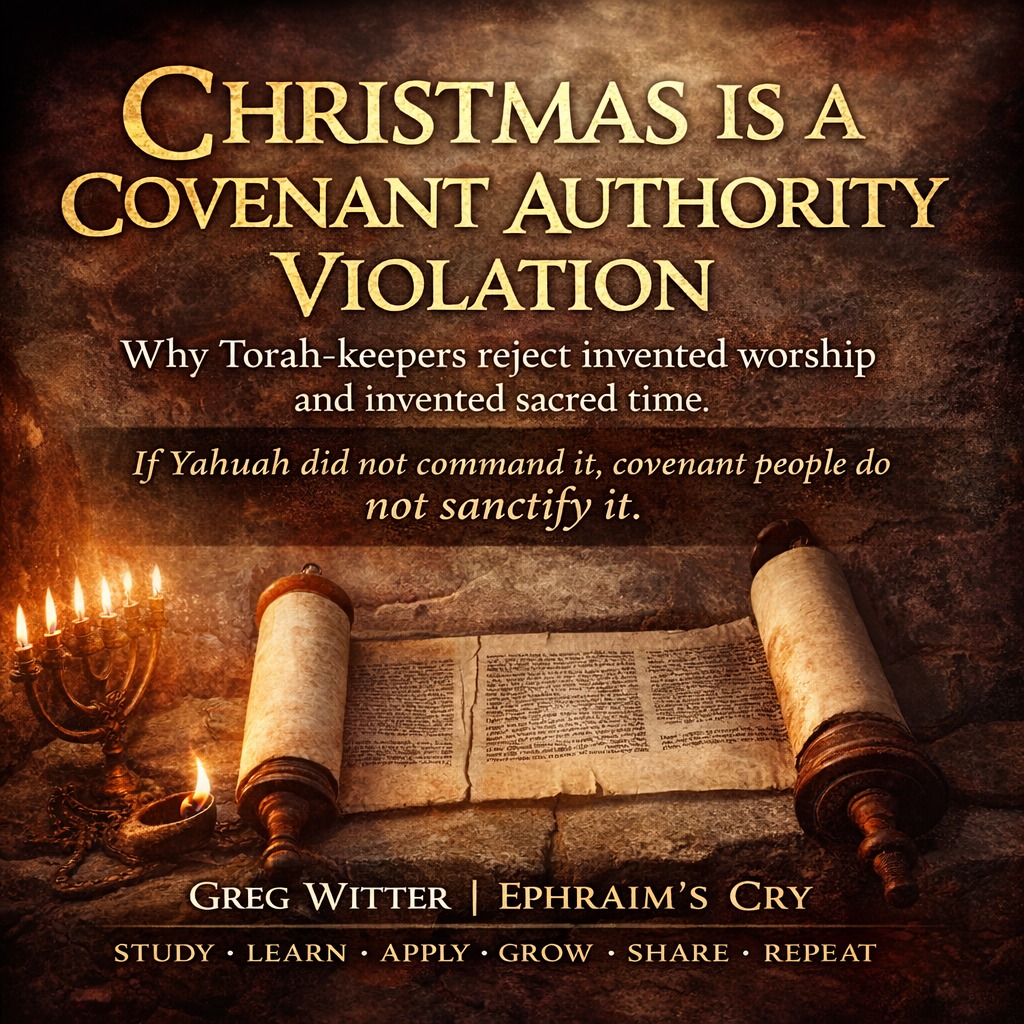
CHRISTMAS IS A COVENANT AUTHORITY VIOLATION
Why Torah-keepers reject invented worship and invented sacred time
If Yahuah did not command it, covenant people do not sanctify it.
Greg Witter | Ephraim’s Cry
Hebraic Mindset Study Series
Study • Learn • Apply • Grow • Share • Repeat
This is not about emotion, nostalgia, preference, or sentiment. This is about covenant authority. The central question is simple and unavoidable: Who has the right to establish worship and sacred time—Yahuah, or man?
Torah does not treat worship as a creative exercise. Sacred time is not something the people of Elohim invent, adapt, or sanctify through intention. Covenant worship is regulated because covenant itself is regulated. When man introduces worship that Yahuah did not command, assigns holiness to it, and then demands divine approval, that is not devotion—it is rebellion clothed in sincerity.
“Whatever I command you, be careful to do it; you shall not add to it nor take away from it.” (Deuteronomy 12:32)
This command is directed at covenant people, not pagans. It establishes a boundary: nothing is added to the worship of Yahuah—no days, no seasons, no rituals, no celebrations—unless He commands them. Worship does not grow by tradition. Sacred time does not expand by culture.
Christmas fails immediately at this first covenant test. Scripture never commands it. Scripture never institutes it. Scripture never establishes a birth date for the Messiah, nor does it instruct the people of Yahuah to commemorate His birth annually. That absence is not accidental—it is deliberate.
When someone says, “But I do it for Messiah,” Torah answers clearly: intention does not create authority. Obedience is measured by command, not by sincerity.
The second covenant boundary is just as explicit.
“Take heed to yourself that you are not ensnared to follow them… and that you do not inquire after their mighty ones, saying, ‘How did these nations serve their mighty ones? I also will do likewise.’ You shall not worship Yahuah your Elohim in that way.” (Deuteronomy 12:30–31)
This passage destroys the idea that pagan practices can be redeemed through rebranding. Torah does not allow covenant people to adopt the worship methods of the nations and simply change the name attached to them. The method matters. The form matters. The structure matters.
The nations have their sacred seasons. Yahuah has His. They are not merged. They are not blended. They are not baptized and reused. Covenant faithfulness requires separation.
The golden calf stands as the eternal warning. Israel did not reject Yahuah when they built it. Aaron declared, “Tomorrow is a feast to Yahuah.” (Exodus 32:5) They attached Yahuah’s Name to a forbidden form of worship—and Yahuah called it corruption.
That pattern has never changed. Borrowed worship forms do not become holy because the Name of Yahuah is spoken over them.
Christmas functions as an invented sacred season. It establishes a calendar authority outside Torah. It comes with its own rituals, symbols, household practices, music, foods, and social expectations. That is not neutral tradition. That is a competing worship system.
Yahuah already gave His calendar: the Sabbath and His appointed times. (Leviticus 23) When man creates another sacred season and trains people to treat it as holy, that is calendar replacement—and Torah does not permit it.
Covenant people do not reject the Messiah’s birth. We reject unauthorized worship.
We do not deny that He was born. We deny that man has authority to create holy days.
We do not reject reverence. We reject syncretism.
Obedience is not optional.
Tradition does not outrank command.
And worship belongs to Yahuah alone.
#HebraicMindset,#TorahTruth,#CovenantFaith,#BiblicalAuthority,#SeparateAndHoly,
#AppointedTimes,#NotAddingToTorah,#TrueWorship,#EphraimsCry,#GregWitter
