
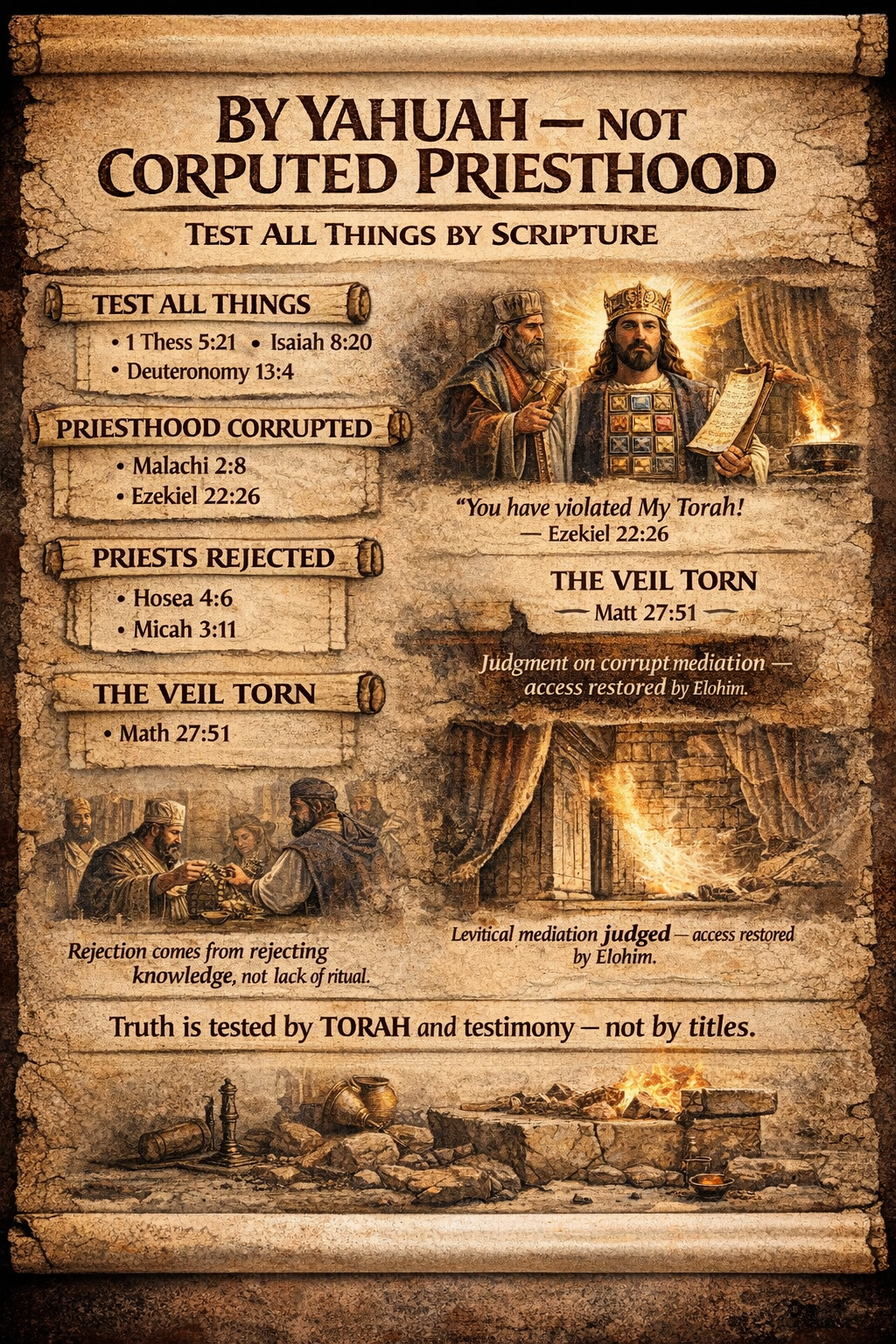
BY YAHUAH — NOT CORRUPTED PRIESTHOOD
Seek & Reprove All Things by Scripture
Testing authority, exposing corruption, and returning to covenant fidelity
Greg Witter | Ephraim’s Cry
Hebraic Mindset Study Series
Study Learn Apply Grow Share Repeat
Orientation
This teaching is not an attack on individuals. It is a covenant diagnostic against a recurring pattern: when men claim spiritual authority while departing from Torah, the result is always the same—confusion, contamination, and oppression of the people (Malachi 2:8; Ezekiel 22:26; Hosea 4:6). Yahuah has never asked His people to submit their conscience to titles, institutions, or religious systems. He has required covenant loyalty, tested truth, and obedience from the heart (Deuteronomy 13:1–4; Isaiah 8:20; 1 Thessalonians 5:21).
This is why the watchman mandate is unavoidable: truth must be proven, error must be exposed, and all claims must be measured by the written standard (Ezekiel 33:7–9; Isaiah 8:20). The goal is not argument. The goal is purification—so the people of Elohim can walk cleanly, without being manipulated by corrupted leadership or lawless religion (Revelation 12:17; Revelation 14:12; 1 John 2:3–6).
The Covenant Standard
Before we can expose corruption, we must recover the standard by which corruption is measured. Scripture does not permit vague discernment or “I feel led” spirituality as the final authority. Yahuah establishes objective covenant boundaries: Torah and testimony. When a teaching, system, or leader deviates, Scripture does not call that “a different expression.” It calls it lawlessness and deception (Deuteronomy 13:1–4; Isaiah 8:20; Matthew 7:21–23).
Yahuah’s covenant has always operated the same way:
Yahuah speaks (His Word establishes reality) (Genesis 1:3; Deuteronomy 30:14).
Yahuah commands (Torah defines righteousness and sin) (Deuteronomy 6:1–9; Psalm 19:7–11).
Yahuah requires obedience (not perfectionism, but faithful walking with repentance) (Deuteronomy 30:1–3; Psalm 119:1–8).
Yahuah judges corruption (especially in leadership) (Malachi 2:1–9; Ezekiel 34:1–10).
Yahuah restores His people through covenant renewal (Jeremiah 31:31–33; Ezekiel 36:26–27).
This is why the core command remains: test everything.
TEST ALL THINGS
1 Thessalonians 5:21; Isaiah 8:20; Deuteronomy 13:4
The covenant people are not permitted to outsource discernment. Scripture never teaches “trust the experts” as a spiritual rule. It teaches the opposite: every message must be tested, and every claim must be weighed against the standard Yahuah already gave.
1) “Test all things; hold fast what is good.”
Paul’s command is not optional (1 Thessalonians 5:21). Testing implies a measurable standard. If the standard is the emotions of the crowd, the charisma of a teacher, institutional credentials, or denominational tradition, then the “test” is already corrupted. Paul’s instruction assumes the assembly has a fixed reference point: the prior revelation of Elohim, the covenant Scriptures (Acts 17:11; Romans 3:31).
Testing also assumes that some things will fail the test. A community that “tests” but never rejects anything is not discerning—it is tolerant of error. And tolerance of error is how deception is normalized over time (2 Timothy 4:3–4).
2) “To the Torah and to the testimony.”
Isaiah is blunt: if a teaching does not speak according to this Word, there is no light in it (Isaiah 8:20). That means we do not begin with modern theology, and we do not begin with church creeds. We begin with Torah and the covenant witness of Scripture—Torah, Prophets, Writings, and the Apostolic witness in alignment with them (Luke 24:44; Matthew 5:17–19).
This standard does not flatter anyone. It judges everyone—teachers, traditions, systems, and listeners (Ecclesiastes 12:13–14). It removes plausible deniability. It also protects the flock, because wolves rely on ambiguity, not clarity (Acts 20:29–31).
3) Deuteronomy 13: the test is obedience, not supernatural display
Deuteronomy 13 is one of the most hated passages in modern religion because it destroys the “signs and wonders prove truth” lie. Yahuah warns that even if a sign appears to come to pass, if the message leads you away from obedience, it is a test and the messenger is false (Deuteronomy 13:1–4). The covenant test is not “did something supernatural happen?” The covenant test is: does this message lead to faithfulness to Yahuah’s commandments and covenant loyalty?
This exposes a primary end-times deception: religious power without covenant obedience (Matthew 7:21–23; Revelation 13:13–14). That is why testing is not optional; it is survival.
PRIESTHOOD CORRUPTED
Malachi 2:8; Ezekiel 22:26
The graphic’s next movement is not “leaders are imperfect.” That is obvious. The movement is covenant accusation: when priesthood becomes corrupt, it does not simply “miss the mark.” It actively damages the people by redefining righteousness and removing the fear of Elohim.
1) Malachi: “You have caused many to stumble at the Torah.”
Yahuah does not treat corrupt teaching as a minor issue. He holds teachers accountable because they shape what the people believe is permissible (Malachi 2:8–9). When priests and instructors deviate from Torah, the consequences are predictable:
instruction becomes partial
the people stumble
covenant identity dissolves
worship becomes ritual without obedience (Isaiah 1:11–17; Amos 5:21–24)
Malachi’s rebuke also exposes a modern tactic: leaders often retain spiritual language while subtracting covenant substance. They speak of “love,” “grace,” “freedom,” and “Spirit,” but they detach those words from obedience. Scripture never allows that divorce. Love is defined as keeping commandments (1 John 5:3). Faith is demonstrated through obedience (James 2:17–22). The Spirit leads into truth, not away from Torah (John 14:26; Ezekiel 36:27).
2) Ezekiel: “They have violated My Torah.”
Ezekiel’s charge is not ambiguous (Ezekiel 22:26). The corruption is specifically Torah violation. The nature of the violation is also defined:
no distinction between set-apart and common (Leviticus 10:10; Ezekiel 22:26)
no distinction between clean and unclean (Leviticus 11; Ezekiel 22:26)
hiding their eyes from the Sabbaths (Exodus 31:13–17; Ezekiel 22:26)
This matters because it shows the pattern: corrupted priesthood doesn’t just commit private sins. It re-labels what Yahuah called holy, and it trains the people to treat it as optional. That is how covenant collapse happens at scale (Judges 2:10–13).
The modern equivalent is any system that reframes obedience as legalism, calls Torah “bondage,” and presents disobedience as spiritual maturity. Scripture calls that darkness (Isaiah 5:20; Isaiah 8:20).
PRIESTS REJECTED
Hosea 4:6; Micah 3:11
This section is the consequence: when leadership refuses Torah, Yahuah does not merely “disagree.” He rejects them. Not because He is harsh, but because leadership is a covenant gate. When the gate is corrupt, the people are destroyed.
1) Hosea: “My people are destroyed for lack of knowledge.”
Hosea 4:6 is often quoted as if it means “people need more information.” That is not what it means. Hosea says the knowledge was rejected. The issue is willful refusal of Torah instruction, resulting in covenant amnesia (Hosea 4:6). When Torah is rejected:
sin is redefined
repentance becomes emotional rather than obedient (Joel 2:12–13; Proverbs 28:13)
worship becomes performance rather than submission (Isaiah 29:13)
the people are destroyed—not because Yahuah is weak, but because they have cut themselves off from the source of life (Deuteronomy 30:15–20)
The truth is severe: rejecting Torah is not “a different theological emphasis.” It is a self-inflicted famine (Amos 8:11–12).
2) Micah: leadership that teaches for pay and divines for money
Micah exposes religious commerce, spiritual bribery, and leadership that uses Elohim’s name while operating in corruption (Micah 3:11). The defining mark is hypocrisy: they claim Yahuah is among them while they pervert justice and truth.
This is not just ancient history. Any system that monetizes truth, sells comfort, and uses religious authority to keep people dependent is walking in the same spirit. Yahuah’s people are not livestock for a religious economy. They are His inheritance (Deuteronomy 32:9; 1 Peter 2:9).
THE VEIL TORN
Matthew 27:51
This part must be handled carefully because it is often used to push lawlessness. The veil tearing is not “Torah ended.” It is a judicial sign that corrupted mediation has been judged, and access has been opened by the work of Yahusha. Access is restored; covenant obedience is not abolished.
1) The veil tearing is a sign of judgment on a corrupted system
The veil separated the Most Set-Apart place. Its tearing at Yahusha’s death is not presented as a random miracle; it is a prophetic sign (Matthew 27:51). Throughout Scripture, when Yahuah tears, rends, or exposes, it signals judgment and transition (Joel 2:13). The old system had become corrupted by hypocrisy and lawlessness, and judgment was coming upon that house (Matthew 23:37–38).
The tearing says: man cannot control access to Yahuah. That destroys the gatekeeper model—where men position themselves as necessary spiritual brokers.
2) Access is restored through Yahusha, not through human mediation
Scripture is clear that access comes through Yahusha’s priestly work (Hebrews 4:14–16; Hebrews 10:19–22). This does not erase Torah; it restores approach. It means the covenant people are not locked out by corrupt leadership. It means the repentant can draw near with a clean conscience because atonement has been secured (Leviticus 17:11; Isaiah 53:5–6).
But here is the key: restored access does not equal lawless living. Yahusha did not die to create rebels. He died to cleanse and produce an obedient people (Titus 2:11–14). The covenant goal remains holiness (Leviticus 19:2; 1 Peter 1:15–16).
3) The veil tearing does not cancel Yahuah’s commandments
The claim “the veil tore so commandments ended” is a lie. Scripture teaches the opposite:
Yahusha upheld Torah and warned against breaking even least commandments (Matthew 5:17–19).
Paul said faith does not void Torah but establishes it (Romans 3:31).
The renewed covenant promise is Torah written on hearts, not deleted from existence (Jeremiah 31:33; Ezekiel 36:27).
The end-times remnant is defined by commandments + testimony of Yahusha (Revelation 12:17; Revelation 14:12).
So what did the veil tearing do? It judged corrupted mediation and restored access. It did not authorize lawlessness.
The Watchman Conclusion
This teaching is a covenant warning because corruption always follows the same cycle:
Truth is no longer tested by Torah and testimony (Isaiah 8:20).
Leadership deviates and causes many to stumble (Malachi 2:8).
Knowledge is rejected and the people are destroyed (Hosea 4:6).
Religious systems become markets and power structures (Micah 3:11).
Yahuah brings judgment, tears the veil, and restores access through His provision (Matthew 27:51; Hebrews 4:14–16).
The people are called back—not into independence, but into covenant obedience with clean access (Jeremiah 31:33; Ezekiel 36:27).
If you want the simplest diagnostic that cannot be twisted, it is this:
Does the message produce obedience to Yahuah and conformity to the walk of Yahusha, or does it produce excuses for sin?
Scripture makes the line plain:
Love is keeping commandments (1 John 5:3).
Claiming to know Him while refusing commandments is lying (1 John 2:4).
Remaining in Him requires walking as He walked (1 John 2:6).
Lawlessness is condemned, even when wrapped in religious language (Matthew 7:21–23).
So the call is not to become anti-leadership or anti-structure. The call is to reject corrupted priesthood, reject gatekeepers, and return to covenant fidelity under the authority of Yahuah—with access restored through Yahusha, and truth tested by Torah and testimony.
That is what “By Yahuah, not corrupted priesthood” means.
#EphraimsCry #GregWitter #HebraicMindset #HebraicMindsetStudySeries #Covenant #Torah #TorahTruth #TorahKeeper #TestAllThings #Isaiah820 #FirstThessalonians521 #Deuteronomy13 #Malachi2 #Ezekiel22 #Hosea4 #Micah3 #VeilTorn #Matthew2751 #RenewedCovenant #Jeremiah31 #Ezekiel36 #Obedience #WalkAsHeWalked #Revelation1217
