
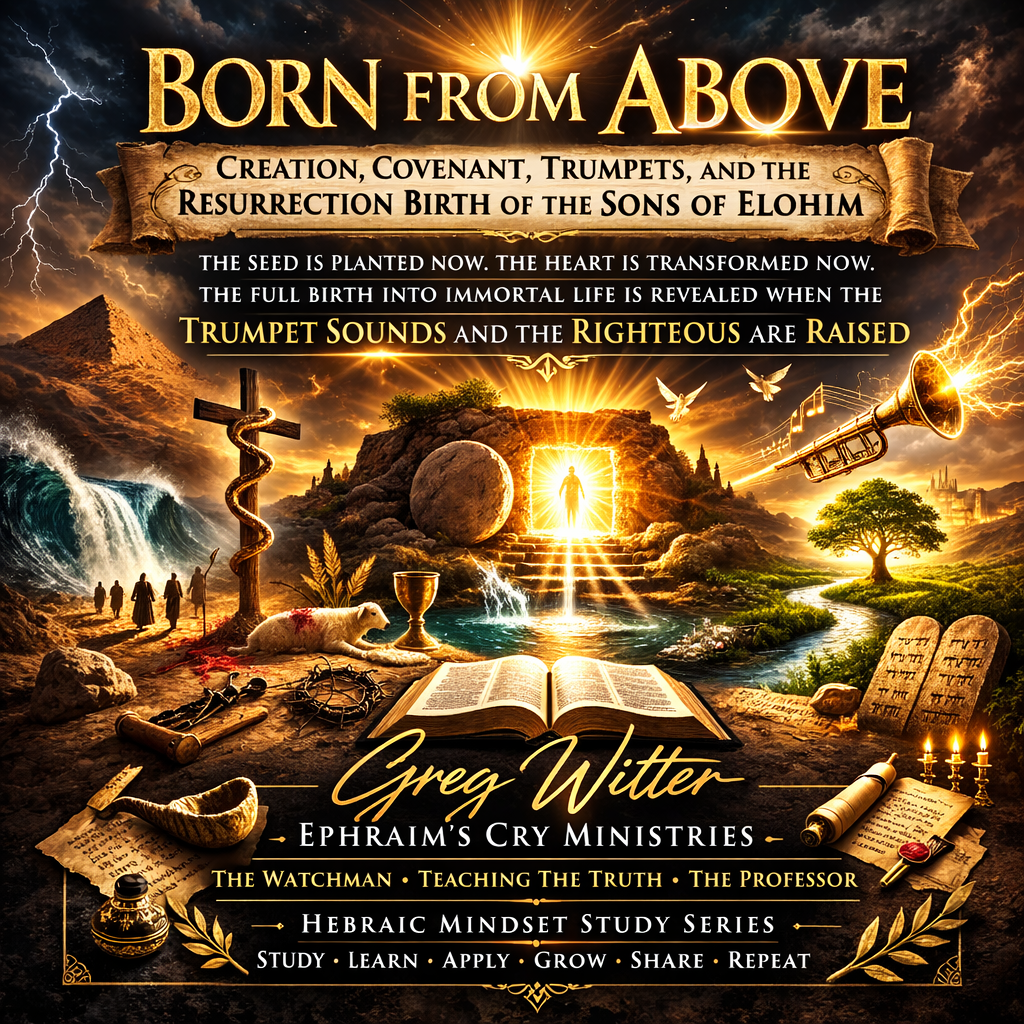
BORN FROM ABOVE
Creation, Covenant, Trumpets, and the Resurrection Birth of the Sons of Elohim
The seed is planted now. The heart is transformed now. The full birth into immortal life is revealed when the trumpet sounds and the righteous are raised.
Greg Witter | Ephraim’s Cry
Hebraic Mindset Study Series
Study Learn Apply Grow Share Repeat
SECTION 1 — THE PROBLEM: “BORN AGAIN” HAS BEEN SHRUNK, COMMERCIALIZED, AND WEAPONIZED
Most people hear the phrase “born again” and immediately think in modern religious categories: altar calls, emotional moments, a one-time prayer, a denominational label, or a badge of identity. That is not how Scripture frames the issue. And if we keep forcing John 3 into churchianity categories, we will keep producing churchianity outcomes: people claiming rebirth while rejecting covenant obedience, people talking about the Kingdom while refusing the King’s constitution, and people claiming the Spirit while resisting the Spirit’s stated purpose.
This is not a minor doctrine. John 3 does not give you an optional religious experience. It gives you a non-negotiable Kingdom requirement. Yahusha does not say “unless you join the right group.” He does not say “unless you repeat the right prayer.” He does not say “unless you have the right emotional moment.” He says something far more absolute.
“Truly, truly I say to you, unless one is born from above, he cannot see the Kingdom of Elohim.” (John 3:3)
That means the Kingdom is not accessed by lineage, intellect, religious status, or tradition. It is accessed by a work of Elohim that comes from above. The Kingdom is not a human achievement. It is a heavenly birthright granted through a heavenly act.
And here is the part that should sober every hearer: Yahusha says this to Nicodemus — not to a pagan, not to an idolater, not to a man who had never opened Scripture. He says it to a leader in Israel.
“There was a man of the Pharisees named Nicodemus, a ruler of the Jews. This man came to Yahusha by night…” (John 3:1–2)
Nicodemus was trained. He was educated. He was respected. He was a teacher of Israel (John 3:10). If anyone should have recognized the patterns Yahusha was speaking in, it was him. Yet Nicodemus is confused, not because Yahusha is using Greek philosophy, but because Yahusha is exposing the difference between knowing the text and being remade by the power behind the text.
Nicodemus approaches Yahusha with a recognition of signs.
“Rabbi, we know that you are a teacher come from Elohim, for no one can do these signs that you do unless Elohim is with him.” (John 3:2)
But Yahusha does not let the conversation stay at the level of signs. He immediately drives to the root: the Kingdom is not entered through observation of miracles; it is entered through birth from above (John 3:3). That is why this passage is so threatening to religious systems. Systems can control information. Systems can control membership. Systems can control rituals. But systems cannot manufacture birth from above. Only Elohim can do that.
So we need to define the subject plainly, biblically, and covenantally.
What is “born from above” according to Scripture?
“Born from above” is the work of Elohim by His Spirit, through His Word, to produce a new creation life in a person that results in covenant loyalty, obedience, and transformation — and that culminates in the resurrection when the body itself is redeemed and immortality replaces mortality.
That is the full biblical arc. If you cut it in half, you will end up with a doctrine that sounds spiritual but has no covenant weight.
And this is where the battle begins, because many want the benefits of new life without the governance of covenant. Many want the promise of the Kingdom without the submission required of citizens of that Kingdom. But Yahusha does not allow that separation. In John 3, He draws an unbreakable connection between Spirit-born life and Kingdom entrance.
SECTION 2 — WHAT YAHUSHA ACTUALLY SAID: BIRTH THAT ORIGINATES “FROM ABOVE”
When Yahusha says “born again,” the language is not a modern slogan. John records His statement using the Greek phrase gennēthē anōthen (John 3:3). The key word is anōthen, meaning “from above,” “from the top,” “from a higher origin.” The point is origin. This is not merely “do-over” language; it is “source” language. This birth comes from Elohim, not from man.
Nicodemus hears it in a purely biological frame and responds with a biological question:
“How can a man be born when he is old? Can he enter a second time into his mother’s womb and be born?” (John 3:4)
Yahusha answers by introducing two necessary elements and then dividing two categories.
“Unless one is born of water and the Spirit, he cannot enter the Kingdom of Elohim.” (John 3:5)
“That which is born of the flesh is flesh, and that which is born of the Spirit is spirit.” (John 3:6)
That is a hard boundary. Flesh produces flesh. Earthly life reproduces earthly life. A man can study Torah, memorize commandments, quote prophets, and still remain operating only in flesh. That is why knowledge alone is not enough. If knowledge alone could birth Kingdom life, the Pharisees would have been the holiest people on earth. But Yahusha repeatedly exposes that they had the words on their lips while rejecting the Author in their hearts (Matthew 15:7–9; John 5:39–40).
This is why Yahusha intensifies the point:
“Do not marvel that I said to you, ‘You must be born from above.’” (John 3:7)
Then He gives a living illustration.
“The wind blows where it wishes, and you hear its sound, but you do not know where it comes from or where it goes. So it is with everyone who is born of the Spirit.” (John 3:8)
The point is not mystery for the sake of mystery. The point is sovereignty. The wind cannot be controlled by men. It can be recognized by its effects, but it does not submit to human systems. So it is with the Spirit of Elohim. Religious systems can try to define Him, manage Him, schedule Him, and market Him, but the Spirit moves according to Elohim’s will, and the evidence is not hype — it is transformation.
At this point Nicodemus says the honest thing:
“How can these things be?” (John 3:9)
And Yahusha answers with an indictment that should make every teacher tremble:
“Are you the teacher of Israel and yet you do not understand these things?” (John 3:10)
That statement tells you the entire discussion is grounded in Hebrew Scripture. Yahusha is not inventing something foreign. He is calling Nicodemus back to what the Torah and the Prophets already established.
And that takes us to the first major foundation: creation.
SECTION 3 — CREATION LANGUAGE: DUST, BREATH, WATER, AND SPIRIT
If Nicodemus should have understood, then the pattern must be present in the beginning. And it is.
The creation of man is not merely an origin story. It is a template.
“Then Yahuah Elohim formed the man from the dust of the ground and breathed into his nostrils the breath of life, and the man became a living being.” (Genesis 2:7)
Two elements appear immediately:
Dust: earthly formation, physical structure, flesh (Genesis 2:7)
Breath: life from Elohim, the animating force that makes the man alive (Genesis 2:7)
Scripture reinforces this breath-life connection repeatedly.
“The Spirit of Elohim has made me, and the breath of the Almighty gives me life.” (Job 33:4)
“When You take away their breath, they die and return to their dust. When You send forth Your Spirit, they are created…” (Psalm 104:29–30)
This is why Yahusha divides flesh and Spirit in John 3:6. Genesis already built the categories. Dust produces dust. Flesh produces flesh. But life that is truly alive is animated by what comes from Elohim.
Now add the other creation layer Yahusha alludes to: water and Spirit.
“The earth was without form and void… and the Spirit of Elohim was hovering over the face of the waters.” (Genesis 1:2)
Water is present. The Spirit is present. Elohim speaks. Creation comes into ordered life (Genesis 1:3–31). This means “water and Spirit” is not new imagery. It is creation imagery. Yahusha is teaching Nicodemus that entering the Kingdom is not merely joining a movement; it is participation in a new creation work.
John’s Gospel itself signals this from the opening line:
“In the beginning was the Word…” (John 1:1)
John is announcing that what Yahusha is doing is not merely repairing religion. It is bringing about new creation life by the Word of Elohim.
John then says this explicitly:
“To all who received Him… He gave the right to become children of Elohim, who were born, not of blood nor of the will of the flesh nor of the will of man, but of Elohim.” (John 1:12–13)
Not of blood: lineage cannot produce it.
Not of the will of the flesh: human effort cannot produce it.
Not of the will of man: institutional authority cannot produce it.
But of Elohim: only Elohim can produce it.
So the conversation with Nicodemus is anchored in Genesis. Yahusha is speaking creation language because He is announcing a creation-level work.
But here is the key: the prophets also spoke this way. They described the coming covenant renewal as cleansing water, new heart, new spirit, and Spirit-empowered obedience. This is not churchianity language. This is covenant constitutional language.
SECTION 4 — PROPHETIC COVENANT RENEWAL: CLEAN WATER, NEW HEART, SPIRIT-EMPOWERED OBEDIENCE
Yahusha says “born of water and the Spirit” (John 3:5). That is not a random phrase. It is covenant promise language.
“I will sprinkle clean water on you, and you shall be clean… I will give you a new heart, and a new spirit I will put within you… I will put My Spirit within you and cause you to walk in My statutes and be careful to obey My rules.” (Ezekiel 36:25–27)
This passage is one of the most devastating refutations of lawless religion in the entire Bible. The Spirit is not given to cancel statutes. The Spirit is given to cause obedience to statutes (Ezekiel 36:27). That means anyone claiming the Spirit while rejecting obedience is either deceived or lying. There is no third option.
Jeremiah confirms the same promise, using Torah language.
“I will put My Torah within them, and I will write it on their hearts.” (Jeremiah 31:33)
Notice what is written.
Not a new set of man-made principles.
Not a substitute constitution.
Torah.
And Torah is not written on the heart so it can be ignored. It is written on the heart so it can be lived.
This covenant internalization is not new. David understood the necessity long before Jeremiah.
“Create in me a clean heart, O Elohim, and renew a right spirit within me.” (Psalm 51:10)
David is not asking for religious status. He is asking for interior transformation. That is rebirth language in covenant form.
So now we have a solid, text-first definition:
Being “born from above” includes:
cleansing (Ezekiel 36:25)
a new heart (Ezekiel 36:26)
a new spirit (Ezekiel 36:26)
the Spirit within (Ezekiel 36:27)
Torah written internally (Jeremiah 31:33)
Spirit-caused obedience (Ezekiel 36:27)
a life that reflects the reality of covenant (Psalm 51:10; 1 John 2:3–4)
Now, the next question is unavoidable, and it is where your original point must be restored and held firmly:
If this is “birth from above,” when does the full birth actually occur?
Is it merely an inward beginning now, or is it completed at the resurrection?
Scripture answers: both—beginning now, completed at resurrection. And it uses a consistent set of metaphors to prove it: seed, firstfruits, childbirth, and the trumpet.
SECTION 5 — THE EXODUS: ISRAEL’S NATIONAL BIRTH PATTERN
If Nicodemus had gone back to Genesis and the prophets, he would have seen the pattern. But there is another place the same pattern appears with great clarity: the Exodus story.
The Exodus is not merely a historical rescue. It is the birth narrative of a nation.
Elohim Himself says this directly.
“Then you shall say to Pharaoh, ‘Thus says Yahuah, Israel is My son, My firstborn.’”
(Exodus 4:22)
The Exodus is the moment when Elohim brings His son out of bondage and into covenant identity.
The steps of that process matter because they establish a prophetic template.
Israel is first redeemed by blood.
“Your lamb shall be without blemish… and you shall take some of the blood and put it on the two doorposts and the lintel.”
(Exodus 12:5–7)
Then comes the declaration that defines Passover.
“When I see the blood, I will pass over you, and no plague will befall you to destroy you.”
(Exodus 12:13)
Passover is deliverance from death through the blood of the lamb.
But redemption by blood was not the end of the process.
After Passover came the crossing of the sea.
“Moses stretched out his hand over the sea… and the waters were divided.”
(Exodus 14:21)
The people walked through the sea as the waters stood on either side.
Israel passed through water.
Paul later interprets this moment using spiritual language.
“Our fathers were all under the cloud, and all passed through the sea, and all were baptized into Moses in the cloud and in the sea.”
(1 Corinthians 10:1–2)
Notice the two elements again:
• water — the sea
• Spirit — the cloud
The cloud represented the presence of Elohim leading Israel.
“And Yahuah went before them by day in a pillar of cloud to lead them along the way.”
(Exodus 13:21)
Water and Spirit appear together again.
This is the same language Yahusha uses in John 3.
The Exodus becomes a national birth story.
Egypt represents bondage.
Passover represents redemption.
The sea represents transition.
The wilderness represents transformation.
The promised land represents inheritance.
The entire journey mirrors the spiritual journey Yahusha is describing to Nicodemus.
SECTION 6 — THE LAW OF THE FIRSTBORN: OPENING THE WOMB
Immediately after the Exodus, Elohim gives a command that seems ceremonial at first glance but is deeply prophetic.
“Consecrate to Me all the firstborn. Whatever is the first to open the womb among the people of Israel… is Mine.”
(Exodus 13:2)
The phrase “open the womb” becomes extremely important.
The firstborn belongs to Elohim because it represents the beginning of life emerging from the womb.
This command ties directly to the Passover event.
“For every firstborn is Mine. On the day that I struck down all the firstborn in the land of Egypt, I consecrated for My own all the firstborn in Israel.”
(Numbers 3:13)
The firstborn were redeemed by blood.
The pattern is clear:
• blood protects the firstborn
• the firstborn belongs to Elohim
• the firstborn represents the beginning of life
This pattern becomes prophetic when applied to Messiah.
Messiah is repeatedly described as the firstborn.
“He is the beginning, the firstborn from the dead.”
(Colossians 1:18)
This wording matters.
Messiah is not called firstborn from Bethlehem.
He is called firstborn from the dead.
The resurrection is the moment when the new creation family begins to emerge.
Paul confirms this again.
“For those whom He foreknew He also predestined to be conformed to the image of His Son, that He might be the firstborn among many brothers.”
(Romans 8:29)
Messiah is the firstborn.
The rest of the family follows.
SECTION 7 — THE BRONZE SERPENT AND THE PASSOVER CONNECTION
In the middle of His conversation with Nicodemus, Yahusha suddenly brings up an event from the wilderness.
“As Moses lifted up the serpent in the wilderness, so must the Son of Man be lifted up.”
(John 3:14)
This refers to an event recorded in Numbers.
“So Moses made a bronze serpent and set it on a pole. And if a serpent bit anyone, he would look at the bronze serpent and live.”
(Numbers 21:9)
The people were dying because of rebellion.
The cure was not complicated.
Look.
Trust.
Live.
The bronze serpent was lifted up so that those who believed would live.
Yahusha applies this image directly to Himself.
The Son of Man would also be lifted up.
The lifting up refers to the crucifixion.
And the crucifixion occurs during the Passover season.
John makes this clear.
“Now it was the day of Preparation of the Passover.”
(John 19:14)
Passover again becomes the starting point of deliverance from death.
Paul confirms the connection.
“For Messiah, our Passover lamb, has been sacrificed.”
(1 Corinthians 5:7)
The bronze serpent shows that salvation comes through looking in faith to the One lifted up.
Passover shows that deliverance from death comes through the blood of the lamb.
Both point directly to the cross.
But the cross is not the final step.
The cross begins the process that leads to resurrection life.
SECTION 8 — SEED, FIRSTFRUITS, AND THE HARVEST OF RESURRECTION
Scripture repeatedly describes the work of Elohim using agricultural imagery.
Seed must be planted before harvest can occur.
Peter describes the beginning of spiritual life this way.
“You have been born again, not of perishable seed but of imperishable, through the living and abiding word of Elohim.”
(1 Peter 1:23)
James uses similar language.
“Of His own will He brought us forth by the word of truth.”
(James 1:18)
The Word plants the seed.
The Spirit nurtures the life.
But the harvest is still coming.
Paul explains the order clearly.
“But in fact Messiah has been raised from the dead, the firstfruits of those who have fallen asleep.”
(1 Corinthians 15:20)
Firstfruits is a harvest term.
It means the first portion of the crop has appeared, but the full harvest has not yet arrived.
Paul then gives the sequence.
“Each in his own order: Messiah the firstfruits, then at His coming those who belong to Messiah.”
(1 Corinthians 15:23)
Messiah rises first.
The rest of the resurrection family rises later.
SECTION 9 — CREATION GROANING FOR BIRTH
Paul then introduces another powerful image: childbirth.
“For the creation waits with eager longing for the revealing of the sons of Elohim.”
(Romans 8:19)
Creation is waiting.
Waiting for what?
The revealing of the sons of Elohim.
That revealing has not yet happened.
Paul explains why.
“For we know that the whole creation has been groaning together in the pains of childbirth until now.”
(Romans 8:22)
Creation itself is described as a mother in labor.
Birth pains mean something new is about to emerge.
But Paul adds that believers are waiting too.
“We ourselves… groan inwardly as we wait eagerly for adoption as sons, the redemption of our body.”
(Romans 8:23)
Notice the phrase carefully.
Redemption of our body.
That is resurrection language.
SECTION 10 — THE RESURRECTION BODY
Paul describes the transformation in detail.
“What is sown is perishable; what is raised is imperishable.”
(1 Corinthians 15:42)
“It is sown a natural body; it is raised a spiritual body.”
(1 Corinthians 15:44)
Mortality is replaced with immortality.
Paul concludes the explanation with a declaration.
“The dead will be raised imperishable, and we shall be changed.”
(1 Corinthians 15:52)
That moment is the full transformation.
SECTION 11 — THE TRUMPET OF RESURRECTION
Scripture consistently connects resurrection with a trumpet.
“For the Master Himself will descend from heaven… with the sound of the trumpet of Elohim.”
(1 Thessalonians 4:16)
Paul describes the same event.
“In a moment, in the twinkling of an eye, at the last trumpet.”
(1 Corinthians 15:52)
Yahusha describes it as well.
“He will send out His angels with a loud trumpet call, and they will gather His elect.”
(Matthew 24:31)
The prophets also saw this day.
“In that day a great trumpet will be blown.”
(Isaiah 27:13)
Trumpets announce:
• gathering
• kingship
• resurrection
The trumpet announces the birth of the resurrection family.
Messiah the firstborn.
Then the many brothers.
SECTION 12 — THE FEASTS OF YAHUAH: THE PROPHETIC CALENDAR OF REDEMPTION
One of the most overlooked frameworks in understanding resurrection and new creation is the calendar of Yahuah Himself. The appointed times recorded in Leviticus are not merely memorials. They are prophetic rehearsals that reveal the unfolding pattern of redemption.
“These are the appointed feasts of Yahuah, the holy convocations which you shall proclaim at their appointed times.”
(Leviticus 23:4)
The Hebrew word translated appointed times is moedim, meaning appointed meeting times or divine appointments. These feasts outline the stages of Elohim’s redemptive plan from sacrifice to resurrection to the final dwelling of Elohim with His people.
The spring feasts correspond with the first coming of Messiah, while the fall feasts correspond with the culmination of redemption and the restoration of the Kingdom.
The order matters.
• Passover — redemption through the blood of the lamb
• Unleavened Bread — removal of sin and burial
• Firstfruits — resurrection of Messiah
• Shavuot (Pentecost) — outpouring of the Spirit
• Trumpets — resurrection and gathering
• Day of Atonement — judgment and national repentance
• Tabernacles — Elohim dwelling with His people
Passover establishes the foundation.
“Messiah, our Passover lamb, has been sacrificed.”
(1 Corinthians 5:7)
Unleavened Bread follows immediately after Passover and represents the removal of corruption.
“You are unleavened… therefore let us keep the feast.”
(1 Corinthians 5:7–8)
Then comes Firstfruits.
“Messiah has been raised from the dead, the firstfruits of those who have fallen asleep.”
(1 Corinthians 15:20)
Firstfruits is the beginning of the harvest. It guarantees that more harvest is coming.
After the resurrection of Messiah came Shavuot.
“When the day of Pentecost arrived, they were all together in one place.”
(Acts 2:1)
The Spirit was poured out, empowering the covenant people.
But the calendar does not stop with Shavuot.
The next appointed time on the calendar is the Feast of Trumpets.
SECTION 13 — THE FEAST OF TRUMPETS AND THE RESURRECTION
The Feast of Trumpets is introduced in Leviticus.
“In the seventh month, on the first day of the month, you shall observe a day of solemn rest, a memorial proclaimed with blast of trumpets.”
(Leviticus 23:24)
The Hebrew word used here is zikaron teruah, meaning a memorial of shouting or trumpet blasts.
Trumpets in Scripture consistently announce critical divine events.
They signal:
• the arrival of a king
• the gathering of a people
• the call to war
• the appearance of Elohim
• the resurrection
The prophets connect trumpets with the Day of Yahuah.
“Blow a trumpet in Zion; sound an alarm on My holy mountain!”
(Joel 2:1)
Isaiah connects the trumpet with the gathering of the dispersed people of Elohim.
“In that day a great trumpet will be blown, and those who were lost… will come and worship Yahuah.”
(Isaiah 27:13)
The apostles connect the trumpet with resurrection.
“For the Master Himself will descend from heaven… and with the trumpet of Elohim.”
(1 Thessalonians 4:16)
Paul says the same thing.
“At the last trumpet… the dead will be raised imperishable.”
(1 Corinthians 15:52)
The trumpet is not symbolic noise. It is the divine announcement that the resurrection has begun.
Messiah was the firstfruits.
The trumpet announces the rest of the harvest.
SECTION 14 — THE DAY OF YAHUAH AND THE REVEALING OF THE SONS OF ELOHIM
The prophets describe the coming Day of Yahuah as the moment when Elohim intervenes in history to judge wickedness and establish His Kingdom.
“For behold, the day is coming, burning like an oven.”
(Malachi 4:1)
“Behold, the day of Yahuah comes.”
(Zechariah 14:1)
Yet the same day that brings judgment also brings restoration.
“And Yahuah will be king over all the earth.”
(Zechariah 14:9)
Paul explains that the resurrection is tied to this moment.
“When Messiah who is your life appears, then you also will appear with Him in glory.”
(Colossians 3:4)
John says the same thing.
“Beloved, we are Elohim’s children now, and what we will be has not yet appeared. But we know that when He appears we shall be like Him.”
(1 John 3:2)
The transformation occurs when He appears.
That is resurrection language.
This is the moment Paul describes in Romans.
“The creation waits with eager longing for the revealing of the sons of Elohim.”
(Romans 8:19)
Creation itself is waiting for this unveiling.
The sons exist now.
But their full form has not yet been revealed.
The resurrection reveals them.
SECTION 15 — THE TABERNACLE AND THE WOMB IMAGERY
Another layer hidden in the Hebrew Scriptures is the symbolism embedded within the Tabernacle itself.
The Tabernacle was designed as the dwelling place of Elohim among His people.
“Let them make Me a sanctuary, that I may dwell in their midst.”
(Exodus 25:8)
The innermost chamber of the Tabernacle was the Holy of Holies, separated by the veil.
Inside the chamber rested the Ark of the Covenant.
The veil functioned as a barrier between the outer realm and the dwelling presence of Elohim.
When Messiah died, the veil was torn.
“The curtain of the temple was torn in two from top to bottom.”
(Matthew 27:51)
This tearing of the veil symbolized access into the presence of Elohim.
The writer of Hebrews explains this clearly.
“We have confidence to enter the holy places by the blood of Yahusha, by the new and living way that He opened for us through the curtain.”
(Hebrews 10:19–20)
The Tabernacle imagery reinforces the birth pattern.
Access to the presence of Elohim comes through sacrifice.
Transformation occurs through the Spirit.
The final dwelling of Elohim with His people occurs in the Kingdom.
SECTION 16 — THE MARRIAGE OF THE LAMB
Scripture repeatedly describes the relationship between Elohim and His people as a covenant marriage.
“For your Maker is your husband, Yahuah of hosts is His name.”
(Isaiah 54:5)
The prophets spoke of Israel as the bride.
“I will betroth you to Me forever.”
(Hosea 2:19)
The apostle Paul uses the same imagery.
“I betrothed you to one husband, to present you as a pure virgin to Messiah.”
(2 Corinthians 11:2)
Betrothal occurs now.
But the wedding occurs later.
Revelation describes the moment.
“Let us rejoice and exult and give Him the glory, for the marriage of the Lamb has come.”
(Revelation 19:7)
The bride must be prepared.
That preparation includes transformation.
That transformation includes resurrection.
SECTION 17 — EDEN RESTORED AND THE TREE OF LIFE
The story of Scripture begins in a garden.
“And Yahuah Elohim planted a garden in Eden.”
(Genesis 2:8)
In the garden stood the Tree of Life.
“And the tree of life was in the midst of the garden.”
(Genesis 2:9)
When Adam rebelled, access to the tree was cut off.
“He drove out the man… and placed the cherubim… to guard the way to the tree of life.”
(Genesis 3:24)
Humanity lost access to immortality.
But the story does not end there.
Revelation describes the restoration of creation.
“Then the angel showed me the river of the water of life… and on either side of the river, the tree of life.”
(Revelation 22:1–2)
The righteous regain access to what Adam lost.
“Blessed are those who wash their robes, so that they may have the right to the tree of life.”
(Revelation 22:14)
The return to the Tree of Life marks the completion of redemption.
SECTION 18 — THE FULL BIBLICAL DEFINITION OF “BORN FROM ABOVE”
When the entire witness of Scripture is brought together, the meaning becomes clear.
Being born from above includes several stages of the same redemptive process.
• The Word plants the seed of life (James 1:18; 1 Peter 1:23)
• The Spirit renews the heart (Ezekiel 36:26–27)
• The Torah is written within (Jeremiah 31:33)
• A life of obedience grows (1 John 2:3–4)
• The resurrection body replaces mortality (1 Corinthians 15:42–44)
• The sons of Elohim are revealed (Romans 8:19)
• The Kingdom is established (Revelation 11:15)
• Creation is restored (Revelation 21–22)
The work begins now.
The completion comes at resurrection.
SECTION 19 — THE WATCHMAN’S CALL
The question that confronted Nicodemus still confronts every generation.
It is possible to know Scripture and still miss the life of the Spirit.
It is possible to quote commandments and still resist the One who gave them.
It is possible to claim rebirth while refusing covenant obedience.
But the Kingdom of Elohim does not operate on claims.
It operates on life.
That life begins when the Spirit plants the seed of new creation within the heart.
It grows through obedience, transformation, and covenant loyalty.
And it reaches its full birth when the trumpet of Elohim sounds and the righteous are raised.
“For the Master Himself will descend from heaven… and the dead in Messiah will rise first.”
(1 Thessalonians 4:16)
“The dead will be raised imperishable, and we shall be changed.”
(1 Corinthians 15:52)
That is the moment when the sons of Elohim are revealed.
That is the moment when corruption puts on incorruption.
That is the moment when the family of the firstborn is complete.
Until that day, the call remains.
Return to the ancient paths.
Walk in the covenant.
Live by the Spirit.
And watch for the trumpet.
#GregWitter #EphraimsCry #HebraicMindset #BornFromAbove #John3Revealed #ResurrectionHope #FirstbornFromTheDead
#ReturnToCovenant #AncientPaths #KingdomOfElohim #SpiritAndTorah #NewCreationLife #TrumpetOfResurrection
#WatchmanTeaching #HebrewRoots #ScriptureContext #TreeOfLifeRestored #StudyLearnApplyGrowShareRepeat
