
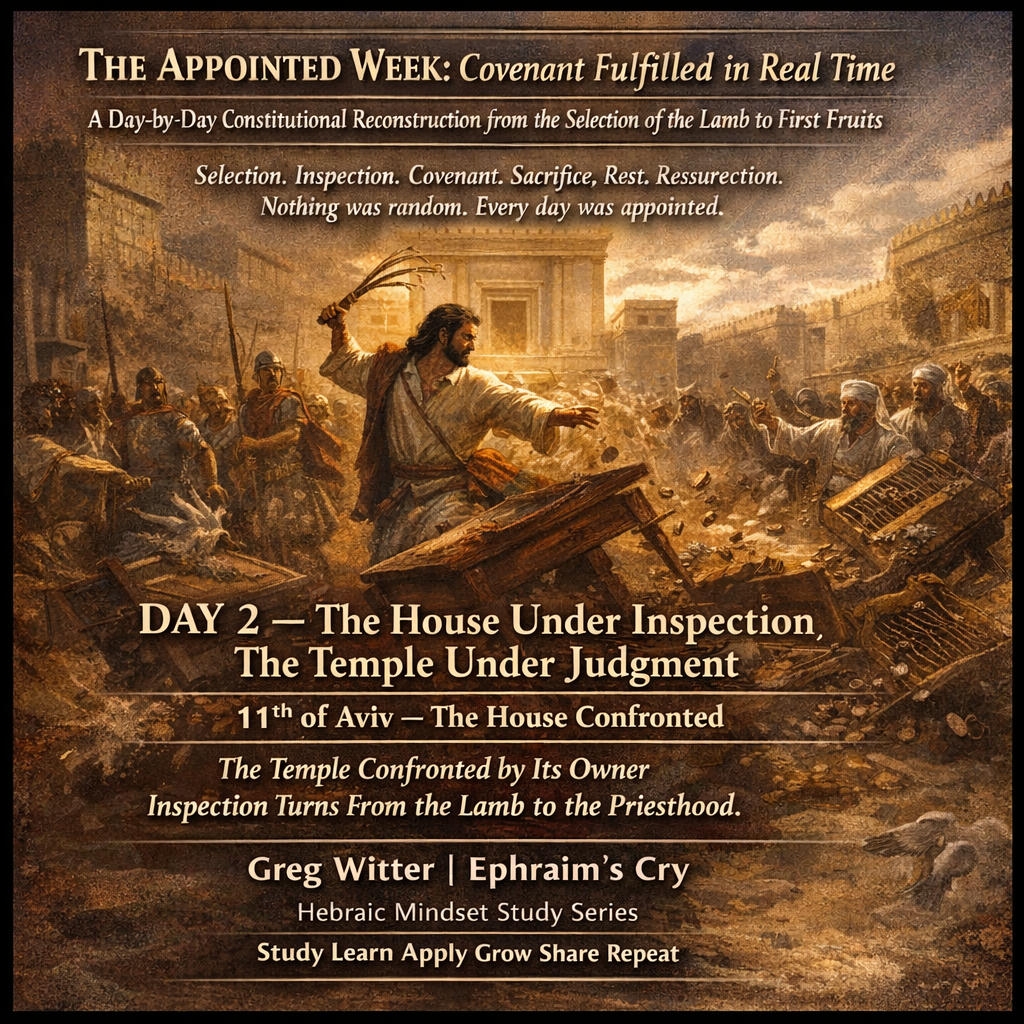
Appointed Weeks DAY 2 — The House Under Inspection
The Temple Confronted by Its Owner
Inspection Was Not Comfortable.
Greg Witter | Ephraim’s Cry
Hebraic Mindset Study Series
Study Learn Apply Grow Share Repeat
Yesterday we saw the King enter.
Not randomly. Not emotionally. Not accidentally.
He entered on purpose.
Today, the confrontation begins.
Most people remember “Jesus flipping tables.”
But almost nobody asks:
Why that day?
Why immediately after entering Jerusalem?
Why target the Temple economy?
Why quote Isaiah and Jeremiah?
This was not temper.
This was authority.
When He entered the Temple and declared:
“My house shall be called a house of prayer, but you have made it a den of robbers” (Isaiah 56:7; Jeremiah 7:11),
He was not merely correcting bad behavior.
He was issuing covenant indictment.
The Lamb had entered the house.
Now the house was being examined.
And what He exposed was not minor corruption — it was systemic compromise.
The money changers were part of the sacrificial system.
The priestly authority oversaw the commerce.
The Temple economy was tied to power and profit.
And now the rightful King was standing in the middle of it.
This was inspection.
Not of the Lamb.
Of the leadership.
Of the priesthood.
Of the system.
And this is where most modern readers become uncomfortable.
Because inspection always exposes.
And exposure always threatens those benefiting from corruption.
This was not a random outburst.
It was Day Two of the appointed week.
The King entered.
The Lamb was selected.
The Temple was confronted.
If yesterday was selection,
today was exposure.
And it will escalate from here.
•The Temple power structure
• The Sadducean control of commerce
• Jeremiah 7 covenant warning
• Why Isaiah 56 matters
• The fig tree sign
• Why this moment seals leadership opposition
This week is not sentimental.
It is structural.
DAY 2 — The Temple Under Judgment
11th of Aviv — The House Confronted
Inspection Turns From the Lamb to the Priesthood
This Was Not an Outburst. It Was a Covenant Prosecution.
Biblical Date: 11th of Aviv
Biblical Day: Sunday Sundown → Monday Sundown
Modern Orientation: Monday daytime events following the entry
Day 1 established selection.
Day 2 establishes exposure.
The Lamb entered the city on the 10th of Aviv, publicly presented, visibly identified, and prophetically aligned with Exodus 12. Selection occurred. The Lamb was brought into the house.
Now on the 11th, the Lamb enters the Temple.
This is not casual movement.
This is covenant progression.
Mark records that after entering Jerusalem on the 10th and surveying the Temple at evening, He returns the next day (Mark 11:11–15). The prior evening was observation. This day is confrontation.
He overturns tables.
Coins scatter.
Chairs collapse.
Commerce halts.
But this is not uncontrolled anger.
This is judicial action inside Torah-governed sacred space.
To understand Day 2, we must understand Torah’s architecture for holy space.
The Temple is not merely a religious building. It is covenant-ordered ground. Leviticus establishes distinctions between clean and unclean, holy and common, authorized and unauthorized (Leviticus 10:10–11). The priesthood was tasked with guarding these distinctions. They were guardians of holiness. Their role was to protect the integrity of sacrifice, worship, and covenant obedience.
When those boundaries collapse, profanation occurs.
When profanation occurs, judgment follows.
The Temple economy had become centralized and controlled by the priestly elite—primarily Sadducean leadership. Pilgrims traveling to Jerusalem required animals deemed acceptable for sacrifice. Temple tax had to be paid in specific currency. Money changers provided exchange. Approved vendors supplied animals.
But systems of necessity become systems of control when authority is corrupted.
Inflated pricing.
Restricted access.
Vendor monopolies.
Gatekeeping of what qualifies as acceptable.
Access to sacrifice tied to economic leverage.
This is not minor mismanagement.
It is structural exploitation.
It converts covenant mercy into profit.
It burdens worshippers.
It disadvantages the poor.
It obstructs the nations who were meant to pray in that House.
And when access to atonement becomes a commercial transaction, the covenant structure has been weaponized.
So when Yahusha overturns tables, He is not attacking commerce in general.
He is confronting profanation in sacred space.
Now listen carefully to what He says, because His quotations define the legal charge.
“My house shall be called a house of prayer for all nations” (Isaiah 56:7).
Isaiah 56 is not a decorative verse about prayer. It is a covenant expansion text. It declares that foreigners who join themselves to Yahuah—who love His name, serve Him, keep His Sabbath, and hold fast to His covenant—will be brought to His holy mountain. It is inclusion tied to obedience.
The Temple was meant to reflect covenant hospitality rooted in Torah faithfulness.
When Messiah cites Isaiah 56, He is indicting the leadership for obstructing covenant purpose.
The nations were meant to pray.
Instead, the outer courts had become commercial corridors.
Then He adds:
“But you have made it a den of robbers” (Jeremiah 7:11).
Jeremiah 7 is not mild correction. It is a covenant lawsuit.
The prophet stands at the gate of the Temple and exposes a people who trust in ritual while breaking Torah. They commit injustice, shed innocent blood, oppress the vulnerable—and then return to the Temple saying, “We are delivered,” as though the building protects them from accountability.
Yahuah responds by pointing back to Shiloh—a prior sanctuary destroyed because of covenant violation.
So when Yahusha quotes Jeremiah 7, He is not complaining about overpricing.
He is declaring that the leadership has turned the Temple into a criminal refuge—a place where exploitation happens outside and then finds religious shelter inside.
That is why the phrase “den of robbers” is devastating.
The robbers are not committing theft inside the den.
They commit it elsewhere and then hide there.
This is institutional hypocrisy.
This is religious cover for covenant violation.
Now integrate the fig tree sign, because it frames the entire event.
On the way to the Temple, Yahusha approaches a fig tree full of leaves but lacking fruit (Mark 11:12–14). The tree appears healthy but produces nothing. Israel is often depicted as a fig tree in the Prophets (Hosea 9:10; Jeremiah 8:13). Fruit represents covenant obedience. Leaves represent outward appearance.
The fig tree is not about hunger.
It is a prophetic sign-act.
The Temple system looked impressive.
Crowds were present.
Sacrifices were ongoing.
Commerce was active.
Leaves everywhere.
But fruit—justice, mercy, obedience—was absent.
After cleansing the Temple, the disciples later see the fig tree withered (Mark 11:20–21).
The sign and the cleansing are connected.
The fruitless tree mirrors the corrupt House.
Inspection reveals deficiency.
Judgment follows exposure.
Now expand the authority conflict, because this day ignites it openly.
After the cleansing, the chief priests, scribes, and elders ask:
“By what authority are You doing these things?” (Mark 11:28).
This is jurisdictional confrontation.
They are not asking for clarification.
They are defending institutional control.
They assume authority flows from position, lineage, and system.
He demonstrates authority rooted in covenant alignment and prophetic fulfillment.
This is why Malachi 3 belongs here:
“The Master whom you seek will suddenly come to His temple… and He will purify the sons of Levi” (Malachi 3:1–3).
Malachi anticipates a visitation marked by purification.
Day 2 is that visitation.
The Master comes.
Not to admire.
To refine.
Not to affirm.
To expose.
Psalm 69:9 adds another prophetic layer:
“Zeal for Your house has consumed Me.”
Zeal here is covenant jealousy.
It is defense of set-apartness.
It is refusal to allow sacred space to be reduced to marketplace manipulation.
Now layer the political atmosphere because it magnifies the risk.
Passover week brings massive pilgrimage crowds to Jerusalem.
Rome increases military presence during feast seasons.
National memory of deliverance from Egypt fuels messianic expectation.
The Temple is the epicenter of religious and national identity.
So when Yahusha disrupts Temple commerce during Passover week, He is not merely challenging theology.
He is threatening the economic, political, and institutional stability of the leadership under Roman oversight.
This is explosive.
It explains Mark 11:18:
“They sought how they might destroy Him.”
Fear drives them.
Not fear of Yahuah.
Fear of losing control.
Fear of losing revenue.
Fear of losing authority.
Fear of exposure before the people.
Fear that the crowd might recognize legitimacy.
Day 2 seals hostility.
Day 1 presented the Lamb.
Day 2 confronts the House.
And the House chooses resistance.
Now connect this to Luke’s warning about visitation (Luke 19:44).
“You did not know the time of your visitation.”
Visitation is covenant inspection.
Visitation is arrival of rightful authority to evaluate condition.
Day 2 intensifies visitation.
The Lamb stands without blemish.
The Temple stands exposed.
The priesthood stands indicted.
Inspection is no longer theoretical.
It is public.
And public exposure forces a decision.
Repentance or elimination.
They choose elimination.
That choice sets the trajectory toward the 14th of Aviv.
Day 2 is the hinge.
It is the day institutional resistance hardens.
It is the day the system moves from suspicion to murder plot.
It is the day the Lamb’s innocence stands in contrast to the leadership’s corruption.
It is the day covenant litigation becomes irreversible.
The Lamb entered.
The Temple was measured.
The fig tree testified.
The prophets were invoked.
The authority was challenged.
The leadership chose violence over repentance.
This was not temper.
This was not disruption.
This was covenant prosecution in Torah-governed space.
Inspection has begun.
The Lamb remains without blemish.
The House has been found fruitless.
And the appointed week continues toward its fixed hour.
#GregWitter #EphraimsCry #HebraicMindset #AppointedWeek #11thOfAviv
#TempleJudgment #CovenantInspection #FigTree #Jeremiah7 #Isaiah56
#Malachi3 #Psalm69 #TorahAlignment #FinalWeek #WholeCounselOfElohim
#ReturnToCovenant #ObedientFaith #StandFirm #DoNotAdd #DoNotTakeAway
