
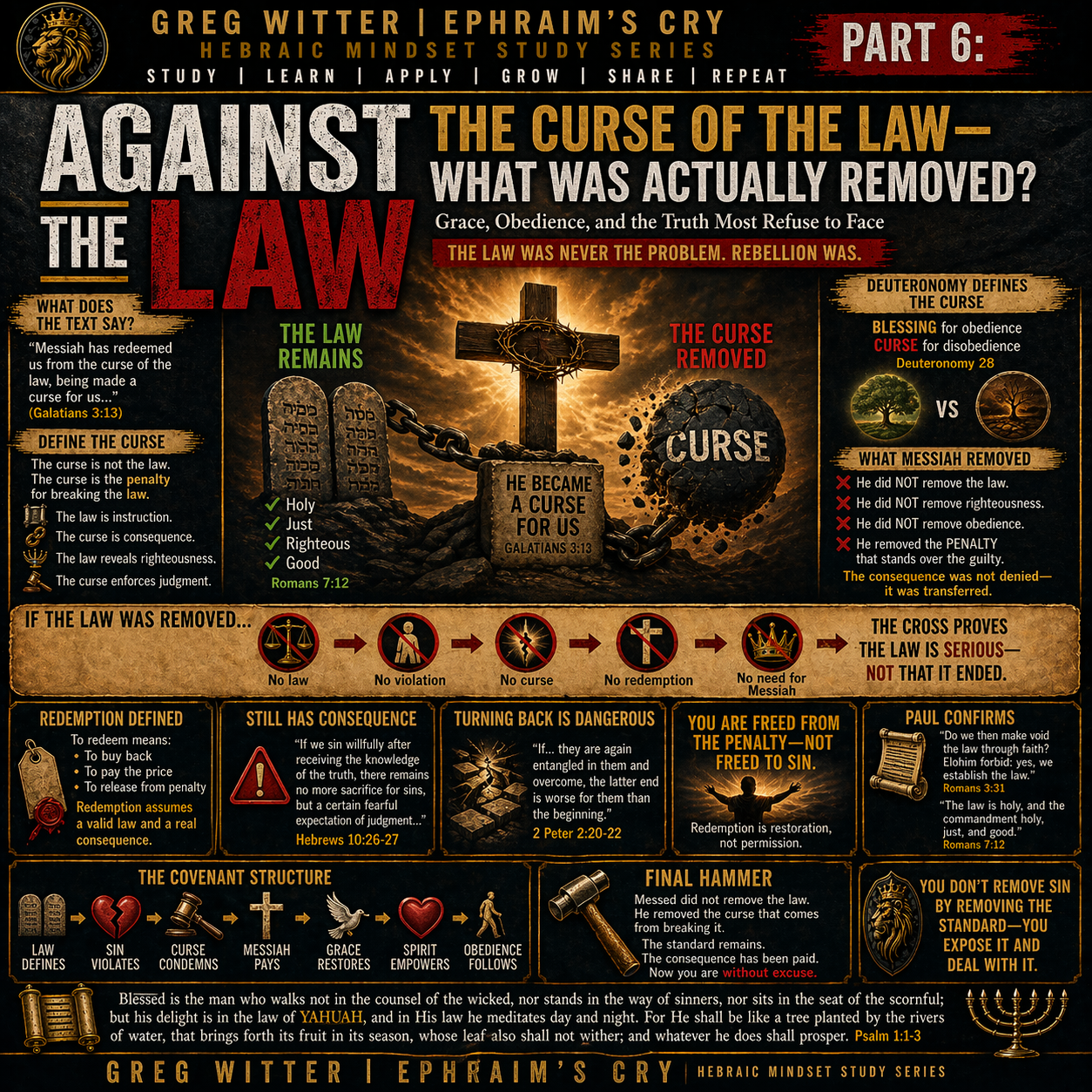
AGAINST THE LAW — PART 6: THE CURSE OF THE LAW — WHAT WAS ACTUALLY REMOVED?
Grace, Obedience, and the Truth Most Refuse to Face
The law was never the problem. Rebellion was.
Greg Witter | Ephraim’s Cry
Hebraic Mindset Study Series
Study Learn Apply Grow Share Repeat
Now we deal with another phrase that gets quoted constantly, repeated carelessly, and weaponized against obedience:
“Messiah redeemed us from the curse of the law.”
And from that phrase, people force a conclusion that the text does not give:
“If we are redeemed from the curse, then we are free from the law.”
“If the curse is gone, then the law must be gone.”
“If Messiah removed the curse, then obedience is no longer the issue.”
That sounds clean.
It sounds simple.
It sounds spiritual.
It is also false.
Because once again, the entire error begins in the same place: people are refusing to define their terms.
So we are going to slow this down, define everything carefully, and remove every hiding place.
WHAT DOES THE TEXT ACTUALLY SAY?
“Messiah has redeemed us from the curse of the law, being made a curse for us…” (Galatians 3:13)
Read it exactly as it is written.
It does not say:
Messiah redeemed us from the law.
It says:
Messiah redeemed us from the curse of the law.
Those are not the same thing.
And if you collapse those into one, you have already twisted the text before you even begin.
DEFINE THE CURSE — THIS IS WHERE THE ENTIRE ARGUMENT STANDS OR FALLS
The curse is not the law.
The curse is the judicial consequence that falls on the one who violates the law.
The law is the standard.
The curse is the penalty for violating the standard.
The law defines righteousness.
The curse enforces consequence for rebellion.
The law reveals what is right.
The curse falls when what is right is violated.
So if you confuse the law with the curse, you have already destroyed the structure of the covenant.
THE LAW AND THE CURSE ARE NOT THE SAME THING
This must be locked in so tightly that no one can blur it later:
The law is instruction.
The curse is judgment.
The law is righteous.
The curse is punitive.
The law is from Yahuah as revelation.
The curse is from Yahuah as covenant consequence.
The law tells you what is holy.
The curse falls when holiness is despised.
So no—the law is not the problem.
The problem is violating it.
DEUTERONOMY DEFINES THE CURSE — NOT GALATIANS ALONE
Paul is not inventing a new idea in Galatians. He is drawing from Torah.
“Cursed is everyone who does not continue in all things written in the book of the law, to do them.” (Deuteronomy 27:26; Galatians 3:10)
And Deuteronomy 28 expands this in full:
Blessing for obedience.
Curse for disobedience.
That means the curse is not some abstract religious term.
It is the covenant enforcement mechanism.
It is what falls when righteousness is rejected.
So the covenant structure is this:
Yahuah establishes the standard.
The law reveals the standard.
Obedience brings blessing.
Disobedience brings curse.
That is the structure Paul is working from.
So when Messiah redeems from the curse, He is not tearing down the structure.
He is stepping into the consequence created by violating it.
THE CURSE PROVES THE LAW MATTERS
This must be stated plainly.
The curse exists because righteousness matters.
If violating righteousness had no consequence, then the law would be meaningless.
Without consequence, command becomes suggestion.
Without consequence, righteousness becomes opinion.
Without consequence, covenant becomes sentiment.
But Scripture does not present righteousness as optional.
It presents it as binding.
That is why curse exists.
Not because the law is bad.
But because violating what is right is serious.
BLESSING AND CURSE — THE FULL COVENANT FRAMEWORK
If you only talk about curse, people will distort the structure.
Deuteronomy gives both:
Blessing for obedience.
Curse for disobedience.
That means the covenant does not merely threaten—it also promises.
There is blessing attached to alignment.
There is curse attached to rebellion.
So redemption from the curse does not remove the expectation that blessing still flows through obedience.
Messiah removes the curse.
He does not abolish the righteousness connected to blessing.
That means:
Redemption does not make obedience irrelevant.
It restores the possibility of walking rightly without standing condemned.
WHAT DID MESSIAH ACTUALLY REMOVE?
Not the law.
Not righteousness.
Not holiness.
Not obedience.
He removed the penalty that was standing over the guilty.
He stepped into the place of judgment.
He took what the violator deserved.
He bore the curse.
He did not bear the law away.
He bore the consequence of breaking it.
That is substitution.
That is atonement.
That is redemption.
DEFINE “REDEEM” — THIS MUST BE MADE PLAIN
To redeem means:
To buy back
To pay the price required
To release someone from bondage or penalty through payment
Redemption only makes sense where there is:
A real debt
A real penalty
A real legal standing against the guilty
So if there is no law, there is no violation.
If there is no violation, there is no curse.
If there is no curse, there is no debt.
If there is no debt, there is nothing to redeem.
That means redemption itself proves:
The law still stands.
Because redemption assumes a valid standard and a real consequence for violating it.
HE BECAME THE CURSE — NOT THE LAW
Galatians says:
“Being made a curse for us…”
It does not say:
Being made law for us.
Destroying law for us.
Removing law for us.
It says He became a curse for us.
That means the consequence did not disappear.
It was transferred.
That is critical.
The curse was not denied.
The curse was not ignored.
The curse was not declared unjust.
It was carried.
The penalty remained real enough that it had to be borne.
And that proves again: the cross is not evidence that the law ended. The cross is evidence that the law is so serious that breaking it requires death.
THE CROSS CONFIRMS THE LAW — IT DOES NOT CANCEL IT
This may be one of the most important lines in the whole teaching:
The cross is not proof the law ended.
The cross is proof the law could not be ignored.
The cross is proof that sin is so serious it requires blood.
The cross is proof that the penalty for rebellion is real.
The cross is proof that righteousness is not sentimental.
The cross is proof that Yahuah did not relax the standard—He upheld it at the highest possible cost.
So if someone uses the cross to argue against the law, they are using the very thing that proves the seriousness of the law to argue that it no longer matters.
That is backward.
IF THE LAW WAS REMOVED — THE CURSE COULD NOT EXIST
Walk the logic all the way through.
If the law is gone:
There is nothing to violate.
There is no guilt.
There is no curse.
There is no need for redemption.
There is no need for blood.
There is no need for Messiah.
That is where the argument leads.
So anyone claiming “Messiah removed the law” is sawing through the very branch they are sitting on.
Because redemption only makes sense where the law still defines the violation.
PAUL DOES NOT TEACH LAW REMOVAL — HE TEACHES THE OPPOSITE
The same Paul who says we are redeemed from the curse also says:
“The law is holy, and the commandment holy, just, and good.” (Romans 7:12)
And again:
“Do we then make void the law through faith? Elohim forbid: yes, we establish the law.” (Romans 3:31)
So Paul does not let you make the move people keep trying to make.
He will not let you say:
Curse removed = law removed.
Because he still calls the law holy.
That means the curse cannot be the law itself.
The curse is what falls on the one who despises what is holy.
THE CURSE DOES NOT PROVE THE LAW IS BAD
People subtly think:
Law leads to curse, therefore law is bad.
That is false.
A speed limit is not bad because violating it gets punished.
A law against theft is not bad because stealing has consequence.
A law against murder is not bad because killing is judged.
Consequence does not prove the law is flawed.
It proves the law has authority.
The curse is not proof the law is bad.
The curse is proof that violating righteousness has consequence.
THE COMMON-SENSE TEST — AGAIN
If a man commits a crime and receives a pardon, what happened?
Was the law abolished?
No.
Was the crime redefined?
No.
Was the judge wrong to judge it?
No.
The penalty was lifted by lawful intervention.
That is redemption.
The law remains.
The violation was real.
The consequence was real.
The pardon changed the standing of the guilty.
That is exactly how this works.
HEBREWS WARNS THAT SIN STILL HAS CONSEQUENCE
This is where people often try to run into a false grace that has no teeth.
But Hebrews shuts that down:
“If we sin willfully after receiving the knowledge of the truth, there remains no more sacrifice for sins, but a certain fearful expectation of judgment…” (Hebrews 10:26–27)
That is after the cross.
After Messiah.
After redemption has been revealed.
So what does that prove?
It proves redemption is not permission to continue in rebellion.
It proves willful lawlessness is still serious.
It proves the standard still matters.
If the law were gone, these warnings would be meaningless.
But they are not meaningless.
They remain because righteousness remains.
TURNING BACK TO SIN IS NOT A SMALL THING
Peter says:
“If, after they have escaped the defilements of the world through the knowledge of the Master and Savior… they are again entangled in them and overcome, the latter end is worse for them than the beginning.” (2 Peter 2:20)
Again—that is after exposure to truth.
After knowledge.
After escape.
So what does this show?
It shows redemption is not automatic immunity while a person persists in lawlessness.
It is not a theological shield for ongoing rebellion.
It is deliverance that calls for transformed living.
So if someone says:
“We are redeemed from the curse, so obedience no longer matters,”
they are not proclaiming freedom.
They are advertising that they do not understand redemption at all.
YOU ARE NOT FREED TO SIN — YOU ARE FREED FROM ITS PENALTY
This is the line that has to be spoken plainly:
Freedom from the curse is not freedom to continue violating.
It is freedom from judgment so that you can now walk correctly.
Messiah did not take the curse so you could make peace with rebellion.
He took the curse so you could be restored out of it.
Redemption is not an escape from righteousness.
It is a restoration to it.
THE PURPOSE OF GRACE WITHIN THIS
Grace does not redefine sin.
Grace does not excuse rebellion.
Grace does not erase the standard.
Grace removes the penalty that stands over the repentant, and grace empowers a new life.
That means grace and law are not enemies.
Grace addresses what the law condemns.
The Spirit empowers what the law requires.
So the law remains the definition.
Grace remains the rescue.
The Spirit remains the power.
WHAT THE CURSE REMOVAL DOES NOT MEAN
It does not mean:
No law
No sin
No obedience
No accountability
No expectation
No judgment
It means:
The one who trusts in Messiah is no longer standing condemned under the penalty—because the price has been paid.
That is not the removal of covenant.
That is the restoration of the sinner.
WHY PEOPLE KEEP TWISTING THIS
Because people want one of the oldest lies in existence:
Forgiveness without repentance
Mercy without submission
Grace without transformation
Salvation without obedience
So they hear:
“Redeemed from the curse”
and translate it into:
“Free from the standard”
But that is not what the text says.
That is what rebellion wants it to say.
THIS ALSO FITS EVERYTHING WE HAVE ALREADY BUILT
Part 1 — The law defines righteousness and sin
Part 2 — The record of violations was nailed to the cross
Part 3 — Not under the law means not under condemnation
Part 4 — The law is written on the heart in the renewed covenant
Part 5 — Fulfill means bring to fullness, not abolish
And now Part 6 makes the next distinction clear:
The curse is removed—not the law
That is not a side point.
That is a major dividing line.
Because if you blur it, you blur the gospel itself.
FINAL STRUCTURE — LOCK THIS IN
The law defines.
Sin violates.
The curse condemns.
Messiah pays.
Grace restores.
The Spirit empowers.
Obedience follows.
That is the structure.
Not:
Law bad
Curse gone
Obedience irrelevant
That is confusion.
FINAL HAMMER — NO ESCAPE
Messiah did not remove the law.
He removed the curse that comes from breaking it.
He did not abolish the standard.
He bore the penalty for violating it.
He did not relax righteousness.
He upheld it at the cost of His own blood.
So no—you are not free from the law.
You are free from the penalty of breaking it.
And if you return to rebellion as though redemption were permission, you prove you never understood what was purchased for you.
The standard remains.
The consequence has been paid.
Now you are without excuse.
You don’t remove sin by removing the standard—you expose it and deal with it.
#GregWitter #EphraimsCry #HebraicMindset #AgainstTheLaw #WatchmanWarning #BiblicalTruth
#TorahIsTruth #CovenantFaithfulness #EndTimesDiscernment #StayAwake #SoundDoctrine #TruthOverTradition
#ScriptureFirst #LawAndGrace #FaithAndObedience #CurseOfTheLaw #Redemption #SpiritualDiscernment #Watch
