
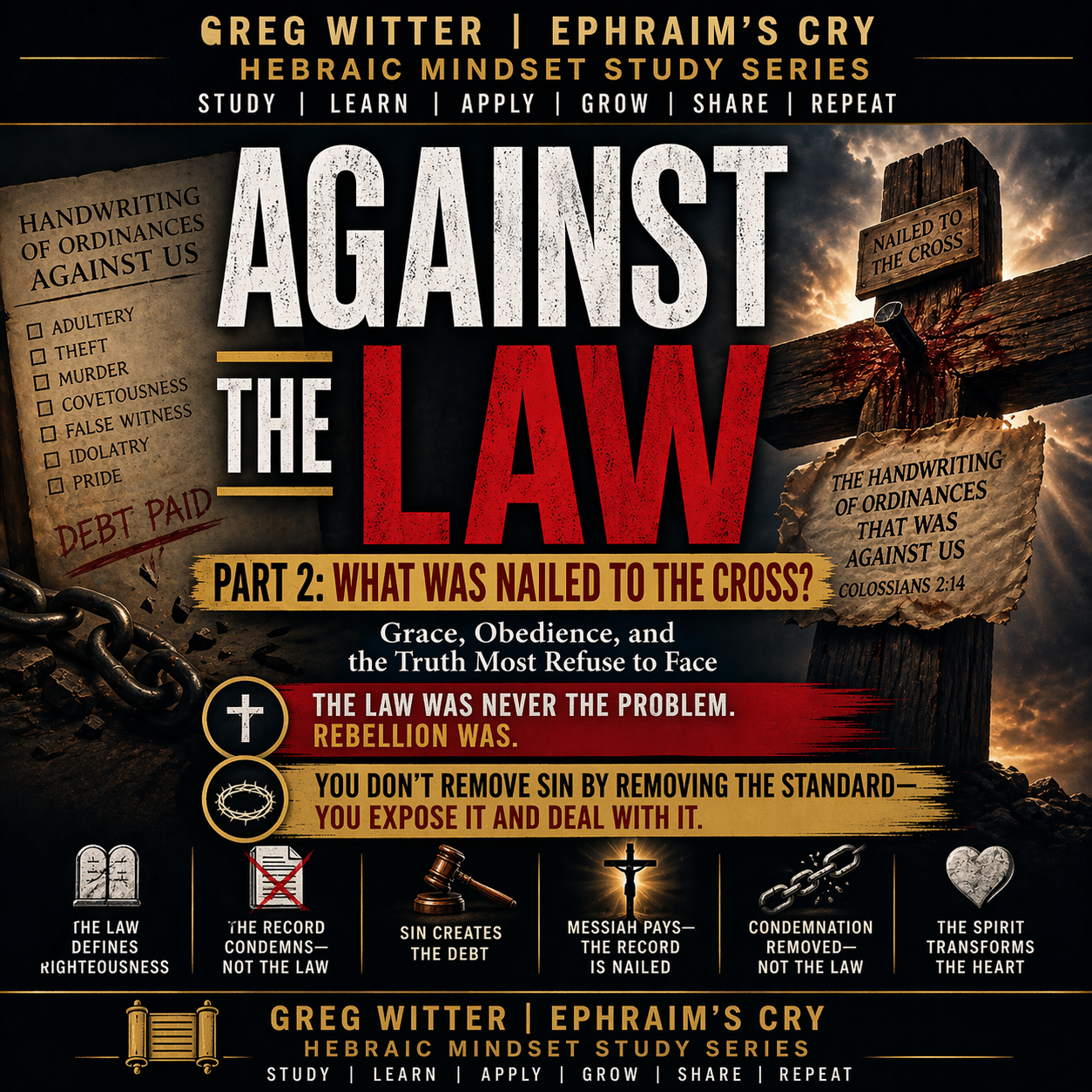
AGAINST THE LAW — PART 2: WHAT WAS ACTUALLY ACCOMPLISHED AT THE STAKE?
Grace, Obedience, and the Truth Most Refuse to Face
You cannot destroy the standard and still call it justice.
Greg Witter | Ephraim’s Cry
Hebraic Mindset Study Series
Study Learn Apply Grow Share Repeat
Now we come to the point where everything either holds together—or collapses completely. Up to this point, the foundation has been established. The law has been defined. Its role has been made clear. But this is where the argument always turns. This is where it always tries to escape. This is where people, almost instinctively, reach for what they believe is the final answer: the cross.
“The law was abolished at the cross.”
That statement is repeated so often, so confidently, that it has taken on the weight of assumed truth. It is treated as settled. Final. Untouchable. But it is not examined. It is not tested. It is not followed to its conclusion. And that is where the problem begins—because Scripture does not allow you to hold a statement without following it all the way through. It forces you to account for every implication, every consequence, every connection.
And beneath that statement—whether people recognize it or not—is the issue of authority.
Not preference. Not tradition. Not denomination.
Authority.
“To the Torah and to the testimony: if they speak not according to this word, it is because there is no light in them” (Isaiah 8:20).
That is the dividing line. That is the measuring rod. That is the standard that judges every teaching, every system, every claim. The moment someone declares that the law has been removed, they are no longer submitting to that standard—they are replacing it. They are placing themselves in the position of defining what righteousness is, what sin is, what obedience is. And that is not interpretation—that is substitution.
So we must ask the question that most people never ask, but must be asked if truth is going to stand:
If the law was removed at the cross—what, then, was the cross actually doing?
Because the cross is not an isolated event. It is not disconnected from what came before. It is not a reset button. It is the culmination of everything that wasalready established. Every sacrifice, every instruction, every covenant point forward to it. And if you redefine what the cross accomplished, you don’t adjust one doctrine—you dismantle the entire system that gives it meaning.
Messiah Himself refuses to allow that misunderstanding to stand. Before anyone could even make the claim, He addressed it directly: “Do not think that I came to destroy the law or the prophets…” (Matthew 5:17). That is not suggestion—it is correction. It is preemptive. It is a direct warning against exactly what is now being taught.
Then He anchors that warning in reality: “Until heaven and earth pass away, not one jot or one tittle will pass from the law…” (Matthew 5:18). That is structural language. That is covenant language. Heaven and earth define the duration. They are still here. Which means the law still stands.
And then He removes all ambiguity: “Whoever breaks one of the least of these commandments and teaches men so, shall be called least in the kingdom…” (Matthew 5:19).
This is not abstract theology. This is enforcement.
And then He confronts the heart behind it: “Why do you call Me, ‘Master, Master,’ and do not do what I say?” (Luke 6:46).
That is the real issue.
Not misunderstanding.
Not confusion.
Submission.
Scripture forces us beyond slogans into structure. “Sin is the transgression of the law” (1 John 3:4). That is the definition. Not one of many. Not optional. Not symbolic. That is what sin is. And Scripture reinforces it: “By the law is the knowledge of sin” (Romans 3:20). “Where there is no law, there is no transgression” (Romans 4:15).
So follow this carefully, because this is where everything either holds—or collapses.
If the law is removed, sin has no definition. If sin has no definition, guilt cannot exist. If guilt cannot exist, then there is nothing to forgive. And if there is nothing to forgive, then the cross is unnecessary.
Not reduced. Not reinterpreted.
Unnecessary.
That is the unavoidable conclusion.
This is why Scripture never presents the law as the problem. “The law is holy, and the commandment holy and just and good” (Romans 7:12). That is not defensive language—that is declarative. It is stating reality. And then it goes further: “Do we then make void the law through faith? Certainly not! On the contrary, we establish the law” (Romans 3:31).
Faith does not dismantle the law.
Faith confirms it.
Faith aligns with it.
Faith establishes it.
Which means any claim that the cross removed the law is not simply incorrect—it is directly opposed to the text.
Now the weight of the cross must be understood correctly. Scripture defines its purpose in relation to the law itself: “What the law could not do in that it was weak through the flesh, Elohim did… that the righteous requirement of the law might be fulfilled in us…” (Romans 8:3–4).
The problem was never the law.
The problem was the flesh.
So the solution is not removal of the standard—but restoration of the ability to walk in it.
“I will put My Spirit within you, and cause you to walk in My statutes…” (Ezekiel 36:27).
The Spirit does not replace the law.
The Spirit produces obedience to it.
That is the covenant shift. Not abolition. Transformation.
Now the full courtroom must be seen clearly, because this is where everything locks into place:
The law defines sin (Romans 3:20; 1 John 3:4).
Sin produces guilt (Romans 6:23).
Guilt creates a record (Colossians 2:14).
That record stands in judgment (Hebrews 9:27).
Messiah pays the penalty (Isaiah 53:5).
The record is removed (Colossians 2:14).
The Spirit restores obedience (Romans 8:4; Ezekiel 36:27).
That is the system.
Remove the law—and the entire structure collapses.
And Scripture confirms it from another angle: “If righteousness comes through the law, then Messiah died in vain” (Galatians 2:21). But if the law is removed entirely, righteousness becomes undefined—and again Messiah’s death becomes unnecessary.
Either direction collapses if misunderstood.
The cross only stands if the law remains.
This brings us back to the nature of Yahuah Himself. “He is just and upright” (Deuteronomy 32:4). Justice is not optional. It requires a standard. Without a standard, there is no righteousness. Without righteousness, there is no sin. Without sin, there is no judgment. Without judgment, there is no need for mercy.
So if the law is removed, justice is removed.
And if justice is removed, Yahuah is no longer just.
That is impossible.
Which means the cross does not remove the law—it proves it.
It proves sin is real.
It proves guilt is real.
It proves judgment is real.
It proves that payment was required.
And it proves that mercy operates within justice—not outside of it.
This has always been the direction of Scripture. “Your law is within my heart” (Psalm 40:8). “Oh how I love Your law…” (Psalm 119:97). The goal was never external compliance alone—it was internal alignment.
The cross does not interrupt that.
It completes it.
Now bring it down to what cannot be avoided:
A law exists.
A violation occurs.
A penalty is required.
A payment is made.
What changes?
The penalty.
What does not change?
The law.
Remove the law, and you remove the entire reason the payment was required.
That is not mercy.
That is corruption.
This is why the claim collapses under its own weight.
If the law was nailed to the cross, then why does sin still exist? Why does Scripture still call for obedience?
“If you love Me, keep My commandments” (John 14:15).
“He that says he abides in Him ought himself also to walk as He walked” (1 John 2:6).
“If you keep My commandments, you shall abide in My love” (John 15:10).
Why is the end defined this way?
“Here are they that keep the commandments of Elohim and the faith of Yahusha” (Revelation 14:12).
“They keep the commandments of Elohim and have the testimony of Yahusha” (Revelation 12:17).
Why does lawlessness define the end?
“Because lawlessness shall abound…” (Matthew 24:12).
“The man of lawlessness…” (2 Thessalonians 2:3).
“He shall think to change times and law…” (Daniel 7:25).
This is not peripheral.
This is central.
And Scripture closes the door completely: “If we sin willfully…” (Hebrews 10:26).
That is post-cross.
Which means sin still exists.
Which means the law still defines it.
The cross did not remove sin’s definition—it removed sin’s claim over you.
“He bore our sins… that we might live for righteousness…” (1 Peter 2:24).
Not escape from obedience.
Restoration to it.
Now the question cannot be avoided.
If the law was not removed—
What was?
That is where we go next.

You don’t remove sin by removing the standard—you expose it and deal with it.
#GregWitter #EphraimsCry #HebraicMindset #AgainstTheLaw #WatchmanWarning #BiblicalTruth #TorahIsTruth #CovenantFaithfulness #EndTimesDiscernment #StayAwake #SoundDoctrine #TruthOverTradition #ScriptureFirst #LawAndGrace #FaithAndObedience #CrossTruth #CovenantLogic #SpiritualDiscernment #WatchmanOnTheWall #TestEverything
