
THE SEVENTH DAY IS COMING
Part 3 — The Fourth Day and the Coming Light
The covenant line has become a people. The people have received Torah, entered the Land, and received a throne carrying a promise that reaches beyond David himself (Exodus 19:3–6; Joshua 11:23; 2 Samuel 7:12–16).
Now the story enters the fourth thousand years.
THE FOURTH THOUSAND YEARS — KINGDOM, PROPHETS, EXILE, AND THE COMING LIGHT
The kingdom eventually divides (1 Kings 11:29–39; 12:16–24).
The northern kingdom descends into persistent rebellion and is ultimately carried away by Assyria (2 Kings 17:6–23).
Yahudah also rebels and is eventually taken into Babylonian captivity; Yerushalayim and the Temple are destroyed (2 Kings 24:18–20; 25:1–21; 2 Chronicles 36:15–21).
Yet judgment is never the final word.
The prophets continually point toward restoration and the coming King.
Yeshayahu speaks of a coming child upon whose shoulder government will rest and whose reign upon David’s throne will be established in righteousness (Isaiah 9:6–7).
Yirmeyahu speaks of a righteous Branch raised up for David who will reign as King (Jeremiah 23:5–6).
Micah identifies Bethlehem as the place from which the coming ruler will emerge (Micah 5:2).
Zechariah announces the King coming to Yerushalayim, righteous and riding upon a donkey (Zechariah 9:9).
Yehezqel speaks of Yahuah gathering His scattered sheep and setting one shepherd over them, described in Davidic terms (Ezekiel 34:11–13, 23–24; 37:21–24).
The fourth millennium therefore becomes a period of increasing prophetic expectation.
Kingdom has been established and divided.
Judgment has come.
Exile has come.
But the prophets keep looking forward.
A King is coming.
A Shepherd is coming.
A righteous Branch is coming.
A Son of David is coming.
And then, near the conclusion of approximately four thousand years of biblical chronology, Yahusha appears.
That placement matters.
THE FOURTH DAY DESERVES ANOTHER LOOK
Return to Creation Week for a moment.
On the fourth day, Yahuah appoints the lights in the heavens to separate light from darkness and to serve for signs, appointed times, days, and years (Genesis 1:14–19).
Then, near the close of approximately four thousand years within the chronology being examined, Messiah enters the world.
Yochanan describes Yahusha in unmistakable light imagery.
“In Him was life, and the life was the light of men” (John 1:4).
He calls Him “the true Light, which enlightens every man” (John 1:9).
Yahusha Himself declares:
“I am the light of the world.” (John 8:12; see also John 9:5).
Yeshayahu had already prophesied that the people walking in darkness would see a great light (Isaiah 9:2).
The Apostolic Witness explicitly connects that prophecy with the ministry of Yahusha (Matthew 4:12–16).
Now put those pieces beside one another.
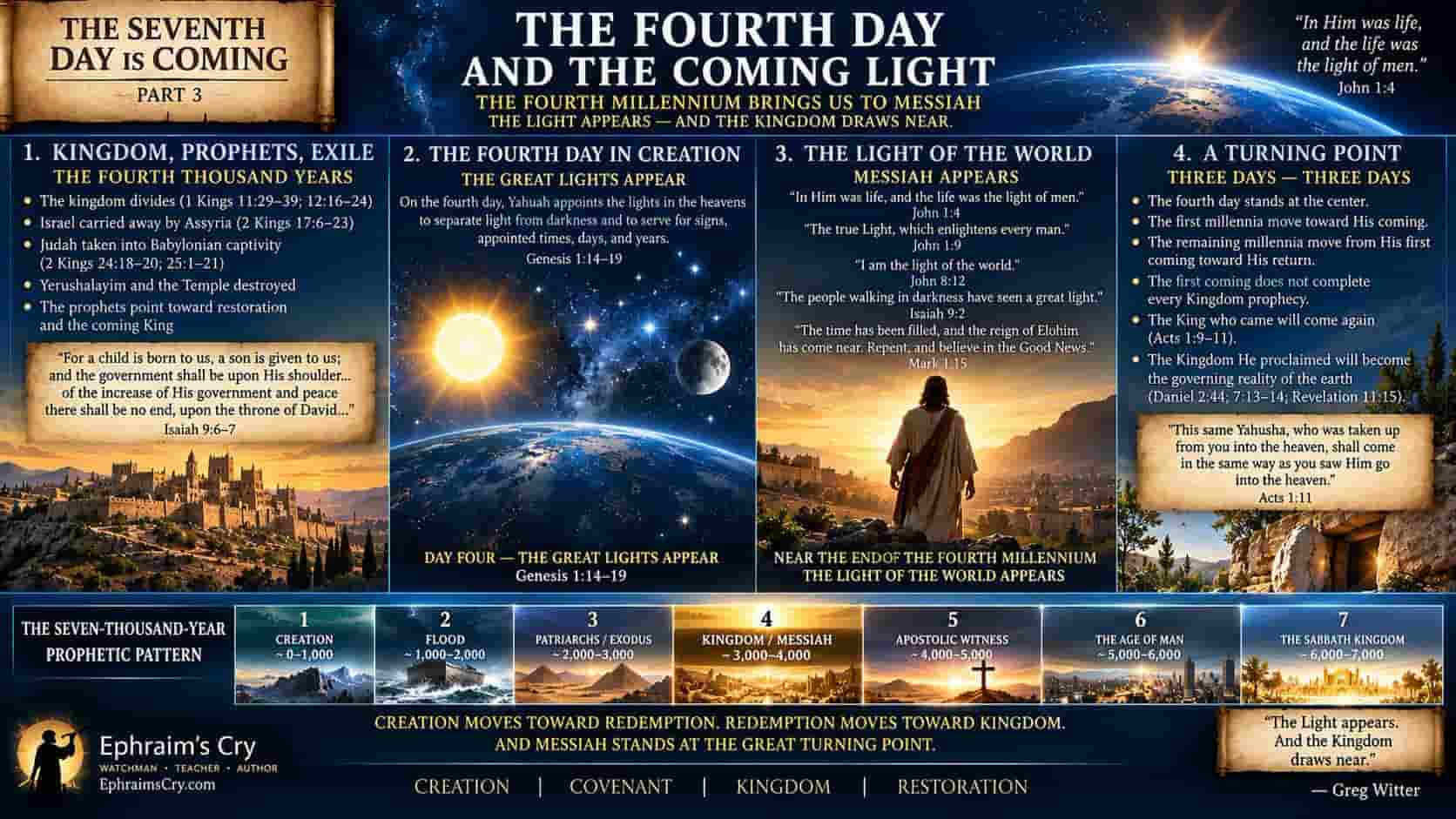
Day Four — the great lights appear (Genesis 1:14–19).
Near the end of the fourth millennium — the Light of the world appears (Isaiah 9:2; Matthew 4:12–16; John 1:4–9; 8:12).
That correspondence deserves attention.
We should be careful not to claim that Genesis 1 explicitly says, “The fourth-day lights predict Messiah coming four thousand years later.”
It does not.
But neither should we ignore a pattern simply because Scripture communicates it through architecture rather than through an explicit chronological declaration.
Patterns must be tested.
And this one deserves to be tested carefully.
MESSIAH COMES AT THE END OF THE FOURTH THOUSAND YEARS
This point is important because the chronology is often presented too loosely.
Within the framework we are examining, Yahusha does not appear somewhere deep inside the fifth millennium.
He comes at the conclusion of approximately four thousand years—just before the beginning of the fifth thousand-year period.
The first four prophetic “days” have been moving toward Him.
The promised Seed has come (Genesis 3:15; Galatians 3:16).
The promised descendant of Abraham has come (Genesis 22:18; Galatians 3:16).
The promised ruler from Yahudah has come (Genesis 49:10; Hebrews 7:14).
The promised Davidic King has come (2 Samuel 7:12–16; Luke 1:31–33).
The promised Shepherd has come (Ezekiel 34:23–24; John 10:11–16).
The promised Light has come (Isaiah 9:2; John 1:4–9; 8:12).
The promised King has appeared (Zechariah 9:9; Matthew 21:4–9).
Thousands of years of promise and prophetic expectation converge upon Yahusha.
MESSIAH STANDS AT THE GREAT TURNING POINT
There is another intriguing dimension to Day Four.
In a seven-day week, the fourth day stands at the center.
Three days precede it.
Three days follow it.
On that fourth day, Yahuah places the great lights in the heavens (Genesis 1:14–19).
Within the seven-thousand-year framework, Messiah likewise appears near the great turning point of the prophetic week.
The first millennia move toward His coming.
The remaining millennia move from His first coming toward His return and Kingdom.
The prophets anticipated Him (Isaiah 7:14; 9:6–7; 11:1–5; Micah 5:2; Zechariah 9:9).
The Apostolic Witness announces that He came (Matthew 1:18–25; Luke 2:1–20; John 1:14).
That same Apostolic Witness declares that He will return (Matthew 24:29–31; Acts 1:9–11; Revelation 19:11–16).
History before Messiah anticipates Him.
History after His first coming anticipates His return.
Creation moves toward redemption.
Redemption moves toward Kingdom.
And Messiah stands at the great turning point.
THE LIGHT DOES MORE THAN APPEAR—HE ANNOUNCES THE KINGDOM
When Yahusha begins His public ministry, His message is not merely that people should become more religious.
He announces the Kingdom.
“Repent, for the reign of the heavens has drawn near” (Matthew 4:17).
Mark records the same proclamation:
“The time has been filled, and the reign of Elohim has come near. Repent, and believe in the Good News” (Mark 1:14–15).
Notice the language:
“The time has been filled.” (Mark 1:15).
Messiah appears according to appointed time.
Sha’ul later describes the same reality:
“But when the completion of the time came, Elohim sent forth His Son” (Galatians 4:4).
The appearance of Messiah is not an accident of history.
It occurs within the appointed purposes of Yahuah.
The Light appears.
And the Light announces that the Kingdom has drawn near.
THE FIRST COMING POINTS TOWARD THE SECOND
Yahusha’s first coming does not complete every Kingdom prophecy.
The prophets speak of a King ruling the nations in righteousness (Isaiah 9:6–7; 11:1–10).
Daniel sees the Son of Man receiving dominion, glory, and a Kingdom in which peoples, nations, and languages serve Him (Daniel 7:13–14).
Zechariah sees Yahuah as King over all the earth and the nations coming to Yerushalayim to worship the King (Zechariah 14:9, 16–19).
Those Kingdom realities still point forward.
Yahusha therefore comes first as the promised Messiah, accomplishes the work given Him by the Father, dies, rises, and ascends (John 17:4; 19:28–30; Matthew 28:1–10; Acts 1:9–11).
But His ascension is accompanied by a promise.
As the disciples watch Yahusha ascend, the messengers tell them:
“This same Yahusha, who was taken up from you into the heaven, shall come in the same way as you saw Him go into the heaven” (Acts 1:9–11).
The first coming therefore points toward the second.
The King who came will come again (Matthew 24:29–31; Acts 1:11; Revelation 19:11–16).
The Kingdom He proclaimed will become the governing reality of the earth (Daniel 2:44; 7:13–14, 27; Revelation 11:15).
The Light who appeared near the close of the fourth millennium points history forward toward the coming Sabbath Kingdom.
The fourth prophetic day has brought us to Messiah.
Now the fifth begins.
And history moves from the coming of the King toward the return of the King.
Next: Part 4 — Messiah, the Apostolic Witness, and the Sixth Day: The Age of Man
— Greg Witter
Ephraim’s Cry
Watchman • Teacher • Author
EphraimsCry.com
#EphraimsCry#Yahuah#Yahusha#CreationWeek#FourthDay#LightOfTheWorld#BiblicalProphecy#SevenThousandYears
#Messiah#GospelOfTheKingdom#KingdomOfElohim#Sabbath#Torah#Covenant#Restoration#Watchman
