
THE SEVENTH DAY IS COMING
Part 2 — The Flood, Babel, the Nations, and the Covenant Line
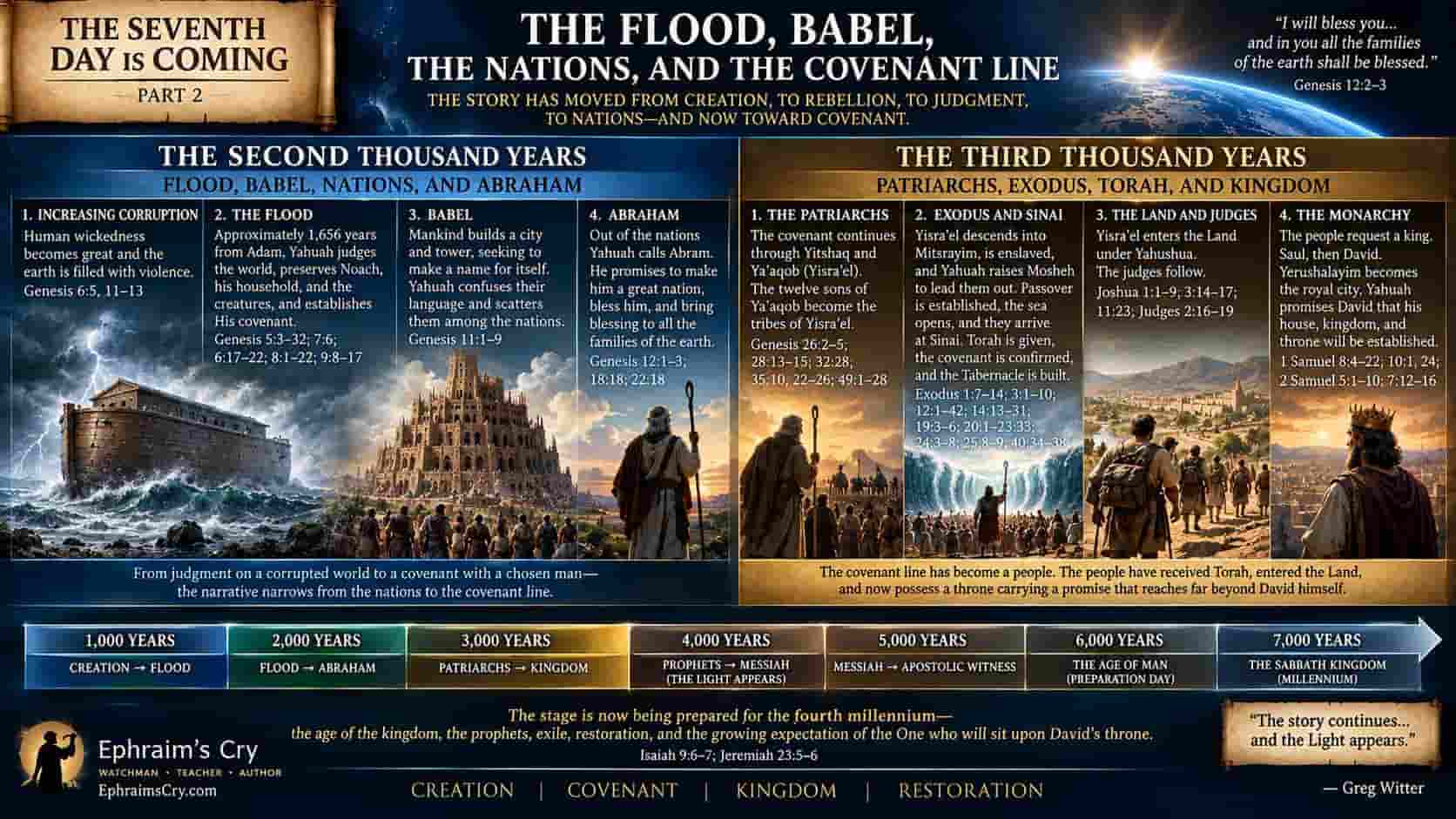
The story has moved from Creation, to rebellion, to judgment, to nations—and now toward Covenant.
THE SECOND THOUSAND YEARS — FLOOD, BABEL, NATIONS, AND ABRAHAM
Human corruption increases until Scripture describes the wickedness of mankind as great and the earth as filled with violence (Genesis 6:5, 11–13).
According to the chronology produced from the ages recorded in Genesis 5 and Genesis 7, the Flood occurs approximately 1,656 years from Adam (Genesis 5:3–32; 7:6).
Yahuah judges the corrupted world through the Flood while preserving Noach, his household, and the creatures aboard the ark (Genesis 6:17–22; 7:1–24; 8:1–22).
Afterward, Yahuah establishes His covenant with Noach and his descendants (Genesis 9:8–17).
But human rebellion soon appears again.
At Babel mankind gathers together, builds a city and tower, and seeks to make a name for itself rather than spreading across the earth as commanded (Genesis 9:1, 7; 11:1–4). Yahuah confuses their language and scatters them among the nations (Genesis 11:5–9).
Then the biblical narrative narrows dramatically.
Out of the nations Yahuah calls Abram (Genesis 12:1–3).
He promises to make him a great nation, bless him, make his name great, and ultimately bring blessing to the families of the earth through him (Genesis 12:2–3; 18:18; 22:18).
The story has moved from Creation, to rebellion, to judgment, to nations—and now toward Covenant.
THE THIRD THOUSAND YEARS — PATRIARCHS, EXODUS, TORAH, AND KINGDOM
The covenant promises continue through Yitshaq (Genesis 26:2–5) and Ya’aqob (Genesis 28:13–15), whose name is changed to Yisra’el (Genesis 32:28; 35:10).
The twelve sons of Ya’aqob become the foundation of the tribes of Yisra’el (Genesis 35:22–26; 49:1–28).
The family descends into Mitsrayim (Genesis 46:1–7, 26–27), multiplies there (Exodus 1:7), and eventually becomes enslaved (Exodus 1:8–14).
Yahuah raises Mosheh to lead His people out (Exodus 3:1–10).
Passover is established (Exodus 12:1–28).
The firstborn of Mitsrayim are struck (Exodus 12:29–30).
Yisra’el departs (Exodus 12:31–42).
The sea opens and the people pass through on dry ground (Exodus 14:13–31).
Then Yisra’el arrives at Sinai.
Yahuah declares that if they obey His voice and guard His Covenant, they will be His treasured possession, a kingdom of priests, and a set-apart nation (Exodus 19:3–6).
Torah is given (Exodus 20:1–23:33).
The Covenant is confirmed (Exodus 24:3–8).
The Tabernacle is constructed so that Yahuah may dwell among His people (Exodus 25:8–9; 40:34–38).
Yisra’el eventually enters the Land under Yahushua (Joshua 1:1–9; 3:14–17; 11:23).
The judges follow (Judges 2:16–19).
The monarchy eventually emerges (1 Samuel 8:4–22; 10:1, 24).
David becomes king (2 Samuel 5:1–5), Yerushalayim becomes his royal city (2 Samuel 5:6–10), and Yahuah promises David that his house, kingdom, and throne will be established (2 Samuel 7:12–16).
The expectation of the coming King is taking shape.
The covenant line that began with Abraham has become a people. The people have received Torah, entered the Land, and now possess a throne carrying a promise that reaches far beyond David himself (Genesis 12:1–3; Exodus 19:3–6; 2 Samuel 7:12–16).
The stage is now being prepared for the fourth millennium—the age of the kingdom, the prophets, exile, restoration, and the growing expectation of the One who will sit upon David’s throne (Isaiah 9:6–7; Jeremiah 23:5–6).
And it is near the end of that fourth thousand-year period that something extraordinary happens.
The Light appears.
Next: Part 3 — The Fourth Day and the Coming Light
— Greg Witter
Ephraim’s Cry
Watchman • Teacher • Author
EphraimsCry.com
#EphraimsCry#Yahuah#Yahusha#CreationWeek#BiblicalProphecy#SevenThousandYears#Covenant#Abraham
#Yisrael#Torah#Exodus#Kingdom#Sabbath#Restoration#Watchman
