
THE SEVENTH DAY IS COMING
Part 1 — The Pattern Established at Creation
The beginning was never merely history. It established a pattern—and that pattern points toward the King and His Kingdom.
There is a pattern running through Scripture that begins in Genesis and reaches its final expression in Revelation. It is simple enough to recognize immediately: six days of work followed by the seventh day of rest (Genesis 1:1–31; 2:1–3; Exodus 20:8–11).
That order was established before Sinai, before Yisra’el became a nation, before Abraham, before the Flood, and before mankind developed religious institutions or traditions. It was built directly into Creation.
Yahuah completed His work and rested on the seventh day. He then blessed the seventh day and set it apart because He rested from His work of Creation (Genesis 2:1–3).
When the Sabbath commandment is later proclaimed at Sinai, Yahuah points directly back to Creation as its foundation: six days of labor followed by the seventh-day Sabbath (Exodus 20:8–11).
Sinai did not create the seven-day pattern.
Creation did.
That raises a much larger question.
What if Creation Week records more than the order of the beginning?
What if the beginning also establishes a prophetic pattern through which the history of mankind can be understood?
Yahuah declares Himself to be the One who is “declaring the end from the beginning” (Isaiah 46:9–10). Therefore, we should at least consider whether the beginning contains patterns that anticipate the end.
Scripture gives us another intriguing connection.
Mosheh declares that a thousand years in the sight of Yahuah are like yesterday when it has passed (Psalm 90:4). Kepha later tells us not to overlook that “with Yahuah one day is as a thousand years, and a thousand years as one day” (2 Peter 3:8).
We need to handle those passages carefully.
Neither Psalm 90:4 nor 2 Peter 3:8 says that every prophetic day automatically equals exactly one thousand years. We should not create a rule Scripture itself does not state.
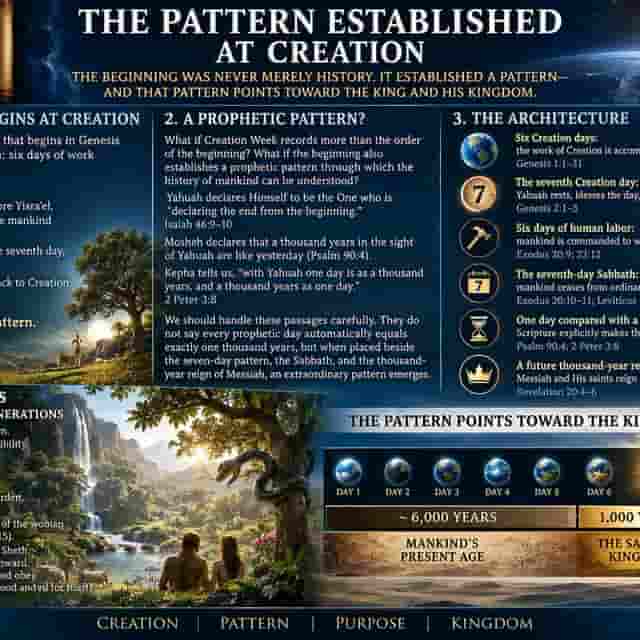
But when we place the day/thousand-year comparison beside the seven-day Creation pattern, the Sabbath, the prophetic Kingdom, and the explicit thousand-year reign of Messiah in Revelation 20, an extraordinary pattern emerges (Genesis 2:1–3; Exodus 20:8–11; Hebrews 4:9–11; Revelation 20:1–7).
Consider the architecture:
– Six Creation days: the work of Creation is accomplished (Genesis 1:1–31).
– The seventh Creation day: Yahuah rests, blesses the day, and sets it apart (Genesis 2:1–3).
– Six days of human labor: mankind is commanded to work six days (Exodus 20:9; 23:12).
– The seventh-day Sabbath: mankind ceases from ordinary labor (Exodus 20:10–11; Leviticus 23:3).
– One day compared with a thousand years: Scripture explicitly makes that comparison (Psalm 90:4; 2 Peter 3:8).
– A future thousand-year reign: Messiah and His saints reign for one thousand years (Revelation 20:4–6).
Taken together, these passages provide the foundation for the seven-thousand-year pattern: approximately six thousand years of mankind’s present age followed by a seventh millennium corresponding to the Sabbath Kingdom.
Scripture does not give us a single verse saying, “Human history shall consist of exactly seven thousand years.”
What Scripture gives us is the pattern.
And that pattern deserves serious examination.
THE FIRST THOUSAND YEARS — CREATION, FALL, AND THE FIRST GENERATIONS
The first millennium begins with Creation and Adam (Genesis 1:1–31; 2:7–25).
Mankind is placed within the Garden and given responsibility under the authority of Yahuah (Genesis 1:26–28; 2:15–17). Almost immediately, however, mankind chooses another way.
The serpent questions the Word of Elohim (Genesis 3:1–5). Adam and Chawwah disobey (Genesis 3:6–7). Judgment follows, mankind is expelled from the Garden, and access to the Tree of Life is guarded (Genesis 3:16–24).
Yet judgment is accompanied by promise.
Yahuah declares that the Seed of the woman will ultimately crush the serpent’s head (Genesis 3:15).
The promise of restoration therefore appears almost immediately after the rebellion.
From that point forward, Scripture begins moving toward the promised Seed.
Cain murders Abel (Genesis 4:1–12). Another line continues through Sheth (Genesis 4:25–26). Genesis then records the generations from Adam onward, giving ages that establish the earliest chronological framework of Scripture (Genesis 5:1–32).
The fundamental conflict has already been established:
Will mankind obey the voice of Yahuah, or determine good and evil for itself? (Genesis 2:16–17; 3:1–7).
That question follows mankind throughout the remaining millennia.
Next: Part 2 — The Flood, Babel, the Nations, and the Covenant Line
— Greg Witter
Ephraim’s Cry
Watchman • Teacher • Author
EphraimsCry.com
#EphraimsCry#Yahuah#Yahusha#CreationWeek#Sabbath#Shabbat#BiblicalProphecy#SevenThousandYears#
KingdomOfElohim#Torah#Covenant#Restoration#Watchman
