
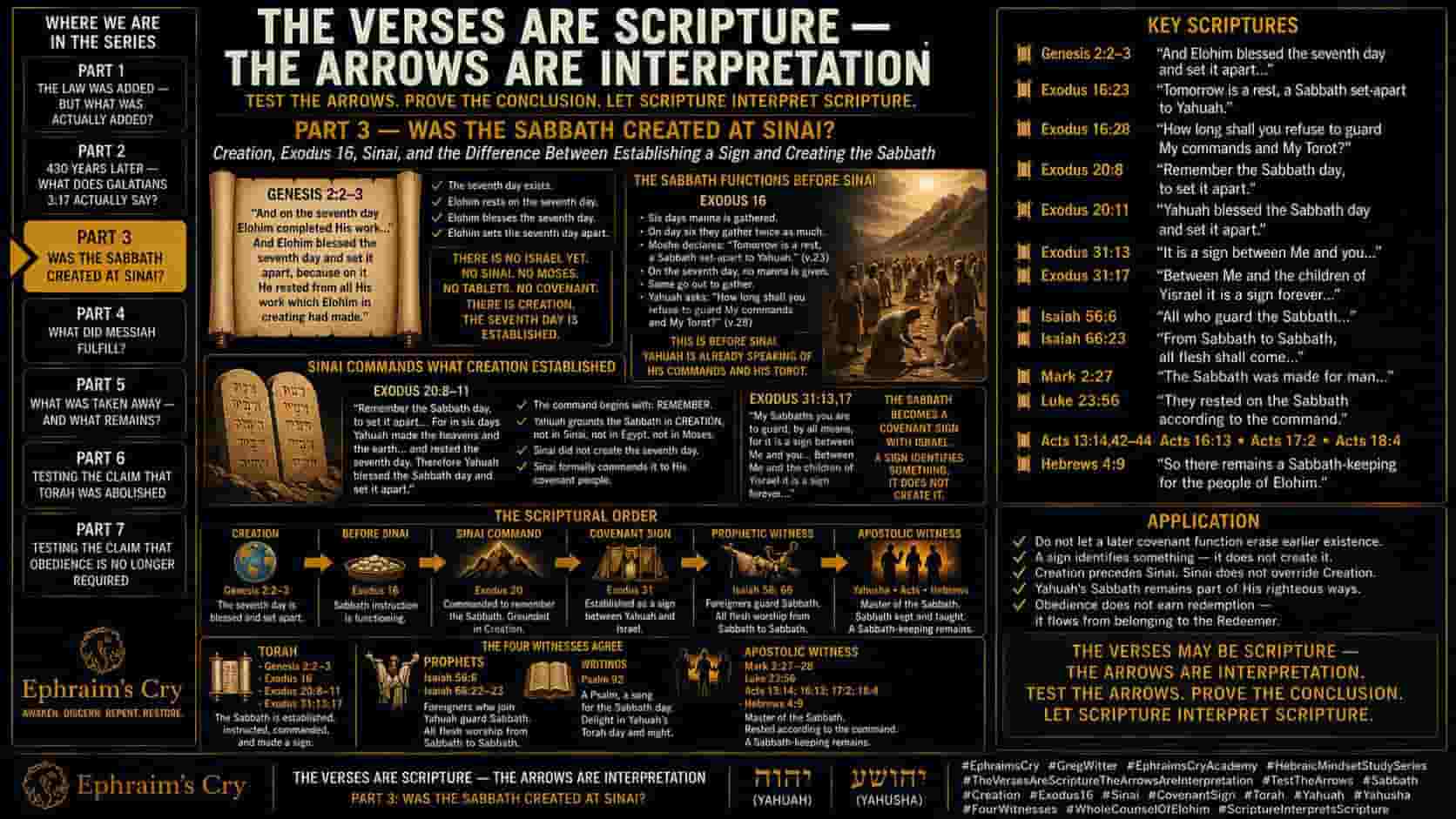
THE VERSES ARE SCRIPTURE — THE ARROWS ARE INTERPRETATION
PART 3 — WAS THE SABBATH CREATED AT SINAI?
Greg Witter | Ephraim’s Cry
Hebraic Mindset Study Series
Study • Learn • Apply • Grow • Share ☆ Repeat
Creation, Exodus 16, Sinai, and the Difference Between Establishing a Sign and Creating the Sabbath
One of the theological arrows that repeatedly appears in discussions about Torah is this:
SINAI → SABBATH GIVEN TO YISRA’EL → SABBATH BEGINS
The verses used to construct that argument may be Scripture.
But the arrow is interpretation.
And once again, the arrow must be proven.
If someone claims that the Sabbath was created at Sinai, we have a very simple way to test that claim:
Go backward in Scripture and see whether the Sabbath existed before Sinai.
If it did, then Sinai cannot be its point of origin.
The chronology settles the question.
And Scripture does not begin the Sabbath at Sinai.
It begins at Creation.
THE SEVENTH DAY APPEARS AT CREATION
Genesis 2:2–3 says:
«“And on the seventh day Elohim completed His work which He had done, and He rested on the seventh day from all His work which He had made. And Elohim blessed the seventh day and set it apart, because on it He rested from all His work which Elohim in creating had made.”»
Look carefully at what Scripture establishes.
The seventh day exists.
Elohim rests on the seventh day.
Elohim blesses the seventh day.
Elohim sets the seventh day apart.
This is Genesis 2.
There is no Yisra’el yet.
There is no Sinai.
There is no Moshe.
There are no stone tablets.
There is no covenant ratification at Horeb.
There is Creation.
And at Creation, Yahuah establishes a six-and-one pattern and distinguishes the seventh day from the other six.
Therefore, whatever later covenantal function the Sabbath receives, Scripture has already established something fundamental:
THE SEVENTH DAY WAS BLESSED AND SET APART BEFORE SINAI.
That fact cannot be erased by beginning a theological timeline at Exodus 20.
SINAI CANNOT CREATE WHAT GENESIS ALREADY ESTABLISHED
This is where the distinction between the verse and the arrow becomes critical.
Someone may quote Exodus 20 and say:
“The Sabbath was given at Sinai.”
But what exactly does that statement mean?
If it means the Sabbath command was formally proclaimed to covenant Yisra’el at Sinai, yes.
If it means the seventh day had no set-apart status before Sinai, Genesis 2 contradicts that conclusion.
Those are two different claims.
Again, we must distinguish:
Existence from codification.
Creation establishment from national covenant administration.
A thing itself from a later covenant function assigned to that thing.
Collapsing all of those categories into the word “given” creates the theological confusion.
EXODUS 16 COMES BEFORE EXODUS 20
Now the evidence becomes even stronger.
Before Yisra’el reaches Sinai, before the Ten Words are proclaimed in Exodus 20, and before the covenant is ratified, the Sabbath is already functioning.
Exodus 16 records the manna instructions.
For six days the people gather manna.
On the sixth day they gather twice as much.
Moshe tells them:
«“Tomorrow is a rest, a Sabbath set-apart to Yahuah.” — Exodus 16:23»
The seventh day arrives.
There is no manna to gather.
Some of the people nevertheless go out looking for it.
Then Yahuah says:
«“How long shall you refuse to guard My commands and My Torot?” — Exodus 16:28»
That statement is before Sinai.
Before Exodus 20.
Before the tablets.
Before the covenant ratification ceremony of Exodus 24.
Yet Yahuah is already speaking about:
MY COMMANDS.
MY TOROT.
And the immediate issue involves the Sabbath.
Therefore, the claim that Sabbath obedience began only when the Ten Words were spoken from Sinai does not survive Exodus 16.
THE MANNA TEST REQUIRES AN EXISTING SABBATH
Think carefully about what happens in Exodus 16.
Yahuah is testing whether Yisra’el will walk in His Torah.
Exodus 16:4 says:
«“In order to try them, whether they walk in My Torah or not.”»
Again, this is before Sinai.
Then the manna cycle operates according to the seven-day pattern.
Days one through five: gather normally.
Day six: gather a double portion.
Day seven: no manna.
That pattern requires the people to recognize the seventh day before Exodus 20.
The Sabbath does not suddenly appear when Yahuah says “Remember” at Sinai.
Yisra’el is already being instructed concerning it.
“REMEMBER THE SABBATH DAY”
Now we arrive at Exodus 20.
Yahuah declares:
«“Remember the Sabbath day, to set it apart.” — Exodus 20:8»
The command begins with:
REMEMBER.
And then Yahuah tells us why the seventh day is set apart.
Exodus 20:11 says:
«“For in six days Yahuah made the heavens and the earth, the sea, and all that is in them, and rested the seventh day. Therefore Yahuah blessed the Sabbath day and set it apart.”»
Where does Yahuah ground the Sabbath?
Not in Egypt.
Not in Moses.
Not in the Levitical priesthood.
Not in the covenant ratification ceremony.
Not even in Sinai itself.
He grounds it in:
CREATION.
Six days.
Creation.
Seventh day.
Rest.
Blessing.
Setting apart.
Exodus 20 reaches directly backward to Genesis 2.
That connection is not an arrow invented by a theologian.
SCRIPTURE MAKES THE CONNECTION ITSELF.
THE SCRIPTURAL ORDER IS CLEAR
Now place the witnesses in chronological order.
GENESIS 2 — CREATION
The seventh day is established.
Elohim rests.
Elohim blesses it.
Elohim sets it apart.
Then:
EXODUS 16 — BEFORE SINAI
The Sabbath is identified.
The manna cycle follows the six-and-one pattern.
The people are instructed concerning Sabbath rest.
Disobedience is rebuked.
Yahuah refers to His commands and His Torot.
Then:
EXODUS 20 — SINAI
Yisra’el is commanded to remember the Sabbath.
The command is explicitly grounded in Creation.
Then later:
EXODUS 31 — COVENANT SIGN
The Sabbath receives a specific covenantal sign function between Yahuah and Yisra’el.
That is the Scriptural sequence:
CREATION → EXODUS 16 → SINAI → COVENANT SIGN
Do not reverse what Scripture established.
BUT WASN’T THE SABBATH A SIGN WITH YISRA’EL?
Yes.
And this is exactly where another theological arrow appears.
Exodus 31:13 says:
«“My Sabbaths you are to guard, by all means, for it is a sign between Me and you throughout your generations…”»
Verse 17 says:
«“Between Me and the children of Yisra’el it is a sign forever…”»
Those verses are Scripture.
Now comes the arrow:
SABBATH IS A SIGN WITH YISRA’EL → THEREFORE THE SABBATH DID NOT EXIST BEFORE YISRA’EL
Stop.
That conclusion does not follow from the verse.
A sign identifies something.
A sign marks something.
A sign testifies to something.
A sign can be assigned a specific covenantal function.
But establishing something as a sign does not necessarily create the thing being used as the sign.
That distinction is essential.
A SIGN DOES NOT CREATE WHAT IT IDENTIFIES
The Sabbath can exist before Sinai and later become a specific covenant sign with Yisra’el.
There is no contradiction.
Genesis 2 answers one question:
When was the seventh day blessed and set apart?
At Creation.
Exodus 16 answers another:
Was Sabbath instruction functioning before Sinai?
Yes.
Exodus 20 answers another:
Was Sabbath commanded within the Sinai covenant?
Yes.
Exodus 31 answers another:
Was Sabbath established as a covenant sign between Yahuah and Yisra’el?
Yes.
All four statements can be true simultaneously.
The error comes when someone takes the fourth statement and uses it to erase the first three.
Scripture does not permit that.
EXISTENCE AND COVENANT FUNCTION ARE NOT THE SAME QUESTION
This distinction is exactly what Parts 1 and 2 prepared us to recognize.
Part 1 distinguished between:
Existence.
Codification.
Covenant ratification.
Covenant sign.
Justification.
Part 2 distinguished between Yahuah’s Torah and the historical covenant administration established at Sinai.
Now Part 3 applies those distinctions directly to the Sabbath.
Something can already exist and later receive a specific covenantal function.
The later function does not prove earlier nonexistence.
That is the same interpretive mistake we confronted with Galatians 3:17.
“CAME LATER” DOES NOT AUTOMATICALLY MEAN “NEVER EXISTED BEFORE.”
And:
“BECAME A SIGN” DOES NOT AUTOMATICALLY MEAN “WAS CREATED AT THAT MOMENT.”
NEHEMIAH 9 MUST BE READ CAREFULLY
Nehemiah 9:13–14 is sometimes used to argue that Sabbath first appeared at Sinai:
«“And You came down on Mount Sinai, and spoke with them from the heavens, and gave them straight right-rulings and Torot of truth, good laws and commands. And You made known to them Your set-apart Sabbath…”»
Again, read exactly what the verse says.
Yahuah made known His set-apart Sabbath to them.
But does “made known” mean:
“created for the first time”?
It cannot.
Genesis 2 already exists.
Exodus 16 already exists.
The Sabbath was already functioning before the people reached the mountain.
Therefore Nehemiah cannot be interpreted in a way that forces Scripture to contradict its own chronology.
Sinai formally revealed, proclaimed, codified, and covenantally administered the Sabbath to the nation.
It did not create the seventh day.
CREATION IS BIGGER THAN SINAI
This distinction matters because Creation precedes every later covenant administration.
Yahuah established patterns at Creation before there was a nation called Yisra’el.
Male and female precede Sinai.
Marriage precedes Sinai.
Work precedes Sinai.
Rest precedes Sinai.
The seven-day cycle precedes Sinai.
The seventh day being blessed and set apart precedes Sinai.
Therefore, when Sinai later incorporates Creation realities into covenant life, we should not automatically assume Sinai created them.
Sinai can command what Creation already established.
That is exactly what Exodus 20 does.
YAHUSHA POINTS BACK TO CREATION
Yahusha (Jesus) gives us another important interpretive principle when discussing the Sabbath.
Mark 2:27 says:
«“The Sabbath was made for man, and not man for the Sabbath.”»
Notice the language.
Yahusha does not say:
“The Sabbath was made only for the Yahudim.”
He says:
FOR MAN.
The Greek term is anthrōpos—humanity, man.
The statement reaches beyond the idea that Sabbath exists merely as an ethnic marker.
And the Creation account explains why.
The seventh day was blessed and set apart before there was a Yisra’elite nation.
Yahusha then says in verse 28:
«“Therefore the Son of Adam is also Master of the Sabbath.”»
He does not reject the Sabbath.
He identifies Himself as its Master.
YAHUSHA DID NOT TREAT SABBATH AS A DEFECT
This matters because another arrow is frequently drawn:
SABBATH → SINAI → BURDEN → MESSIAH → SABBATH REMOVED
But Yahusha does not speak that way.
He confronts corrupt interpretations and human traditions surrounding Sabbath.
He confronts those who turn Sabbath into an oppressive system.
But correcting abuse is not abolishing the command.
Yahusha asks whether it is lawful to do good on the Sabbath.
He does not ask whether Sabbath has become irrelevant.
He restores proper understanding.
The problem was not Yahuah’s Sabbath.
The problem was human handling of it.
THE PROPHETS LOOK FORWARD, NOT AWAY FROM SABBATH
The Prophets also prevent us from treating Sabbath as merely a temporary historical inconvenience.
Isaiah 56 looks toward the inclusion of foreigners who join themselves to Yahuah.
Isaiah 56:6 specifically describes foreigners:
«“all who guard the Sabbath, and not profane it, and are holding onto My covenant.”»
That is significant.
Foreigners.
Covenant.
Sabbath.
Then Isaiah 66:22–23 looks forward to the future restoration and says:
«“And it shall be that from New Moon to New Moon, and from Sabbath to Sabbath, all flesh shall come to worship before Me, declares Yahuah.”»
ALL FLESH.
That is prophetic.
The trajectory is not:
Sabbath → Sinai → Messiah → disappearance.
The prophetic witness points forward to Sabbath.
Again:
Test the arrow.
THE APOSTOLIC WITNESS DOES NOT ERASE THE SABBATH
After Yahusha’s death, Luke records the women preparing spices and perfumes.
Luke 23:56 says:
«“And they rested on the Sabbath according to the command.”»
That statement appears in the Apostolic Witness.
The command is still called:
THE COMMAND.
Acts repeatedly records Sabbath settings as the Good News goes outward.
Acts 13.
Acts 16.
Acts 17.
Acts 18.
The point is not that merely attending somewhere on Sabbath proves every theological question concerning Sabbath.
The point is that the Apostolic Witness does not present the Sabbath as something Messiah had just abolished.
That conclusion must be imported.
HEBREWS STILL SPEAKS OF SABBATH REST
Hebrews 4:9 states:
«“So there remains a Sabbath-keeping for the people of Elohim.”»
The argument in Hebrews develops the themes of rest, faithfulness, entering Yahuah’s rest, and the seventh day.
Hebrews 4:4 explicitly reaches back to Creation:
«“And somewhere He has said thus about the seventh day, ‘And Elohim rested on the seventh day from all His works.’”»
Again, the Apostolic Witness reaches back to Genesis.
Creation remains foundational.
The Sabbath discussion does not begin at Sinai.
THE FOUR WITNESSES AGREE
Now put the whole counsel of Elohim on the table.
TORAH
Genesis 2 establishes the seventh day at Creation.
Exodus 16 demonstrates Sabbath instruction before Sinai.
Exodus 20 commands Yisra’el to remember Sabbath and grounds it in Creation.
Exodus 31 establishes Sabbath as a covenant sign.
PROPHETS
Isaiah calls foreigners joining themselves to Yahuah to guard Sabbath.
Isaiah’s future restoration pictures all flesh worshiping from Sabbath to Sabbath.
WRITINGS
Psalm 92 is explicitly identified as:
«“A Psalm, a song for the Sabbath day.”»
The Writings recognize Sabbath as a day of praise, thanksgiving, and declaring Yahuah’s works.
APOSTOLIC WITNESS
Yahusha identifies Himself as Master of the Sabbath.
Luke records Sabbath rest according to the command.
Acts repeatedly records Sabbath activity.
Hebrews reaches back to Creation and says a Sabbath-keeping remains for the people of Elohim.
The witnesses do not support the claim:
SABBATH BEGAN AT SINAI AND THEREFORE DISAPPEARED WITH SINAI.
That arrow cannot survive the whole counsel of Elohim.
THE REAL QUESTION IS NOT “WAS IT GIVEN AT SINAI?”
Of course Sabbath was commanded at Sinai.
That is not disputed.
The real question is:
DID SINAI CREATE THE SABBATH?
Scripture says no.
The seventh day was already blessed.
Already set apart.
Already embedded in Creation.
Already functioning in Exodus 16.
Sinai formally commands the redeemed covenant nation to remember it.
Later Scripture identifies it as a covenant sign.
Those distinctions preserve every verse.
Nothing needs to be discarded.
Nothing needs to be forced.
Nothing needs to contradict anything else.
REDEMPTION STILL COMES FIRST
And once again, obedience must not be confused with earning salvation.
Yisra’el was redeemed before Sinai.
Yahuah did not tell enslaved Yisra’el:
“Keep Sabbath perfectly and I will consider rescuing you.”
He rescued them.
Then He instructed them.
That pattern matters.
Sabbath obedience does not purchase redemption.
Sabbath obedience is not a substitute for Messiah.
Sabbath keeping does not earn the blood of Yahusha.
But none of those truths means redemption authorizes us to disregard what Yahuah set apart.
The correct order remains:
REDEMPTION FIRST → COVENANT FAITHFULNESS FOLLOWS.
GRACE DOES NOT UN-BLESS WHAT YAHUAH BLESSED
Genesis says Yahuah blessed the seventh day.
That raises a simple question.
Where does Scripture say He later un-blessed it?
Genesis says Yahuah set the seventh day apart.
Where does Scripture say He later made it common?
The burden belongs to the person making that claim.
Do not simply draw:
MESSIAH → SABBATH ENDS
Show the verse.
Where does Yahusha say:
“The seventh day My Father blessed at Creation is no longer blessed”?
Where does Yahusha say:
“The day My Father set apart is now common”?
Where does the Apostolic Witness say:
“Because Messiah came, the seventh day has lost the distinction Yahuah gave it at Creation”?
That burden cannot be satisfied merely by pointing to Sinai.
Sinai came after Creation.
THIS IS THE ARROW TEST
Here is the claim:
The Sabbath was given as a sign to Yisra’el.
True.
Now comes the arrow:
Therefore the Sabbath did not exist before Sinai.
False.
Genesis 2 and Exodus 16 prevent that conclusion.
Then another arrow:
The Sabbath belonged to the Sinai covenant.
It certainly functioned within that covenant.
Then:
Therefore when that covenant administration changed, the Sabbath disappeared.
Stop.
That conclusion must be proven.
Creation still stands.
The Prophets still stand.
Yahusha still stands.
The Apostolic Witness still stands.
Do not confuse a later covenant function with the original existence of what received that function.
THE WATCHMAN WARNING
Do not allow a theological system to begin the Sabbath story at Sinai when Scripture begins it at Creation.
That is the fundamental error.
If Genesis 2 says Yahuah blessed and set apart the seventh day, then Exodus 31 cannot be interpreted as though the seventh day had no set-apart status until it became a covenant sign.
If Exodus 16 shows Yisra’el receiving Sabbath instruction before Sinai, then Exodus 20 cannot be interpreted as the first existence of Sabbath.
If Exodus 20 itself reaches backward to Creation as the reason for Sabbath, then the command tells us where its foundation lies.
If Isaiah looks forward and sees foreigners guarding Sabbath and ultimately all flesh worshiping before Yahuah from Sabbath to Sabbath, then the prophetic trajectory does not point toward Sabbath disappearing.
If Yahusha identifies Himself as Master of the Sabbath and says Sabbath was made for man, we cannot make His mission the destruction of what He claims authority over.
If Hebrews reaches backward to the seventh day of Creation and says Sabbath-keeping remains for the people of Elohim, we cannot simply erase that witness because a theological system tells us Sinai ended everything associated with Sabbath.
Put the whole counsel of Elohim on the table.
Do not protect the arrow.
Protect the integrity of Scripture.
THE VERSES ESTABLISH THE ORDER
The Scriptural sequence is not difficult:
CREATION → SABBATH ESTABLISHED
EXODUS 16 → SABBATH FUNCTIONING BEFORE SINAI
EXODUS 20 → SABBATH COMMANDED TO COVENANT YISRA’EL AND GROUNDED IN CREATION
EXODUS 31 → SABBATH ESTABLISHED AS A COVENANT SIGN
Those are different stages.
They answer different questions.
Creation answers the question of origin.
Exodus 16 establishes pre-Sinai function.
Exodus 20 establishes formal covenant command and explicitly points backward to Creation.
Exodus 31 establishes covenant-sign function.
The mistake is collapsing all four into one statement:
“The Sabbath was given at Sinai.”
That statement is too imprecise to carry the theological weight placed upon it.
Given in what sense?
Created?
No.
First blessed?
No.
First set apart?
No.
First functioning?
No.
Formally commanded within the Sinai covenant?
Yes.
Established as a covenant sign with Yisra’el?
Yes.
Precision matters.
DO NOT LET ONE TRUE STATEMENT CREATE A FALSE CONCLUSION
This is the governing lesson of the entire series.
“The Sabbath was a covenant sign between Yahuah and Yisra’el.”
True.
But truth can be connected to an unsupported conclusion.
TRUE VERSE → FALSE ARROW → FALSE CONCLUSION
The fact that the first statement is Scriptural does not automatically sanctify everything placed after it.
The Sabbath was a covenant sign.
That does not prove it originated when it became a sign.
The Sabbath was commanded at Sinai.
That does not prove it originated at Sinai.
The Sabbath was given specific covenantal meaning to Yisra’el.
That does not erase Genesis 2.
The verses must control the conclusion.
WHAT WOULD HAVE TO BE PROVEN?
If someone wants to establish that the Sabbath ended because the Sinai covenant administration changed, several questions must actually be answered.
Where does Scripture say the seventh day Yahuah blessed at Creation was later un-blessed?
Where does Scripture say the seventh day Yahuah set apart was later made common?
Where does Scripture say the Creation pattern ceased?
Where does Yahusha abolish Sabbath?
Where do the Prophets announce that Sabbath will disappear when Messiah comes?
Where does the Apostolic Witness declare the seventh day no longer set apart?
Those are not rhetorical distractions.
They are burden-of-proof questions.
If the claim is:
MESSIAH → SABBATH ABOLISHED
then show the connection.
Do not merely assume it.
THE CREATION FOUNDATION CANNOT BE IGNORED
This is ultimately why the Sinai-only argument fails.
The Sabbath has roots deeper than Sinai.
Its roots are in Creation.
Before Yisra’el existed as a nation, Yahuah established the seven-day pattern.
Before there was a Levitical priesthood, Yahuah blessed the seventh day.
Before there was a tabernacle, Yahuah set apart the seventh day.
Before there were sacrifices at Sinai, Yahuah rested on the seventh day.
Sinai did not reach forward and create Genesis 2.
Genesis 2 came first.
Therefore, any interpretation of Sinai must remain consistent with Creation.
THE DECISIVE POINT
Was the Sabbath created at Sinai?
NO.
Was Sabbath formally commanded within the covenant made with Yisra’el at Sinai?
YES.
Was Sabbath established as a specific covenant sign between Yahuah and Yisra’el?
YES.
Did those later covenant functions create the seventh day, its blessing, or its set-apart status?
NO.
Scripture already established those things at Creation.
That is the distinction.
And once the distinction is maintained, every verse remains standing.
Genesis remains standing.
Exodus remains standing.
The Prophets remain standing.
The Writings remain standing.
The Apostolic Witness remains standing.
We do not need Scripture to contradict itself.
We need our interpretation to submit to Scripture.
WHERE PART 3 LEAVES US
Part 1 established that “added” does not automatically mean “first came into existence.”
Part 2 established that “430 years later” does not automatically mean “nothing existed before.”
Part 3 now establishes that “became a covenant sign” does not mean “was created at that moment.”
That progression matters.
The same interpretive error keeps appearing in different forms.
A verse establishes something true.
An arrow adds something the verse never said.
Then the conclusion is presented as though the verse itself established it.
That is precisely what we must stop doing.
The Sabbath was established at Creation.
It functioned before Sinai.
It was commanded at Sinai.
It became a covenant sign with Yisra’el.
Those are the verses.
Now test every arrow drawn between them.
COMING IN PART 4
THE GUARDIAN UNTIL MESSIAH — DOES “UNTIL” MEAN TORAH ENDED?
Another major theological arrow is built from Galatians 3:
TORAH → GUARDIAN → UNTIL MESSIAH → TORAH ENDED
But does the word “until” automatically mean abolition?
What was the guardian?
What was its purpose?
What changed when Messiah came?
And does Sha’ul’s argument actually establish the disappearance of Yahuah’s righteous instruction—or is that conclusion another arrow drawn between the verses?
That is where Part 4 takes us.
Because the standard remains the same:
THE VERSES MAY BE SCRIPTURE.
THE ARROWS ARE INTERPRETATION.
TEST THE ARROWS.
#EphraimsCry#GregWitter#EphraimsCryAcademy#HebraicMindsetStudySeries#TheVersesAreScriptureTheArrowsAreInterpretation#
TestTheArrows#Sabbath#SeventhDaySabbath#CreationSabbath#Genesis2#Exodus16#Exodus20#Exodus31#Torah#Covenant
#CovenantSign#Yahuah#Yahusha#Yisrael#FourWitnesses#WholeCounselOfElohim#ScriptureInterpretsScripture#BiblicalContext
#CovenantFaithfulness#TorahObedience#TestAllThings#HebraicMindset#ReturnToCovenant#KingdomOfElohim
