
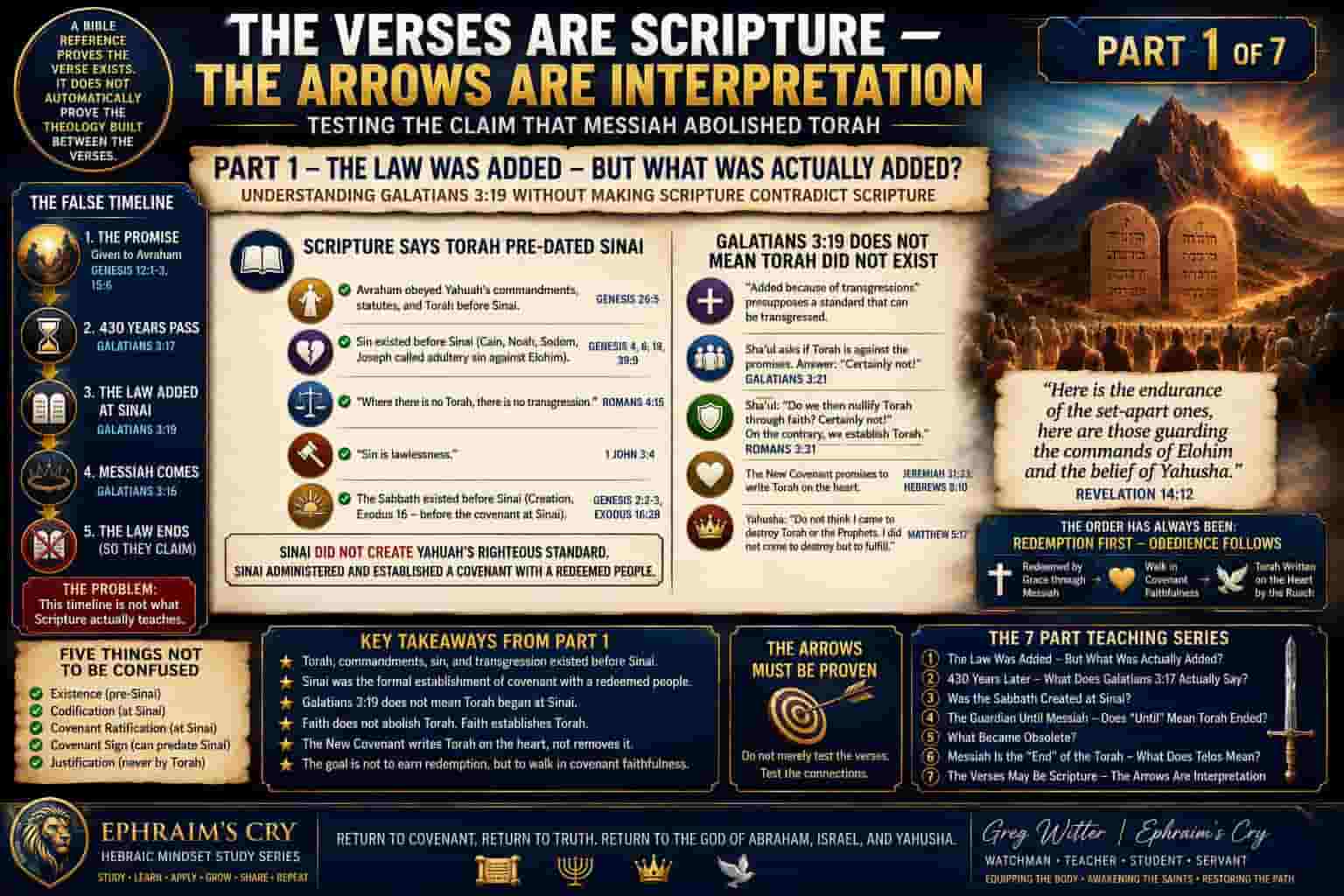
THE VERSES ARE SCRIPTURE — THE ARROWS ARE INTERPRETATION
PART 1 — THE LAW WAS ADDED — BUT WHAT WAS ACTUALLY ADDED?
Greg Witter | Ephraim’s Cry
Hebraic Mindset Study Series
Study • Learn • Apply • Grow • Share ☆ Repeat
Understanding Galatians 3:19 Without Making Scripture Contradict Scripture
A Bible reference proves the verse exists. It does not automatically prove the theology built between the verses.
One of the most common arguments used to establish that Torah was temporary is built from Galatians 3:19:
“Why, then, the Torah? It was added because of transgressions, until the Seed should come to whom the promise was made.”
From that verse, a theological timeline is often constructed:
Avraham receives the promise → 430 years pass → Torah begins at Sinai → Messiah comes → Torah ends.
It looks clean.
It sounds reasonable.
It fits neatly into a graphic.
But a neat timeline is not the same thing as a Scriptural conclusion.
The verses may be Scripture.
The arrows are interpretation.
And those arrows must be proven.
The first question is not whether Galatians 3:19 uses the language of something being “added.” It does.
The question is much more precise:
What was added? In what sense was it added? Why was it added? What existed before Sinai? What changed at Sinai? And does the coming of the Seed mean Yahuah abolished His standard of righteousness?
We cannot answer those questions from one verse while ignoring the rest of Scripture.
The whole counsel of Elohim must remain on the table.
BEFORE SINAI — TORAH WAS ALREADY PRESENT
The claim that Torah first came into existence at Sinai immediately encounters a problem in Genesis.
Yahuah says concerning Avraham (Abraham):
“Avraham obeyed My voice and kept My charge, My commandments, My statutes, and My Torah.”
— Genesis 26:5
Avraham lived centuries before Sinai.
Read the language carefully.
Yahuah does not merely say Avraham was a generally decent person.
He specifically identifies:
My voice.
My charge.
My commandments.
My statutes.
My Torah.
Therefore, whatever Galatians 3:19 means, it cannot mean Yahuah possessed no commandments, statutes, or Torah until Moses stood at Mount Sinai.
Genesis has already prevented that conclusion.
Someone may respond, “But Avraham did not possess the complete written Torah given through Moses.”
That is an entirely different statement.
Now we are discussing codification, not existence.
And those two things must not be confused.
Something may exist before it is formally written, organized, expanded, and covenantally administered to a nation.
That distinction is foundational to this entire discussion.
SIN EXISTED BEFORE SINAI
There is another major problem with the idea that Yahuah had no Torah or righteous standard before Sinai.
Sin existed before Sinai.
Cain murdered Abel.
The generation of Noah became corrupt and violent.
Sodom and Gomorrah were judged for wickedness.
Joseph refused adultery with Potiphar’s wife and declared:
“How then can I do this great wickedness and sin against Elohim?”
— Genesis 39:9
Joseph lived before Sinai.
Yet Joseph already understood adultery as sin against Elohim.
How?
Because righteousness did not begin at Sinai.
Yahuah did not suddenly decide at Mount Sinai that murder, adultery, theft, idolatry, and rebellion were wrong.
Sin already existed because Yahuah’s righteous standard already existed.
YOU CANNOT TRANSGRESS A NONEXISTENT STANDARD
Now bring in the Apostolic Witness.
Sha’ul (Paul) writes:
“Where there is no Torah, there is no transgression.”
— Romans 4:15
That statement has enormous consequences for interpreting Galatians 3:19.
Galatians says something was added:
“because of transgressions.”
Romans says:
“where there is no Torah there is no transgression.”
Therefore, the existence of transgression cannot be used to prove Torah did not previously exist.
Quite the opposite.
If people were transgressing, there was already something capable of being transgressed.
This does not yet answer every question concerning what was added at Sinai.
But it destroys the simplistic formula:
No Torah existed → people transgressed → therefore Yahuah created Torah.
That cannot work.
You cannot violate a nonexistent command.
You cannot transgress a nonexistent boundary.
You cannot be guilty of lawlessness when no righteous standard exists.
WHAT IS SIN?
The Apostolic Witness reinforces this further:
“Sin is lawlessness.”
— 1 John 3:4
Sin is not merely whatever human beings happen to dislike.
Sin is not created by culture.
Sin is not defined by denominational theology.
Sin involves violation of Yahuah’s righteous standard.
So when Galatians 3:19 speaks of transgressions, the word itself requires us to recognize an already-existing standard.
That should force us to slow down before claiming:
“Added means Torah suddenly came into existence.”
The text requires greater precision than that.
THE SABBATH ALSO PREDATES SINAI
The Sabbath provides another unmistakable witness.
Genesis 2:2–3 places the seventh day at Creation.
Elohim rested on the seventh day.
He blessed the seventh day.
He set it apart.
That occurred long before Sinai.
Then Exodus 16 provides an even more direct witness.
Yisra’el (Israel) has not yet reached Mount Sinai.
The covenant of Exodus 19–24 has not yet been ratified.
Yet Yahuah gives instructions concerning manna and the Sabbath.
When some refuse to obey, Yahuah asks:
“How long shall you refuse to keep My commandments and My Torah?”
— Exodus 16:28
Before Sinai.
Before the tablets.
Before the covenant ratification ceremony.
Yahuah is already speaking of His commandments and His Torah.
Therefore Sinai cannot honestly be treated as the moment when Yahuah suddenly invented divine instruction.
Something significant happened at Sinai.
But “Torah first existed” is not an adequate description of it.
THEN WHAT DID HAPPEN AT SINAI?
At Sinai, Yahuah took a people He had already redeemed and formally established them as His covenant nation.
This order is critical.
Yisra’el did not keep Torah perfectly in Egypt and thereby earn deliverance.
Yahuah redeemed them first.
He brought them through the sea.
He sustained them.
He brought them to Himself.
Then Exodus 19:4 declares:
“You have seen what I did to the Mitsrites, and how I bore you on eagles’ wings and brought you to Myself.”
Only after redemption does Yahuah establish the covenantal responsibilities of His redeemed people.
That pattern destroys the accusation that Torah was given as a system through which enslaved sinners could earn salvation.
It was not.
Redemption came first.
Then came covenant instruction.
That same pattern continues throughout Scripture.
We do not obey in order to purchase redemption.
We obey because we belong to the Redeemer.
FIVE DIFFERENT THINGS ARE BEING COLLAPSED INTO ONE WORD
A major reason this debate becomes confused is because very different theological categories are all compressed into the single English word “law.”
We must distinguish them.
Existence: Did Yahuah’s righteous instruction exist before Sinai?
Yes.
Codification: Were Yahuah’s instructions formally declared, written, organized, and expanded for covenant Yisra’el?
Yes.
Covenant ratification: Was a specific covenant formally made with Yisra’el at Sinai?
Yes.
Covenant sign: Could something already existing later function as a specific sign of covenant relationship?
Yes. The Sabbath is a clear example.
Justification: Could Torah obedience purchase righteousness or redemption?
No.
Those five questions are not interchangeable.
Yet many theological diagrams collapse them into one box:
LAW
They put Sinai at the beginning.
Messiah at the end.
Then an arrow announces:
LAW ENDED.
But the arrow has not been proven.
GALATIANS 3 IS DEFENDING THE PROMISE
Now return to Galatians itself.
Galatians 3:16 identifies the Seed connected to the promise as Messiah.
Then Galatians 3:17 explains that what came 430 years later could not annul the promise previously established by Elohim.
What is Sha’ul defending?
The promise.
His argument is that Yahuah’s later covenantal administration at Sinai could not cancel the promise given beforehand to Avraham.
That does not mean:
“There were no commandments before Sinai.”
It means:
“Sinai cannot invalidate the promise.”
Those are completely different propositions.
The promise came first.
Sinai came later.
Sinai could not cancel the promise.
Messiah is the promised Seed.
That is the argument.
“WHY THEN THE TORAH?”
Now Sha’ul asks the question in Galatians 3:19:
“Why then the Torah?”
Why was something added because of transgressions?
That question follows his argument concerning the promise.
But here is where interpretation must remain disciplined.
We cannot answer Sha’ul by contradicting Genesis.
We cannot answer Sha’ul by denying sin before Sinai.
We cannot answer Sha’ul by pretending Avraham never obeyed Yahuah’s commandments.
We cannot answer Sha’ul by ignoring Exodus 16.
We cannot answer Sha’ul by contradicting Romans 4:15.
Therefore “added” cannot simply mean:
“Yahuah had no Torah, then He invented Torah at Sinai.”
Scripture will not allow that interpretation.
Something more specific happened.
The Sinai covenant brought formal national codification, administration, judgments, priestly structures, sacrifices, penalties, and covenant governance into the life of a redeemed nation.
But Yahuah’s righteousness did not originate there.
That distinction is essential.
GALATIANS ITSELF STOPS THE FALSE CONCLUSION
Two verses later, Sha’ul asks:
“Is the Torah then against the promises of Elohim?”
— Galatians 3:21
His answer is forceful:
Certainly not.
That is an interpretive boundary.
Whatever Galatians 3:19 means, Torah cannot be turned into the enemy of the promise.
Whatever “added” means, it cannot make Yahuah’s righteousness temporary.
Whatever “until the Seed should come” means, we cannot simply assume it means Messiah arrived to abolish covenant obedience.
That conclusion must be proven.
It cannot merely be placed between two verses with an arrow.
SHA’UL DOES NOT PUT FAITH AGAINST TORAH
Romans makes this even clearer.
Sha’ul asks:
“Do we then nullify the Torah through faith?”
— Romans 3:31
His answer:
Certainly not. On the contrary, we establish the Torah.
That verse matters.
If our interpretation of Galatians says faith nullifies Torah, while Sha’ul explicitly says faith does not nullify Torah, then Sha’ul is not the contradiction.
Our interpretation is.
Romans 7:12 says:
“The Torah is set-apart, and the commandment set-apart and righteous and good.”
This is the same Sha’ul.
The writer of Galatians calls Torah righteous and good.
Therefore we should be extremely cautious about making him teach that Messiah came to remove Yahuah’s righteous and good standard.
YAHUSHA SAID DO NOT THINK THAT
Yahusha (Jesus) directly warns against another conclusion:
“Do not think that I came to destroy the Torah or the Prophets. I did not come to destroy but to fulfill.”
— Matthew 5:17
The first words matter:
DO NOT THINK.
Whatever “fulfill” means, it cannot mean the exact opposite of what Yahusha just said.
He did not say:
“I did not come to destroy Torah, but I came to destroy Torah.”
Yet that is effectively what abolition theology requires “fulfill” to mean.
Yahusha continues by warning against breaking even the least commandments and teaching others to do the same.
Messiah does not establish righteousness by abolishing Yahuah’s definition of righteousness.
THE NEW COVENANT WRITES TORAH UPON THE HEART
Now bring in the Prophets.
Jeremiah 31:31 announces the New Covenant.
And with whom?
The house of Yisra’el and the house of Yahudah (Judah).
Then Yahuah declares:
“I will put My Torah within them and write it upon their hearts.”
— Jeremiah 31:33
Hebrews 8 repeats the same promise.
This creates a devastating problem for Torah-abolition theology.
If the New Covenant abolishes Torah, why does the New Covenant explicitly promise to write Torah upon the heart?
The New Covenant does not say:
“I will remove My Torah from them.”
It says:
“I will put My Torah within them.”
That is not abolition.
That is internalization.
WHAT WAS WRONG?
Hebrews 8:8 says:
“Finding fault with them…”
Jeremiah 31 says:
“My covenant which they broke.”
The people broke Covenant.
The problem was not that righteousness had become defective.
The problem was covenant-breaking hearts.
Yahuah’s solution is not to abolish His righteous instructions.
His solution is to transform His people and write those instructions within them.
That is restoration.
That is Covenant renewal.
That is the heart of the New Covenant promise.
GRACE DOES NOT MEAN LAWLESSNESS
Now we must guard the other side of this teaching.
Torah obedience does not save us.
Sabbath keeping does not purchase redemption.
Eating clean does not purchase redemption.
Keeping Feast days does not purchase redemption.
No human being earns the blood of Messiah.
Yahusha is our redemption.
Salvation is by grace through faith.
But grace does not convert rebellion into righteousness.
Sha’ul anticipated that distortion in Romans 6:
“Shall we continue in sin that grace may increase?”
His answer:
Certainly not.
Grace delivers us from slavery to sin.
It does not abolish Yahuah’s definition of sin.
THE SCRIPTURAL ORDER IS REDEMPTION THEN OBEDIENCE
This is one of the most important distinctions in the entire discussion.
Scripture does not teach:
Obey → earn redemption.
Scripture teaches:
Redeemed → therefore walk faithfully.
Avraham believed Yahuah and was counted righteous.
Then Scripture tells us Avraham obeyed Yahuah’s voice, commandments, statutes, and Torah.
Yisra’el was redeemed from Egypt.
Then Yisra’el was instructed how redeemed people should live.
Yahusha redeems.
The Ruach HaKodesh transforms.
The New Covenant writes Torah upon the heart.
And at the end of Scripture, Revelation 14:12 identifies the faithful as those who:
keep the commandments of Elohim AND the faith of Yahusha.
Not Torah instead of Messiah.
Not Messiah instead of obedience.
Not works instead of grace.
Not grace instead of righteousness.
Faith and covenant faithfulness standing together.
THE VERSES MAY BE RIGHT WHILE THE ARROWS ARE WRONG
This is the warning that governs this entire series.
A person can construct a graphic using nothing but legitimate Bible verses and still teach a false conclusion.
How?
By placing an unsupported interpretation between them.
The verse says:
The promise came before Sinai.
True.
The arrow says:
Therefore Torah did not exist before Sinai.
Prove it.
The verse says:
Something was added because of transgressions.
True.
The arrow says:
Therefore Yahuah’s entire righteous standard began at Sinai.
Prove it.
The verse says:
Torah cannot justify.
True.
The arrow says:
Therefore Torah has been abolished.
Prove it.
The verse says:
Messiah is the Seed.
Absolutely true.
The arrow says:
Therefore Messiah ended obedience to Yahuah.
Prove it.
The verse says:
The first covenant became obsolete.
True.
The arrow says:
Therefore Torah became obsolete.
Prove it.
That is the discipline Scripture requires.
Do not merely test the verses. Test the arrows.
THE WATCHMAN WARNING
We have to stop allowing theological systems to force Scripture to testify against itself.
If Genesis says Avraham kept Yahuah’s commandments and Torah, Galatians cannot mean Torah did not exist until Moses.
If Romans says there is no transgression where there is no Torah, transgression cannot prove the absence of Torah.
If Exodus speaks of Yahuah’s commandments and Torah before Sinai, Sinai cannot be the absolute beginning of divine instruction.
If Yahusha says He did not come to destroy Torah, we cannot define His mission as destroying Torah.
If Sha’ul says faith establishes Torah, we cannot make Sha’ul teach that faith abolished Torah.
If Jeremiah and Hebrews say the New Covenant writes Torah upon the heart, we cannot define the New Covenant as removing Torah.
If Revelation still presents the faithful as keeping the commandments of Elohim and the faith of Yahusha, we cannot manufacture a Gospel that makes those two things enemies.
The whole counsel of Elohim must remain on the table:
Torah.
Prophets.
Writings.
Apostolic Witness.
The witnesses must agree.
WHERE PART 1 LEAVES US
Galatians 3:19 absolutely says something was added because of transgressions.
We are not denying the verse.
We are refusing to add an interpretation to it that contradicts the rest of Scripture.
Part 1 establishes the foundation:
Yahuah’s righteous standard existed before Sinai.
Sin existed before Sinai.
Transgression existed before Sinai.
Avraham obeyed Yahuah’s commandments, statutes, and Torah before Sinai.
The Sabbath existed before Sinai.
Yahuah referred to His commandments and Torah before Sinai.
Sinai formally established and administered covenant instruction to a redeemed nation, but Sinai did not create Yahuah’s righteousness.
Therefore the simplistic timeline—
NO TORAH → SINAI → TORAH → MESSIAH → NO TORAH
—cannot survive the witnesses.
Something was added.
Something served a particular purpose because of transgression.
Something functioned in relation to the coming Seed.
But we cannot define that “something” by destroying everything Scripture has already established.
That is why the next question must be approached carefully.
Galatians 3:17 specifically tells us that something came 430 years after the promise.
What came 430 years later?
What did not come 430 years later?
What exactly is Sha’ul comparing?
What Covenant is he discussing?
And most importantly:
Does “430 years later” prove Torah did not previously exist—or is that another arrow someone has drawn between the verses?
That is where Part 2 begins.
PART 2 — 430 YEARS LATER — WHAT DOES GALATIANS 3:17 ACTUALLY SAY?
The Promise to Avraham, Sinai, and the Covenant That Could Not Be Annulled
Before accepting any theological timeline, test every connection.
Because a verse printed beside another verse does not prove the theology connecting them.
The verses may be Scripture.
The arrows are interpretation.
TEST THE ARROWS.
#EphraimsCry#GregWitter#EphraimsCryAcademy#HebraicMindsetStudySeries#TheVersesAreScriptureTheArrowsAreInterpretation
#TestTheArrows#Torah#Galatians3#Galatians319#AbrahamicCovenant#Avraham#Sinai#Covenant#NewCovenant#Yahusha
#Yahuah#WholeCounselOfElohim#FourWitnesses#TorahProphetsWritingsApostolicWitness#ScriptureInterpretsScripture
#CovenantFaithfulness#TorahObedience#FaithAndObedience#GraceAndTruth#BiblicalContext#TestAllThings#ScriptureStudy
#HebraicMindset#KingdomOfElohim#ReturnToCovenant
