
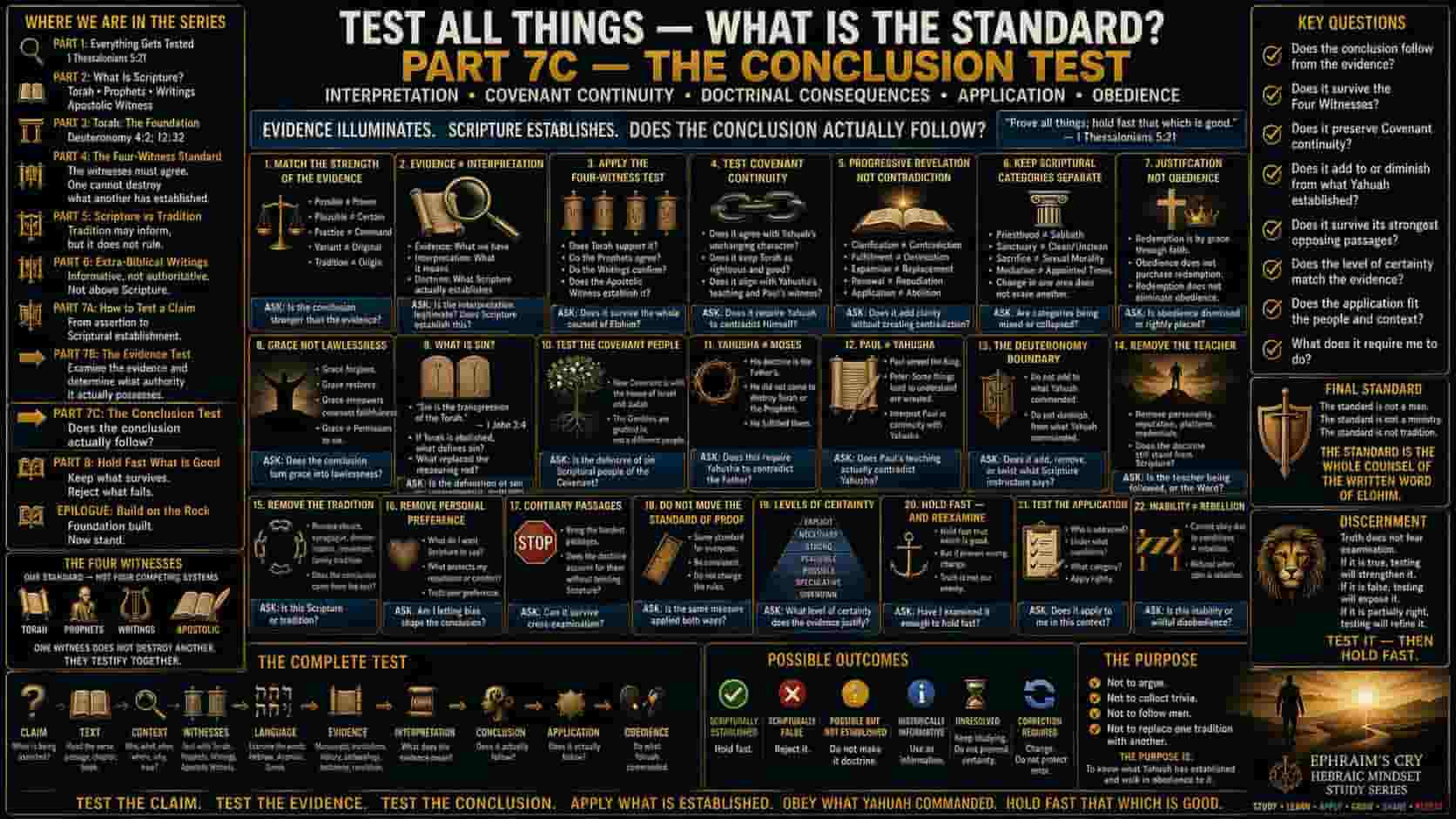
TEST ALL THINGS — WHAT IS THE STANDARD?
PART 7C — THE CONCLUSION TEST
INTERPRETATION • COVENANT CONTINUITY • DOCTRINAL CONSEQUENCES • APPLICATION • OBEDIENCE
Greg Witter | Ephraim’s Cry
Hebraic Mindset Study Series
Study • Learn • Apply • Grow • Share • Repeat
Part 7A taught us how to test the claim.
Part 7B taught us how to test the evidence being presented to support that claim.
Now we come to the final stage of the testing process:
DOES THE CONCLUSION ACTUALLY FOLLOW?
This is where many arguments fail.
A person can present legitimate evidence and still reach an illegitimate conclusion.
A manuscript may genuinely contain the reading being cited.
A Hebrew word may genuinely possess the semantic possibility being presented.
Masoretic vowel points may genuinely preserve a particular later reading tradition.
An archaeological discovery may genuinely exist.
Josephus may genuinely record the practice being discussed.
An ancient community may genuinely have practiced what someone says it practiced.
A scholar may accurately describe the evidence.
A personal experience may genuinely have happened.
But none of those things automatically proves the theological conclusion attached to them.
That is why Part 7B established:
EVIDENCE HAS VALUE — BUT IT HAS A MASTER.
Now Part 7C asks:
What does that evidence actually allow us to conclude?
Does the conclusion follow from the evidence?
Does it survive the Four Witnesses?
Does it preserve Covenant continuity?
Does it require one Scriptural witness to contradict another?
Does it add to or diminish from what Yahuah established?
Does it survive its strongest opposing passages?
What happens when the conclusion is followed to its logical destination?
And finally:
WHAT DOES THE ESTABLISHED TRUTH REQUIRE ME TO DO?
Paul’s command remains the governing standard:
“Prove all things; hold fast that which is good.” — 1 Thessalonians 5:21
We tested the claim.
We tested the evidence.
Now:
TEST THE CONCLUSION.
1. DO NOT MAKE THE CONCLUSION STRONGER THAN THE EVIDENCE
This is the first rule.
The strength of the conclusion must correspond to the strength of the evidence.
If the evidence establishes:
POSSIBLE
do not announce:
PROVEN.
If the evidence establishes:
PLAUSIBLE
do not announce:
CERTAIN.
If the evidence establishes:
SOME PEOPLE PRACTICED THIS
do not announce:
YAHUAH COMMANDED THIS.
If the evidence establishes:
THIS MANUSCRIPT CONTAINS THIS READING
do not announce:
THIS READING IS UNQUESTIONABLY ORIGINAL.
If the evidence establishes:
THIS LATER VOCALIZATION TRADITION READ THE WORD THIS WAY
do not announce:
THIS UNQUESTIONABLY PROVES THE ORIGINAL ANCIENT PRONUNCIATION.
Those are evidentiary leaps.
Say what the evidence establishes.
No more.
No less.
2. EVIDENCE AND INTERPRETATION ARE NOT THE SAME THING
Evidence asks:
WHAT DO WE HAVE?
Interpretation asks:
WHAT DOES IT MEAN?
Doctrine asks:
WHAT DOES SCRIPTURE ACTUALLY ESTABLISH?
Those are different questions.
Suppose archaeology establishes that ancient Israelites performed a particular practice.
That establishes historical activity.
It does not automatically establish Torah.
Suppose an ancient manuscript contains a textual variant.
That establishes the existence of the variant.
It does not automatically establish which reading is original.
Suppose a Hebrew word has several possible meanings.
That establishes semantic range.
It does not automatically establish which meaning the writer intended in that particular passage.
The evidence can be legitimate.
The interpretation can still be wrong.
DO NOT CONFUSE THE EXISTENCE OF EVIDENCE WITH THE VALIDITY OF THE CONCLUSION.
3. APPLY THE FOUR-WITNESS TEST TO THE CONCLUSION
The conclusion must now survive the complete Scriptural testimony:
TORAH
PROPHETS
WRITINGS
APOSTOLIC WITNESS
Torah establishes the foundation.
The Prophets enforce Covenant faithfulness and call Yisra’el back to what Yahuah established.
The Writings demonstrate Covenant truth through history, wisdom, worship, obedience, rebellion, consequence, and restoration.
The Apostolic Witness testifies concerning Yahusha and confirms Yahuah’s continuing Covenant and Kingdom purpose.
These are not four competing theological systems.
Therefore:
Do not use Paul to silence Moses.
Do not use Yahusha to erase the Prophets.
Do not use poetic language from the Writings to overthrow explicit Torah instruction.
Do not use one difficult Apostolic passage to destroy dozens of clear Scriptural witnesses.
ONE WITNESS DOES NOT DESTROY ANOTHER.
If the conclusion requires that, the conclusion has failed.
4. TEST COVENANT CONTINUITY
Ask:
Does this conclusion preserve the continuity of Yahuah’s character, Covenant, righteousness, and Kingdom?
Or does it require Yahuah to contradict what He previously established?
Yahuah says:
“For I am Yahuah, I change not…” — Malachi 3:6
The Writings declare:
“Thy righteousness is an everlasting righteousness, and thy Torah is the truth.” — Psalm 119:142
Yahusha says:
“Think not that I am come to destroy the Torah, or the prophets…” — Matthew 5:17
Paul says:
“Do we then make void the Torah through faith? Elohim forbid: yea, we establish the Torah.” — Romans 3:31
Those witnesses establish continuity.
If an interpretation requires Yahuah’s previous righteousness to become unrighteousness, test the interpretation again.
5. PROGRESSIVE REVELATION IS NOT PROGRESSIVE CONTRADICTION
Scripture unfolds.
Later revelation can provide additional clarity.
The Prophets reveal dimensions of Yahuah’s Kingdom purpose.
Yahusha accomplishes the redemptive work anticipated throughout Scripture.
The Apostolic Witness explains Messiah’s death, resurrection, priesthood, mediation, restoration, and Kingdom mission.
But greater revelation does not require contradiction.
Keep the distinctions clear:
CLARIFICATION IS NOT CONTRADICTION.
FULFILLMENT IS NOT DESTRUCTION.
EXPANSION IS NOT REPLACEMENT.
RENEWAL IS NOT REPUDIATION.
APPLICATION IS NOT ABOLITION.
If our definition of progressive revelation requires Yahuah eventually to contradict Himself, we have not discovered progression.
We have created contradiction.
6. KEEP SCRIPTURAL CATEGORIES SEPARATE
Many false conclusions are produced by collapsing different Scriptural categories.
For example, Hebrews discusses:
Priesthood.
Sacrifice.
Sanctuary.
Mediation.
Atonement.
Access.
Covenant.
The work of Yahusha.
Hebrews 7:12 discusses a change associated with the priesthood.
Then study the priesthood.
Do not silently transform:
A CHANGE CONCERNING PRIESTHOOD
into:
YAHUAH CHANGED HIS DEFINITION OF RIGHTEOUSNESS.
Those are different claims.
A priesthood issue does not automatically abolish Sabbath.
A sanctuary issue does not automatically abolish clean and unclean.
A sacrificial issue does not automatically abolish sexual morality.
A mediation issue does not automatically abolish appointed times.
A CHANGE IN ONE CATEGORY DOES NOT AUTOMATICALLY ERASE ANOTHER CATEGORY.
7. DISTINGUISH JUSTIFICATION FROM OBEDIENCE
Torah obedience does not purchase redemption.
The Exodus establishes the pattern.
Yahuah redeemed Yisra’el from Egypt.
Then He brought the redeemed people to Sinai and instructed them how to walk.
Redemption came first.
Instruction followed.
Likewise, salvation is by grace through faith.
But the conclusion:
“THEREFORE OBEDIENCE NO LONGER MATTERS”
does not follow.
Paul says:
“Do we then make void the Torah through faith? Elohim forbid: yea, we establish the Torah.” — Romans 3:31
James says:
“Faith without works is dead.” — James 2:20
Therefore:
OBEDIENCE DOES NOT PURCHASE REDEMPTION.
But:
REDEMPTION DOES NOT ELIMINATE OBEDIENCE.
Do not destroy sanctification while defending justification.
8. DISTINGUISH GRACE FROM LAWLESSNESS
Grace does not redefine rebellion as righteousness.
Paul anticipated the distortion:
“What shall we say then? Shall we continue in sin, that grace may abound? Elohim forbid.” — Romans 6:1–2
John tells us:
“Sin is the transgression of the Torah.” — 1 John 3:4
Therefore grace cannot logically authorize what Scripture identifies as sin.
Grace forgives.
Grace restores.
Grace reconciles.
Grace empowers Covenant faithfulness.
GRACE IS NOT PERMISSION TO REBEL.
If a theological conclusion turns grace into permission to violate Yahuah’s instruction, the conclusion has failed.
9. ASK WHAT THE DOCTRINE DOES WITH SIN
This is one of the strongest diagnostic questions available.
WHAT IS SIN?
John says:
“Sin is the transgression of the Torah.” — 1 John 3:4
Paul says:
“I had not known sin, but by the Torah…” — Romans 7:7
If someone claims Torah has been abolished as an objective standard, ask:
What now defines transgression?
What replaced the measuring rod?
Where was that replacement established?
When did Yahuah redefine righteousness?
A theological system cannot remove the Scriptural definition of sin and continue using the word sin as though nothing happened.
If the standard supposedly changed, establish the new standard from Scripture.
10. TEST THE COVENANT PEOPLE
Another conclusion frequently produced by later theology is the existence of two fundamentally different Covenant peoples operating under contradictory standards.
But Jeremiah identifies the parties to the Renewed Covenant:
“I will make a new covenant with the house of Israel, and with the house of Judah…” — Jeremiah 31:31
Paul describes those formerly alienated from the covenants:
“But now in Messiah Yahusha ye who sometimes were far off are made nigh by the blood of Messiah.” — Ephesians 2:13
Romans 11 describes:
GRAFTING.
Not replacement.
Not another tree.
Grafting.
Therefore ask:
Does the conclusion preserve the Covenant people Scripture identifies?
Or has theology manufactured another people with another standard of righteousness?
11. YAHUSHA DOES NOT CONTRADICT MOSES
Yahusha says:
“My doctrine is not mine, but his that sent me.” — John 7:16
And:
“Think not that I am come to destroy the Torah, or the prophets…” — Matthew 5:17
Yahusha does not present Himself as correcting His Father’s righteousness.
He restores us to the Father.
Therefore if an interpretation requires Yahusha to rescue humanity from Yahuah’s righteous instruction, something has gone wrong.
Yahusha does not contradict the One who sent Him.
12. PAUL DOES NOT CONTRADICT YAHUSHA
Paul is not the King.
Paul served the King.
Therefore Paul must be interpreted in continuity with Yahusha.
Peter warns concerning Paul’s writings:
“…in which are some things hard to be understood, which they that are unlearned and unstable wrest…” — 2 Peter 3:16
When an interpretation of Paul appears to contradict Torah, the Prophets, Yahusha, and Paul’s own statements concerning Torah, examine the interpretation again.
Ask what Paul is actually discussing.
Justification?
Circumcision?
Condemnation?
Human tradition?
Works used to establish standing?
Flesh versus Spirit?
A particular controversy?
Context matters.
NO APOSTLE OVERTURNS THE KING.
13. APPLY THE DEUTERONOMY BOUNDARY
Yahuah commands:
“Ye shall not add unto the word which I command you, neither shall ye diminish ought from it…” — Deuteronomy 4:2
And:
“What thing soever I command you, observe to do it: thou shalt not add thereto, nor diminish from it.” — Deuteronomy 12:32
Now test the conclusion.
Does it add requirements Yahuah never commanded?
Does it remove commandments Yahuah did command?
Does it transform human interpretation into divine law?
Does it create exemptions Yahuah never created?
Does it elevate historical practice into Torah?
Does it spiritualize an explicit instruction until the actual command disappears?
Both directions violate the boundary.
DO NOT ADD.
DO NOT DIMINISH.
14. REMOVE THE TEACHER
Take the personality out of the argument.
Remove Greg Witter.
Remove the pastor.
Remove the rabbi.
Remove the professor.
Remove the Hebrew scholar.
Remove the famous ministry.
Remove the YouTube personality.
Remove the reputation.
Remove the credentials.
Now ask:
DOES THE DOCTRINE STILL STAND?
Paul says:
“Be ye followers of me, even as I also am of Messiah.” — 1 Corinthians 11:1
Notice the limitation.
Follow the teacher as the teacher follows Messiah.
If something I teach cannot survive Scripture:
Reject what I taught.
The standard is not the teacher.
15. REMOVE THE TRADITION
Now remove what you inherited.
Remove what the church taught.
Remove what the synagogue taught.
Remove what the denomination taught.
Remove what the movement taught.
Remove what your family practiced.
Then ask:
IF I HAD NEVER HEARD THIS TRADITION, WOULD I ARRIVE AT THIS CONCLUSION FROM THE TEXT ITSELF?
Tradition becomes particularly dangerous when it becomes invisible.
People can live inside an interpretation for so long that they no longer recognize where Scripture ends and tradition begins.
Yahusha warns:
“Full well ye reject the commandment of Elohim, that ye may keep your own tradition.” — Mark 7:9
Tradition must remain underneath Scripture.
16. REMOVE PERSONAL PREFERENCE
Now the examination becomes personal.
Ask:
What do I want Scripture to say?
Which conclusion makes my life easier?
Which conclusion protects my reputation?
Which conclusion protects relationships?
Which conclusion protects something I have already taught?
Which conclusion prevents me from admitting I was wrong?
Confirmation bias does not belong only to other people.
Truth must matter more than preserving our position.
If Scripture establishes that I am wrong:
I NEED TO CHANGE.
The Word does not need to change to protect me.
17. BRING THE STRONGEST CONTRARY PASSAGES
Do not collect only verses supporting your conclusion.
Find the passages that appear hardest for it.
If you teach Torah continuity, confront Romans, Galatians, Colossians, and Hebrews honestly.
If you teach Sabbath continuity, confront the strongest passages offered against it.
If you make a pronunciation claim, confront the strongest contrary linguistic evidence.
If you make a calendar claim, confront the passages that appear to challenge it.
Ask:
CAN MY CONCLUSION ACCOUNT FOR THESE PASSAGES WITHOUT TWISTING THEM?
A doctrine that survives only because contrary evidence was excluded has not survived examination.
TRUTH MUST SURVIVE CROSS-EXAMINATION.
18. DO NOT MOVE THE STANDARD OF PROOF
Use one measuring rod.
Do not demand explicit Scripture from the other position while allowing assumption for your own.
Do not accept historical evidence when it supports you and dismiss historical evidence merely because it challenges you.
Do not call inference illegitimate only when the other side uses it.
Do not keep changing the standard whenever the evidence becomes uncomfortable.
If explicit Scripture is required, require it consistently.
If necessary inference is permitted, evaluate it consistently.
ONE STANDARD.
ONE MEASURING ROD.
19. DISTINGUISH LEVELS OF CERTAINTY
Not every conclusion carries the same evidentiary weight.
A responsible conclusion may be:
EXPLICITLY ESTABLISHED
Scripture directly states it.
NECESSARILY ESTABLISHED
Multiple Scriptural facts require the conclusion.
STRONGLY SUPPORTED
The available evidence heavily favors it.
PLAUSIBLE
The evidence reasonably permits it.
POSSIBLE
The evidence does not exclude it, but does not establish it.
SPECULATIVE
The proposal extends beyond what the evidence can responsibly establish.
UNKNOWN
The evidence is presently insufficient.
Do not confuse these categories.
Possible is not proven.
Plausible is not certain.
Inference is not explicit text.
OUR RHETORIC MUST NEVER BE STRONGER THAN OUR EVIDENCE.
20. KNOW WHEN TO HOLD FAST — AND WHEN TO REEXAMINE
Testing does not mean permanent skepticism.
Paul says:
“Prove all things; hold fast that which is good.” — 1 Thessalonians 5:21
There are two movements.
PROVE.
Then:
HOLD FAST.
When Scripture establishes something, we do not surrender it every time another person presents another theory.
But holding fast does not mean becoming uncorrectable.
If legitimate evidence demonstrates that an assumption was wrong, reopen the question.
If Scripture proves you wrong:
CHANGE.
Truth did not change.
Your understanding did.
21. TEST THE APPLICATION
Even correct doctrine can be applied incorrectly.
Ask:
Who is addressed?
Under what conditions?
What Scriptural category applies?
Is the command:
Priestly?
Judicial?
Agricultural?
Land-dependent?
Temple-dependent?
Male-specific?
Female-specific?
Individual?
Corporate?
A command can remain valid without applying identically to every person in every circumstance.
Correct doctrine requires correct application.
22. DISTINGUISH INABILITY FROM REBELLION
There is a difference between:
“THE SCRIPTURAL CONDITIONS NECESSARY TO PERFORM THIS COMMAND ARE NOT PRESENTLY AVAILABLE.”
and:
“THIS COMMAND APPLIES TO ME, I CAN OBEY IT, AND I REFUSE.”
Those are not the same thing.
There is presently no functioning Temple where an individual can simply recreate the Levitical sacrificial system on his own authority.
That does not erase Torah’s instructions concerning sacrifice.
It means the Scriptural conditions governing their administration are not presently available.
Do not redefine inability as rebellion.
And do not redefine rebellion as inability.
23. DO NOT ADD TO THE APPLICATION
A correct command can be surrounded by incorrect human additions.
One fence is created.
Then another.
Then another.
Eventually the fence becomes more prominent than Yahuah’s command.
A personal practice may be wise.
A protective boundary may be useful.
A household may choose to be stricter in a particular area.
Fine.
But:
PERSONAL CAUTION DOES NOT AUTOMATICALLY BECOME UNIVERSAL TORAH.
Do not put your fence into Yahuah’s mouth.
24. DO NOT DIMINISH THE APPLICATION
The opposite error is equally dangerous.
A command can be spiritualized until nothing remains.
“Sabbath is merely spiritual rest.”
“Clean and unclean is merely about having a clean heart.”
“The appointed times are merely symbolic.”
Scripture can reveal spiritual dimensions within physical commandments.
But deeper meaning does not erase plain meaning.
Yahusha did not deepen Torah by destroying Torah.
Therefore:
SPIRITUAL DEPTH DOES NOT CANCEL PHYSICAL OBEDIENCE WHERE THE COMMAND STILL APPLIES.
Do not add to the command.
Do not diminish from the command.
25. TEST THE INTERPRETATION FOR CONSISTENCY
Ask:
DO I APPLY MY INTERPRETIVE METHOD CONSISTENTLY?
People frequently spiritualize commandments they do not want while interpreting commandments they prefer literally.
That should immediately raise a question.
If “fulfilled” means “abolished,” does that definition work consistently throughout Scripture?
If “spiritual” means physical obedience is unnecessary, does that reasoning also eliminate the physical prohibition against adultery?
Murder?
Theft?
Idolatry?
False witness?
If not, why does the interpretive method suddenly change when Sabbath, clean food, or appointed times appear?
A valid interpretive method should survive comparable applications.
Selective methodology frequently exposes theological preference rather than textual reasoning.
26. TRACE THE DOCTRINE TO ITS LOGICAL DESTINATION
Every doctrine produces consequences.
Follow the doctrine all the way down.
If someone teaches:
“TORAH IS ABOLISHED,”
what happens to the Scriptural definition of sin?
If someone teaches:
“ONLY COMMANDMENTS YAHUSHA PERSONALLY REPEATED REMAIN VALID,”
what happens to commandments He never had occasion to repeat explicitly?
If someone teaches:
“GRACE MAKES OBEDIENCE UNNECESSARY,”
what happens to Yahusha’s commands concerning obedience?
If someone teaches:
“PERSONAL REVELATION CAN CORRECT PREVIOUS SCRIPTURE,”
what prevents unlimited doctrinal chaos?
If someone teaches:
“ANCIENT PRACTICE ESTABLISHES DIVINE AUTHORITY,”
which ancient community gets to become the final authority?
If someone teaches:
“SCHOLARLY CONSENSUS DETERMINES TRUTH,”
which scholarly consensus becomes binding when scholars disagree?
A doctrine may sound attractive as a slogan.
Its consequences may expose its weakness.
EVERY DOCTRINE HAS A DESTINATION.
Follow it there.
Then test that destination against Scripture.
27. TEST THE FRUIT — BUT KEEP FRUIT UNDER SCRIPTURE
Yahusha says:
“Wherefore by their fruits ye shall know them.” — Matthew 7:20
Fruit matters.
But fruit must also be interpreted Scripturally.
Visible success does not establish doctrine.
A large ministry does not establish doctrine.
A huge following does not establish doctrine.
Financial prosperity does not establish doctrine.
A packed conference does not establish doctrine.
Emotional testimonies do not establish doctrine.
Even supernatural manifestations do not automatically establish doctrine.
Deuteronomy 13 already establishes that even a sign or wonder cannot authorize departure from Yahuah.
Therefore ask what the teaching actually produces.
Does it produce:
Repentance?
Faithfulness?
Holiness?
Obedience?
Humility?
Endurance?
Love for Yahuah?
Hunger for His Word?
Discernment?
Or does it produce dependence upon a teacher?
Dependence upon a religious system?
Rebellion presented as freedom?
Lawlessness presented as grace?
Pride presented as special revelation?
Fruit matters.
But:
FRUIT IS TESTED BY SCRIPTURE.
Scripture is not tested by apparent fruit.
28. DO NOT CONFUSE AN UNANSWERED QUESTION WITH A REFUTATION
Someone may raise a difficult question you cannot immediately answer.
That does not automatically mean your position has been disproven.
Sometimes the responsible answer is:
“I DO NOT KNOW. I NEED TO EXAMINE THAT.”
Then examine it.
An unanswered question identifies something requiring investigation.
It does not automatically establish the opposing doctrine.
Likewise, asking twenty hypothetical questions does not establish an alternative position.
Questions can expose weaknesses.
Questions can reveal assumptions.
Questions can identify missing evidence.
But questions themselves do not establish doctrine.
The alternative claim still carries its own burden of proof.
29. KNOW WHEN THE EVIDENCE IS SUFFICIENT
Testing cannot become permanent paralysis.
At some point the evidence either establishes the matter or it does not.
Paul did not say:
“Question everything forever.”
He said:
“Prove all things; hold fast that which is good.” — 1 Thessalonians 5:21
Some people become trapped in perpetual questioning.
Every answer generates another hypothetical.
Every established conclusion is treated as though certainty itself were dangerous.
Every passage receives another:
“But what if…?”
Eventually discernment becomes paralysis.
That is not the purpose of testing.
When Torah establishes the foundation, the Prophets agree, the Writings reinforce it, and the Apostolic Witness confirms the continuity, we do not have to surrender the conclusion every time another theory appears.
Once the matter has been established:
HOLD FAST.
30. MOVE FROM CONCLUSION TO OBEDIENCE
Eventually study must leave the desk and enter the life.
James says:
“But be ye doers of the word, and not hearers only, deceiving your own selves.” — James 1:22
We are not collecting Biblical trivia.
We are not collecting Hebrew words.
We are not collecting manuscript names.
We are not collecting archaeological discoveries.
We are not collecting historical theories.
We are not collecting arguments.
We are determining what Yahuah has established so that we can walk according to it.
At the end of the examination ask:
WHAT DOES THIS REQUIRE OF ME?
If the teaching is Scripturally false:
REJECT IT.
If the teaching is merely possible:
DO NOT TURN IT INTO DOCTRINE.
If it is historically informative:
USE IT AS INFORMATION.
If the matter remains unresolved:
KEEP STUDYING WITHOUT PRETENDING CERTAINTY.
If Scripture establishes it:
OBEY.
Knowledge that never produces faithfulness has missed the purpose of study.
31. THE COMPLETE TEST
Parts 7A, 7B, and 7C now come together.
Part 7A asked:
WHAT IS THE CLAIM?
Identify exactly what is being asserted.
Establish the burden of proof.
Read the verse.
Read the passage.
Read the chapter.
Read the book.
Identify the genre.
Separate description from prescription.
Apply the Four-Witness Standard.
Examine the language.
Use roots carefully.
Use Paleo-Hebrew carefully.
Compare lexicons.
Identify assumptions.
Separate explicit text from inference.
Trace logical consequences.
Find the difficult passages.
Test your own position.
Part 7B asked:
WHAT EVIDENCE SUPPORTS THE CLAIM?
What manuscript?
What textual variant?
What translation?
What vocalization tradition?
What ancient translation?
What archaeological evidence?
What historical source?
What scholarly argument?
What reconstruction?
What testimony?
What claimed revelation?
What does the evidence actually establish?
What authority does it possess?
Is the evidence supporting the doctrine?
Or is the secondary evidence actually carrying the doctrine?
Part 7C asks:
DOES THE CONCLUSION ACTUALLY FOLLOW?
Does it survive Torah?
Does it survive the Prophets?
Does it survive the Writings?
Does it survive the Apostolic Witness?
Does it preserve Covenant continuity?
Does it keep Scriptural categories separate?
Does it add to or diminish from what Yahuah established?
Does it survive removal of the teacher?
Does it survive removal of tradition?
Does it survive removal of personal preference?
Does it survive the strongest contrary passages?
Is the same standard of proof being applied consistently?
Does the level of certainty match the evidence?
Does the application fit the people and circumstances actually addressed?
Does the doctrine survive its own logical consequences?
And finally:
WHAT DOES IT REQUIRE ME TO DO?
That is the complete examination.
32. THE COMPLETE TESTING SEQUENCE
When a doctrine, teaching, tradition, historical reconstruction, calendar claim, linguistic argument, manuscript claim, prophetic interpretation, or claimed revelation comes before you, slow everything down.
Do not begin with:
“I agree.”
Do not begin with:
“I disagree.”
Do not begin with:
“My teacher says.”
Do not begin with:
“The rabbis say.”
Do not begin with:
“The scholars say.”
Do not begin with:
“This ancient book says.”
Do not begin with:
“Yahuah showed me.”
Begin with:
WHAT IS THE CLAIM?
Then proceed:
CLAIM → TEXT → CONTEXT → WITNESSES → LANGUAGE → EVIDENCE → INTERPRETATION → CONCLUSION → APPLICATION → OBEDIENCE
The order matters.
The claim identifies what must be proven.
The text gives us the actual words.
Context establishes how those words function.
The Four Witnesses test the claim against the whole counsel of Elohim.
Language helps us understand what the text communicates.
Evidence helps illuminate transmission, history, culture, and meaning.
Interpretation explains what we believe that evidence means.
The conclusion states what we believe has actually been established.
Application determines how the established truth operates.
Obedience puts the truth into practice.
Do not reverse the order.
Do not begin with the conclusion and search backward for evidence.
That is not examination.
That is confirmation bias.
33. THE POSSIBLE OUTCOMES OF THE TEST
When the examination is complete, the result should fall into an honest category.
SCRIPTURALLY ESTABLISHED
The claim survives the witnesses and the evidence.
Hold fast.
SCRIPTURALLY FALSE
The claim contradicts what Yahuah established.
Reject it.
POSSIBLE BUT NOT ESTABLISHED
The evidence permits the possibility but does not justify doctrine.
Do not turn possibility into commandment.
HISTORICALLY INFORMATIVE
The evidence illuminates culture, language, geography, chronology, practice, or history.
Use it as information.
Do not give it authority it does not possess.
UNRESOLVED
The evidence remains insufficient.
Keep studying.
Do not manufacture certainty.
CORRECTION REQUIRED
The evidence demonstrates that something previously believed or taught was wrong.
Correct it.
Do not protect error because correcting it is uncomfortable.
Those categories protect us from two opposite failures:
Believing everything.
And rejecting everything.
The command is neither.
The command is:
TEST EVERYTHING.
CONCLUSION — TEST IT, THEN HOLD FAST
The purpose of this process is not endless skepticism.
It is discernment.
Paul does not tell us merely:
“Prove all things…”
He finishes:
“…hold fast that which is good.” — 1 Thessalonians 5:21
Testing must eventually produce a decision.
If the claim contradicts Scripture:
REJECT IT.
If the evidence does not establish the conclusion:
DO NOT CALL IT DOCTRINE.
If something is merely possible:
CALL IT POSSIBLE.
If something is historically informative:
USE IT AS INFORMATION.
If the evidence remains insufficient:
KEEP STUDYING.
If Scripture proves that you were wrong:
CORRECT IT.
But when Torah establishes the foundation, the Prophets bear witness, the Writings remain in agreement, the Apostolic Witness confirms the continuity, the context supports the conclusion, the evidence survives examination, and the strongest contrary passages have been honestly addressed:
HOLD FAST.
That is not stubbornness.
That is conviction established through examination.
Then comes the final responsibility:
WALK IT OUT.
James says:
“But be ye doers of the word, and not hearers only…” — James 1:22
The purpose of studying Scripture is not to become better at arguing about Scripture.
It is not to collect Hebrew words.
It is not to collect manuscripts.
It is not to accumulate archaeological evidence.
It is not to become dependent upon scholars.
It is not to follow personalities.
It is not to replace Church tradition with another tradition.
The purpose is to determine what Yahuah has actually established and then walk accordingly.
That is why every teacher remains underneath the standard.
Every scholar remains underneath the standard.
Every tradition remains underneath the standard.
Every manuscript argument remains underneath the standard.
Every historical source remains underneath the standard.
Every personal experience remains underneath the standard.
Every claimed revelation remains underneath the standard.
And Greg Witter remains underneath the standard.
The standard is:
TORAH.
PROPHETS.
WRITINGS.
APOSTOLIC WITNESS.
The whole counsel of Elohim.
Test the claim.
Test the evidence.
Test the conclusion.
Apply what is established.
Obey what Yahuah commanded.
And:
HOLD FAST THAT WHICH IS GOOD.
Truth does not require our permission.
IT REQUIRES OUR SUBMISSION.
#GregWitter#EphraimsCry#EphraimsCryAcademy#HebraicMindsetStudySeries#HebraicMindset#TorahCommunity
#TorahStudy#BibleStudy#ScriptureStudy#BiblicalTruth#CovenantCommunity#RemnantAwakening#KingdomDisciples#
Watchmen#TestAllThings#WhatIsTheStandard#TestTheConclusion#FourWitnesses#Torah#Prophets#Writings#ApostolicWitness
#CovenantContinuity#BiblicalDiscernment#ScriptureFirst#SoundDoctrine#WholeCounselOfElohim#HoldFastWhatIsGood
#Obedience#ReturnToCovenant
