
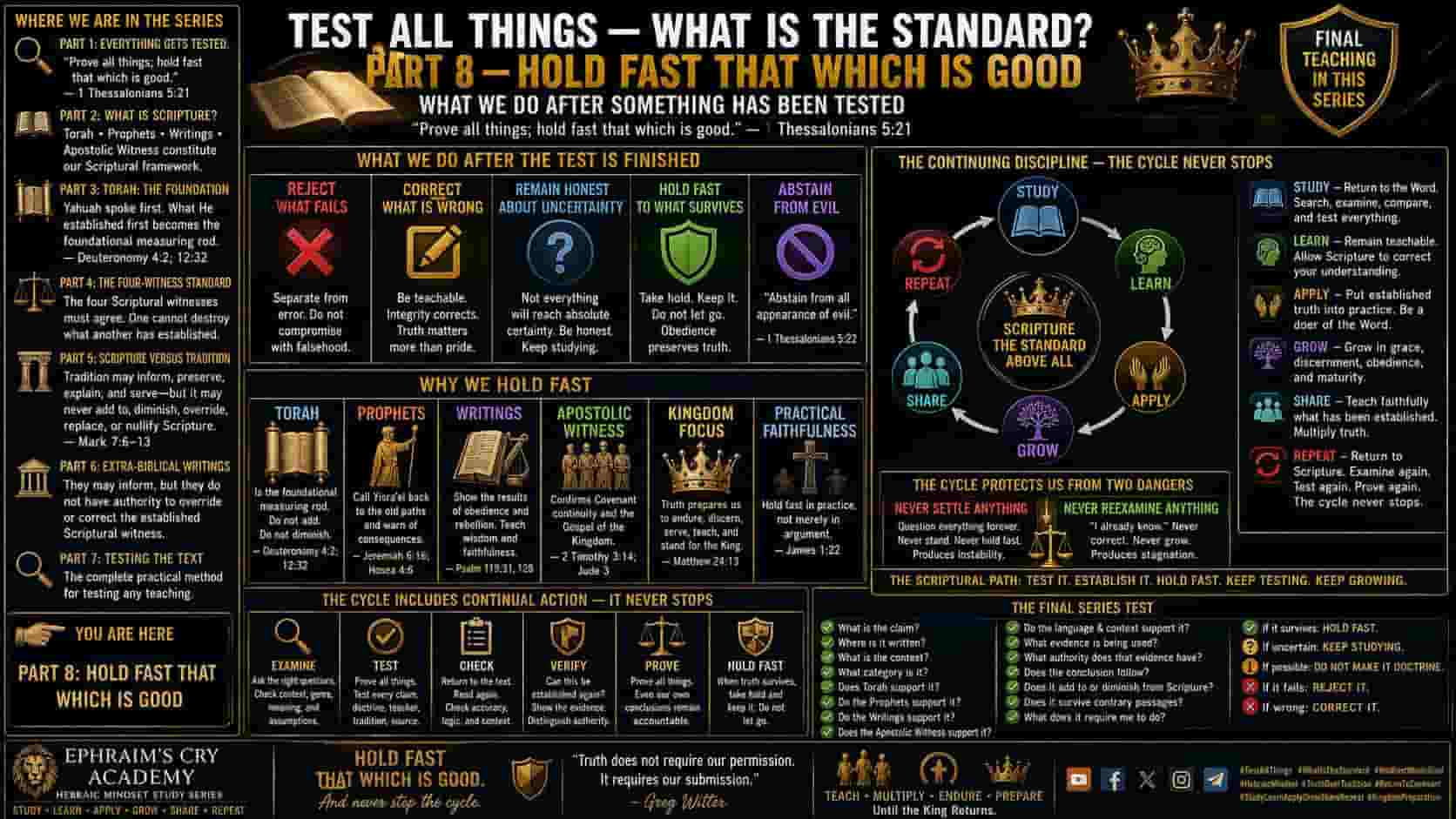
TEST ALL THINGS — WHAT IS THE STANDARD?
PART 8 — HOLD FAST THAT WHICH IS GOOD
WHAT WE DO AFTER SOMETHING HAS BEEN TESTED
Greg Witter | Ephraim’s Cry
Hebraic Mindset Study Series
Study • Learn • Apply • Grow • Share • Repeat
We have reached the final teaching in this series.
We began with Paul’s command:
“Prove all things; hold fast that which is good.”
— 1 Thessalonians 5:21
Most people concentrate upon the first half.
PROVE ALL THINGS.
Test it.
Examine it.
Compare it.
Question assumptions.
Search the Scriptures.
That is necessary.
But Paul does not tell us to spend our lives permanently examining without ever reaching a conclusion.
There is a second command:
HOLD FAST THAT WHICH IS GOOD.
That is where this series ends.
Testing has a destination.
The purpose of testing Scripture, doctrine, teachers, traditions, manuscripts, historical claims, interpretations, and claimed revelations is not to produce permanent uncertainty.
The purpose is to distinguish truth from error so that we can stand upon what Yahuah has established.
Part 7 gave us the complete testing process:
TEST THE CLAIM.
TEST THE EVIDENCE.
TEST THE CONCLUSION.
Now Part 8 asks:
WHAT DO WE DO WHEN THE TEST IS FINISHED?
The answer is simple.
Reject what fails.
Correct what is wrong.
Remain honest about what is uncertain.
And:
HOLD FAST TO WHAT SURVIVES.
1. TESTING MUST PRODUCE A DECISION
There is a danger in becoming addicted to examination.
Some people never finish testing anything.
Every answer creates another hypothetical.
Every conclusion creates another objection.
Every established passage becomes merely another “perspective.”
Eventually nothing can ever be known.
That is not discernment.
Paul says:
PROVE.
Then:
HOLD FAST.
Testing is a process.
Holding fast is the response when that process establishes truth.
If Torah establishes something, the Prophets remain in agreement, the Writings confirm it, the Apostolic Witness maintains continuity, the context supports it, and the contrary passages have been honestly examined, there comes a point where we must stop treating established truth as though it were permanently undecided.
Truth is not required to remain on trial forever.
2. HOLD FAST MEANS TAKE HOLD AND DO NOT LET GO
The Greek expression translated “hold fast” in 1 Thessalonians 5:21 carries the idea of holding firmly, retaining, possessing, or keeping something.
That is active language.
Paul is not telling us merely:
“Recognize what is good.”
He is telling us:
TAKE HOLD OF IT.
Keep it.
Retain it.
Do not casually surrender it.
Once something has survived honest Scriptural examination, it becomes something we are responsible to preserve.
That means discernment requires more than recognizing truth.
It requires faithfulness to truth.
3. HOLD FAST TO WHAT IS GOOD — NOT TO WHAT IS FAMILIAR
Paul does not say:
Hold fast to what you inherited.
Hold fast to what your denomination teaches.
Hold fast to what your family practiced.
Hold fast to what your favorite teacher says.
Hold fast to what Greg Witter says.
He says:
“Hold fast that which is good.”
That means testing may require us to release something familiar.
Tradition can be familiar and wrong.
A theological system can be familiar and wrong.
A calendar can be familiar and wrong.
A pronunciation can be familiar and wrong.
A teacher can be respected and wrong.
Our own previous conclusion can be wrong.
We do not hold something because it is ours.
We hold it because it survives the standard.
4. REJECT WHAT FAILS THE TEST
Holding fast to good necessarily requires releasing what fails examination.
Paul continues immediately:
“Abstain from all appearance of evil.”
— 1 Thessalonians 5:22
Testing produces separation.
Truth is retained.
Error is rejected.
If a doctrine contradicts Torah, reject it.
If a tradition nullifies Yahuah’s commandment, reject its authority.
If an extra-Biblical writing contradicts Scripture, Scripture wins.
If a manuscript argument requires the Four Witnesses to contradict one another, reject the conclusion.
If claimed revelation contradicts what Yahuah already established, reject the claim.
If something I teach fails Scripture:
REJECT WHAT I TAUGHT.
The standard does not bend to protect the teacher.
5. CORRECT WHAT NEEDS TO BE CORRECTED
Sometimes testing does not reveal that everything was wrong.
Sometimes it reveals that part of our understanding was wrong.
Then correct the part that failed.
Do not defend an error merely because you have taught it for years.
Do not protect an interpretation because it appears in something you published.
Do not preserve a mistake because admitting it is uncomfortable.
Proverbs says:
“He that refuseth instruction despiseth his own soul: but he that heareth reproof getteth understanding.”
— Proverbs 15:32
Correction is not defeat.
Correction is what happens when truth matters more than reputation.
A teachable person can say:
“I WAS WRONG.”
Then correct it.
That is integrity.
6. DO NOT TURN UNCERTAINTY INTO DOCTRINE
Not everything we examine will reach absolute certainty.
Sometimes the evidence remains incomplete.
Then say so.
There is a difference between:
ESTABLISHED
and:
POSSIBLE.
There is a difference between:
STRONGLY SUPPORTED
and:
SPECULATIVE.
There is a difference between:
SCRIPTURE SAYS
and:
I THINK.
Do not turn:
“This could be”
into:
“This is.”
Do not create commandments from possibilities.
Do not create doctrine from speculation.
Where Scripture gives certainty, stand firmly.
Where evidence remains incomplete, remain honest.
7. DO NOT REOPEN ESTABLISHED TRUTH FOR EVERY NEW CLAIM
There is also a point where constant reconsideration becomes instability.
Paul warns about being:
“…tossed to and fro, and carried about with every wind of doctrine…”
— Ephesians 4:14
A new video appears.
A new teacher appears.
A new calendar theory appears.
A new manuscript claim appears.
A new “hidden book” appears.
A new pronunciation theory appears.
A new prophetic interpretation appears.
That does not mean everything previously established must immediately be abandoned.
Test the new claim.
But test it against what Scripture has already established.
Yahuah’s measuring rod does not reset every time somebody discovers another theory.
8. HOLD FAST TO TORAH
Torah remains the foundational measuring rod.
Yahuah warns:
“Ye shall not add unto the word which I command you, neither shall ye diminish ought from it…”
— Deuteronomy 4:2
And:
“What thing soever I command you, observe to do it: thou shalt not add thereto, nor diminish from it.”
— Deuteronomy 12:32
Holding fast means refusing both directions of corruption.
Do not add.
Do not diminish.
Do not replace.
Do not nullify.
Do not allow tradition to become Torah.
Do not allow theology to erase Torah.
Hold fast to what Yahuah established.
9. THE PROPHETS SHOW US WHAT HAPPENS WHEN PEOPLE DO NOT HOLD FAST
The Prophets repeatedly confront Yisra’el for abandoning what Yahuah established.
Jeremiah says:
“Stand ye in the ways, and see, and ask for the old paths, where is the good way, and walk therein…”
— Jeremiah 6:16
The problem was not that Yahuah had failed to provide the path.
The people departed from it.
Hosea declares:
“My people are destroyed for lack of knowledge: because thou hast rejected knowledge…”
— Hosea 4:6
Notice the problem.
Knowledge was not merely unavailable.
Knowledge was rejected.
Holding fast requires refusing to exchange established truth for something more culturally acceptable, religiously popular, or personally convenient.
10. THE WRITINGS SHOW US WHAT HOLDING FAST LOOKS LIKE
Psalm 119 repeatedly expresses attachment to Yahuah’s Word.
“I have stuck unto thy testimonies…”
— Psalm 119:31
And:
“Therefore I esteem all thy precepts concerning all things to be right; and I hate every false way.”
— Psalm 119:128
That is discernment followed by commitment.
The Psalmist does not merely recognize Yahuah’s instruction.
He clings to it.
He orders his life around it.
He rejects the false way because he has recognized the true way.
That is holding fast.
11. YAHUSHA CALLS US TO ENDURE
Yahusha does not call disciples merely to begin.
He calls them to endure.
“But he that shall endure unto the end, the same shall be saved.”
— Matthew 24:13
Truth must be held when it becomes costly.
It is easy to agree with truth when everyone around us agrees.
The test comes when obedience costs something.
Relationships.
Reputation.
Comfort.
Opportunity.
Acceptance.
Convenience.
Holding fast means truth remains truth even when obedience becomes expensive.
12. THE APOSTOLIC WITNESS COMMANDS CONTINUED FAITHFULNESS
Paul tells Timothy:
“But continue thou in the things which thou hast learned and hast been assured of…”
— 2 Timothy 3:14
Notice the language:
CONTINUE.
Not constantly reinvent.
Not chase every new doctrine.
Continue in what has been established.
Jude likewise says:
“…earnestly contend for the faith which was once delivered unto the saints.”
— Jude 3
There is something worth preserving.
Something worth defending.
Something worth continuing in.
Holding fast is not passive.
It requires endurance.
13. HOLD FAST DOES NOT MEAN BECOME UNCORRECTABLE
This distinction remains essential.
Holding fast is not stubbornness.
Stubbornness says:
“I WILL NOT CHANGE REGARDLESS OF THE EVIDENCE.”
Holding fast says:
“I WILL NOT ABANDON WHAT SCRIPTURE HAS ESTABLISHED WITHOUT SCRIPTURAL REASON.”
Those are completely different postures.
A disciple must remain teachable.
If Scripture proves us wrong, we correct.
But neither should we surrender established truth merely because someone objects loudly.
Correction requires evidence.
So does abandonment.
14. GUARD AGAINST THE PRESSURE TO COMPROMISE
Truth is often surrendered gradually.
Not because someone disproved it.
Because holding it became inconvenient.
Family pressure.
Religious pressure.
Cultural pressure.
Social pressure.
Fear of rejection.
Fear of appearing strange.
Fear of losing relationships.
Fear of standing alone.
But Scripture repeatedly warns Yisra’el not to follow the multitude into error.
Truth does not become false because the majority rejects it.
And falsehood does not become true because the majority accepts it.
The measuring rod remains unchanged.
15. HOLD FAST WITHOUT BECOMING PROUD
There is another danger.
A person discovers something true and begins looking down upon everyone who has not discovered it.
That is not maturity.
Truth should produce humility because truth reminds us how often we ourselves have required correction.
Paul says:
“Knowledge puffeth up, but charity edifieth.”
— 1 Corinthians 8:1
Holding fast does not mean becoming arrogant.
We can stand firmly without pretending we learned everything by our own brilliance.
We can correct error without worshiping ourselves.
We can defend truth without making ourselves the truth.
16. HOLD FAST IN PRACTICE, NOT MERELY IN ARGUMENT
It is possible to defend Sabbath online and violate Sabbath in practice.
It is possible to argue Torah while treating people unjustly.
It is possible to teach clean and unclean while ignoring holiness of speech.
It is possible to defend Covenant while refusing Covenant faithfulness.
It is possible to win arguments and lose the walk.
James says:
“But be ye doers of the word, and not hearers only…”
— James 1:22
Holding fast means living what has been established.
Not merely defending it.
17. TEACH WHAT HAS BEEN ESTABLISHED
Truth is not meant to stop with us.
Moses commanded Yisra’el concerning Yahuah’s words:
“And thou shalt teach them diligently unto thy children…”
— Deuteronomy 6:7
Paul tells Timothy:
“And the things that thou hast heard of me among many witnesses, the same commit thou to faithful men, who shall be able to teach others also.”
— 2 Timothy 2:2
That is multiplication.
Receive truth.
Test truth.
Hold truth.
Live truth.
Teach truth.
Prepare others to do the same.
That is how Covenant continuity moves from generation to generation.
18. DO NOT MAKE PEOPLE DEPENDENT UPON THE TEACHER
The objective of teaching is not to create permanent dependency.
A mature disciple should eventually know how to test claims himself.
He should know how to examine context.
How to use the Four Witnesses.
How to recognize assumptions.
How to evaluate secondary evidence.
How to distinguish Scripture from tradition.
How to test a conclusion.
How to recognize when evidence is insufficient.
The successful teacher does not produce people who constantly ask:
“WHAT DOES GREG THINK?”
He produces people who ask:
WHAT DOES SCRIPTURE ESTABLISH?
That is the goal.
19. HOLD FAST TO THE KINGDOM
This series is ultimately not about winning theological disputes.
It is about Kingdom preparation.
Yahusha proclaimed the Gospel of the Kingdom.
The Kingdom requires allegiance to the King.
And allegiance produces obedience.
We are preparing to endure.
Preparing to discern.
Preparing to stand.
Preparing to serve.
Preparing to teach.
Preparing to multiply.
Preparing for the return of the King.
That requires people who cannot be carried away by every new doctrine, tradition, personality, revelation claim, or religious system.
It requires people anchored to the Word.
20. STUDY • LEARN • APPLY • GROW • SHARE • REPEAT
This brings us directly to the Ephraim’s Cry standard:
STUDY • LEARN • APPLY • GROW • SHARE • REPEAT
This is not merely a closing line beneath a teaching.
It describes the continuing discipline of Covenant discipleship.
And it explains something essential about everything we have studied in this series:
THE TESTING CYCLE NEVER STOPS.
Holding fast does not mean we stop studying.
Holding fast does not mean we stop learning.
Holding fast does not mean our understanding can never be corrected.
Holding fast does not mean we have arrived at perfect knowledge.
We hold fast to what has been established while continuing to examine, test, check, verify, and prove.
That is not instability.
It is disciplined faithfulness.
The difference is crucial.
We do not repeatedly throw established truth back into uncertainty merely because another theory appears.
But neither do we become so attached to our present understanding that we refuse legitimate Scriptural correction.
We hold fast.
And we keep growing.
STUDY
Everything begins by returning to the Word.
Paul tells Timothy:
“Study to shew thyself approved unto Elohim, a workman that needeth not to be ashamed, rightly dividing the word of truth.”
— 2 Timothy 2:15
Study requires discipline.
Read the passage.
Read the chapter.
Read the book.
Examine the context.
Bring Torah.
Bring the Prophets.
Bring the Writings.
Bring the Apostolic Witness.
Examine the language.
Check the assumptions.
Test the claim.
We do not study merely to confirm what we already believe.
We study because Scripture remains the standard.
STUDY.
LEARN
Study must produce learning.
Learning requires teachability.
Proverbs says:
“Give instruction to a wise man, and he will be yet wiser: teach a just man, and he will increase in learning.”
— Proverbs 9:9
A person can study constantly without actually learning if every passage is forced through conclusions he has already decided cannot be questioned.
Learning means allowing Scripture to correct our understanding.
It means recognizing:
“I misunderstood that.”
“I assumed something the passage did not say.”
“I gave tradition too much authority.”
“I made the conclusion stronger than the evidence.”
“I need to correct my position.”
That is learning.
A teacher who stops learning becomes dangerous.
A disciple who stops learning becomes stagnant.
LEARN.
APPLY
Knowledge must move into obedience.
James says:
“But be ye doers of the word, and not hearers only…”
— James 1:22
We do not merely study Sabbath.
We keep Sabbath.
We do not merely study righteousness.
We walk in righteousness.
We do not merely study Covenant.
We walk in Covenant faithfulness.
We do not merely study repentance.
We repent.
We do not merely identify error.
We correct it.
Application asks:
WHAT DOES WHAT I HAVE LEARNED REQUIRE OF ME?
Information becomes discipleship when established truth enters the life.
APPLY.
GROW
Application produces growth.
Peter says:
“But grow in grace, and in the knowledge of our Master and Saviour Yahusha Messiah.”
— 2 Peter 3:18
Growth does not mean constantly inventing something new.
Growth means becoming increasingly aligned with what Yahuah has already established.
Our understanding grows.
Our discernment grows.
Our obedience grows.
Our ability to recognize assumptions grows.
Our ability to distinguish Scripture from tradition grows.
Our ability to identify false doctrine grows.
Our ability to handle Scripture accurately grows.
Our endurance grows.
Our character grows.
Our ability to teach others grows.
GROW.
SHARE
Truth is not meant to terminate with us.
Moses says:
“And thou shalt teach them diligently unto thy children…”
— Deuteronomy 6:7
Paul tells Timothy:
“And the things that thou hast heard of me among many witnesses, the same commit thou to faithful men, who shall be able to teach others also.”
— 2 Timothy 2:2
That is multiplication.
But sharing carries responsibility.
We should not rush to teach publicly what we have not first tested privately.
Before saying:
“SCRIPTURE TEACHES THIS,”
we should have done the work necessary to establish that Scripture actually teaches it.
We study.
We learn.
We apply.
We grow.
Then we are prepared to share faithfully.
SHARE.
REPEAT
And then we come to the final word:
REPEAT.
This is what keeps the entire process alive.
We do not share something and declare:
“I have arrived.”
We return to Scripture.
We study again.
We learn again.
We apply again.
We grow again.
We share again.
Then we repeat again.
And again.
And again.
As long as Yahuah gives us breath.
STUDY • LEARN • APPLY • GROW • SHARE • REPEAT
The cycle never stops.
Not because truth changes.
Yahuah’s truth does not change.
The standard does not change.
But we are continually being formed by that truth.
We continue examining.
We continue testing.
We continue checking.
We continue verifying.
We continue proving.
We continue correcting where correction is necessary.
We continue strengthening what has been established.
And we continue holding fast to what survives examination.
That is what REPEAT means.
It sends us back to STUDY, but we do not return as the same student.
We return having learned.
Having applied.
Having grown.
Having shared.
Having been corrected.
Having gained discernment.
Having become better equipped to handle the Word accurately.
Then the cycle begins again.
STUDY.
LEARN.
APPLY.
GROW.
SHARE.
REPEAT.
—
21. CONSTANTLY EXAMINE • TEST • CHECK • VERIFY • PROVE
This continuing cycle explains why testing never stops.
Acts describes the Bereans:
«“…they received the word with all readiness of mind, and searched the scriptures daily, whether those things were so.”
— Acts 17:11»
Notice:
DAILY.
They did not examine Paul’s teaching once and then surrender their responsibility to test everything else he said.
Examination became a discipline.
That is the pattern.
We continually examine.
Did I understand the passage correctly?
Did I read the context?
Did I distinguish description from prescription?
Did I confuse tradition with Scripture?
Did I confuse inference with explicit text?
Did I make the conclusion stronger than the evidence?
Did I overlook a contrary passage?
Did I give a secondary source more authority than it possesses?
Did I allow personal preference to influence my conclusion?
We continually:
EXAMINE.
Then:
TEST.
Every new doctrine gets tested.
Every new interpretation gets tested.
Every new calendar claim gets tested.
Every manuscript claim gets tested.
Every historical claim gets tested.
Every pronunciation claim gets tested.
Every teacher gets tested.
Every tradition gets tested.
Every claimed revelation gets tested.
And our own teachings remain subject to the same standard.
Then we:
CHECK.
Go back to the text.
Read it again.
Read before it.
Read after it.
Check the Hebrew.
Check the Greek where necessary.
Check the grammar.
Check the context.
Check the chronology.
Check the assumptions.
Check whether the Four Witnesses remain in agreement.
Then:
VERIFY.
Can this conclusion actually be established?
Can I demonstrate it from Scripture?
Can I show the context?
Can I identify what is explicit and what is inferred?
Can I distinguish primary Scriptural authority from secondary historical evidence?
Can another serious student examine the same evidence and understand how the conclusion was reached?
Truth should never depend upon:
“TRUST ME.”
The mature teacher should be able to say:
VERIFY IT.
Then:
PROVE.
We return to Paul’s command:
«“Prove all things…”»
Not some things.
Not only doctrines we already dislike.
Not only the other person’s interpretation.
ALL THINGS.
That includes our own conclusions.
Our own traditions.
Our own assumptions.
Our own teaching.
And when something survives:
HOLD FAST.
—
22. HOLD FAST AND KEEP TESTING
There is no contradiction between these two commands.
HOLD FAST.
And:
KEEP TESTING.
Holding fast does not mean refusing examination.
Testing does not mean abandoning established truth.
The mature disciple can say:
“THIS HAS BEEN ESTABLISHED FROM SCRIPTURE, AND I WILL HOLD FAST TO IT.”
While also saying:
“IF YOU BELIEVE I AM WRONG, BRING THE SCRIPTURE. I WILL EXAMINE IT.”
That is stability without stagnation.
Teachability without gullibility.
Conviction without arrogance.
Discernment without endless uncertainty.
We do not throw established truth back into doubt every time somebody produces another YouTube video.
But neither do we say:
“I HAVE BELIEVED THIS FOR THIRTY YEARS, THEREFORE I REFUSE TO EXAMINE IT.”
Length of belief does not create truth.
Tradition does not create truth.
Reputation does not create truth.
The standard remains Scripture.
—
23. THE CYCLE PROTECTS US FROM TWO DANGERS
There are two opposite errors.
The first is:
NEVER SETTLE ANYTHING.
Question forever.
Never reach a conclusion.
Never stand.
Never hold fast.
That produces instability.
Paul warns against being:
«“…tossed to and fro, and carried about with every wind of doctrine…”
— Ephesians 4:14»
The second error is:
NEVER REEXAMINE ANYTHING.
“I already know.”
“My teacher settled it.”
“My denomination settled it.”
“My movement settled it.”
“My tradition settled it.”
“I already taught it.”
“I already published it.”
That produces stagnation.
And eventually stagnation becomes tradition protected from examination.
The Scriptural path avoids both errors.
TEST IT.
ESTABLISH IT.
HOLD FAST.
Then:
KEEP STUDYING.
KEEP LEARNING.
KEEP APPLYING.
KEEP GROWING.
KEEP SHARING.
REPEAT.
If correction becomes necessary:
Correct.
Then continue.
If deeper understanding comes:
Grow.
Then continue.
If a new claim appears:
Test it.
Then continue.
The cycle never stops.
—
24. REPEAT DOES NOT MEAN RETURN TO ZERO
This distinction matters.
Every time we repeat the cycle, we do not erase everything already established.
We do not throw Torah back into uncertainty.
We do not pretend we know nothing.
We do not abandon established truth merely because we are continuing to study.
We build upon what has survived examination.
Think of the cycle not as running endlessly around the same circle, but as continuing formation.
We return to Scripture with greater understanding.
Greater discernment.
Greater experience applying what we learned.
Greater awareness of our own weaknesses.
Greater ability to recognize assumptions.
Greater ability to identify false arguments.
Greater ability to teach.
Greater maturity.
Then we study again from that stronger position.
REPEAT DOES NOT MEAN START OVER.
It means:
CONTINUE GROWING.
—
25. THE CYCLE PRODUCES COVENANT CONTINUITY
This is where the Ephraim’s Cry standard becomes larger than personal study.
Truth is not supposed to terminate with us.
Moses commanded Yisra’el:
«“And thou shalt teach them diligently unto thy children…”
— Deuteronomy 6:7»
Paul tells Timothy:
«“And the things that thou hast heard of me among many witnesses, the same commit thou to faithful men, who shall be able to teach others also.”
— 2 Timothy 2:2»
Look at the pattern.
Someone receives truth.
They learn it.
They live it.
They become mature in it.
They teach another person.
That person learns how to test it.
Then that person teaches another.
That is multiplication.
Truth moves:
FROM SCRIPTURE → INTO UNDERSTANDING.
FROM UNDERSTANDING → INTO OBEDIENCE.
FROM OBEDIENCE → INTO CHARACTER.
FROM CHARACTER → INTO MATURITY.
FROM MATURITY → INTO TEACHING.
FROM TEACHING → INTO ANOTHER DISCIPLE.
Then that disciple begins:
STUDY.
LEARN.
APPLY.
GROW.
SHARE.
REPEAT.
That is Covenant continuity.
—
26. THE FINAL SERIES TEST
When any teaching comes before you, ask:
WHAT IS THE CLAIM?
WHERE IS IT WRITTEN?
WHAT IS THE CONTEXT?
WHAT CATEGORY DOES IT BELONG TO?
DOES TORAH SUPPORT IT?
DO THE PROPHETS SUPPORT IT?
DO THE WRITINGS SUPPORT IT?
DOES THE APOSTOLIC WITNESS SUPPORT IT?
DO THE LANGUAGE AND CONTEXT SUPPORT IT?
WHAT EVIDENCE IS BEING USED?
WHAT AUTHORITY DOES THAT EVIDENCE ACTUALLY POSSESS?
DOES THE CONCLUSION ACTUALLY FOLLOW?
DOES IT ADD TO OR DIMINISH FROM SCRIPTURE?
DOES IT SURVIVE THE STRONGEST CONTRARY PASSAGES?
WHAT DOES IT REQUIRE ME TO DO?
Then determine the outcome.
If it fails:
REJECT IT.
If it remains uncertain:
KEEP STUDYING.
If it is merely possible:
DO NOT MAKE IT DOCTRINE.
If correction is required:
CORRECT IT.
If it survives:
HOLD FAST.
Then:
APPLY IT.
GROW IN IT.
SHARE IT.
And:
REPEAT.
—
CONCLUSION — HOLD FAST, AND NEVER STOP THE CYCLE
We began this series with one command:
«“Prove all things; hold fast that which is good.”
— 1 Thessalonians 5:21»
That command has governed everything we have done.
What gets tested?
Everything.
What is the standard?
Not Greg Witter.
Not Ephraim’s Cry.
Not Christianity.
Not Judaism.
Not rabbinic authority.
Not denominational authority.
Not scholarship.
Not tradition.
Not antiquity.
Not popularity.
Not personal experience.
Not:
“Yahuah showed me.”
The standard is what Yahuah has established in His Word.
Torah provides the foundation.
The Prophets enforce Covenant faithfulness and call Yisra’el back.
The Writings demonstrate Covenant truth through history, wisdom, worship, obedience, rebellion, and consequence.
The Apostolic Witness confirms Yahuah’s Covenant and Kingdom purpose through Yahusha.
Everything else comes to the examination table.
That includes:
Tradition.
Extra-Biblical books.
Historical sources.
Manuscripts.
Translations.
Masoretic vowel points.
Scholarship.
Archaeology.
Teachers.
Personal testimony.
Claimed revelation.
And our own interpretations.
We test the claim.
We test the evidence.
We test the conclusion.
Then we decide.
If it fails:
REJECT IT.
If it is wrong:
CORRECT IT.
If it is uncertain:
KEEP STUDYING.
If it is merely possible:
DO NOT CALL IT DOCTRINE.
If it survives:
HOLD FAST.
But now we understand that holding fast is not the end of the disciple’s work.
It is the foundation from which we continue.
STUDY.
Return continually to the Word.
LEARN.
Remain teachable and allow Scripture to correct your understanding.
APPLY.
Put established truth into practice.
GROW.
Become increasingly aligned with Yahuah’s ways.
SHARE.
Teach faithfully what has been established and equip others to test it.
REPEAT.
Return to Scripture.
Examine again.
Test again.
Check again.
Verify again.
Prove again.
Learn again.
Apply again.
Grow again.
Share again.
Then repeat again.
THE CYCLE NEVER STOPS.
Not because truth changes.
Because we must continually grow in our understanding, obedience, discernment, faithfulness, and ability to handle truth accurately.
We hold fast to what has been established.
And we remain willing to be corrected where our understanding has not.
That is not contradiction.
That is maturity.
That is why we can say simultaneously:
HOLD FAST.
And:
TEST EVERYTHING.
We do not chase every wind of doctrine.
We do not surrender established truth because another personality appears.
We do not rebuild our theology every time another video is uploaded.
But neither do we become uncorrectable.
We remain under the authority of the Word.
Always.
Teacher and student alike.
Ministry and individual alike.
Greg Witter and everyone listening alike.
No exceptions.
The standard remains above us all.
So when the next claim comes:
TEST IT.
When the next teacher speaks:
TEST IT.
When the next ancient book is presented:
TEST IT.
When the next calendar theory appears:
TEST IT.
When the next pronunciation is declared unquestionably correct:
TEST IT.
When somebody says:
“Yahuah showed me”
—test it.
And when Greg Witter teaches:
TEST IT.
If it fails Scripture:
Reject it.
If correction is necessary:
Correct it.
If it survives:
Hold fast.
Then live it.
Teach it.
Multiply it.
And return to the Word.
STUDY • LEARN • APPLY • GROW • SHARE • REPEAT
Again.
Again.
Again.
Until the King returns.
TRUTH DOES NOT REQUIRE OUR PERMISSION.
IT REQUIRES OUR SUBMISSION.
—
#GregWitter#EphraimsCry#EphraimsCryAcademy#HebraicMindsetStudySeries#HebraicMindset#TorahCommunity
#TorahStudy#BibleStudy#ScriptureStudy#BiblicalTruth#CovenantCommunity#KingdomDisciples#RemnantAwakening
#Watchmen#TestAllThings#WhatIsTheStandard#HoldFastWhatIsGood#FourWitnesses#Torah#Prophets#Writings#ApostolicWitness
#ScriptureFirst#BiblicalDiscernment#CovenantFaithfulness#KingdomPreparation#WholeCounselOfElohim#
StudyLearnApplyGrowShareRepeat#TestEverything#ReturnToCovenant
