
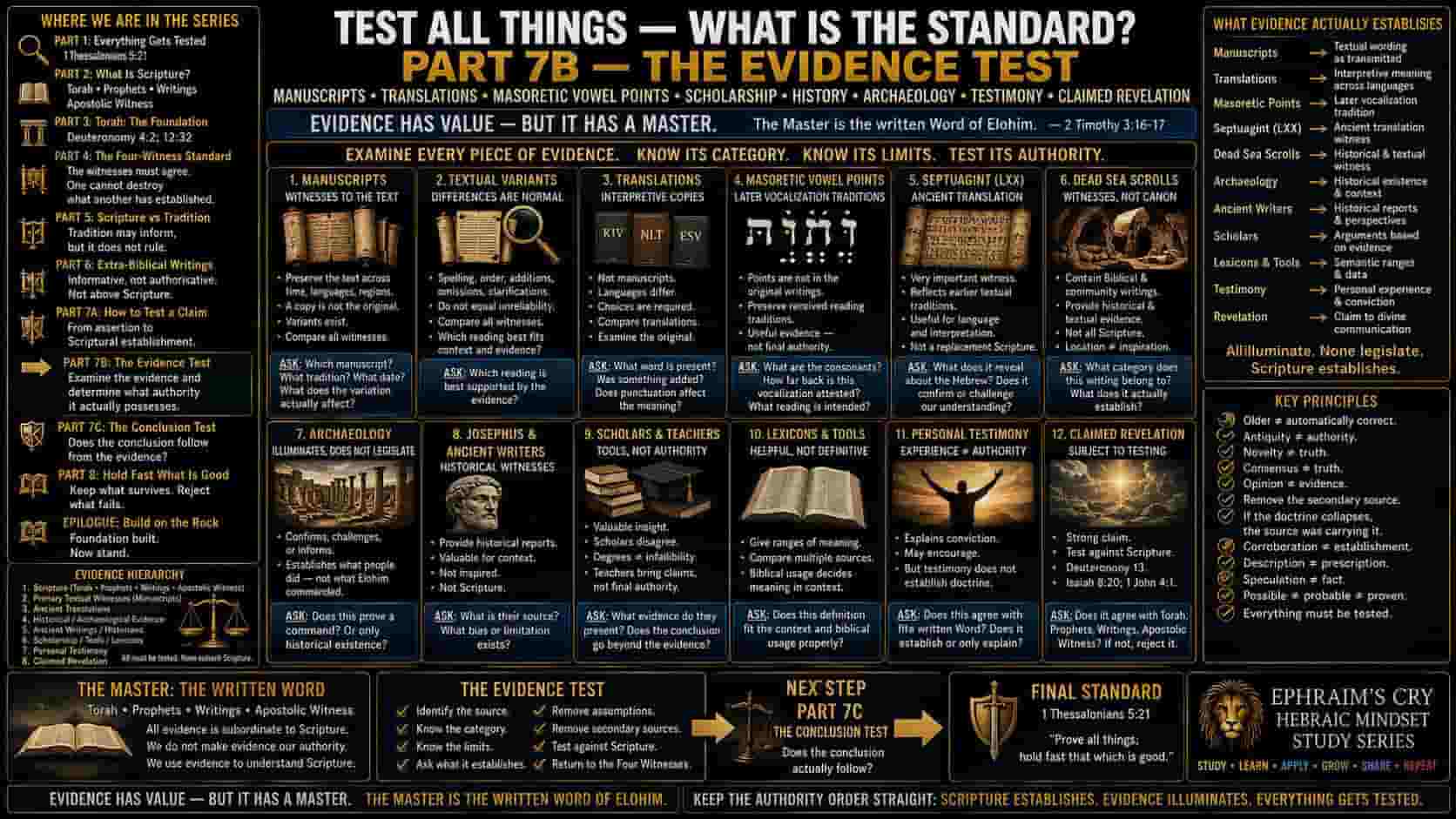
TEST ALL THINGS — WHAT IS THE STANDARD?
PART 7B — THE EVIDENCE TEST
MANUSCRIPTS • TRANSLATIONS • MASORETIC VOWEL POINTS • SCHOLARSHIP • HISTORY • ARCHAEOLOGY • TESTIMONY • CLAIMED REVELATION
Greg Witter | Ephraim’s Cry
Hebraic Mindset Study Series
Study • Learn • Apply • Grow • Share • Repeat
Part 7A taught us how to test a claim.
We learned to identify exactly what is being asserted, establish the burden of proof, examine verse, passage, chapter, book, and genre, distinguish description from prescription, apply the Four-Witness Standard, examine Hebrew and Greek terminology, use roots and Paleo-Hebrew responsibly, compare lexicons, identify assumptions, distinguish explicit text from inference, trace logical consequences, confront difficult passages, and test our own position with the same standard.
Now we move to the next question:
WHAT EVIDENCE IS BEING USED TO SUPPORT THE CLAIM?
This distinction matters.
Someone may correctly quote an ancient source and incorrectly use it.
Someone may accurately identify a manuscript variant and draw a conclusion the variant does not establish.
Someone may cite a legitimate scholar whose evidence is sound while extending the scholar’s conclusion far beyond what the evidence proves.
Someone may demonstrate that an ancient community practiced something and then quietly transform:
“They practiced it”
into:
“Yahuah commanded it.”
Someone may point to Masoretic vowel points and treat a later vocalization tradition as though the marks themselves were written by Moses.
Someone may say:
“The Dead Sea Scrolls prove…”
“Josephus confirms…”
“Archaeology proves…”
“The scholars agree…”
“The oldest manuscript says…”
“Yahuah showed me…”
Every one of those statements introduces another question:
WHAT DOES THAT EVIDENCE ACTUALLY ESTABLISH?
That is the purpose of Part 7B.
We are not rejecting evidence outside the immediate Biblical text.
We are learning to put evidence into its proper category.
Because:
EVIDENCE HAS VALUE — BUT IT HAS A MASTER.
And that Master is not scholarship.
Not archaeology.
Not manuscripts.
Not tradition.
Not antiquity.
The standard remains the written Word of Elohim.
—
1. MANUSCRIPTS ARE WITNESSES TO THE TEXT
Manuscripts are enormously valuable.
They preserve textual witnesses transmitted across generations, languages, geographical regions, and communities.
But a surviving manuscript copy is not automatically the original document written by Moses, Isaiah, Jeremiah, Matthew, Paul, or another Biblical writer.
It is a witness to the transmitted text.
That means when somebody says:
“The manuscript says…”
the immediate question should be:
WHICH MANUSCRIPT?
What manuscript tradition?
What language?
What approximate date?
What portion of Scripture?
What condition?
Is the disputed reading unique?
Is it supported elsewhere?
Are competing readings present?
How widely is the reading distributed?
Does the variation actually affect the doctrine being discussed?
Saying:
“The manuscripts prove…”
can create an illusion of certainty where substantial examination remains necessary.
Ask for the evidence.
—
2. OLDEST DOES NOT AUTOMATICALLY MEAN MOST ACCURATE
A common assumption is:
OLDER = CORRECT.
Not necessarily.
Age matters.
An older manuscript may place us chronologically closer to an earlier textual form.
That makes it important evidence.
But age alone does not guarantee accuracy.
An older copy can contain a scribal error.
A later manuscript can preserve an accurate reading inherited from an older exemplar that no longer survives.
Therefore textual examination considers more than date.
It considers matters such as:
• manuscript agreement
• geographical distribution
• textual relationships
• grammar
• scribal tendencies
• contextual coherence
• ancient quotations
• competing textual traditions
Therefore:
OLDER DESERVES SERIOUS ATTENTION.
But:
OLDER DOES NOT AUTOMATICALLY SETTLE THE QUESTION.
—
3. TEXTUAL VARIANTS DO NOT MEAN SCRIPTURE IS UNRELIABLE
The existence of textual variants sometimes frightens believers unnecessarily.
It should not.
When documents are copied by hand across generations, variations naturally arise.
Spelling can vary.
Words can be transposed.
A line can accidentally be repeated.
A phrase can be omitted because a copyist’s eye moves between similar endings.
A marginal explanation can sometimes enter the body of a later manuscript.
Some scribes may clarify wording.
The existence of these differences does not mean:
“WE HAVE NO IDEA WHAT SCRIPTURE SAYS.”
Quite the opposite.
Because multiple witnesses survive, differences can often be identified precisely because those witnesses can be compared.
The responsible question is not:
“ARE THERE VARIANTS?”
There are.
The responsible question is:
WHICH READING IS BEST ESTABLISHED BY THE EVIDENCE?
Do not panic over textual variants.
Examine them.
—
4. DO NOT BUILD DOCTRINE UPON ONE DISPUTED READING
Here is an important safeguard.
If an entire doctrine depends upon one disputed textual reading, caution is required.
Torah establishes an evidentiary principle:
«“At the mouth of two witnesses, or at the mouth of three witnesses, shall the matter be established.”
— Deuteronomy 19:15»
Suppose one manuscript reading appears to support a doctrine.
Fine.
Now bring the witnesses.
Does Torah establish the doctrine?
Do the Prophets support it?
Do the Writings support it?
Does the Apostolic Witness confirm it elsewhere?
If the doctrine disappears when one disputed phrase disappears, the doctrine was never securely established.
MAJOR DOCTRINE SHOULD NOT HANG FROM ONE DISPUTED TEXTUAL THREAD.
—
5. TRANSLATIONS ARE NOT MANUSCRIPTS
This distinction is fundamental.
A Hebrew manuscript is not an English translation.
A Greek manuscript is not an English translation.
A translation represents someone’s attempt to communicate meaning from one language into another.
That requires decisions.
Languages do not correspond word-for-word with perfect precision.
Words possess semantic ranges.
Idioms differ.
Grammar differs.
Syntax differs.
Cultural concepts differ.
Therefore translators make interpretive choices.
Usually those choices are reasonable.
Sometimes they are debatable.
Sometimes theological assumptions influence them.
That does not justify saying:
“ALL TRANSLATIONS ARE CORRUPT.”
It means:
TRANSLATIONS MUST ALSO BE TESTED.
—
6. NEVER BUILD AN ARGUMENT ENTIRELY UPON ONE ENGLISH TRANSLATION
When a doctrine depends heavily upon the exact wording of one English version, investigate.
Compare translations.
Then, when necessary, examine the underlying Hebrew, Aramaic, or Greek.
Ask:
What word is actually present?
What is its semantic range?
What grammatical construction is being used?
Was something supplied for readability?
Does punctuation influence the interpretation?
Does capitalization create a theological impression?
Was an idiom translated literally or functionally?
Remember:
Chapter divisions came later.
Verse numbers came later.
Modern punctuation came later.
Section headings came later.
These tools help us navigate Scripture.
They are not themselves inspired Scripture.
A translator’s heading cannot create doctrine.
READ THE TEXT.
—
7. THE MASORETIC VOWEL POINTS MUST BE TESTED
This deserves particular attention because enormous pronunciation and doctrinal claims are sometimes built upon the Masoretic pointing system as though those dots and marks were present in the original Biblical writings.
They were not.
Biblical Hebrew was transmitted fundamentally through a consonantal writing tradition, with certain consonants also serving in some periods and contexts as vowel indicators. The elaborate vowel-pointing systems familiar from later Hebrew manuscripts belong to a later stage of transmission associated with Masoretic scribes.
Therefore we must distinguish:
THE CONSONANTAL TEXT
from:
THE LATER VOCALIZATION SYSTEM.
That distinction does not mean the Masoretes randomly invented Hebrew pronunciation.
That claim would also exceed the evidence.
The Masoretic traditions preserved received ways of reading the Hebrew text and are extremely valuable witnesses.
But a preserved reading tradition remains a witness.
The vowel points themselves were not physically written into the original Torah manuscripts by Moses.
They were not written by David into the Psalms.
They were not written by Isaiah into his original scroll.
That historical distinction matters.
—
8. WHAT DO THE MASORETIC VOWEL POINTS ACTUALLY ESTABLISH?
The system generally called niqqud uses dots and small marks around Hebrew consonants to represent vowels and aspects of pronunciation.
Different Masoretic traditions existed, with the Tiberian system eventually becoming dominant in the Hebrew Bible tradition most readers encounter today.
Therefore, when someone points to a modern pointed Hebrew text and says:
“THE VOWELS ARE RIGHT THERE. THAT SETTLES EXACTLY HOW THIS WORD WAS ORIGINALLY PRONOUNCED.”
the conclusion is stronger than the evidence.
The pointing provides important evidence concerning a transmitted reading tradition.
The historical question remains:
How far back can that specific vocalization be demonstrated?
That question must be examined.
Not assumed.
—
9. KEEP THREE QUESTIONS SEPARATE
When examining a Hebrew pronunciation claim, ask three different questions:
1. WHAT ARE THE CONSONANTS?
That is a textual question.
2. HOW WAS THE WORD HISTORICALLY PRONOUNCED?
That is a linguistic and historical question.
3. HOW DID THE MASORETIC TRADITION VOCALIZE OR DIRECT THE READING OF IT?
That is a transmission-history question.
These questions are related.
They are not automatically identical.
Sometimes the evidence may strongly align.
Sometimes additional investigation is required.
The error occurs when Question 3 is automatically treated as though it settles Questions 1 and 2 without further examination.
—
10. THE DIVINE NAME MAKES THIS ESPECIALLY IMPORTANT
This distinction becomes particularly significant when discussing the four Hebrew consonants of the Divine Name:
יהוה
The written consonants are one question.
Later reading conventions surrounding those consonants are another.
Jewish reading traditions developed practices of avoiding the spoken pronunciation of the written Name and substituting another spoken expression.
Therefore vowel notation associated with the four consonants cannot responsibly be examined as though no reading convention existed.
The argument:
“THE MASORETIC VOWEL POINTS ARE THERE, THEREFORE THEY UNQUESTIONABLY PRESERVE THE ORIGINAL PRONUNCIATION OF THE NAME”
does not complete the investigation.
We must ask:
What were the points intended to communicate to the reader?
Was a substitute reading convention involved?
Which manuscript tradition is being examined?
What does the consonantal structure establish?
What do earlier linguistic witnesses indicate?
What historical pronunciation evidence exists?
The point is not to force a preferred pronunciation into the text.
The point is to test the evidence honestly.
—
11. MASORETIC POINTING IS EVIDENCE — NOT THE FINAL COURT OF APPEAL
We avoid both extremes.
We do not say:
“THE MASORETES ARE WORTHLESS. IGNORE EVERYTHING THEY PRESERVED.”
That would be foolish.
Neither do we say:
“EVERY MASORETIC VOCALIZATION IS INSPIRED AND THEREFORE UNQUESTIONABLY PRESERVES THE ORIGINAL ANCIENT PRONUNCIATION.”
That also goes beyond the evidence.
Instead:
USE THE MASORETIC TRADITION AS A WITNESS.
Compare it with:
• the consonantal Hebrew text
• Hebrew grammar
• morphology
• Biblical usage
• earlier manuscript evidence where available
• ancient transliterations where available
• cognate linguistic evidence where appropriate
• other textual traditions
• historical reading practices
The governing principle is:
THE MASORETIC VOWEL POINTS ARE EVIDENCE OF A RECEIVED VOCALIZATION TRADITION.
THEY ARE NOT THEMSELVES THE ORIGINAL CONSONANTAL TEXT.
That keeps the evidence in its proper category.
—
12. PALEO-HEBREW REMINDS US THAT THE TEXT EXISTED BEFORE THE POINTS
Earlier Hebrew writing systems long predate the medieval Masoretic pointing systems.
That fact alone prevents us from acting as though Hebrew could not exist or be pronounced before niqqud.
Ancient Hebrew speakers spoke Hebrew.
They knew how words were pronounced.
They did not require medieval vowel notation in order to communicate.
The pointing system is therefore a later notation preserving a reading tradition.
It is not the origin of Hebrew pronunciation.
Again:
KEEP THE CATEGORIES STRAIGHT.
—
13. THE SEPTUAGINT MUST REMAIN IN ITS PROPER CATEGORY
The ancient Greek translation tradition commonly called the Septuagint can be extremely valuable.
It can help reveal how ancient translators understood Hebrew terminology.
It can preserve evidence concerning earlier textual traditions.
It can illuminate Greek vocabulary later appearing in the Apostolic writings.
Use it.
Study it.
Compare it.
But do not enthrone it.
USEFUL DOES NOT MEAN SUPREME AUTHORITY.
The Septuagint does not become a replacement Torah.
Neither should any later Hebrew manuscript tradition be treated as though scribal transmission itself were incapable of variation.
Compare witnesses.
Examine evidence.
Return to Scripture.
—
14. THE DEAD SEA SCROLLS ARE WITNESSES — NOT A NEW CANON
Part 6 established the proper category for the Dead Sea Scrolls and Qumran literature.
Now apply that principle to evidence.
The Dead Sea Scrolls are enormously important historically and textually.
They contain Biblical manuscripts.
They contain commentaries.
They contain sectarian writings.
They contain community regulations.
They provide evidence concerning Second Temple Judaism and textual transmission.
But:
FOUND AT QUMRAN DOES NOT MEAN INSPIRED BY YAHUAH.
A Biblical manuscript discovered at Qumran can provide textual evidence concerning Scripture.
A community document tells us what that community believed or practiced.
Those are different categories.
Location does not create inspiration.
Antiquity does not create authority.
—
15. SCHOLARSHIP IS A TOOL — NOT A PRIESTHOOD
Good scholarship is valuable.
A scholar may spend decades studying:
Hebrew.
Aramaic.
Greek.
Manuscripts.
Archaeology.
Geography.
Ancient inscriptions.
Textual transmission.
Chronology.
Ancient Near Eastern culture.
Learn from that work.
But scholarship must never become another priesthood standing between the disciple and Scripture.
A degree does not create infallibility.
And lacking a degree does not automatically make someone correct.
Scholars disagree.
Hebrew scholars disagree.
Greek scholars disagree.
Archaeologists disagree.
Historians disagree.
Textual critics disagree.
Theologians certainly disagree.
Therefore:
“SCHOLARS SAY” IS NOT AN ARGUMENT.
Which scholars?
What do they claim?
What evidence do they present?
How strong is their reasoning?
Does the conclusion go beyond the evidence?
The scholar can bring evidence to the table.
THE SCHOLAR DOES NOT BECOME THE TABLE.
—
16. CONSENSUS IS NOT THE SAME AS TRUTH
Consensus deserves consideration.
If qualified specialists independently examine evidence and reach similar conclusions, that matters.
But consensus does not create truth.
Scripture itself prevents us from worshiping majority opinion.
Ten spies agreed.
Joshua and Caleb disagreed.
The majority was wrong.
The Prophets repeatedly stood against national consensus.
Yahusha confronted established religious leadership.
Therefore:
Do not automatically reject consensus.
But do not bow before it either.
CONSENSUS TELLS US WHAT PEOPLE AGREE UPON.
It does not automatically tell us what Yahuah said.
—
17. ARCHAEOLOGY ILLUMINATES — IT DOES NOT LEGISLATE
Archaeology can provide extraordinary insight into the Biblical world.
It can illuminate:
• settlements
• architecture
• inscriptions
• pottery
• agriculture
• burial customs
• trade routes
• political boundaries
• ancient technologies
• language
• cultural practices
It can support historical reconstruction.
It can challenge assumptions.
It can provide corroborating evidence.
But archaeology cannot create commandments.
Suppose archaeology demonstrates that ancient Israelites practiced something.
What has been established?
THEY PRACTICED IT.
Has it been established that Yahuah commanded it?
No.
Yisra’el also practiced idolatry.
Archaeological evidence of idolatry would not transform idolatry into Torah.
Remember Part 7A:
DESCRIPTION IS NOT PRESCRIPTION.
—
18. ABSENCE OF EVIDENCE IS NOT AUTOMATICALLY EVIDENCE OF ABSENCE
This principle is particularly important when discussing ancient history.
Someone says:
“ARCHAEOLOGISTS HAVE NEVER FOUND EVIDENCE FOR THIS, THEREFORE IT NEVER HAPPENED.”
That conclusion may exceed the evidence.
Archaeology is fragmentary.
Most ancient material did not survive.
Organic material decays.
Sites are destroyed.
Cities are rebuilt.
Political upheaval destroys records.
Only a fraction of potential archaeological sites have been excavated.
Sometimes the responsible conclusion is simply:
WE CURRENTLY DO NOT POSSESS ARCHAEOLOGICAL CONFIRMATION.
That is different from:
IT NEVER HAPPENED.
Do not force evidence to say more than it says.
—
19. HISTORICAL SOURCES ARE WITNESSES — NOT TORAH
Josephus can be valuable.
Ancient historians can be valuable.
Second Temple writings can be valuable.
Early Christian writings can be valuable.
Rabbinic literature can be valuable for understanding what later rabbis believed, debated, or practiced.
But the category must remain clear.
If Josephus records a practice, that establishes evidence concerning what Josephus reports.
It does not automatically establish:
“YAHUAH COMMANDED THIS.”
If an early Christian writer describes a practice, that establishes evidence concerning that writer or community.
It does not automatically establish Apostolic authority.
If rabbinic literature records a tradition, that tells us something about rabbinic interpretation.
It does not automatically make the tradition Torah.
Historical sources can illuminate.
They cannot legislate.
—
20. DISTINGUISH FACT FROM HISTORICAL RECONSTRUCTION
Historical reconstruction is often necessary.
But it must be labeled honestly.
There is a difference between:
EXPLICIT FACT
The evidence directly states it.
NECESSARY CONCLUSION
Multiple pieces of evidence require the conclusion.
STRONG INFERENCE
The evidence strongly favors the conclusion.
PLAUSIBLE RECONSTRUCTION
The evidence permits the conclusion.
SPECULATION
It could have happened.
Those categories are not interchangeable.
A major problem develops when:
“THIS MIGHT EXPLAIN WHAT HAPPENED”
quietly becomes:
“THIS IS WHAT HAPPENED.”
Then, after sufficient repetition:
“SCRIPTURE TEACHES THIS.”
No.
Historical reconstruction can be useful.
But reconstruction must remain subordinate to what the evidence actually establishes.
DO NOT PROMOTE SPECULATION INTO DOCTRINE.
—
21. CHRONOLOGY MUST COME FROM ACTUAL TIME MARKERS
Chronological arguments frequently contain invisible assumptions.
When reconstructing Biblical chronology, identify the actual textual markers:
• day
• night
• evening
• morning
• Sabbath
• month
• year
• feast
• reign
• before
• after
• until
• on the morrow
• number of days
• sequence of events
Then construct the timeline from those markers.
Do not begin with the timeline you want and force the passages into it.
This matters enormously when studying:
Passover.
The Exodus.
The crucifixion and resurrection.
Sabbath.
Feast days.
Calendar questions.
Kings.
Genealogies.
Prophetic periods.
TIME MARKERS ARE EVIDENCE.
What we imagine happened between those markers is not automatically evidence.
22. WATCH FOR ARGUMENTS FROM SILENCE
An argument from silence commonly sounds like this:
“SCRIPTURE NEVER SAYS THEY DIDN’T DO IT.”
Therefore:
“THEY MUST HAVE DONE IT.”
No.
Silence may leave something possible.
Silence does not establish it as historical fact.
Likewise, the opposite argument can fail:
“SCRIPTURE NEVER RECORDS THEM DOING IT.”
Therefore:
“IT NEVER HAPPENED.”
That also may exceed the evidence.
Keep the categories straight:
POSSIBLE DOES NOT MEAN PLAUSIBLE.
PLAUSIBLE DOES NOT MEAN PROBABLE.
PROBABLE DOES NOT MEAN PROVEN.
Likewise:
NOT FORBIDDEN does not automatically mean COMMANDED.
And:
NOT RECORDED does not automatically mean IMPOSSIBLE.
Say only what the evidence allows.
23. WATCH FOR THE APPEAL TO ANTIQUITY
People frequently assume:
ANCIENT = TRUE.
It does not.
An ancient error is still an error.
An ancient tradition is still a tradition.
An ancient sect can still be wrong.
An ancient interpretation can still misunderstand Scripture.
Yisra’el practiced false worship in ancient times.
The Prophets repeatedly condemned practices that had existed for generations.
Yahusha confronted traditions already well established in His day.
Therefore the statement:
“THIS PRACTICE IS ANCIENT”
establishes age.
It does not establish divine authority.
The correct question remains:
DID YAHUAH COMMAND IT?
Antiquity can establish historical existence.
It cannot establish righteousness.
24. WATCH FOR THE APPEAL TO NOVELTY
The opposite error also occurs.
Some people assume:
NEW = BETTER.
A newly discovered theory appears.
A new calendar.
A new pronunciation.
A new manuscript interpretation.
A new archaeological reconstruction.
A new “hidden Hebrew meaning.”
A new prophetic timeline.
Then novelty itself becomes part of the attraction:
“We finally discovered what everybody has missed for two thousand years.”
Maybe.
But that is a claim.
Test it.
New information can correct old assumptions.
But novelty is not proof.
Neither argument works:
“IT IS OLD, THEREFORE IT IS TRUE.”
Nor:
“IT IS NEW, THEREFORE IT IS MORE ACCURATE.”
Test both.
25. WATCH FOR APPEALS TO AUTHORITY
Authority arguments appear everywhere.
“My pastor says…”
“The rabbis say…”
“The Church Fathers say…”
“The Masoretes preserved…”
“This Hebrew scholar says…”
“This archaeologist says…”
“This professor says…”
“This famous teacher says…”
“This ministry teaches…”
“Greg Witter says…”
None of those statements establishes doctrine.
A knowledgeable person may point us toward valuable evidence.
Good.
Examine it.
But the authority of the personality cannot replace the evidence.
Acts tells us concerning the Bereans:
«“They received the word with all readiness of mind, and searched the scriptures daily, whether those things were so.” — Acts 17:11»
The person teaching them was Paul.
Yet they examined what Paul said against Scripture.
And Scripture calls them noble for doing it.
If Paul could be examined against Scripture, every teacher alive today can be examined against Scripture.
Including me.
THE TEACHER BRINGS THE CLAIM.
THE EVIDENCE MUST ESTABLISH IT.
26. WATCH FOR EMOTIONAL EVIDENCE
A teaching may feel profound.
That does not make it true.
A testimony may bring tears.
That does not establish doctrine.
A worship experience may feel powerful.
That does not establish doctrine.
A dream may feel supernatural.
That does not establish doctrine.
A teacher may speak passionately.
That does not establish doctrine.
A person may experience overwhelming peace.
That does not establish doctrine.
Emotion is real.
Experience is real.
But neither is the measuring rod.
Jeremiah warns:
«“The heart is deceitful above all things, and desperately wicked: who can know it?” — Jeremiah 17:9»
Feelings themselves must come under examination.
This does not mean emotion is evil.
It means:
EMOTION CANNOT CARRY DOCTRINAL AUTHORITY.
27. TEST PERSONAL TESTIMONY
Someone may sincerely tell you:
“I used to believe what you believe.”
“I prayed about this for years.”
“I had a dream.”
“I experienced a miracle.”
“I felt overwhelming peace.”
“I know what Yahuah showed me.”
Their experience may explain why they believe what they believe.
It does not establish what Scripture teaches.
People holding contradictory doctrines report powerful experiences.
People belonging to contradictory religious systems report answered prayers, dreams, visions, supernatural encounters, and profound emotional experiences.
Those contradictory conclusions cannot all become Scriptural truth merely because the people reporting them are sincere.
Therefore:
TESTIMONY MAY EXPLAIN CONVICTION.
TESTIMONY DOES NOT CREATE DOCTRINAL AUTHORITY.
The written Word tests the testimony.
The testimony does not judge the written Word.
28. TEST CLAIMED REVELATION
Now we come to one of the most serious evidence claims:
“YAHUAH TOLD ME.”
Or:
“THE RUACH REVEALED THIS TO ME.”
Or:
“I PRAYED AND YAHUAH SHOWED ME THE TRUTH.”
That is not a small statement.
Divine authority has just been claimed.
The proper response is neither automatic ridicule nor automatic acceptance.
The proper response is:
TEST IT.
Torah establishes the principle in Deuteronomy 13.
Even when a sign or wonder occurs, the supernatural manifestation does not authorize departure from what Yahuah has already commanded.
That is an extraordinary standard.
A supernatural experience itself remains subordinate to previous revelation.
Isaiah says:
«“To the Torah and to the testimony: if they speak not according to this word, it is because there is no light in them.” — Isaiah 8:20»
The Apostolic Witness agrees:
«“Beloved, believe not every spirit, but try the spirits whether they are of Elohim…” — 1 John 4:1»
Therefore:
CLAIMED REVELATION DOES NOT ESCAPE EXAMINATION.
It demands examination precisely because divine authority is being claimed.
29. “YAHUAH SHOWED ME” CANNOT BECOME A SHIELD AGAINST EXAMINATION
This becomes especially dangerous when someone says:
“Yahuah showed me this.”
Then when challenged from Scripture responds:
“You are rejecting what Yahuah revealed.”
Stop.
A substitution has occurred.
The person has moved from:
“I BELIEVE YAHUAH SHOWED ME THIS.”
to:
“MY INTERPRETATION IS YAHUAH’S POSITION.”
Those are not the same statement.
No human being gets to place his interpretation into Yahuah’s mouth and then accuse everyone who questions him of rebellion.
If Yahuah revealed it, the claim will survive Scriptural examination.
Bring Torah.
Bring the Prophets.
Bring the Writings.
Bring the Apostolic Witness.
If the claimed revelation contradicts what Yahuah already established:
REJECT THE CLAIM.
The written Word does not submit to private revelation.
Private revelation submits to the written Word.
30. REMOVE THE SECONDARY SOURCE AND TEST THE CLAIM AGAIN
Now perform one of the strongest evidence tests in this teaching.
Remove the secondary source.
Remove Josephus.
Remove the Talmud.
Remove Jubilees.
Remove Enoch.
Remove the Church Fathers.
Remove the sectarian Qumran writings.
Remove the archaeological reconstruction.
Remove the Masoretic vowel points.
Remove the preferred scholar.
Remove the disputed manuscript.
Remove the YouTube teacher.
Remove the denominational commentary.
Now ask:
DOES THE DOCTRINE STILL STAND FROM SCRIPTURE?
If the answer is no, something important has been exposed.
The secondary source was not merely supporting the doctrine.
IT WAS CARRYING IT.
Secondary evidence can illuminate.
It can corroborate.
It can provide historical context.
It can help explain language.
It can challenge assumptions.
But it cannot become the load-bearing wall supporting a doctrine Scripture itself never establishes.
This principle is critical:
IF THE DOCTRINE COLLAPSES WHEN THE SECONDARY SOURCE IS REMOVED, THE SECONDARY SOURCE WAS CARRYING THE AUTHORITY.
31. DISTINGUISH CORROBORATION FROM ESTABLISHMENT
Suppose archaeology discovers evidence consistent with a Biblical account.
Excellent.
That evidence may corroborate the Scriptural record.
Suppose Josephus records a historical practice also reflected in Scripture.
That may provide historical corroboration.
Suppose an ancient inscription preserves terminology consistent with Biblical Hebrew.
That may provide linguistic corroboration.
Suppose an ancient translation reflects an interpretation consistent with the Hebrew text.
That may provide textual corroboration.
But:
CORROBORATION IS NOT THE SAME AS ESTABLISHMENT.
Secondary evidence can support our understanding.
It cannot create Scriptural authority.
We do not say:
“Scripture became true when archaeology finally approved it.”
Archaeology did not give Scripture permission to be true.
Likewise, Josephus does not give Torah authority.
Qumran does not give Isaiah authority.
The Masoretes do not give the Hebrew consonantal text authority.
A modern scholar does not give Yahusha authority.
Keep the order straight.
32. ASK WHAT IS ACTUALLY CARRYING THE CONCLUSION
After examining manuscripts, translations, Masoretic vocalization, ancient translations, Qumran, scholarship, archaeology, chronology, historical reconstruction, testimony, and claimed revelation, ask:
WHAT IS ACTUALLY CARRYING THE CONCLUSION?
Is it Scripture?
Or scholarship?
Is it Scripture?
Or archaeology?
Is it Scripture?
Or tradition?
Is it Scripture?
Or manuscript preference?
Is it Scripture?
Or Masoretic vocalization?
Is it Scripture?
Or historical reconstruction?
Is it Scripture?
Or an ancient writer?
Is it Scripture?
Or a teacher?
Is it Scripture?
Or personal experience?
Is it Scripture?
Or claimed revelation?
This question exposes authority confusion.
Secondary evidence may help us understand Scripture.
It may corroborate historical claims.
It may illuminate language and culture.
It may challenge assumptions.
It may expose translation problems.
But secondary evidence must never quietly become the authority over Scripture.
SCRIPTURE FIRST.
EVERYTHING ELSE UNDER EXAMINATION.
33. THE EVIDENCE TEST
When someone presents evidence for a doctrinal claim, ask:
WHAT IS THE SOURCE?
WHAT CATEGORY DOES IT BELONG TO?
HOW OLD IS IT?
IS IT PRIMARY OR SECONDARY EVIDENCE?
IS IT SCRIPTURE OR A WITNESS TO SCRIPTURE?
IS IT TEXT OR INTERPRETATION?
IS IT CONSONANTAL TEXT OR LATER VOCALIZATION?
IS IT HISTORICAL DESCRIPTION OR DIVINE PRESCRIPTION?
IS IT FACT, INFERENCE, RECONSTRUCTION, OR SPECULATION?
IS THE ARGUMENT DEPENDENT UPON SILENCE?
IS ANTIQUITY BEING CONFUSED WITH AUTHORITY?
IS NOVELTY BEING CONFUSED WITH DISCOVERY OF TRUTH?
IS A SCHOLAR, RABBI, PASTOR, TEACHER, OR HISTORIAN CARRYING THE ARGUMENT?
IS EMOTION BEING USED AS EVIDENCE?
IS PERSONAL TESTIMONY BEING TREATED AS DOCTRINAL AUTHORITY?
IS CLAIMED REVELATION BEING PLACED ABOVE THE WRITTEN WORD?
And finally:
IF I REMOVE THE SECONDARY SOURCE, DOES THE DOCTRINE STILL STAND FROM SCRIPTURE?
That question will expose a tremendous amount of false teaching.
CONCLUSION — EVIDENCE HAS VALUE, BUT IT HAS A MASTER
We do not fear evidence.
We examine it.
We do not fear manuscripts.
We compare them.
We do not fear Hebrew.
We study it.
We do not fear questions concerning Masoretic vowel points.
We distinguish the consonantal text from later vocalization traditions and examine both honestly.
We do not fear the Septuagint.
We use it appropriately.
We do not fear the Dead Sea Scrolls.
We put them into their proper categories.
We do not fear archaeology.
We learn from it.
We do not fear scholarship.
We examine its arguments.
We do not fear history.
We reconstruct it carefully.
We do not fear testimony.
We simply refuse to make testimony Scripture.
And we do not fear someone saying:
“YAHUAH SHOWED ME.”
Because if Yahuah showed it, the claim will not require Scripture to be pushed aside in order to survive.
Truth does not fear examination.
Truth does not require manipulated evidence.
Truth does not require inflated certainty.
Truth does not require us to pretend speculation is fact.
Truth does not require us to enthrone scholars.
Truth does not require us to canonize ancient books.
Truth does not require us to make later scribal notation identical with the original Hebrew text.
Truth does not require us to accept somebody’s testimony as divine authority.
Evidence matters.
But evidence must remain in its proper place.
Part 7A taught us:
TEST THE CLAIM.
Part 7B has taught us:
TEST THE EVIDENCE.
And Part 7C will ask the question that necessarily follows:
DOES THE CONCLUSION ACTUALLY FOLLOW?
That is the next step.
Because legitimate evidence can still be interpreted incorrectly.
A true historical fact can still produce a false theological conclusion.
A legitimate Hebrew definition can still be applied incorrectly.
A real manuscript can still be made to carry more weight than it possesses.
So we do not stop merely because someone produced evidence.
We determine what that evidence actually establishes.
Then we test the conclusion.
Until then:
KEEP THE AUTHORITY ORDER STRAIGHT.
SCRIPTURE ESTABLISHES.
EVIDENCE ILLUMINATES.
EVERYTHING GETS TESTED.
And when the entire matter survives examination:
HOLD FAST THAT WHICH IS GOOD.
#GregWitter#EphraimsCry#EphraimsCryAcademy#HebraicMindsetStudySeries#HebraicMindset#TorahCommunity
#TorahStudy#BibleStudy#ScriptureStudy#BiblicalTruth#CovenantCommunity#RemnantAwakening#KingdomDisciples#
Watchmen#TestAllThings#WhatIsTheStandard#TestTheEvidence#FourWitnesses#Torah#Prophets#Writings#ApostolicWitness
#BiblicalManuscripts#MasoreticVowelPoints#DeadSeaScrolls#BiblicalDiscernment#ScriptureFirst#SoundDoctrine
#WholeCounselOfElohim#HoldFastWhatIsGood
