
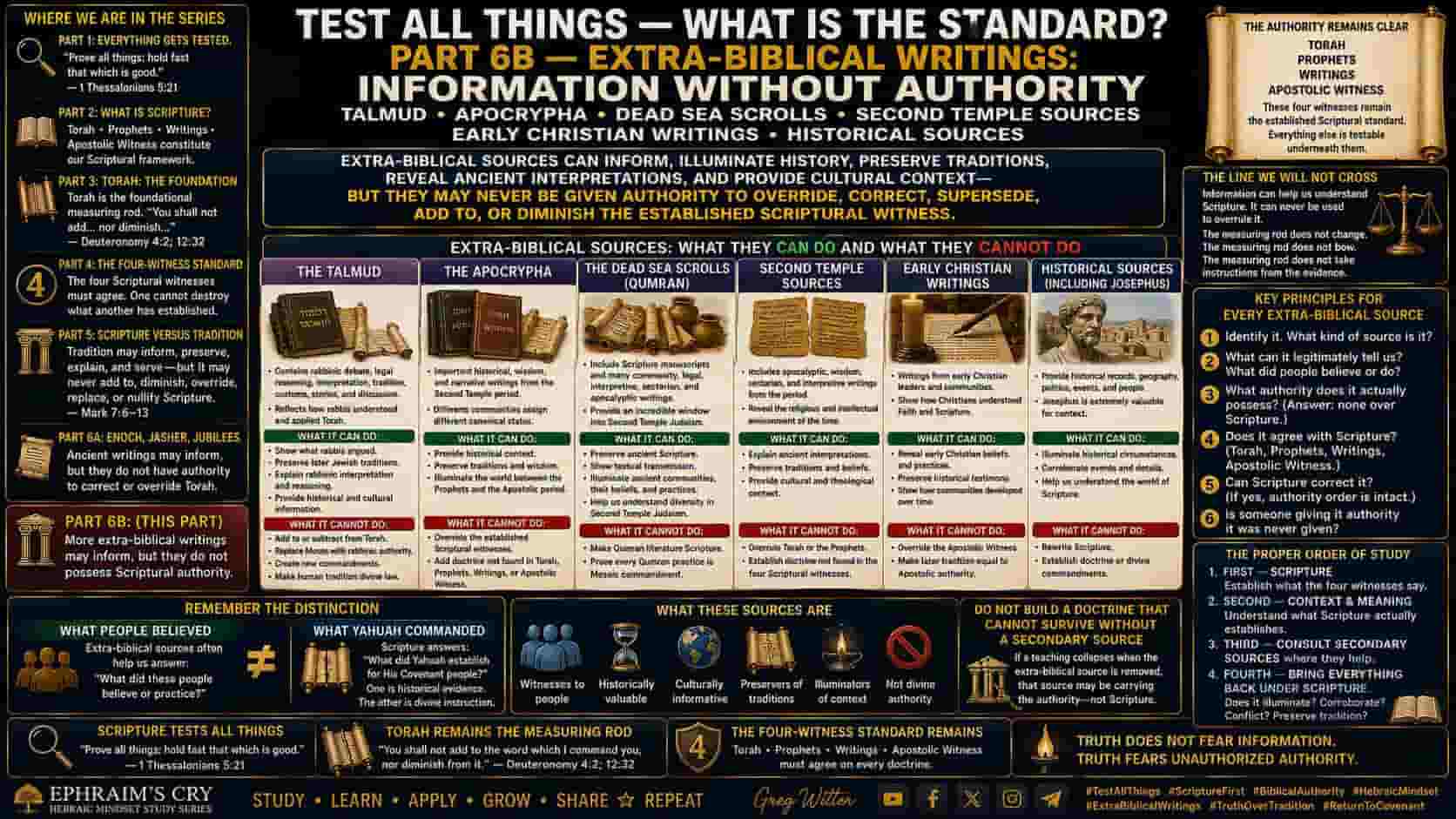
TEST ALL THINGS — WHAT IS THE STANDARD?
Part 6B — Extra-Biblical Writings: Information Without Authority
Talmud • Apocrypha • Dead Sea Scrolls • Second Temple Sources • Early Christian Writings • Historical Sources
Greg Witter | Ephraim’s Cry
Hebraic Mindset Study Series
Study • Learn • Apply • Grow • Share ☆ Repeat
Extra-biblical sources can help us reconstruct history, understand ancient communities, examine traditions, and illuminate the world surrounding Scripture. But information remains information. It does not become divine authority merely because it is ancient, religious, Jewish, Christian, archaeological, or historically valuable.
Part 6A established the governing principle:
INFORMATION IS NOT AUTHORITY.
We applied that principle specifically to:
Enoch.
Jasher.
Jubilees.
We established that these writings may contain information, preserve traditions, illuminate ancient thought, and provide historical context without possessing authority to override the established Scriptural witnesses.
We also established:
ANCIENT DOES NOT MEAN INSPIRED.
HEBREW DOES NOT MEAN INSPIRED.
A BIBLICAL NAME ON A BOOK DOES NOT PROVE AUTHORSHIP.
CITATION IS NOT CANONIZATION.
REFERENCE IS NOT CANONIZATION.
And:
TORAH JUDGES THE EXTRA-BIBLICAL SOURCE.
THE EXTRA-BIBLICAL SOURCE DOES NOT JUDGE TORAH.
Part 6B continues that same teaching without changing the standard.
Now we turn to several other important categories of extra-biblical literature.
THE TALMUD
The Talmud belongs to a very different historical category from Enoch, Jasher, or Jubilees.
The Talmud contains an enormous body of rabbinic discussion, legal reasoning, interpretation, debate, tradition, storytelling, customs, and commentary accumulated within rabbinic Judaism.
It is extraordinarily important if we want to understand how later rabbinic Judaism developed.
It can help us understand rabbinic reasoning.
It can help us understand later Jewish customs.
It can preserve arguments concerning how rabbis interpreted Torah.
It can show disagreements among rabbis.
It can provide historical and cultural information.
It can help us understand terminology and practices that developed within Jewish communities.
All of that can be useful.
But none of that makes the Talmud Torah.
THE TALMUD CAN TELL US WHAT RABBIS ARGUED
That is one of its legitimate historical functions.
If I want to know:
“How did particular rabbis understand this passage?”
the Talmud may be extremely useful.
If I want to know:
“What legal debate developed around this commandment?”
the Talmud may be useful.
If I want to know:
“How did this later Jewish custom develop?”
rabbinic literature may provide important evidence.
But those are questions about:
rabbinic interpretation.
They are not automatically questions about:
what Moses commanded.
Keep the categories separate.
RABBINIC AUTHORITY IS NOT MOSAIC AUTHORITY
A rabbi can interpret Moses.
A group of rabbis can debate Moses.
A later rabbinic tradition can develop around Moses.
But none of those things turns the rabbi into Moses.
Therefore:
TALMUDIC INTERPRETATION ≠ TORAH COMMANDMENT.
That distinction must remain clear.
If a rabbinic interpretation agrees with Torah, it may contain useful insight.
If it conflicts with Torah, Torah remains authoritative.
YAHUSHA ALREADY ESTABLISHED THIS PRINCIPLE
Part 5 examined Mark 7 in detail.
Yahusha confronted the “tradition of the elders” (Mark 7:1–5).
He said:
“Laying aside the commandment of Elohim, ye hold the tradition of men.” (Mark 7:8)
Then:
“Full well ye reject the commandment of Elohim, that ye may keep your own tradition.” (Mark 7:9)
And finally:
“Making the word of Elohim of none effect through your tradition.” (Mark 7:13)
That authority principle does not disappear because a tradition is later written into a respected collection.
Writing tradition down does not transform human tradition into divine commandment.
THE TALMUD CAN BE STUDIED WITHOUT BECOMING OUR AUTHORITY
This is the balance.
We do not need to fear the Talmud.
Neither do we need to submit to it.
Read it where it is relevant.
Study rabbinic arguments.
Understand how rabbinic Judaism developed.
Examine how particular Torah passages were interpreted.
But keep the source in its proper category.
It is evidence concerning rabbinic thought.
It is not a replacement Torah.
THE TALMUD DOES NOT COMPLETE AN INCOMPLETE TORAH
This is particularly important.
If someone argues that Torah cannot actually be obeyed or understood without later rabbinic legislation, then a serious authority question arises.
Did Yahuah give His people an incomplete instruction that could not function until later rabbis supplied what He omitted?
That claim needs to be tested very carefully.
Torah itself says:
“Ye shall not add unto the word which I command you, neither shall ye diminish ought from it.” (Deuteronomy 4:2)
Again:
“Thou shalt not add thereto, nor diminish from it.” (Deuteronomy 12:32)
Therefore later rabbinic explanation may inform.
It cannot quietly become additional Torah.
THE APOCRYPHA
The writings commonly called the Apocrypha, and in some religious traditions the Deuterocanonical books, require a different kind of caution.
Different historical communities have assigned different canonical status to these writings.
That fact matters.
These writings include important historical, wisdom, religious, and narrative material associated particularly with the centuries surrounding the Second Temple period.
They can help illuminate Jewish history.
They can help us understand political struggles.
They can provide cultural context.
They can show theological developments.
They can preserve traditions.
They can help illuminate the historical environment leading toward the Apostolic period.
That makes them valuable.
But historical value and Scriptural authority remain different questions.
DIFFERENT COMMUNITIES DISAGREE ABOUT THEIR STATUS
Some religious traditions include certain books within their canonical collections.
Others classify them differently.
Others exclude them from their canon.
That historical disagreement should produce careful classification rather than careless certainty.
If a writing’s canonical authority is disputed, we should be honest about that fact.
Within the standard established throughout this series, a disputed writing cannot be allowed to overturn the established Scriptural witnesses.
The established witnesses judge the disputed source.
Not the other way around.
HISTORICAL VALUE DOES NOT SETTLE CANONICAL AUTHORITY
A writing may accurately describe a historical event.
That does not automatically make every theological statement in the writing inspired.
A writing may preserve wisdom.
That does not automatically make the entire work canonical.
A writing may help explain the world between the Prophets and the Apostolic period.
That does not automatically give it authority over Torah.
Again:
INFORMATION IS NOT INSPIRATION.
THE APOCRYPHA CAN BE READ
Yes.
Read it when relevant.
Study its historical material.
Examine its wisdom literature.
Use it to better understand developments in Jewish history and thought.
But know what category you are working in.
Do not silently move a disputed writing into the position of final doctrinal authority simply because it supports a conclusion you already prefer.
THE DEAD SEA SCROLLS
The Dead Sea Scrolls are among the most important manuscript discoveries for understanding the biblical world and Second Temple Judaism.
Their importance should not be minimized.
They provide ancient copies and fragments of Scriptural books.
They provide evidence concerning textual transmission.
They preserve Hebrew and Aramaic material.
They contain community documents.
Interpretive writings.
Hymns.
Legal texts.
Calendrical material.
Sectarian writings.
Apocalyptic material.
And other ancient literature.
This collection gives us an extraordinary window into portions of the Jewish world before and around the time of Yahusha.
That makes the Dead Sea Scrolls enormously valuable.
But again:
VALUE DOES NOT EQUAL AUTHORITY.
FOUND AT QUMRAN DOES NOT MEAN SCRIPTURE
This principle was introduced in Part 6A and now needs to be applied directly.
A document being found among the Dead Sea Scrolls does not automatically make that document Scripture.
Why?
Because the collection contains different categories of writings.
Scriptural manuscripts exist alongside community documents and sectarian literature.
Therefore:
FOUND AT QUMRAN ≠ INSPIRED.
Archaeological location does not create canonical authority.
QUMRAN WAS NOT A DIVINE CANON STAMP
We should not imagine every scroll or fragment preserved in the caves as though it carried a label from Yahuah saying:
“This is Scripture.”
The discovery tells us the document existed.
It may tell us something about its antiquity.
It may tell us that a community possessed or used it.
It may reveal how widely a text circulated.
Those are important historical facts.
But they do not automatically establish inspiration.
A LIBRARY CAN CONTAIN DIFFERENT KINDS OF BOOKS
Think about a modern library.
A library may contain:
Bibles.
Dictionaries.
Commentaries.
History books.
Theological works.
Novels.
Government records.
Scientific works.
Religious literature.
The fact that all of them sit in the same building does not give all of them equal authority.
Likewise, the fact that different ancient writings survived within the same archaeological collection does not make them equal in authority.
THE DEAD SEA SCROLLS ARE EXTREMELY IMPORTANT FOR TEXTUAL STUDY
This is one area where their value is tremendous.
Ancient Scriptural manuscripts allow scholars to compare textual witnesses across long periods of transmission.
That can help us examine readings.
Spellings.
Language.
Textual variation.
The history of Scriptural manuscripts.
That is valuable evidence.
But notice what is happening.
The manuscript is helping us study the transmission of Scripture.
The archaeological discovery does not itself become a new Scripture simply because it assists the study.
QUMRAN CAN HELP US UNDERSTAND ANCIENT INTERPRETATION
The Dead Sea Scrolls also preserve interpretations of Scripture.
That can be tremendously useful.
We can see how particular ancient communities interpreted prophetic passages.
We can see how they understood themselves.
We can see how they organized community life.
We can see what theological concerns mattered to them.
That helps us understand the diversity of Second Temple Judaism.
But again:
Their interpretation remains their interpretation.
It is evidence concerning what that community believed.
It is not automatically evidence concerning what Yahuah commanded.
QUMRAN CALENDAR TEXTS
This becomes especially important in calendar discussions.
The Dead Sea Scrolls contain calendrical material.
That proves ancient Jewish communities were deeply concerned about calendars.
It demonstrates that calendar disputes existed.
It can help us reconstruct calendrical systems used by particular groups.
That is historically important.
But:
The existence of a calendar text at Qumran does not prove that calendar is the calendar Moses commanded.
That additional claim must be established from Scripture.
“THE ESSENES DID IT” IS NOT A TORAH COMMAND
Even if a practice can be securely associated with the Essenes or another ancient Jewish group, the practice does not become Torah merely because it is ancient.
Ancient sectarian practice remains ancient sectarian practice unless Scripture establishes otherwise.
This is precisely why historical evidence and Scriptural authority must remain separate categories.
SECOND TEMPLE JUDAISM WAS NOT ONE UNIFORM SYSTEM
This is extremely important.
People sometimes speak about:
“What the Jews believed in the time of Yahusha”
as though every Jew believed exactly the same thing.
That is historically inaccurate.
Different Jewish groups existed.
Different interpretations existed.
Different theological emphases existed.
Different approaches to purity existed.
Different expectations existed.
Different calendar ideas existed.
Different groups disagreed with one another.
Therefore the statement:
“The ancient Jews believed…”
often needs qualification.
Which Jews?
Which group?
Which source?
Which period?
Which location?
AN ANCIENT JEWISH BELIEF IS NOT AUTOMATICALLY A BIBLICAL BELIEF
This distinction is essential.
Something can be:
Ancient Jewish
without being:
Torah commanded.
Something can be:
Second Temple Jewish
without being:
Mosaic.
Something can be:
Rabbinic
without being:
Scriptural.
Something can be:
widely practiced
without being:
commanded by Yahuah.
Keep the categories straight.
OTHER SECOND TEMPLE WRITINGS
There are many other writings from the broader Second Temple world.
Some are apocalyptic.
Some are wisdom-oriented.
Some expand biblical narratives.
Some present sectarian interpretations.
Some preserve prayers or hymns.
Some contain historical material.
These writings can help us understand the intellectual and religious environment surrounding Yahusha and the Apostles.
That can be very valuable.
But the same authority rule applies to all of them.
They illuminate the world surrounding Scripture.
They do not automatically become Scripture.
EARLY CHRISTIAN WRITINGS
Now apply the same standard on the other side.
Early Christian writings produced after the Apostolic period can also be historically valuable.
They may help us understand how particular communities worshiped.
How leadership developed.
How certain theological disputes arose.
How Christians responded to persecution.
How various communities interpreted the Apostolic writings.
How practices changed over time.
That information can be extremely useful.
But an early Christian writer does not become an Apostle merely because he lived close to the Apostolic period.
PROXIMITY IS NOT INSPIRATION
Someone living one hundred years after Paul is historically closer to Paul than we are.
That matters when studying history.
But chronological proximity does not create Apostolic authority.
A second-century Christian can misunderstand Paul.
A third-century Christian can misunderstand Yahusha.
An early bishop can inherit a tradition that did not originate with the Apostles.
Therefore:
EARLY DOES NOT AUTOMATICALLY MEAN APOSTOLIC.
Just as:
ANCIENT DOES NOT AUTOMATICALLY MEAN INSPIRED.
“THE CHURCH FATHERS SAY” IS NOT THE END OF THE DISCUSSION
Which Church Father?
When did he write?
Where did he live?
What community did he represent?
Was he reporting firsthand information?
Was he quoting an earlier source?
Was he offering his own interpretation?
Did other early Christian writers disagree?
And most importantly:
Does the conclusion agree with Scripture?
Those questions matter.
THE CHURCH FATHERS CAN PROVIDE HISTORICAL EVIDENCE
Suppose we want to know:
“What did a particular Christian community believe in the second century?”
An early Christian writing may provide excellent evidence.
But that answers a historical question.
It does not automatically answer:
“What did Yahusha command?”
or:
“What did the Apostles teach?”
Those claims still require Scriptural evidence.
EARLY CHRISTIAN WRITINGS CANNOT CORRECT THE APOSTLES
If a later Christian writer teaches something contrary to the Apostolic Witness, we do not use the later writer to correct the Apostle.
The authority order remains:
APOSTOLIC WITNESS → TEST THE LATER CHRISTIAN WRITER.
Not:
LATER CHRISTIAN WRITER → REDEFINE THE APOSTOLIC WITNESS.
Again, the later source may provide information.
It does not possess authority over the established Scriptural witness.
HISTORIANS
Ancient historians can also be extremely valuable.
Josephus is an obvious example.
His writings can help illuminate:
Jewish history.
Political events.
Geography.
Individuals.
Wars.
Temple matters.
Roman administration.
Jewish sects.
And other historical circumstances.
That makes Josephus extremely useful for historical study.
But Josephus is not Torah.
Josephus is not Isaiah.
Josephus is not Matthew.
Josephus is not Acts.
Josephus is a historian.
Use him accordingly.
A HISTORIAN CAN BE RIGHT WITHOUT BEING INSPIRED
This should now be obvious.
If Josephus accurately records an event, use the information.
If archaeological evidence supports his account, that may strengthen confidence in the historical claim.
But the accuracy of one account does not turn everything Josephus wrote into inspired Scripture.
Again:
A TRUE STATEMENT DOES NOT CANONIZE THE SOURCE.
HISTORICAL SOURCES SHOULD BE CROSS-EXAMINED
A responsible historian compares sources.
Who wrote the account?
When?
How close was the writer to the event?
What sources did he use?
Did he have a political interest?
A religious interest?
A polemical interest?
Do other sources corroborate the claim?
That is how historical evidence is responsibly evaluated.
This detailed methodology belongs primarily in Part 7, but the principle matters here because historical usefulness should not be confused with Scriptural authority.
WHAT PEOPLE BELIEVED VERSUS WHAT YAHUAH COMMANDED
This may be the most important distinction in Part 6B.
Extra-biblical sources can often help answer:
“What did these people believe?”
Scripture answers the different question:
“What did Yahuah establish?”
Those are not the same question.
A Talmudic source can tell us what rabbis argued.
A Qumran document can tell us what a sectarian community believed.
An early Church Father can tell us what a Christian writer believed.
Josephus can tell us what he understood historically.
But none of those sources automatically answers:
“What did Yahuah command?”
PRACTICE IS NOT AUTOMATICALLY OBEDIENCE
This principle also matters.
Suppose archaeology or ancient literature proves that Israelites practiced something.
Does that prove the practice was commanded?
No.
Scripture itself records Yisra’el practicing idolatry (Judges 2:11–13; 2 Kings 17:7–17).
Therefore:
ANCIENT ISRAELITE PRACTICE ≠ AUTOMATICALLY TORAH PRACTICE.
Historical evidence tells us what people did.
Torah tells us whether what they did was faithful.
THE SAME APPLIES TO EARLY CHRISTIAN PRACTICE
Suppose we demonstrate that a Christian community practiced something in the second century.
That proves the practice existed by that period.
It does not automatically prove Yahusha commanded it.
It does not automatically prove the Apostles instituted it.
The historical evidence must remain historical evidence.
Do not make it carry more weight than it actually possesses.
THE SAME APPLIES TO RABBINIC PRACTICE
Suppose we establish that a rabbinic custom is very old.
Fine.
That establishes antiquity.
It does not automatically establish Mosaic origin.
Again:
OLD IS OLD.
MOSAIC REQUIRES MOSAIC EVIDENCE.
THE SAME APPLIES TO QUMRAN PRACTICE
Suppose a Qumran document proves a community observed a particular calendar.
Fine.
That establishes that the calendar existed within that community.
It does not automatically establish that the calendar came from Moses.
Again:
HISTORICAL EXISTENCE ≠ DIVINE COMMAND.
THIS IS WHY CATEGORIES MATTER
We now have several categories:
SCRIPTURE.
HISTORICAL SOURCE.
RABBINIC LITERATURE.
SECTARIAN LITERATURE.
APOCALYPTIC LITERATURE.
EARLY CHRISTIAN LITERATURE.
COMMENTARY.
TRADITION.
ARCHAEOLOGICAL EVIDENCE.
Each category can contribute something.
But they do not possess equal authority.
KEEP THE SOURCE IN ITS PROPER CATEGORY
If the source is historical, use it historically.
If the source records rabbinic debate, use it to understand rabbinic debate.
If the source records sectarian belief, use it to understand that sect.
If the source is an early Christian writing, use it to understand that writer or community.
If the source preserves archaeological evidence, use it to illuminate the material world.
But do not quietly move a source from:
“This tells us what people believed”
to:
“Therefore this is what Yahuah commanded.”
That move requires evidence.
INFORMATION SHOULD ILLUMINATE SCRIPTURE — NOT RULE SCRIPTURE
This is the proper relationship.
Historical information may illuminate context.
Archaeology may illuminate geography, architecture, inscriptions, practices, or material culture.
Rabbinic literature may illuminate later Jewish interpretation.
Second Temple writings may illuminate the religious environment surrounding Yahusha and the Apostles.
Early Christian writings may illuminate developments after the Apostolic period.
But secondary evidence should serve our understanding.
It should never become the master that tells Scripture what Scripture must say.
EXTRA-BIBLICAL SOURCES ARE WITNESSES TO PEOPLE
This is a useful way to understand their role.
A Qumran text may witness to what a Qumran community believed.
A Talmudic text may witness to what rabbis debated.
An early Christian writing may witness to what a particular Christian community believed.
Josephus may witness to how he understood an historical event.
Those are legitimate historical witnesses.
But a historical witness concerning what people believed is not automatically a divine witness concerning what Yahuah commanded.
That distinction must remain.
THE FOUR-WITNESS STANDARD REMAINS UNCHANGED
Part 4 established the Scriptural witnesses:
TORAH.
PROPHETS.
WRITINGS.
APOSTOLIC WITNESS.
Part 6B does not create additional doctrinal witnesses.
The Talmud does not become a fifth witness.
The Apocrypha does not become a fifth witness.
Qumran does not become a fifth witness.
Josephus does not become a fifth witness.
The Church Fathers do not become a fifth witness.
They remain secondary sources.
SCRIPTURE MAY JUDGE THESE SOURCES
This is the authority direction:
SCRIPTURE → TESTS THE TALMUD.
SCRIPTURE → TESTS THE APOCRYPHA.
SCRIPTURE → TESTS QUMRAN INTERPRETATION.
SCRIPTURE → TESTS SECOND TEMPLE WRITINGS.
SCRIPTURE → TESTS EARLY CHRISTIAN WRITINGS.
SCRIPTURE → TESTS HISTORICAL CLAIMS USED DOCTRINALLY.
The arrow does not reverse.
THESE SOURCES MAY NOT JUDGE SCRIPTURE
We do not say:
“The Talmud teaches this, therefore Torah must mean this.”
We do not say:
“Qumran practiced this, therefore Moses must have commanded it.”
We do not say:
“A Church Father practiced this, therefore the Apostles must have instituted it.”
We do not say:
“Josephus describes this, therefore Scripture must be reinterpreted to fit Josephus.”
That reverses the authority order.
THE DANGER IS UNAUTHORIZED AUTHORITY
This is the same danger identified throughout Part 6.
The problem is not that a source contains information.
The problem begins when someone grants the source authority it does not possess.
The source begins by helping.
Then it begins interpreting.
Then it becomes necessary.
Eventually Scripture is not allowed to disagree with it.
That progression must be stopped.
DO NOT BUILD A DOCTRINE THAT CANNOT SURVIVE WITHOUT A SECONDARY SOURCE
This is an important practical test.
Suppose someone claims a doctrine is biblical.
Remove the extra-biblical source.
Can the doctrine still be established from Scripture?
If the answer is no, ask why it is being called a Scriptural doctrine.
Historical information may support a Scriptural conclusion.
But if the doctrine collapses the moment the secondary source is removed, the secondary source may actually be carrying the authority.
That should concern us.
THE SAFE ORDER OF STUDY
The proper order remains:
FIRST — SCRIPTURE.
Establish what Torah, Prophets, Writings, and Apostolic Witness say.
SECOND — UNDERSTAND THE SCRIPTURAL CONTEXT.
Determine what the text actually establishes.
THIRD — CONSULT SECONDARY SOURCES WHERE THEY CAN LEGITIMATELY HELP.
Talmud.
Apocrypha.
Dead Sea Scrolls.
Second Temple writings.
Early Christian writings.
Josephus.
Historical sources.
Archaeology.
FOURTH — BRING THE INFORMATION BACK UNDER SCRIPTURE.
Does it illuminate?
Does it corroborate?
Does it show what a community believed?
Does it conflict?
Does it merely preserve tradition?
Does someone appear to be giving it unauthorized authority?
That order protects the standard.
THE FOUR QUESTIONS FOR ANY EXTRA-BIBLICAL SOURCE
Whenever an extra-biblical source is introduced, ask:
1. WHAT IS IT?
History?
Rabbinic commentary?
Sectarian literature?
Apocalyptic literature?
Community regulation?
Early Christian writing?
Historical narrative?
2. WHAT CAN IT LEGITIMATELY TELL US?
What people believed?
What they practiced?
How they interpreted Scripture?
What happened historically?
How a tradition developed?
3. WHAT AUTHORITY DOES IT ACTUALLY POSSESS?
Is it part of the established Scriptural witness?
Or is it secondary?
4. DOES ITS CLAIM AGREE WITH SCRIPTURE?
Torah?
Prophets?
Writings?
Apostolic Witness?
Those questions prevent category confusion.
DO NOT GIVE SECONDARY SOURCES YAHUAH’S AUTHORITY
This is ultimately what we are protecting against.
If a Talmudic interpretation is presented as:
“Yahuah commands…”
show the command.
If a Qumran practice is presented as:
“This is Yahuah’s calendar…”
show it from Scripture.
If an early Christian practice is presented as:
“Yahusha changed this…”
show Yahusha changing it.
If an Apocryphal writing is used to establish a doctrine not found in the established Scriptural witnesses, identify honestly what is happening.
The source has moved from information into authority.
“SCHOLARS SAY THIS SOURCE PROVES…” IS STILL NOT THE END
Even academic conclusions must be tested.
Scholarship may help date a text.
Identify linguistic features.
Compare manuscripts.
Reconstruct historical settings.
Identify literary relationships.
That can be extremely valuable.
But scholarly interpretation remains interpretation.
Experts should be respected within their expertise.
They should not be treated as inspired.
The detailed examination of scholarship belongs in Part 7.
For Part 6B, the important principle remains:
Expert analysis of a secondary source does not transform the secondary source into Scripture.
WE DO NOT NEED TO BE ANTI-HISTORY TO BE SCRIPTURE-FIRST
This is important.
Scripture-first does not mean history-ignorant.
It does not mean anti-intellectual.
It does not mean refusing archaeology.
It does not mean refusing ancient literature.
It does not mean refusing scholarship.
Quite the opposite.
We should want accurate information.
We should want to understand the historical world.
We should want to understand language.
We should want to know what ancient communities believed.
But we should also know the difference between:
evidence
and:
authority.
TRUTH DOES NOT NEED US TO IGNORE EVIDENCE
If archaeological evidence illuminates Scripture, good.
If manuscript evidence clarifies a textual question, good.
If historical evidence exposes an assumption, good.
If an ancient source demonstrates that a tradition is later than people claimed, good.
Use the evidence.
But use it honestly.
Do not make evidence carry authority it does not possess.
SCRIPTURE-FIRST DOES NOT MEAN SCRIPTURE-ONLY INFORMATION
This distinction is worth stating carefully.
Scripture is our authoritative Scriptural measuring rod.
That does not mean Scripture contains every historical fact, every linguistic explanation, every archaeological detail, or every astronomical calculation human beings may legitimately know.
We can learn information outside Scripture.
The issue is not whether information exists outside Scripture.
Obviously it does.
The issue is:
Can outside information acquire authority to override what Scripture establishes?
No.
That is the line.
A MAP IS NOT SCRIPTURE — BUT IT CAN HELP YOU READ SCRIPTURE
That is a simple analogy.
A biblical map is not inspired Scripture.
But it can help you understand geography.
A Hebrew lexicon is not Scripture.
But it can help you investigate a Hebrew word.
An archaeological report is not Scripture.
But it can help illuminate a site.
Josephus is not Scripture.
But he can provide historical context.
The Talmud is not Torah.
But it can help us understand rabbinic interpretation.
Qumran sectarian texts are not automatically Scripture.
But they can help us understand Second Temple sectarian thought.
Useful tools do not have to become authoritative Scripture in order to be useful.
THAT IS THE MATURE POSITION
We do not need to choose between:
“Accept every ancient writing as Scripture”
and:
“Reject every ancient writing as worthless.”
Both extremes are unnecessary.
The mature position is:
Read it.
Identify it.
Classify it.
Understand what it can legitimately tell you.
Test it.
Keep it underneath Scripture.
PART 1 STILL GOVERNS PART 6B
Everything gets tested (1 Thessalonians 5:21).
That includes ancient Jewish sources.
Rabbinic sources.
Christian sources.
Archaeological interpretations.
Historical reconstructions.
And our own use of those sources.
PART 2 STILL GOVERNS PART 6B
Our Scriptural framework remains:
TORAH • PROPHETS • WRITINGS • APOSTOLIC WITNESS.
Part 6B does not modify that framework.
PART 3 STILL GOVERNS PART 6B
Torah remains the foundational measuring rod.
Yahuah says:
“Ye shall not add unto the word which I command you, neither shall ye diminish ought from it.” (Deuteronomy 4:2)
Again:
“Thou shalt not add thereto, nor diminish from it.” (Deuteronomy 12:32)
Therefore secondary writings cannot create additional divine obligations or remove established ones.
PART 4 STILL GOVERNS PART 6B
The Four-Witness Standard remains intact.
A doctrine must survive Torah, Prophets, Writings, and Apostolic Witness.
It cannot be rescued from those witnesses merely by introducing an extra-biblical source.
PART 5 STILL GOVERNS PART 6B
Tradition remains underneath Scripture.
The fact that a tradition has been written down, preserved for centuries, discovered archaeologically, or associated with respected religious authorities does not change that relationship.
PART 6A AND 6B TOGETHER ESTABLISH ONE PRINCIPLE
Part 6A examined:
ENOCH.
JASHER.
JUBILEES.
Part 6B examined:
THE TALMUD.
THE APOCRYPHA.
THE DEAD SEA SCROLLS.
SECOND TEMPLE SOURCES.
EARLY CHRISTIAN WRITINGS.
HISTORICAL SOURCES.
The sources differ.
Their dates differ.
Their authorship differs.
Their genres differ.
Their historical value differs.
Their transmission differs.
But the authority principle does not change:
THEY MAY INFORM.
THEY MAY NOT OVERRIDE SCRIPTURE.
WHAT THESE SOURCES CAN DO
They can provide historical context.
They can preserve traditions.
They can reveal ancient interpretations.
They can help reconstruct religious debates.
They can illuminate language and culture.
They can show how communities practiced.
They can corroborate certain historical claims.
They can help us understand the world surrounding Scripture.
Those are legitimate uses.
WHAT THESE SOURCES CANNOT DO
They cannot add to Torah.
They cannot diminish Torah.
They cannot correct the Prophets.
They cannot supersede the Writings.
They cannot overturn Yahusha.
They cannot replace the Apostolic Witness.
They cannot create a divine commandment Yahuah never gave.
They cannot become necessary authorities without which Scripture supposedly cannot be understood.
That is the boundary.
THE FINAL AUTHORITY TEST
Whenever someone introduces an extra-biblical source, ask:
Is this source being used to provide information—or is it being used to exercise authority?
If information:
Examine it.
If authority:
Ask where that authority came from.
Then ask:
Is this source being allowed to override an explicit Scriptural witness?
If yes:
Stop.
The line has been crossed.
PART 6B BOTTOM LINE
The Talmud can inform us about rabbinic Judaism.
The Apocrypha can inform us about historical and religious developments.
The Dead Sea Scrolls can enormously illuminate textual history and Second Temple Judaism.
Qumran writings can tell us what particular communities believed and practiced.
Early Christian writings can tell us what particular post-Apostolic communities believed and practiced.
Josephus and other historians can illuminate historical circumstances.
But:
THE TALMUD IS NOT TORAH.
QUMRAN IS NOT MOSES.
A CHURCH FATHER IS NOT AN APOSTLE.
JOSEPHUS IS NOT A PROPHET.
ANCIENT PRACTICE IS NOT AUTOMATICALLY DIVINE COMMAND.
HISTORICAL VALUE IS NOT SCRIPTURAL AUTHORITY.
THE PRINCIPLE IN ONE SENTENCE
Part 6A and Part 6B together can be summarized this way:
EXTRA-BIBLICAL WRITINGS MAY INFORM OUR STUDY, ILLUMINATE HISTORY, PRESERVE TRADITIONS, REVEAL ANCIENT INTERPRETATIONS, AND PROVIDE CULTURAL CONTEXT—BUT THEY MAY NEVER BE GIVEN AUTHORITY TO OVERRIDE, CORRECT, SUPERSEDE, ADD TO, OR DIMINISH THE ESTABLISHED SCRIPTURAL WITNESS.
That is the standard.
PART 6 IS NOW COMPLETE
We have not rejected history.
We have not rejected ancient literature.
We have not rejected archaeology.
We have not rejected rabbinic sources.
We have not rejected Second Temple literature.
We have not rejected early Christian writings.
We have put them in their proper place.
UNDER SCRIPTURE.
Use them.
Study them.
Compare them.
Learn from them where appropriate.
But never surrender the measuring rod.
TORAH • PROPHETS • WRITINGS • APOSTOLIC WITNESS remain the established Scriptural witnesses.
And everything else remains testable underneath them.
That prepares us for Part 7.
We have established what gets tested.
We have established what Scripture is.
We have established the foundational measuring rod.
We have established the Four-Witness Standard.
We have established the proper place of tradition.
We have established the proper place of extra-biblical writings.
Now we need to learn exactly how to perform the examination.
PART 7 — HOW TO TEST A TEACHING PROPERLY
Context • Language • History • Manuscripts • Scholarship • Evidence • Responsible Interpretation
How do we examine context?
How do we handle Hebrew and Greek?
How do we use lexicons without turning them into Scripture?
How do we compare translations?
How do we evaluate manuscript claims?
How do we use history and archaeology?
How do we evaluate scholarship?
How do we distinguish:
Explicit text.
Necessary establishment.
Reasonable inference.
Tradition.
Theory.
Speculation.
That is where Part 7 goes next.
#GregWitter#EphraimsCry#EphraimsCryAcademy#HebraicMindsetStudySeries#ReturnToCovenant#TorahStudents
#BibleStudents#ScriptureStudents#HebrewStudents#TruthSeekers#CovenantSeekers#ExtraBiblicalWritings#Talmud#
Apocrypha#DeadSeaScrolls#Qumran#SecondTempleJudaism#ChurchFathers#Josephus#ScriptureFirst#BiblicalAuthority
#InformationNotAuthority#AncientDoesNotMeanInspired#HistoricalContext#FourWitnesses#TorahFirst#TestAllThings
#SearchTheScriptures#TruthMatters
