
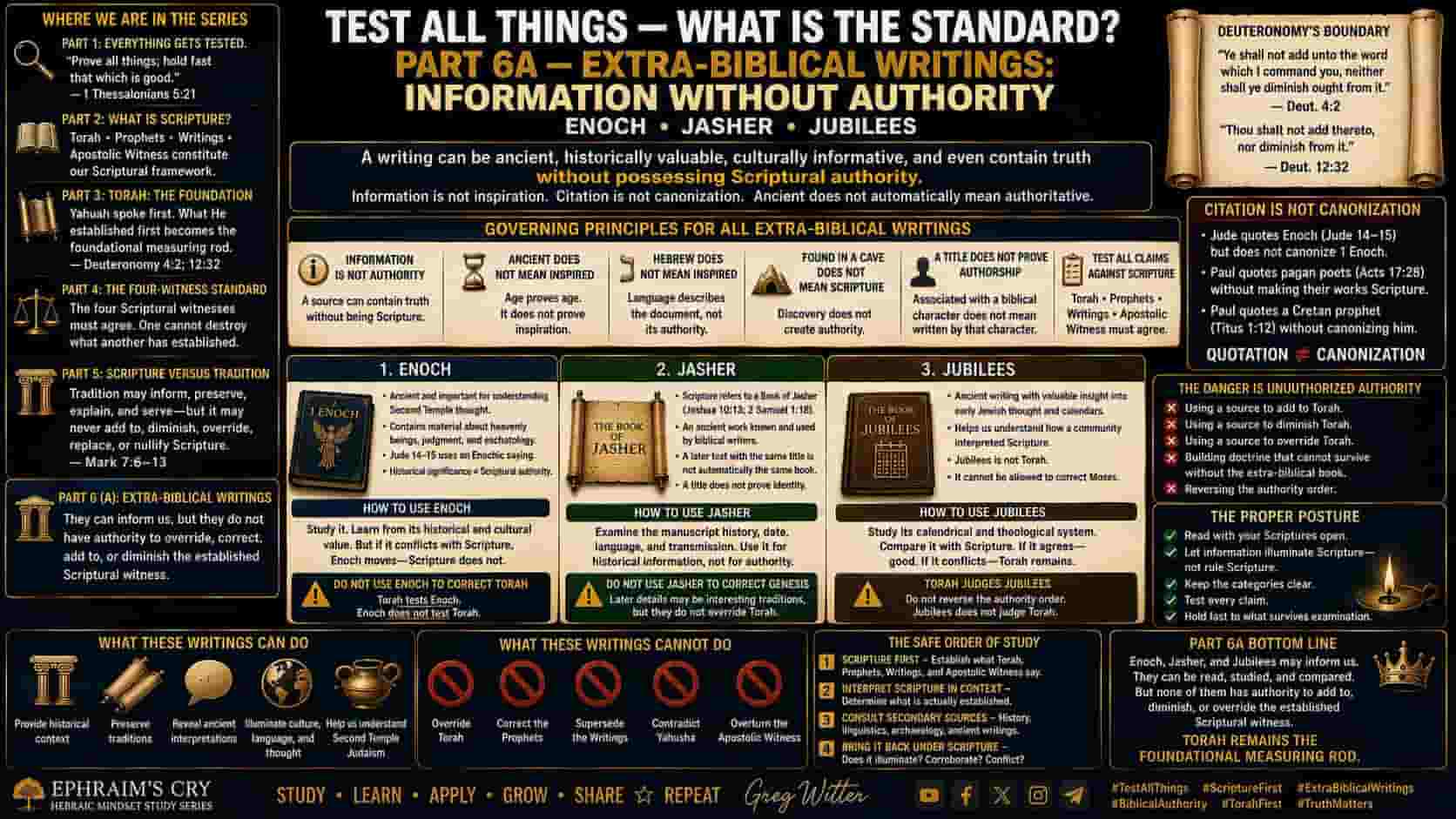
TEST ALL THINGS — WHAT IS THE STANDARD?
Part 6A — Extra-Biblical Writings: Information Without Authority
Enoch • Jasher • Jubilees
A writing can be ancient, historically valuable, culturally informative, and even contain truth without possessing Scriptural authority. Information is not inspiration. Citation is not canonization. Ancient does not automatically mean authoritative.
Greg Witter | Ephraim’s Cry
Hebraic Mindset Study Series
Study • Learn • Apply • Grow • Share ☆ Repeat
Part 1 established:
EVERYTHING GETS TESTED. (1 Thessalonians 5:21; Acts 17:11)
Part 2 established:
TORAH • PROPHETS • WRITINGS • APOSTOLIC WITNESS constitute our Scriptural framework (Luke 24:27, 44; 2 Timothy 3:15–17; 2 Peter 3:15–16).
Part 3 established:
TORAH IS THE FOUNDATIONAL MEASURING ROD. What Yahuah established first becomes foundational for testing what is claimed later (Deuteronomy 4:2; 12:32; 13:1–5).
Part 4 established:
THE FOUR SCRIPTURAL WITNESSES MUST AGREE. A doctrine cannot legitimately require one Scriptural witness to destroy another.
Part 5 established:
TRADITION REMAINS UNDER SCRIPTURE. Tradition may inform, preserve, explain, and serve, but it may never add to, diminish, override, replace, or nullify what Yahuah established (Mark 7:6–13).
Now Part 6 addresses a closely related but distinct question.
What do we do with extra-biblical writings?
What do we do with Enoch?
Jasher?
Jubilees?
The Talmud?
The Apocrypha?
The Dead Sea Scrolls?
Other ancient Jewish writings?
Early Christian writings?
Second Temple literature?
Historical records?
Can these writings contain useful information?
Yes.
Can they preserve genuine historical traditions?
Possibly.
Can they help us understand what ancient communities believed?
Certainly.
Can they provide cultural, linguistic, historical, or interpretive background?
Yes.
But does that make them Scripture?
No.
Can they be given authority to override Torah?
No.
Can they be used to correct the Prophets?
No.
Can they supersede the Writings?
No.
Can they overturn Yahusha or the Apostolic Witness?
No.
That is the distinction Part 6 must establish.
Because of the amount of material involved, Part 6 is being presented in two sections. Part 6A establishes the governing principles and examines Enoch, Jasher, and Jubilees. Part 6B will continue the same teaching with the Talmud, Apocrypha, Dead Sea Scrolls, other ancient sources, and the final application.
Nothing about the standard changes.
INFORMATION IS NOT AUTHORITY
This is the foundational principle.
A source can contain information without possessing authority.
That should not be difficult to understand.
A dictionary can contain accurate information.
A history book can contain accurate information.
An archaeological report can contain accurate information.
A scientific paper can contain accurate information.
A commentary can contain accurate information.
A nonbiblical ancient writer can record something accurately.
A rabbi can make a correct observation.
A Church Father can make a correct observation.
A pagan historian can record a genuine historical event.
None of those facts automatically transforms the source into inspired Scripture.
Therefore the question:
“Does this book contain something true?”
is not the same question as:
“Does this book possess Scriptural authority?”
Those are two entirely different questions.
A BOOK DOES NOT HAVE TO BE SCRIPTURE TO BE USEFUL
This is where people sometimes create a false choice.
Either:
“This book is Scripture.”
Or:
“This book is worthless and should never be read.”
Those are not our only options.
A writing may be useful without being authoritative.
It may provide historical context.
It may reveal how a particular ancient community interpreted Scripture.
It may preserve traditions.
It may help us understand language.
It may show what theological debates existed during a particular period.
It may contain genuine historical information.
It may preserve an interpretation worth examining.
But useful does not mean inspired.
That distinction allows us to study ancient literature without surrendering the authority structure already established in Parts 2–5.
ANCIENT DOES NOT MEAN INSPIRED
This principle must be firmly established.
There is a growing tendency to assume that if something is ancient, mysterious, suppressed, discovered in a cave, written in Hebrew or Aramaic, associated with a biblical character, or excluded from a later Bible collection, then it must contain hidden truth that someone deliberately removed.
That conclusion does not follow.
Ancient people wrote truth.
Ancient people also wrote error.
Ancient Jewish communities disagreed with one another.
Ancient sects competed with one another.
Ancient teachers interpreted Scripture differently.
Ancient calendars differed.
Ancient theological systems differed.
Ancient people were still people.
Therefore:
AGE PROVES AGE.
It does not prove inspiration.
HEBREW DOES NOT MEAN INSPIRED
The same principle applies to language.
A document being written in Hebrew does not make it Scripture.
Neither does Aramaic.
Neither does Greek.
Language tells us the language of the document.
It does not establish divine authority.
A Hebrew manuscript can contain truth.
A Hebrew manuscript can contain error.
Therefore:
“It was written in Hebrew”
does not settle the authority question.
FOUND IN A CAVE DOES NOT MEAN SCRIPTURE
The discovery of ancient manuscripts, particularly among the Dead Sea Scrolls, has created enormous interest in ancient Jewish writings.
That interest is understandable.
Such discoveries are tremendously important for studying ancient manuscripts, Second Temple Judaism, Hebrew and Aramaic, textual transmission, sectarian beliefs, calendars, community practices, and biblical interpretation.
But a document being found in a cave does not automatically make it Scripture.
Location does not determine inspiration.
We will deal specifically with the Dead Sea Scrolls in Part 6B.
For now, the governing principle is enough:
DISCOVERY DOES NOT CREATE AUTHORITY.
ASSOCIATED WITH A BIBLICAL CHARACTER DOES NOT MEAN WRITTEN BY THAT CHARACTER
This is another major problem.
Ancient writings were sometimes attributed to famous biblical figures.
A book may carry the name of Enoch.
Another may be associated with Ezra.
Another with Baruch.
Another with a patriarch.
But a title or attribution is not automatic proof of authorship.
We must distinguish:
the name attached to a work
from:
demonstrated authorship of the work.
That distinction becomes particularly important when someone argues that a book must possess authority simply because its title contains the name of someone found in Scripture.
AUTHORSHIP MATTERS
If a book claims association with an ancient biblical figure, authorship should be examined.
Can the claimed author reasonably have written the document?
Does the language fit the alleged period?
Does the historical setting fit?
Does the manuscript evidence support the claim?
Does the document contain material indicating a later historical context?
Those questions do not automatically disprove a work.
They help establish what kind of work we are actually dealing with.
AUTHENTICITY MATTERS
A title alone is not enough.
A later copy bearing an ancient name does not automatically establish that the text is identical to something known centuries earlier.
We must ask:
What is the manuscript history?
What is the date?
What is the language?
What evidence connects the surviving text with the claimed ancient source?
Can the transmission be demonstrated?
Those are legitimate questions.
ACCURACY MATTERS
Even if a source is genuinely ancient, we still ask whether its claims are accurate.
Ancient authors could misunderstand events.
Ancient communities could preserve legends.
Ancient interpreters could disagree.
Ancient chronology could be disputed.
Ancient religious writers could promote sectarian theology.
Again:
ANCIENT DOES NOT MEAN INFALLIBLE.
SCRIPTURAL CONSISTENCY MATTERS
For doctrinal purposes, this is decisive.
Suppose an extra-biblical source teaches something.
Bring it to Torah.
Does it agree?
Bring it to the Prophets.
Does it agree?
Bring it to the Writings.
Does it agree?
Bring it to Yahusha and the Apostolic Witness.
Does it agree?
If it conflicts with the established Scriptural testimony, the extra-biblical source does not receive authority to correct Scripture.
The source fails the doctrinal test.
THE FOUR-WITNESS STANDARD STILL GOVERNS
Part 4 established:
TORAH • PROPHETS • WRITINGS • APOSTOLIC WITNESS.
Part 6 does not create a fifth witness called:
“Ancient Books.”
Enoch does not become a fifth witness.
Jasher does not become a fifth witness.
Jubilees does not become a fifth witness.
The Talmud does not become a fifth witness.
The Apocrypha does not become a fifth witness.
The Dead Sea Scrolls do not become a fifth witness.
They remain secondary sources.
SECONDARY DOES NOT MEAN USELESS
This needs repeating because people often hear:
“Not authoritative”
and assume:
“Worthless.”
That is not what I am saying.
A secondary source can be extremely valuable.
A lexicon is secondary.
Historical research is secondary.
Archaeology is secondary.
Astronomical observation is not Scripture.
Yet all of these can provide useful information when used properly.
The category determines the authority, not whether the source can ever be useful.
USEFULNESS AND AUTHORITY MUST NEVER BE CONFUSED
A source may be:
Useful and noncanonical.
Accurate in one place and wrong in another.
Historically valuable but doctrinally unreliable.
Ancient but sectarian.
Interesting but unverifiable.
Helpful for context but incapable of establishing commandment.
Those are legitimate categories.
We do not have to turn every useful source into Scripture.
EXTRA-BIBLICAL WRITINGS CAN CONTAIN TRUE INFORMATION
Of course they can.
Truth does not become false because somebody outside Scripture states it.
Paul demonstrates this principle when speaking in Athens:
“For in him we live, and move, and have our being; as certain also of your own poets have said, For we are also his offspring.” (Acts 17:28)
Paul uses material associated with Greek poets.
Does that make the entire body of Greek poetry Scripture?
No.
Paul also writes:
“One of themselves, even a prophet of their own, said, The Cretians are alway liars, evil beasts, slow bellies.” (Titus 1:12)
Again, Paul can use an outside saying without granting canonical authority to everything written by its source.
This gives us an important principle:
A TRUE STATEMENT DOES NOT CANONIZE THE SOURCE CONTAINING IT.
CITATION IS NOT CANONIZATION
This principle becomes essential when discussing Enoch and Jasher.
A Scriptural writer can cite or use material from outside the canonical Scriptural corpus without canonizing the entire source.
Therefore:
QUOTATION ≠ CANONIZATION.
REFERENCE ≠ CANONIZATION.
AGREEMENT ≠ CANONIZATION.
That distinction must remain in place.
ENOCH
The writings commonly grouped under 1 Enoch are among the most discussed extra-biblical works within Torah-observant and related communities.
They are ancient.
They are important for understanding portions of Second Temple Jewish thought.
They contain extensive material concerning heavenly beings, judgment, wickedness, eschatology, and other subjects.
They clearly reflect concepts circulating within the Jewish world surrounding the Apostolic period.
That makes Enoch historically significant.
But historical significance and Scriptural authority are not identical.
“BUT JUDE QUOTES ENOCH”
This is one of the most common arguments.
Jude says:
“And Enoch also, the seventh from Adam, prophesied of these, saying, Behold, Yahuah cometh with ten thousands of his saints, to execute judgment upon all…” (Jude 14–15)
The wording has a clear relationship to material preserved in the Enochic tradition.
That fact should not be denied.
But what does it prove?
It proves that Jude uses or preserves an Enochic saying.
It does not, by itself, prove that every section of every form of 1 Enoch carries Scriptural authority.
That additional conclusion requires additional evidence.
PAUL SHOWS WHY THE QUOTATION ARGUMENT FAILS
Paul quotes outside material (Acts 17:28; Titus 1:12).
Yet nobody reasonably concludes that every work associated with those outside writers therefore belongs in Scripture.
The same standard must be applied consistently.
We cannot create one rule for Enoch because we want Enoch to be canonical and another rule for pagan writers because we do not.
The principle remains:
CITATION IS NOT CANONIZATION.
CAN ENOCH BE STUDIED?
Yes.
It can be studied historically.
It can be compared with Scripture.
It can help us understand certain ideas circulating during the Second Temple period.
It may help illuminate the conceptual environment surrounding some Apostolic language.
But it remains underneath the established Scriptural witnesses.
If an interpretation from Enoch contradicts Torah, Torah does not move.
If it contradicts the Prophets, the Prophets do not move.
If it contradicts the Writings, the Writings do not move.
If it contradicts Yahusha and the Apostolic Witness, the Scriptural witnesses do not move.
ENOCH MOVES.
That is the authority order.
DO NOT USE ENOCH TO CORRECT TORAH
This is the practical boundary.
If Enoch contains information consistent with Torah, examine it.
If it contains historical or cultural material useful for understanding an ancient period, study it.
But if someone uses Enoch to say:
“Torah actually means something different because Enoch says…”
the authority order has been reversed.
Torah tests Enoch.
Enoch does not test Torah.
JASHER
Jasher creates a different issue because Scripture itself refers to a work by that title.
Joshua says:
“Is not this written in the book of Jasher?” (Joshua 10:13)
Second Samuel likewise says:
“Behold, it is written in the book of Jasher.” (2 Samuel 1:18)
Therefore we can establish something confidently:
An ancient work known as the Book of Jasher, or Book of the Upright, was known to the biblical writers.
That is explicit.
But the next question is unavoidable.
Does that prove that a later surviving work carrying the title Jasher is unquestionably identical to the ancient document referenced in Joshua and Samuel?
No.
That requires evidence.
A TITLE DOES NOT PROVE IDENTITY
Suppose Scripture mentions an ancient book.
Centuries later, a document appears carrying the same title.
The shared title alone does not establish uninterrupted identity.
We must ask:
What is the manuscript history?
What is the date?
What is the language?
What evidence connects the surviving text to the ancient source?
Can the chain of transmission be demonstrated?
Therefore we cannot simply reason:
Scripture mentions Jasher → I possess a book called Jasher → therefore my book is unquestionably the same ancient work.
That conclusion does not automatically follow.
EVEN A BIBLICAL REFERENCE DOES NOT AUTOMATICALLY CANONIZE THE WHOLE SOURCE
Joshua and Samuel can cite a historical source.
That does not necessarily mean every sentence in that historical source possessed the same authority as Torah.
Biblical writers refer to other historical records as well (1 Kings 14:19, 29; 1 Chronicles 29:29; 2 Chronicles 9:29).
The use of an external source does not automatically transform the entire source into Scripture.
Again:
REFERENCE IS NOT CANONIZATION.
DO NOT USE JASHER TO CORRECT GENESIS
If a later Jasher text adds details to a Genesis narrative, those details may be interesting.
They may represent traditions.
They may preserve possible historical material.
They may provide a reconstruction worth examining.
But they cannot automatically be used to say:
“Genesis did not give us the whole truth, so Jasher tells us what really happened.”
That reverses the authority order.
Genesis is Torah.
The later Jasher text remains secondary.
JUBILEES
Jubilees is another ancient writing receiving considerable attention, particularly in discussions concerning chronology and the biblical calendar.
It is historically valuable.
It tells us something about theological and calendrical ideas present within an ancient Jewish context.
That makes it worth studying.
But the authority question remains separate.
Jubilees is not Torah.
Therefore Jubilees cannot be permitted to correct Moses.
THE JUBILEES CALENDAR QUESTION
This becomes particularly important when someone begins with the calendar framework found in Jubilees and then forces Torah to conform to it.
The order must remain the opposite.
First:
What does Torah establish?
Then:
What does Jubilees claim?
Then compare them.
If Jubilees preserves information compatible with Torah, examine it.
If Jubilees preserves evidence concerning an ancient calendar tradition, study it historically.
But if an interpretation of Jubilees requires Torah to be overridden, Torah remains the measuring rod.
TORAH JUDGES JUBILEES
This is the authority relationship.
TORAH JUDGES JUBILEES.
JUBILEES DOES NOT JUDGE TORAH.
That is not hostility toward Jubilees.
It is simply maintaining the authority structure already established in this series.
If Torah establishes one thing and Jubilees appears to establish another, both cannot simultaneously function as the supreme measuring rod.
One must judge the other.
Torah remains foundational.
DO NOT CLAIM “DO NOT ADD” AND THEN ADD JUBILEES AS AN AUTHORITY
Torah says:
“Ye shall not add unto the word which I command you, neither shall ye diminish ought from it.” (Deuteronomy 4:2)
Again:
“Thou shalt not add thereto, nor diminish from it.” (Deuteronomy 12:32)
If we take an extra-biblical writing and give it authority to impose requirements not established by Torah, we need to ask whether we have done exactly what Torah warned against.
Reading Jubilees is not the problem.
Studying Jubilees is not the problem.
Using Jubilees historically is not the problem.
Giving Jubilees authority Yahuah did not establish is the problem.
DO NOT BUILD A DOCTRINE THAT CANNOT SURVIVE WITHOUT THE EXTRA-BIBLICAL BOOK
This is an important test.
If a doctrine cannot be established from Scripture and survives only because an extra-biblical writing supplies the missing requirement, ask why.
If someone says:
“You cannot understand the true calendar without Jubilees,”
ask whether Yahuah actually left His Covenant people without sufficient Scriptural witness until they accepted Jubilees.
If someone says:
“You cannot understand Genesis without Enoch,”
ask whether Genesis actually requires Enoch to become intelligible.
If someone says:
“Jasher gives us what Genesis left out, therefore we need Jasher to know what really happened,”
ask whether the later source has just been elevated from historical information to interpretive authority over Torah.
Those are legitimate questions.
The issue is not whether additional information can ever be useful.
The issue is whether the additional information has become necessary authority.
EXTRA-BIBLICAL SUPPORT MAY CORROBORATE — IT SHOULD NOT CREATE THE DOCTRINE
There is a proper use for secondary evidence.
Suppose Scripture establishes something.
Then an ancient source independently demonstrates that a community understood or practiced something consistent with that Scriptural pattern.
That can be valuable historical evidence.
But notice the order:
SCRIPTURE ESTABLISHES.
THE SECONDARY SOURCE CORROBORATES.
Do not reverse the order:
THE SECONDARY SOURCE ESTABLISHES.
SCRIPTURE IS THEN FORCED TO CONFORM.
That reversal is exactly what Part 6 warns against.
CORROBORATION IS NOT AUTHORITY
An ancient writing may corroborate a historical practice.
An archaeological discovery may corroborate a biblical location.
An inscription may corroborate the existence of a king.
An ancient historian may corroborate an event.
A Second Temple document may corroborate the existence of a particular interpretation.
That evidence can strengthen historical understanding.
But corroboration does not elevate the corroborating source into Scripture.
Again:
INFORMATION IS NOT INSPIRATION.
WHAT IF ENOCH, JASHER, OR JUBILEES AGREES WITH SCRIPTURE?
Then recognize the agreement.
There is no reason to reject a true statement merely because it appears outside Scripture.
If Enoch contains a statement consistent with Scripture, acknowledge it.
If a Jasher tradition preserves information that can be independently supported, examine it.
If Jubilees reflects something consistent with Torah, recognize the consistency.
But the source remains what it is.
Agreement with Scripture does not transform an extra-biblical source into Scripture.
WHAT IF THEY DISAGREE WITH SCRIPTURE?
Then the authority question has already been answered.
Scripture remains the standard.
The secondary source must be rejected at that point, reinterpreted if warranted, or treated simply as evidence of what a particular writer or community believed.
It does not receive authority to correct the established Scriptural witness.
That is not complicated.
It becomes complicated only when we become emotionally invested in the secondary source.
DO NOT FALL IN LOVE WITH THE SOURCE
This is a real danger.
Someone discovers Enoch and becomes fascinated.
Suddenly every reference to heavenly beings must be interpreted through Enoch.
Someone discovers Jasher and becomes fascinated by the additional narrative details.
Suddenly Jasher becomes the missing key to Genesis.
Someone discovers Jubilees and becomes fascinated by its calendar.
Suddenly every Torah calendar passage must be interpreted through Jubilees.
Interest becomes attachment.
Attachment becomes loyalty.
Loyalty becomes authority.
That progression must be stopped.
THE SOURCE DOES NOT GET A FREE PASS BECAUSE IT HELPED YOU
This is the same principle established in Part 1 concerning teachers.
A source may help you understand something.
Good.
Use the information.
But usefulness does not make the source infallible.
A book can help you see one truth and still contain error somewhere else.
Therefore:
TEST EVERY CLAIM.
THE SAME STANDARD MUST BE APPLIED CONSISTENTLY
We cannot reject one extra-biblical source because it conflicts with our theology while treating another as unquestionable because it supports our theology.
That is not testing.
That is confirmation bias.
If Enoch is secondary when it challenges us, it remains secondary when it agrees with us.
If Jubilees is extra-biblical when we disagree with it, it remains extra-biblical when it supports our calendar.
If a later Jasher is historically uncertain when it contains something we dislike, it remains historically uncertain when it contains something we want to use.
The standard cannot change according to convenience.
PART 1 STILL GOVERNS PART 6A
Remember:
“Prove all things; hold fast that which is good.” (1 Thessalonians 5:21)
Everything gets tested.
That includes books we dislike.
It also includes books we love.
That includes evidence against our position.
It also includes evidence supporting our position.
Testing only what threatens our doctrine is not testing everything.
PART 3 STILL GOVERNS PART 6A
Torah remains the foundational measuring rod.
Deuteronomy says:
“Ye shall not add unto the word which I command you, neither shall ye diminish ought from it.” (Deuteronomy 4:2)
Again:
“Thou shalt not add thereto, nor diminish from it.” (Deuteronomy 12:32)
Therefore no extra-biblical writing receives permission to add divine obligations to Torah or remove obligations from Torah.
PART 4 STILL GOVERNS PART 6A
The Four-Witness Standard remains:
TORAH.
PROPHETS.
WRITINGS.
APOSTOLIC WITNESS.
Part 6 does not create:
TORAH • PROPHETS • WRITINGS • APOSTOLIC WITNESS • ENOCH.
It does not create:
TORAH • PROPHETS • WRITINGS • APOSTOLIC WITNESS • JASHER.
It does not create:
TORAH • PROPHETS • WRITINGS • APOSTOLIC WITNESS • JUBILEES.
There is no fifth witness.
These writings remain secondary.
PART 5 STILL GOVERNS PART 6A
Tradition remains underneath Scripture.
Extra-biblical writings frequently preserve traditions.
That makes them useful for studying tradition.
It does not automatically give the preserved tradition divine authority.
Yahusha warns about:
“Making the word of Elohim of none effect through your tradition.” (Mark 7:13)
An ancient written tradition does not become immune from that principle merely because someone wrote it down centuries ago.
READ THESE WRITINGS WITH YOUR SCRIPTURES OPEN
That is the proper posture.
Do not approach Enoch thinking:
“What hidden revelation did Scripture fail to give me?”
Approach it asking:
“What does this writing tell me about Enochic traditions and the religious environment represented by this material, and how does it compare with Scripture?”
Do not approach Jasher thinking:
“This will fill in everything Genesis forgot.”
Approach it asking:
“What traditions or historical claims does this text preserve, what can actually be established concerning its transmission, and how do its claims compare with Torah?”
Do not approach Jubilees thinking:
“This book will tell Torah what the calendar really is.”
Approach it asking:
“What calendrical and theological system does Jubilees represent, and does that system agree with what Torah actually establishes?”
That keeps the authority order intact.
INFORMATION SHOULD ILLUMINATE SCRIPTURE — NOT RULE SCRIPTURE
Historical information may illuminate context.
Ancient literature may illuminate interpretive traditions.
Linguistic evidence may clarify terminology.
But secondary information should serve our study.
It should not become the master that tells Scripture what Scripture is permitted to say.
THREE BOOKS — THREE DIFFERENT QUESTIONS
This is why Enoch, Jasher, and Jubilees should not simply be thrown together as though they present identical historical issues.
With Enoch, one major question concerns Enochic tradition, composite material, and Jude’s use of an Enochic saying (Jude 14–15).
With Jasher, one major question concerns whether later surviving texts carrying the title can actually be identified with the ancient work referenced in Joshua 10:13 and 2 Samuel 1:18.
With Jubilees, one major question concerns the authority given to its reinterpretation of biblical history and its calendrical system.
Different source.
Different historical questions.
Same authority test.
THE AUTHORITY TEST REMAINS THE SAME
For Enoch:
Does it agree with Scripture?
For Jasher:
Does it agree with Scripture?
For Jubilees:
Does it agree with Scripture?
And if it does not:
Scripture remains standing.
That is the point.
PART 6A BOTTOM LINE
Enoch can provide information.
Jasher can provide information.
Jubilees can provide information.
They can be read.
They can be studied.
They can be compared.
They can be historically useful.
But:
ENOCH IS NOT TORAH.
JASHER IS NOT TORAH.
JUBILEES IS NOT TORAH.
None of them has authority to correct Moses.
None of them has authority to override the Prophets.
None of them has authority to supersede the Writings.
None of them has authority to contradict Yahusha.
None of them has authority to overturn the Apostolic Witness.
THE PRINCIPLE FOR PART 6A
The governing principle is simple:
A WRITING MAY BE ANCIENT, INTERESTING, HISTORICALLY VALUABLE, AND EVEN CONTAIN TRUE INFORMATION WITHOUT POSSESSING SCRIPTURAL AUTHORITY.
Therefore:
INFORMATION IS NOT INSPIRATION.
ANCIENT IS NOT AUTOMATICALLY AUTHORITATIVE.
A BIBLICAL NAME ON A BOOK IS NOT PROOF OF AUTHORSHIP.
A QUOTATION IS NOT CANONIZATION.
A REFERENCE IS NOT CANONIZATION.
AGREEMENT WITH SCRIPTURE DOES NOT MAKE THE ENTIRE SOURCE SCRIPTURE.
And above all:
TORAH JUDGES THE EXTRA-BIBLICAL SOURCE.
THE EXTRA-BIBLICAL SOURCE DOES NOT JUDGE TORAH.
PART 6A CONCLUSION
This is where Part 6A ends.
We have established the governing authority principle and applied it specifically to:
ENOCH.
JASHER.
JUBILEES.
We have not rejected information simply because it is extra-biblical.
Neither have we granted authority simply because something is ancient.
We have kept the categories intact.
Read them.
Study them.
Compare them.
Learn what they can legitimately teach us about ancient beliefs, traditions, interpretations, and historical contexts.
But never move the measuring rod.
TORAH • PROPHETS • WRITINGS • APOSTOLIC WITNESS remain the established Scriptural witnesses.
Part 6B will continue this same teaching with:
THE TALMUD.
THE APOCRYPHA.
THE DEAD SEA SCROLLS.
SECOND TEMPLE AND OTHER ANCIENT SOURCES.
EARLY CHRISTIAN WRITINGS.
And the final practical rules governing how extra-biblical sources may legitimately be used without granting them Scriptural authority.
#GregWitter#EphraimsCry#EphraimsCryAcademy#HebraicMindsetStudySeries#ReturnToCovenant#TorahStudents#
BibleStudents#ScriptureStudents#HebrewStudents#TruthSeekers#CovenantSeekers#ExtraBiblicalWritings#Enoch#
Jasher#Jubilees#ScriptureFirst#BiblicalAuthority#Torah#FourWitnesses#InformationNotAuthority#CitationIsNotCanonization
#AncientDoesNotMeanInspired#TestAllThings#SearchTheScriptures#Deuteronomy42#Deuteronomy1232#Jude14#Joshua1013
#SecondSamuel118#TruthMatters
