
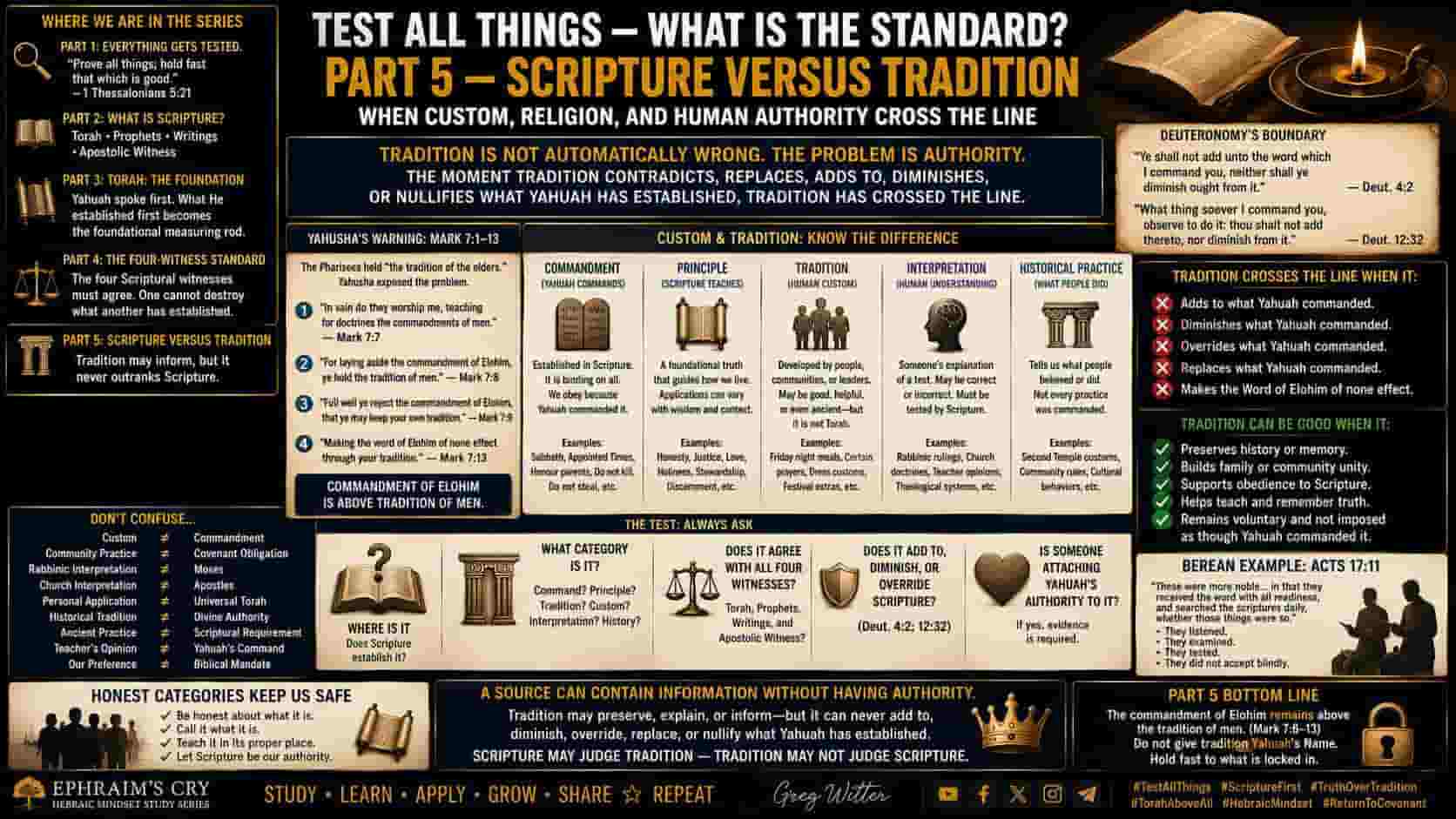
TEST ALL THINGS — WHAT IS THE STANDARD?
Part 5 — Scripture Versus Tradition
When Custom, Religion, and Human Authority Cross the Line
Tradition may preserve information, history, and practice. But the moment tradition contradicts, replaces, adds to, diminishes, or nullifies what Yahuah has established, tradition has crossed the line.
Part 1 established:
EVERYTHING GETS TESTED. (1 Thessalonians 5:21; Acts 17:11)
Part 2 established:
TORAH • PROPHETS • WRITINGS • APOSTOLIC WITNESS constitute our Scriptural framework (Luke 24:27, 44; 2 Timothy 3:15–17; 2 Peter 3:15–16).
Part 3 established:
TORAH IS THE FOUNDATIONAL MEASURING ROD. Yahuah spoke first, and later claims must be tested against what He already established (Deuteronomy 4:2; 12:32; 13:1–5; Isaiah 8:20).
Part 4 established:
THE FOUR SCRIPTURAL WITNESSES MUST AGREE. True doctrine cannot require one Scriptural witness to destroy another.
Now Part 5 asks the next necessary question:
What happens when human tradition is placed alongside Scripture—and then gradually begins functioning as though it possesses the authority of Scripture?
That question matters because tradition is powerful.
Tradition can survive for centuries.
Tradition can become deeply connected to identity.
Tradition can be passed from parent to child.
Tradition can become institutionalized.
Tradition can become so familiar that people stop asking where it came from.
Eventually people may no longer recognize the difference between:
“Yahuah commanded this”
and:
“Our community has always done this.”
That is where the problem begins.
TRADITION IS NOT AUTOMATICALLY WRONG
We need to establish this immediately.
The word tradition should not automatically be treated as though it means evil.
A tradition can preserve memory.
A tradition can preserve history.
A tradition can provide family or community structure.
A tradition can help people remember an event.
A tradition can represent a voluntary way of doing something.
A tradition may even preserve an ancient practice accurately.
The problem is not simply that tradition exists.
The question is:
What authority are we giving it?
That is the issue.
CUSTOM AND COMMANDMENT ARE NOT THE SAME THING
A community may develop a custom.
There is nothing inherently wrong with that.
But a custom becomes something very different when someone says:
“You must do this because Yahuah commands it.”
At that moment, the burden of proof changes.
Now we must ask:
Where did Yahuah command it?
If Scripture establishes the command, then teach the command.
If Scripture does not establish the command, we must not attach Yahuah’s authority to our custom.
That is the distinction between:
“This is what we do”
and:
“This is what Yahuah commands everyone to do.”
Those are not the same statement.
YAHUAH ALREADY WARNED AGAINST ADDING AND DIMINISHING
The foundational boundary was established in Torah:
“Ye shall not add unto the word which I command you, neither shall ye diminish ought from it.” (Deuteronomy 4:2)
Again:
“What thing soever I command you, observe to do it: thou shalt not add thereto, nor diminish from it.” (Deuteronomy 12:32)
Those commands become extremely important when discussing tradition.
If we add a human requirement and then teach it as though Yahuah commanded it, we have crossed the boundary.
If we use tradition to remove, weaken, or redefine something Yahuah did command, we have crossed the boundary from the opposite direction.
Therefore tradition must remain tradition.
It cannot quietly become Torah.
YAHUSHA DIRECTLY CONFRONTS THIS PROBLEM
Mark 7 is one of the clearest passages in Scripture concerning the relationship between divine commandment and human tradition.
The Pharisees and certain scribes observe that some of Yahusha’s disciples eat bread with what they call “defiled” or unwashen hands (Mark 7:1–2).
Mark then explains:
“For the Pharisees, and all the Jews, except they wash their hands oft, eat not, holding the tradition of the elders.” (Mark 7:3)
Then:
“And when they come from the market, except they wash, they eat not. And many other things there be, which they have received to hold…” (Mark 7:4)
Notice the terminology:
“the tradition of the elders.”
The issue being discussed is not a Torah command concerning ordinary ritual handwashing before every meal.
It is a received tradition.
THE QUESTION ASKED OF YAHUSHA
The Pharisees and scribes ask:
“Why walk not thy disciples according to the tradition of the elders?” (Mark 7:5)
That question reveals the conflict.
They do not ask:
“Why are Your disciples violating Torah?”
They ask:
“Why…not…according to the tradition of the elders?”
Yahusha’s answer establishes the authority order.
YAHUSHA DOES NOT PLACE TRADITION BESIDE COMMANDMENT AS AN EQUAL
Yahusha responds by quoting Isaiah:
“This people honoureth me with their lips, but their heart is far from me.” (Mark 7:6; Isaiah 29:13)
Then:
“Howbeit in vain do they worship me, teaching for doctrines the commandments of men.” (Mark 7:7)
There is the problem.
Human commandments have been elevated into doctrine.
Yahusha continues:
“For laying aside the commandment of Elohim, ye hold the tradition of men.” (Mark 7:8)
That statement establishes the conflict unmistakably:
COMMANDMENT OF ELOHIM
versus
TRADITION OF MEN.
THE PROBLEM IS NOT TRADITION EXISTING — THE PROBLEM IS TRADITION DISPLACING COMMANDMENT
Yahusha says:
“Full well ye reject the commandment of Elohim, that ye may keep your own tradition.” (Mark 7:9)
That is extremely strong language.
The tradition has not merely been placed beside the commandment.
The tradition has become powerful enough to cause the commandment to be rejected.
This is exactly the line we must never cross.
YAHUSHA PROVIDES A SPECIFIC EXAMPLE
Yahusha points directly to Torah:
“For Moses said, Honour thy father and thy mother; and, Whoso curseth father or mother, let him die the death.” (Mark 7:10; Exodus 20:12; 21:17)
Then He contrasts that commandment with the tradition:
“But ye say, If a man shall say to his father or mother, It is Corban…” (Mark 7:11)
The tradition had created a mechanism by which a person could avoid the responsibility Yahuah had established toward father and mother.
Yahusha says:
“And ye suffer him no more to do ought for his father or his mother.” (Mark 7:12)
Then comes the conclusion:
“Making the word of Elohim of none effect through your tradition, which ye have delivered: and many such like things do ye.” (Mark 7:13)
That is the issue.
Tradition has become powerful enough to make the Word of Elohim ineffective in practice.
MARK 7 GIVES US THE AUTHORITY HIERARCHY
The hierarchy is clear:
THE COMMANDMENT OF ELOHIM > THE TRADITION OF MEN.
Not:
Tradition equals commandment.
Not:
Ancient tradition corrects commandment.
Not:
Religious leaders may redefine commandment through tradition.
Yahusha places the commandment above the tradition.
That becomes the controlling principle for Part 5.
A TRADITION CAN BE ANCIENT AND STILL BE WRONG
The traditions Yahusha confronted were not invented the previous afternoon.
They were received traditions.
They had history.
They had religious authority behind them.
They were associated with respected teachers.
They were embedded within the community.
Yet Yahusha still tested them.
Age did not protect them.
Religious acceptance did not protect them.
Community practice did not protect them.
Once they conflicted with Yahuah’s commandment, Yahusha exposed them.
“WE HAVE ALWAYS DONE IT THIS WAY” IS NOT AUTHORITY
This phrase appears in many forms.
“Our people have always done this.”
“The rabbis have always taught this.”
“The Church has always taught this.”
“Our denomination has always believed this.”
“Our fellowship has always practiced this.”
Maybe.
That may be historically interesting.
But it does not answer the authority question.
The authority question is:
WHAT DID YAHUAH COMMAND?
Longevity proves longevity.
It does not prove divine authority.
JEWISH TRADITION MUST BE TESTED
This principle applies to Jewish and rabbinic tradition.
The fact that a tradition is Jewish does not automatically make it Torah.
The fact that rabbis have discussed something for centuries does not transform rabbinic interpretation into the commandment of Yahuah.
The fact that a custom may preserve ancient Jewish practice does not mean Moses commanded it.
Yahusha Himself confronted the tradition of the elders when that tradition displaced the commandment (Mark 7:1–13).
Therefore Jewish tradition must remain underneath Scripture.
CHRISTIAN TRADITION MUST BE TESTED BY THE SAME STANDARD
We cannot condemn rabbinic tradition while protecting Christian tradition.
That would be hypocrisy.
Church tradition gets tested too.
Sunday sanctification gets tested.
Christmas traditions get tested.
Easter traditions get tested.
Creeds get tested.
Councils get tested.
Denominational customs get tested.
Inherited theological systems get tested.
If we tell rabbinic Judaism:
“Show me where Torah commands that,”
then Christianity must be willing to answer the same question.
The standard cannot change depending upon whose tradition is being examined.
MESSIANIC TRADITION MUST ALSO BE TESTED
The same applies within Messianic communities.
A practice does not become Torah because Hebrew terminology is attached to it.
A custom does not become a commandment because it is performed while wearing a tallit.
A rabbinic practice does not become Mosaic simply because a Messianic congregation adopts it.
Again:
Where did Yahuah command it?
That question must remain available.
HEBREW ROOTS TRADITION MUST ALSO BE TESTED
People who leave traditional Christianity often assume that because they have rejected one set of traditions, they are now free from tradition.
That is not necessarily true.
Movements develop traditions quickly.
A teacher proposes an interpretation.
Other teachers repeat it.
Videos circulate.
Graphics circulate.
Books repeat it.
Eventually the teaching becomes:
“Everyone knows this.”
Then someone asks:
“Where does Scripture actually say that?”
And suddenly the question is treated as rebellion.
That is how new traditions are born.
Therefore Hebrew Roots traditions must be tested too.
TORAH-OBSERVANT COMMUNITIES CAN CREATE TRADITION
Keeping Torah does not make someone immune from adding to Torah.
That is precisely why Deuteronomy 4:2 and 12:32 remain important.
We can become so determined to protect a commandment that we build additional rules around it.
Eventually the fence around the commandment can become treated as though the fence itself was commanded.
Then violating the fence becomes treated as though it were violating Torah.
That is exactly where categories become confused.
A FENCE IS NOT THE COMMANDMENT
Someone may choose a personal safeguard.
That can be wise.
Suppose someone says:
“I personally avoid this situation because it helps me avoid violating a commandment.”
Fine.
But if that person then says:
“Yahuah commands everyone to observe my safeguard,”
the claim has changed.
Personal discipline has become alleged divine legislation.
That requires Scriptural authority.
VOLUNTARY PRACTICE MUST REMAIN VOLUNTARY
There may be many practices people choose voluntarily.
Special prayers.
Meal customs.
Clothing customs.
Family traditions.
Ways of preparing for Sabbath.
Ways of celebrating an appointed time beyond the explicit requirements.
Ways of decorating.
Ways of teaching children.
Ways of organizing community gatherings.
These may be useful.
They may be beautiful.
They may help families remember Yahuah’s works.
But if Scripture does not command the practice, it should not be imposed upon others as though Yahuah commanded it.
That is the distinction.
TRADITION BECOMES DANGEROUS WHEN ITS SOURCE IS FORGOTTEN
A tradition may begin honestly.
Everyone knows:
“This is simply our custom.”
A generation passes.
Then another.
Eventually children grow up assuming:
“This is what Scripture requires.”
The origin is forgotten.
The practice remains.
Then someone asks for the Scripture.
Nobody knows.
But because the practice feels sacred, questioning it feels wrong.
That is how tradition can quietly acquire authority it never possessed.
TRADITION BECOMES PARTICULARLY DANGEROUS WHEN IT IS ATTACHED TO FEAR
Sometimes traditions are enforced through fear.
“If you don’t do this, you are disobedient.”
“If you don’t follow this custom, you are outside the community.”
“If you question this practice, you are rebellious.”
“If you do not accept our interpretation, you are rejecting Yahuah.”
Those are serious claims.
Before attaching Yahuah’s authority to them, show the command.
If the command exists, teach it.
If it does not, do not manufacture one.
CREEDS AND CONFESSIONS ARE TRADITIONS TOO
A creed may summarize what a community believes.
A confession may organize doctrine.
A statement of faith may help people understand a ministry’s position.
Those can be useful tools.
But they remain human summaries.
A creed does not become Scripture because it is ancient.
A council does not create truth through majority vote.
A confession does not become inspired because generations have repeated it.
Every statement still gets tested.
COUNCILS DO NOT OUTRANK SCRIPTURE
Religious councils can discuss difficult questions.
They can examine evidence.
They can reach conclusions.
Sometimes those conclusions may be sound.
But the authority of a sound conclusion comes from its agreement with truth, not merely from the existence of the council.
A council can recognize truth.
A council cannot manufacture divine truth.
Therefore:
Council decisions remain testable.
DENOMINATIONAL DOCTRINE IS ORGANIZED TRADITION
Every denomination develops doctrinal boundaries.
Those boundaries help define the group.
But denominational identity can also become a filter.
Instead of asking:
“What does Scripture say?”
people begin asking:
“What does our denomination teach?”
Those are not necessarily the same question.
A denominational statement may accurately reflect Scripture.
If so, good.
But it must remain underneath Scripture.
IDENTITY MAKES TRADITION HARDER TO QUESTION
Tradition becomes especially powerful when it becomes part of identity.
If someone has observed a custom for forty years, questioning it may feel like questioning his family.
If a denomination has taught something for five hundred years, questioning it may feel like rejecting the entire religious community.
If a Jewish practice has been maintained for centuries, questioning whether Moses actually commanded it may feel culturally threatening.
But emotional attachment cannot determine authority.
We can respect people.
We can respect history.
We can respect culture.
And still ask:
“Where is this established in Scripture?”
TRADITION CAN PRESERVE TRUTH
We must keep the balance.
A tradition may preserve something true.
The fact that a teaching is traditional does not automatically make it false.
If a tradition agrees with Scripture, there is no need to reject it merely because it is old.
The question remains:
Does it agree with Scripture?
This is why we test tradition rather than automatically accepting or rejecting it.
TRADITION CAN ALSO PRESERVE ERROR
Error can survive for generations.
Repetition does not purify it.
Age does not sanctify it.
Popularity does not inspire it.
Once error becomes tradition, it can actually become harder to correct because people stop recognizing it as an interpretation.
It becomes simply:
“The way things are.”
That is precisely why testing remains necessary.
TRADITION MUST NEVER BECOME THE INTERPRETER THAT SCRIPTURE CANNOT CORRECT
This is the critical line.
If our tradition determines in advance what Scripture is allowed to mean, then tradition has become the authority.
We may still claim:
“Scripture is our authority.”
But functionally, tradition is controlling Scripture.
A real authority must be capable of correcting us.
If Scripture cannot correct the tradition, Scripture is not actually functioning as the authority.
THE SAME STANDARD APPLIES TO MY TRADITIONS
Everything established in Part 1 still applies.
My customs get tested.
My practices get tested.
The practices of Ephraim’s Cry get tested.
If I begin doing something regularly, repetition does not turn it into Torah.
If I develop a teaching method, that method does not become a commandment.
If I establish a ministry custom, that custom does not become Scripture.
If I prefer doing something a particular way, my preference does not receive Yahuah’s authority.
The teacher does not get an exemption.
DO NOT CONFUSE APPLICATION WITH COMMANDMENT
This distinction is important.
Scripture may establish a principle.
Different people may apply that principle in different legitimate ways.
The application may be wise.
But the particular application should not automatically be elevated into the commandment itself.
For example, Torah may command preparation.
A family may develop a particular preparation routine.
The command is authoritative.
The family’s routine is an application.
Keep those categories separate.
DO NOT CONFUSE DESCRIPTION WITH PRESCRIPTION
A historical text may describe what people did.
That does not automatically mean everyone is commanded to repeat it.
Likewise, a historical tradition may tell us what a particular community practiced.
That does not automatically mean Yahuah required the practice.
This distinction protects us from turning historical behavior into universal law.
DO NOT CONFUSE CULTURE WITH COVENANT
Culture matters.
Biblical events occurred in real cultures.
Understanding those cultures can illuminate Scripture.
But cultural practice is not automatically Covenant commandment.
Ancient Israelites did many things because they lived in the ancient Near East.
Not every cultural practice becomes Torah.
Likewise, later Jewish culture contains practices that developed historically.
Those practices may be meaningful.
They are not automatically commandments from Sinai.
DO NOT CONFUSE RABBINIC INTERPRETATION WITH MOSES
This distinction must remain clear.
Moses is Moses.
A rabbi interpreting Moses centuries later is an interpreter.
The interpretation may be insightful.
It may preserve useful information.
It may even be correct.
But the rabbi does not become Moses.
Therefore when someone says:
“The rabbis say…”
the proper response is not automatically rejection.
The proper response is:
“Show me what they are saying, show me why they are saying it, and then let us test it against Scripture.”
That is the responsible approach.
We do not automatically reject something because a rabbi said it.
We do not automatically accept something because a rabbi said it.
We test it.
The rabbinic interpretation remains secondary.
Moses remains the Scriptural witness.
DO NOT CONFUSE CHURCH INTERPRETATION WITH THE APOSTLES
The same standard must be applied equally to Christianity.
A Church Father is not an Apostle.
A bishop is not Paul.
A theologian is not Peter.
A church council is not Acts 15.
A denominational confession is not Scripture.
Later Christian writers may provide historical information.
They may preserve interpretations.
They may preserve evidence concerning what particular communities believed.
Some of their conclusions may be correct.
Some may be wrong.
But later church interpretation cannot simply be projected backward and called Apostolic doctrine.
If someone says:
“The Church Fathers taught…”
that is historical evidence concerning what those writers taught.
It is not automatically evidence that Yahusha or the Apostles taught the same thing.
The Scriptural witnesses still have to be examined.
DO NOT CONFUSE MAJORITY PRACTICE WITH DIVINE COMMAND
A practice can become nearly universal and still require Scriptural examination.
Large numbers do not create authority.
Exodus warns:
“Thou shalt not follow a multitude to do evil.” (Exodus 23:2)
That does not mean the majority is always wrong.
It means the majority is not the measuring rod.
Likewise, the minority is not automatically right simply because it is small.
The question remains:
What did Yahuah establish?
RELIGIOUS SINCERITY DOES NOT SANCTIFY TRADITION
People can practice traditions sincerely.
They may genuinely believe they are honoring Yahuah.
Their sincerity should be respected.
But sincerity does not transform a human command into a divine command.
Yahusha’s opponents in Mark 7 were religious people.
They were concerned about holiness.
They were concerned about purity.
They were concerned about obedience.
But sincere religious concern did not give their traditions authority over Yahuah’s commandments (Mark 7:6–13).
That is the warning.
TRADITION CAN BEGIN AS AN ATTEMPT TO PROTECT TORAH
This is one of the more subtle dangers.
Someone may reason:
“We do not want anyone to violate this commandment, so we will establish an additional rule to keep people far away from the possibility of transgression.”
At first, everyone understands that the additional rule is simply a protective measure.
But generations later, the distinction can disappear.
The protective rule becomes sacred.
Eventually people may believe violating the protective tradition is equivalent to violating Yahuah’s commandment.
At that point, the fence has become confused with the Torah it was supposedly designed to protect.
That is exactly why Deuteronomy’s warning against adding matters (Deuteronomy 4:2; 12:32).
A FENCE MAY BE WISE WITHOUT BEING TORAH
This distinction allows us to remain balanced.
Someone may establish a personal boundary because he knows his own weakness.
That can be wisdom.
A family may establish a household practice to help everyone prepare for Sabbath.
That can be useful.
A community may develop an orderly way of conducting a gathering.
That can be practical.
The problem begins when the statement changes from:
“This helps us obey”
to:
“Yahuah commanded everyone to do this.”
Now the claim requires Scriptural evidence.
YAHUSHA’S MARK 7 TEST IS SIMPLE
Mark 7 gives us an extraordinarily useful test.
Ask:
Is this the commandment of Elohim?
Or:
Is this the tradition of men?
Then ask:
Does the tradition support obedience to the commandment, or has it begun replacing, altering, or nullifying the commandment?
Yahusha says:
“Laying aside the commandment of Elohim, ye hold the tradition of men.” (Mark 7:8)
Then:
“Full well ye reject the commandment of Elohim, that ye may keep your own tradition.” (Mark 7:9)
Finally:
“Making the word of Elohim of none effect through your tradition.” (Mark 7:13)
Those three statements show a progression.
LAYING ASIDE.
REJECTING.
MAKING OF NONE EFFECT.
That is how tradition crosses the line.
FIRST: LAYING ASIDE
The commandment is no longer central.
Tradition begins receiving more attention.
People know the custom better than they know the Scripture.
They know how the community performs something but cannot explain where Yahuah commanded it.
The tradition begins occupying the space where Scripture should be.
SECOND: REJECTING
Eventually Scripture itself becomes inconvenient because it does not support the tradition.
Now instead of correcting the tradition, people reinterpret or dismiss the commandment.
The tradition has moved above Scripture.
THIRD: MAKING THE WORD OF NONE EFFECT
Finally, the tradition becomes so authoritative that the actual commandment no longer functions as written.
The Word remains on the page.
People may still claim to honor it.
But in practice, the tradition controls behavior.
That is exactly what Yahusha condemned (Mark 7:6–13).
THIS CAN HAPPEN IN ANY RELIGIOUS SYSTEM
This is not a Jewish problem.
It is a human problem.
Christians can do it.
Jews can do it.
Messianics can do it.
Hebrew Roots communities can do it.
Torah-observant fellowships can do it.
Individual ministries can do it.
Families can do it.
I can do it.
You can do it.
That is why the standard cannot change depending upon who is being examined.
CHRISTIAN TRADITION: THE SAME TEST
Suppose someone says:
“Sunday is the biblical Sabbath.”
Do not begin with denominational history.
Begin with Scripture.
Where does Yahuah identify the Sabbath?
Torah identifies the seventh day (Genesis 2:1–3; Exodus 20:8–11).
If someone claims that the day was later changed, that claim must be demonstrated Scripturally.
Tradition cannot perform the change merely because the practice became widespread.
Again, the issue here is not to teach the entire Sabbath doctrine.
The issue is demonstrating the testing principle.
Tradition cannot create a divine command.
JEWISH TRADITION: THE SAME TEST
Suppose someone says:
“The rabbis require this.”
The next question is:
“Does Torah require it?”
If Torah requires it, then Torah is the authority.
If Torah does not require it, then the rabbinic requirement must remain in its proper category.
It may be a custom.
It may be an interpretation.
It may be a protective fence.
It may be a community regulation.
But do not call it Yahuah’s commandment unless Yahuah commanded it.
MESSIANIC AND HEBREW ROOTS TRADITION: THE SAME TEST
Suppose a teacher says:
“This is the ancient Hebraic way.”
Fine.
Show the evidence.
Then show whether Scripture commands it.
Historical antiquity and Scriptural obligation are two separate questions.
Something can be ancient without being commanded.
Something can be Hebraic without being Torah.
Something can be Jewish without being Mosaic.
Something can sound biblical without actually being established by Scripture.
Keep the categories separate.
CALENDAR TRADITION MUST ALSO BE TESTED
Calendar traditions are not exempt.
A calendar method does not become Scriptural merely because a Jewish community practiced it.
It does not become Scriptural merely because an ancient sect practiced it.
It does not become Scriptural merely because a modern teacher reconstructed it.
The question remains:
What does Scripture establish?
Then historical and observational evidence can be examined in its proper place.
But tradition cannot become the authority that tells Scripture what it is permitted to mean.
NAMES TRADITION MUST BE TESTED
The same principle applies when studying the Name.
Traditional pronunciation does not automatically settle the linguistic question.
Neither does rejecting tradition automatically prove an alternative pronunciation.
Both claims require evidence.
Again:
Test it.
Tradition may preserve something correctly.
Tradition may preserve something incorrectly.
Its age alone does not decide.
FEAST TRADITIONS MUST BE TESTED
Many beautiful customs have developed around the appointed times.
Some may help families remember the meaning of the Feast.
Some may be culturally meaningful.
Some may be educational.
But the commanded requirements of the Feast and later customs surrounding the Feast must remain distinguishable.
If Yahuah commands something, obey it.
If a family voluntarily adds a meaningful custom, fine.
But do not tell everyone else Yahuah commanded the custom if He did not.
SABBATH TRADITIONS MUST BE TESTED
The same applies to Sabbath.
Torah commands the Sabbath (Exodus 20:8–11; Deuteronomy 5:12–15).
Communities may develop many ways of preparing for and observing Sabbath.
Some may be wise.
Some may be helpful.
Some may become burdensome.
The question remains:
Which part did Yahuah command, and which part did people develop?
Keeping that distinction clear protects both Torah and freedom from humanly manufactured commandments.
TRADITION CAN SOMETIMES HELP US UNDERSTAND HISTORY
This must remain balanced.
Suppose we want to know how a particular Jewish community understood a passage during the Second Temple period.
Traditional literature may be extremely valuable.
Suppose we want to know how Christians in the second or third century practiced something.
Early Christian writings may be useful.
Suppose we want to know how a custom developed.
Historical traditions may help us trace it.
That is legitimate historical study.
But historical evidence answers:
“What did people believe or do?”
Scripture answers the different question:
“What did Yahuah establish?”
Do not confuse those questions.
WHAT PEOPLE DID IS NOT ALWAYS WHAT YAHUAH COMMANDED
Scripture itself proves this.
Yisra’el repeatedly practiced idolatry (Judges 2:11–13; 2 Kings 17:7–17).
Kings established unlawful worship (1 Kings 12:26–33).
People adopted practices from surrounding nations (2 Kings 17:15).
Therefore proving that ancient Israelites did something does not prove Yahuah commanded it.
Historical practice is evidence of practice.
It is not automatically evidence of obedience.
EVEN ANCIENT ISRAELITE PRACTICE MUST BE TESTED AGAINST TORAH
This is an important safeguard.
Someone may find archaeological or historical evidence showing that Israelites practiced something.
Interesting.
But the next question remains:
Was the practice faithful to Torah?
Scripture itself records generations when Yisra’el was deeply unfaithful.
Therefore:
Israelite practice ≠ automatically Torah practice.
The standard remains what Yahuah commanded.
TRADITION SHOULD NEVER BE USED TO FILL SCRIPTURAL SILENCE WITH DIVINE AUTHORITY
Sometimes Scripture does not provide every detail people want.
Human beings dislike uncertainty.
So tradition fills the gap.
That may be understandable.
But we must distinguish:
“This is one possible historical explanation”
from:
“Yahuah says this is what happened.”
If Scripture is silent, do not make Scripture speak through tradition.
We can discuss possibilities.
We can examine evidence.
But we must not attach divine authority to what Yahuah did not reveal.
“EVERYBODY KNOWS” IS OFTEN TRADITION HIDING IN PLAIN SIGHT
Be cautious when an argument begins:
“Everybody knows…”
Everybody knows according to whom?
Where did the belief originate?
What evidence establishes it?
Sometimes widely accepted ideas have been repeated so long that nobody remembers why they believe them.
That is exactly when the Berean question becomes necessary:
“Are these things so?” (Acts 17:11)
THE BEREANS ARE THE OPPOSITE OF BLIND TRADITION
The Bereans received Paul’s teaching with readiness, but they searched the Scriptures daily to determine whether his claims were true (Acts 17:11).
Think about the principle.
They did not say:
“Paul has authority, so we do not need to check.”
They did not say:
“Our existing tradition is old, so Paul must be wrong.”
They did both things correctly.
They listened.
Then they tested.
That is exactly how tradition should be handled.
HONOR DOES NOT REQUIRE BLIND ACCEPTANCE
You can honor parents and still test a doctrine they taught you.
You can respect a pastor and still examine his interpretation.
You can appreciate a rabbi’s historical knowledge and still test his conclusion.
You can appreciate a teacher who helped you understand Torah and still challenge one of his teachings.
Honor does not mean surrendering discernment.
UNITY DOES NOT REQUIRE PRETENDING EVERY TRADITION IS TRUE
Sometimes people avoid testing tradition because they fear division.
Unity matters.
But Scriptural unity cannot be built upon pretending contradictions do not exist.
Yahusha prayed that His disciples would be sanctified through truth:
“Thy word is truth.” (John 17:17)
Truth must remain part of genuine unity.
TRADITION SHOULD SERVE — NEVER RULE
This gives us a useful principle.
Tradition can serve memory.
Tradition can serve community.
Tradition can serve education.
Tradition can serve family.
Tradition can serve historical understanding.
But tradition must never rule over Yahuah’s Word.
The servant cannot become the master.
SCRIPTURE MUST RETAIN THE RIGHT TO CORRECT TRADITION
This may be the most important test.
Ask:
Can Scripture correct this tradition?
If the answer is no, then tradition has become the authority.
If someone says:
“We know Scripture appears to say this, but our tradition teaches otherwise, and therefore Scripture must mean something else,”
the authority order has likely been reversed.
A genuine Scriptural standard must retain the ability to correct us.
THE FOUR-WITNESS STANDARD STILL APPLIES
Part 4 established that doctrine must survive:
Torah.
Prophets.
Writings.
Apostolic Witness.
Tradition receives no exemption.
If a tradition contradicts Torah, it fails.
If it contradicts the Prophets, it fails.
If it contradicts the Writings, it fails.
If it contradicts Yahusha and the Apostolic Witness, it fails.
If it survives all four, it may represent a legitimate practice or interpretation.
But its authority still comes from its agreement with Scripture—not from being tradition.
THIS IS THE AUTHORITY LINE
We can now state the line clearly:
SCRIPTURE MAY JUDGE TRADITION.
TRADITION MAY NOT JUDGE SCRIPTURE.
Scripture may expose tradition.
Scripture may correct tradition.
Scripture may confirm tradition.
Scripture may show that a tradition is harmless.
Scripture may show that a tradition is useful.
Scripture may show that a tradition is contrary to Yahuah’s command.
But tradition does not receive authority to rewrite Scripture.
WHAT PART 5 DOES NOT DO
We are not yet conducting the detailed examination of Enoch, Jasher, Jubilees, the Talmud, the Apocrypha, Dead Sea Scrolls, and other extra-biblical writings as sources.
That is Part 6.
Some of those sources preserve traditions, but Part 6 deals specifically with their status, usefulness, limitations, and authority.
We are not yet developing the full practical study methodology involving context, language, translations, manuscripts, archaeology, history, commentaries, and scholarship.
That is Part 7.
And we are not yet completing the series with correction, doctrinal humility, repentance, burden of proof, and holding fast to what survives examination.
That is Part 8.
Part 5 has one purpose:
Establish the proper relationship between Scripture and human tradition.
WHAT WE HAVE ESTABLISHED
Tradition is not automatically evil.
Tradition can preserve useful information.
Tradition can preserve history.
Tradition can create meaningful voluntary customs.
But tradition is not automatically Scripture.
Custom is not commandment.
Community practice is not automatically Covenant obligation.
Age is not authority.
Majority acceptance is not authority.
Rabbinic interpretation is not Moses.
Church interpretation is not the Apostles.
Messianic custom is not automatically Torah.
Hebrew Roots practice is not automatically ancient biblical practice.
The commandment of Elohim remains above the tradition of men (Mark 7:6–13).
Yahuah forbids adding to or diminishing from His instruction (Deuteronomy 4:2; 12:32).
Therefore human traditions must remain underneath Scripture.
THE MARK 7 WARNING
Yahusha gives us three stages worth remembering:
“Laying aside the commandment of Elohim…” (Mark 7:8)
“Ye reject the commandment of Elohim…” (Mark 7:9)
“Making the word of Elohim of none effect through your tradition…” (Mark 7:13)
That progression should serve as a warning to every religious community.
First the commandment becomes secondary.
Then the commandment becomes inconvenient.
Finally the tradition effectively replaces it.
Do not allow that progression to occur.
THE QUESTION TO ASK ABOUT EVERY TRADITION
When confronted with a tradition, ask:
What is it?
Is it a commandment?
A custom?
A historical practice?
A community rule?
A personal safeguard?
An interpretation?
A cultural expression?
Then ask:
Where did it come from?
Then:
Does Scripture command it?
Then:
Does it contradict anything Scripture commands?
Then:
Is someone attaching Yahuah’s authority to something Yahuah never commanded?
Those questions keep tradition in its proper place.
THE PRINCIPLE IN ONE SENTENCE
Part 5 can be summarized this way:
TRADITION MAY INFORM, PRESERVE, EXPLAIN, AND SERVE—BUT IT MAY NEVER ADD TO, DIMINISH, OVERRIDE, REPLACE, OR NULLIFY WHAT YAHUAH HAS ESTABLISHED IN SCRIPTURE.
That is the line.
CONCLUSION
Part 1 established:
EVERYTHING GETS TESTED.
Part 2 established:
TORAH • PROPHETS • WRITINGS • APOSTOLIC WITNESS constitute our Scriptural framework.
Part 3 established:
TORAH IS THE FOUNDATIONAL MEASURING ROD.
Part 4 established:
THE FOUR SCRIPTURAL WITNESSES MUST AGREE.
Part 5 now establishes:
TRADITION REMAINS UNDER SCRIPTURE.
Not beside Scripture as an equal.
Not above Scripture as an interpreter Scripture cannot correct.
Under Scripture.
That applies to Jewish tradition.
Christian tradition.
Catholic tradition.
Protestant tradition.
Messianic tradition.
Hebrew Roots tradition.
Torah-observant tradition.
Family tradition.
Ministry tradition.
My tradition.
Your tradition.
All of it.
If it is tradition, call it tradition.
If it is custom, call it custom.
If it is interpretation, call it interpretation.
If it is historical practice, call it historical practice.
If it is personal application, call it personal application.
But if we say:
“Yahuah commands this,”
then we must be able to demonstrate that Yahuah actually commanded it.
That is the boundary.
DO NOT GIVE TRADITION YAHUAH’S NAME
This is ultimately what makes the matter so serious.
When we take something human beings established and declare:
“Yahuah requires this,”
we are no longer merely discussing a custom.
We have attached Yahuah’s authority to our statement.
That carries responsibility.
If Yahuah commanded it, teach it as His commandment.
If He did not command it, do not put His Name behind it.
Deuteronomy establishes the boundary:
“Ye shall not add unto the word which I command you, neither shall ye diminish ought from it.” (Deuteronomy 4:2)
The safest course is honesty concerning the category.
SCRIPTURE DOES NOT NEED TRADITION TO BECOME AUTHORITATIVE
Tradition may help us understand how people interpreted Scripture.
Tradition may help reconstruct historical practices.
Tradition may preserve memories.
But Yahuah’s Word does not become authoritative because later generations agreed with it.
The authority originates with Yahuah.
That is why Yahusha can place the:
“commandment of Elohim”
against the:
“tradition of men.” (Mark 7:8)
One derives its authority from Elohim.
The other derives from men.
That distinction cannot be erased.
THE PROBLEM IS AUTHORITY, NOT INFORMATION
This is the point I want to leave firmly established before moving into Part 6.
A tradition may contain information.
It may contain accurate information.
It may preserve a correct interpretation.
It may even help us understand something that would otherwise be difficult.
None of that automatically gives the tradition authority.
Information and authority are different categories.
That distinction becomes essential in the next teaching when we examine extra-biblical writings.
A source may tell us something useful.
That does not automatically give the source authority to correct Scripture.
THE MOMENT TRADITION OVERRIDES SCRIPTURE, STOP
When a tradition says something and Scripture says something different, the decision has already been made concerning which possesses greater authority.
Scripture wins.
Not because we despise tradition.
Not because everything old is wrong.
Not because historical sources have no value.
But because tradition does not possess authority to overrule what Yahuah established.
That is the order Yahusha Himself demonstrates in Mark 7:6–13.
THE MOMENT TRADITION ADDS A COMMANDMENT, STOP
If someone says:
“You must do this because Yahuah requires it,”
ask:
“Where?”
Not disrespectfully.
Not arrogantly.
But responsibly.
Where is the command?
If Scripture establishes it, then we have something to obey.
If Scripture does not establish it, then the teacher must be honest about what is being presented.
Perhaps it is wisdom.
Perhaps it is custom.
Perhaps it is application.
Perhaps it is tradition.
But those categories cannot be quietly transformed into Torah.
THE MOMENT TRADITION REMOVES A COMMANDMENT, STOP
The same applies in the opposite direction.
If Yahuah explicitly commanded something and later tradition says:
“That no longer matters,”
ask:
“Where did Yahuah remove it?”
Remember:
Deuteronomy prohibits both adding and diminishing (Deuteronomy 4:2; 12:32).
Religious systems can violate the standard in either direction.
One system may add requirements.
Another may subtract requirements.
Both require examination.
THAT IS WHY BOTH SIDES NEED THE SAME MEASURING ROD
We cannot accuse rabbinic Judaism of adding while giving Christianity permission to subtract.
We cannot accuse Christianity of creating traditions while giving Messianic Judaism permission to adopt rabbinic traditions unquestioningly.
We cannot accuse Messianic Judaism while pretending Hebrew Roots communities never develop traditions of their own.
The standard must be consistent.
If it changes depending upon which group we like, it is not really a standard.
THE TEACHER DOES NOT GET TO PROTECT HIS OWN TRADITION
This includes me.
If something becomes customary within Ephraim’s Cry, that does not make it Scripture.
If I teach something repeatedly for ten years, repetition does not turn my teaching into Torah.
If hundreds of people begin repeating something I taught, popularity does not give it authority.
If a study guide says it, test it.
If a teaching board says it, test it.
If I say:
“Yahuah commands…”
make sure Yahuah commands it.
That is the standard established in Part 1, and it remains in force here.
THIS IS HOW WE KEEP TRADITION IN ITS PROPER PLACE
We do not have to destroy every tradition.
We categorize it correctly.
SCRIPTURAL COMMANDMENT: obey because Yahuah commanded it.
SCRIPTURAL PRINCIPLE: apply faithfully according to what Scripture establishes.
HISTORICAL PRACTICE: study it for what it tells us about history.
COMMUNITY CUSTOM: participate voluntarily where appropriate, provided it does not violate Scripture.
PERSONAL APPLICATION: use it where it helps obedience without imposing it as Torah upon everyone else.
TRADITION: examine it, understand its origin where possible, and test it against Scripture.
The problem begins when those categories are collapsed.
CATEGORY CONFUSION CREATES FALSE AUTHORITY
A tradition becomes dangerous when it is presented as commandment.
A historical practice becomes dangerous when it is presented as universal Torah.
A personal safeguard becomes dangerous when it is imposed upon everyone.
An interpretation becomes dangerous when it is presented as though the text explicitly says what the interpreter concluded.
The solution is not complicated:
Tell the truth about the category.
YAHUSHA DID EXACTLY THAT
Mark 7 distinguishes:
“the commandment of Elohim” (Mark 7:8–9)
from:
“the tradition of men” (Mark 7:8)
and:
“your own tradition.” (Mark 7:9)
Yahusha did not blur those categories.
Neither should we.
THE WATCHMAN’S WARNING
Tradition becomes most dangerous when people no longer know it is tradition.
Once a community believes its customs came directly from Yahuah, questioning those customs becomes almost impossible.
The person asking:
“Where is that written?”
is treated as rebellious.
But that question may be exactly what is needed.
The Bereans searched:
“whether those things were so.” (Acts 17:11)
That question must remain available in every generation.
DO NOT BE AFRAID OF THE QUESTION
Where is it written?
That question should not frighten a teacher.
If Scripture establishes the teaching, show it.
If history establishes the historical claim, identify it as history.
If tradition preserves the custom, identify it as tradition.
If the conclusion is an interpretation, identify it as interpretation.
Honest categories make teaching stronger.
False certainty makes teaching weaker.
THE BOTTOM LINE
Human beings will always develop customs.
Communities will always develop traditions.
Teachers will always interpret.
Families will always establish routines.
Religious systems will always organize practices.
That is part of human community.
The problem begins when human practice acquires divine authority without divine authorization.
That is the line Yahusha exposes.
“Laying aside the commandment of Elohim…” (Mark 7:8)
“Ye reject the commandment of Elohim…” (Mark 7:9)
“Making the word of Elohim of none effect through your tradition…” (Mark 7:13)
Do not cross that line.
PART 5 IS NOW COMPLETE
We have established what this part was intended to establish.
Tradition may exist.
Tradition may contain useful information.
Tradition may preserve history.
Tradition may provide meaningful voluntary practice.
But:
TRADITION DOES NOT HAVE AUTHORITY TO ADD TO SCRIPTURE.
TRADITION DOES NOT HAVE AUTHORITY TO DIMINISH SCRIPTURE.
TRADITION DOES NOT HAVE AUTHORITY TO OVERRIDE SCRIPTURE.
TRADITION DOES NOT HAVE AUTHORITY TO REPLACE SCRIPTURE.
TRADITION DOES NOT HAVE AUTHORITY TO NULLIFY SCRIPTURE.
The commandment of Elohim remains above the tradition of men (Mark 7:6–13).
That is Part 5.
WHERE THE SERIES GOES NEXT
We are now prepared for a closely related but distinct question.
What about writings that are not merely traditions but actual ancient books and collections?
What about:
Enoch?
Jasher?
Jubilees?
The Talmud?
The Apocrypha?
The Dead Sea Scrolls?
Other ancient Jewish and religious writings?
Can they contain useful information?
Yes.
Can they preserve historical material?
Possibly.
Can they illuminate what ancient communities believed?
Certainly.
But does usefulness equal inspiration?
Does ancient equal authoritative?
Does being quoted equal canonization?
Can any of these writings override Torah, the Prophets, the Writings, or the Apostolic Witness?
Those questions belong exactly where we locked them into this series:
PART 6 — EXTRA-BIBLICAL WRITINGS: INFORMATION WITHOUT AUTHORITY
Enoch • Jasher • Jubilees • Talmud • Apocrypha • Dead Sea Scrolls • Other Ancient Sources
And Part 6 will establish the critical distinction:
A SOURCE CAN CONTAIN INFORMATION WITHOUT POSSESSING SCRIPTURAL AUTHORITY.
#GregWitter#EphraimsCry#EphraimsCryAcademy#HebraicMindsetStudySeries#ReturnToCovenant#TorahStudents
#ScriptureFirst#BiblicalAuthority#Torah#CommandmentsOfElohim#TraditionsOfMen#Mark7#Deuteronomy42#
Deuteronomy1232#TestAllThings#SearchTheScriptures#BiblicalDiscernment#HumanTradition#ScriptureOverTradition
#CustomVersusCommandment#TruthOverTradition#BereanStudy#Acts1711#TruthMatters
