
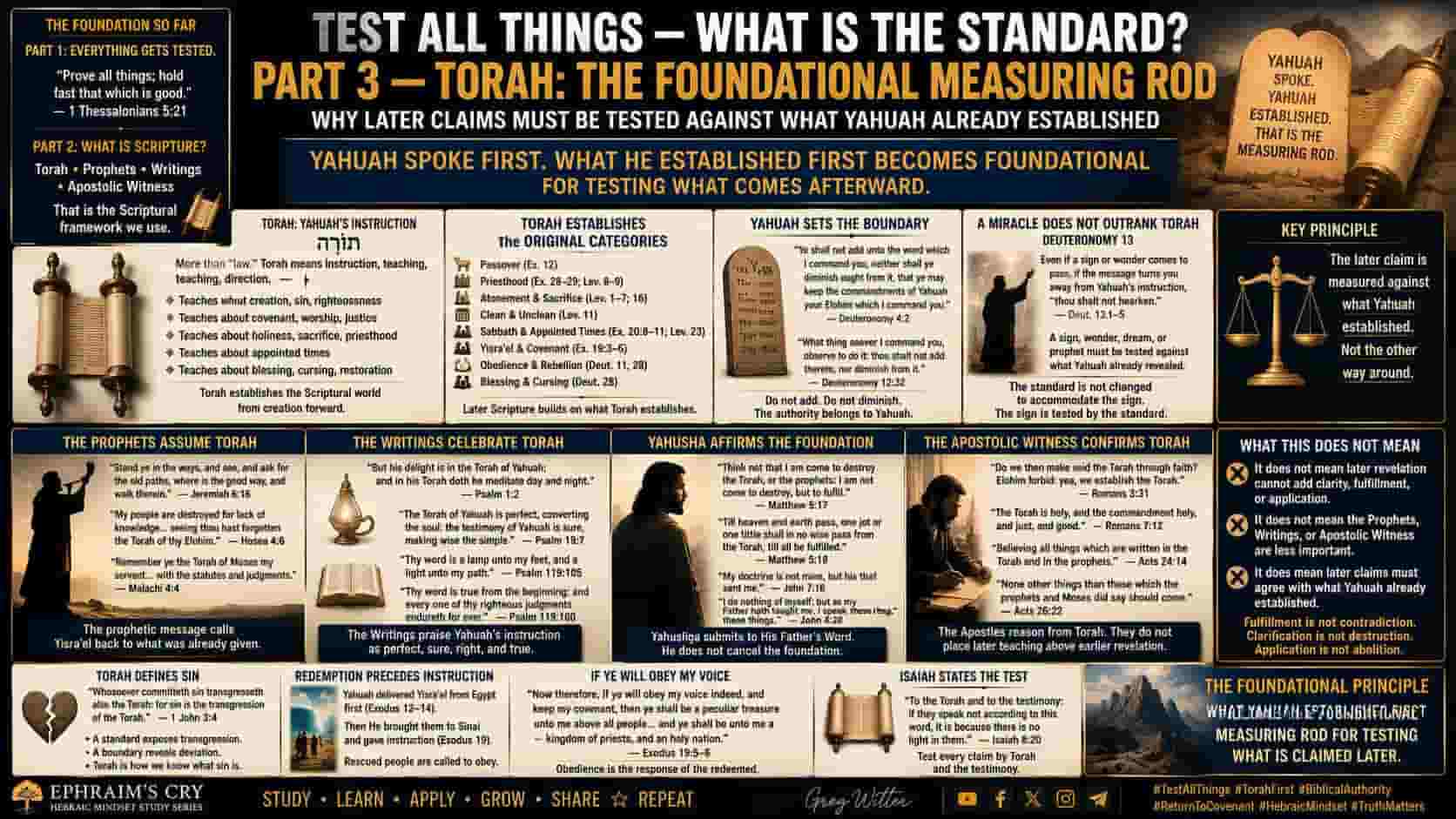
TEST ALL THINGS — WHAT IS THE STANDARD?
Part 3 — Torah: The Foundational Measuring Rod
Why Later Claims Must Be Tested Against What Yahuah Already Established
Yahuah spoke first. What He established first becomes foundational for testing what comes afterward.
Greg Witter | Ephraim’s Cry
Hebraic Mindset Study Series
Study • Learn • Apply • Grow • Share ☆ Repeat
Part 1 established that everything gets tested (1 Thessalonians 5:21; Acts 17:11).
Part 2 established the Scriptural framework within which that testing takes place:
Torah • Prophets • Writings • Apostolic Witness.
Now we come to the next necessary question.
Within that continuing Scriptural testimony, where does the foundational measuring rod begin?
Torah.
This does not mean that the Prophets, Writings, or Apostolic Witness are unimportant. It does not mean that later revelation cannot clarify, expand, fulfill, or apply what came earlier.
It means something much more fundamental:
Later revelation cannot legitimately make Yahuah wrong about what He already established.
Yahuah spoke.
Yahuah instructed.
Yahuah entered Covenant.
Yahuah defined obedience.
Yahuah defined transgression.
Yahuah established His appointed order.
Therefore what comes later must be understood in continuity with what He already revealed.
That is the principle we establish in Part 3.
WHAT IS TORAH?
The Hebrew word is:
תּוֹרָה — Torah
Torah is frequently translated into English simply as “law.”
That translation can be legitimate in certain contexts, but the English word law can also communicate something narrower than the Hebrew concept.
Torah fundamentally carries the sense of instruction, teaching, direction.
Therefore when we speak of Torah, we are not merely speaking about an arbitrary collection of religious regulations.
We are speaking about Yahuah’s revealed instruction.
Torah teaches us who Yahuah is.
Torah teaches us about creation.
Torah teaches us about humanity.
Torah teaches us about sin.
Torah teaches us about righteousness.
Torah teaches us about Covenant.
Torah teaches us about redemption.
Torah teaches us about holiness.
Torah teaches us about worship.
Torah teaches us about justice.
Torah teaches us about clean and unclean.
Torah teaches us about appointed times.
Torah teaches us about priesthood.
Torah teaches us about sacrifice.
Torah teaches us about blessing and cursing.
Torah teaches us about Yisra’el.
Torah teaches us about obedience and rebellion.
Torah teaches us about repentance and restoration.
This is foundational revelation.
TORAH IS MORE THAN SINAI
We should also recognize that the Torah begins before Yisra’el arrives at Mount Sinai.
Genesis is Torah.
Creation is Torah.
The Garden is Torah.
Adam and Eve are Torah.
Cain and Abel are Torah.
Noah is Torah.
Abraham is Torah.
Isaac is Torah.
Jacob is Torah.
Joseph is Torah.
The Exodus is Torah.
Passover is Torah.
The wilderness events before Sinai are Torah.
Therefore Torah establishes far more than what modern people sometimes dismiss as “the Mosaic Law.”
It establishes the Scriptural worldview from creation forward.
TORAH ESTABLISHES THE ORIGINAL CATEGORIES
This matters because later Scripture assumes categories Torah has already established.
When later Scripture speaks about sin, Torah has already given us the framework.
When later Scripture speaks about Covenant, Torah has already given us the framework.
When later Scripture speaks about Passover, Torah has already established Passover (Exodus 12:1–28).
When later Scripture speaks about priesthood, Torah has already established priesthood (Exodus 28–29; Leviticus 8–9).
When later Scripture speaks about sacrifice and atonement, Torah has already established those categories (Leviticus 1–7; 16).
When later Scripture speaks about clean and unclean, Torah has already established those distinctions (Leviticus 11:1–47).
When later Scripture speaks about Sabbath and appointed times, Torah has already established the framework (Genesis 2:1–3; Exodus 20:8–11; Leviticus 23:1–44).
When later Scripture speaks about Yisra’el, Torah has already established who Yisra’el is within the Covenant story (Genesis 32:28; Exodus 4:22; 19:3–6).
Therefore later Scripture does not arrive in an empty theological room.
The vocabulary already exists.
YAHUAH ESTABLISHES THE BOUNDARY
One of the clearest authority principles appears in Deuteronomy.
Moses tells Yisra’el:
“Ye shall not add unto the word which I command you, neither shall ye diminish ought from it, that ye may keep the commandments of Yahuah your Elohim which I command you.” (Deuteronomy 4:2)
That is an extraordinarily important boundary.
Do not add.
Do not diminish.
Why?
Because these are not Moses’ private philosophical opinions.
The text identifies them as:
“the commandments of Yahuah your Elohim.” (Deuteronomy 4:2)
The authority belongs to Yahuah.
Therefore human beings do not possess authority to alter what Yahuah has established.
THE SAME BOUNDARY IS REPEATED
Deuteronomy states the principle again:
“What thing soever I command you, observe to do it: thou shalt not add thereto, nor diminish from it.” (Deuteronomy 12:32)
Again:
Do not add.
Do not diminish.
That creates a protective boundary around Yahuah’s instruction.
A later teacher cannot legitimately say:
“Yahuah forgot something, so I will add it.”
A religious institution cannot legitimately say:
“This command is inconvenient, so we will remove it.”
A tradition cannot legitimately transform itself into a divine command merely through age.
And an interpretation cannot legitimately erase what Yahuah explicitly established.
That is the authority principle.
ADDING AND TAKING AWAY ARE BOTH DANGEROUS
People often recognize one side while ignoring the other.
Adding is dangerous.
Taking away is also dangerous.
We can add requirements Yahuah never commanded.
We can also remove requirements Yahuah did command.
Both actions place human judgment above divine instruction.
That means every later claim must be examined carefully.
Does it add?
Does it diminish?
Does it reinterpret an instruction until the instruction effectively disappears?
Does it introduce a requirement and then attach Yahuah’s authority to something Yahuah never said?
Those questions belong directly to Torah’s authority boundary.
TORAH BECOMES THE TEST FOR LATER CLAIMS
This is demonstrated dramatically in Deuteronomy 13.
Moses describes a prophet or dreamer who produces a sign or wonder:
“If there arise among you a prophet, or a dreamer of dreams, and giveth thee a sign or a wonder, and the sign or the wonder come to pass…” (Deuteronomy 13:1–2)
Notice what happens.
The sign can actually occur.
This is not merely a false prediction that fails.
The sign may happen.
Yet the person then says:
“Let us go after other mighty ones… and let us serve them.” (Deuteronomy 13:2)
What is Yisra’el instructed to do?
“Thou shalt not hearken unto the words of that prophet, or that dreamer of dreams.” (Deuteronomy 13:3)
Why?
Because the supernatural experience does not outrank the revelation Yahuah already gave.
That is one of the strongest authority principles in all of Scripture.
A MIRACLE DOES NOT OUTRANK TORAH
Think carefully about what Deuteronomy 13 establishes.
A sign does not outrank Torah.
A wonder does not outrank Torah.
A dream does not outrank Torah.
A prophet does not outrank Torah.
A supernatural experience does not outrank Torah.
A claimed revelation does not outrank Torah.
The later claim is tested against the established revelation.
Not the other way around.
That means Yahuah’s people were never instructed to abandon discernment simply because someone demonstrated spiritual power.
The standard had already been given.
THE PROPHET STANDS UNDER THE WORD
This is extremely important.
A prophet does not become the standard merely because he claims to speak for Yahuah.
The prophet himself must be tested.
Deuteronomy 18 likewise addresses the prophet who presumptuously speaks something Yahuah has not commanded him to speak (Deuteronomy 18:20–22).
Therefore the authority structure is not:
Prophet → Torah.
It is:
Yahuah’s established Word → test the prophet.
That protects the Covenant community from deception.
THIS IS WHY “YAHUAH SHOWED ME” IS NOT ENOUGH
Someone may sincerely say:
“Yahuah showed me.”
That statement does not end the discussion.
It begins the examination.
If Yahuah genuinely revealed something, the revelation will not require Yahuah to contradict what He has already established.
Deuteronomy 13:1–5 demonstrates that even an impressive spiritual manifestation does not remove the responsibility to test the message.
Therefore personal revelation remains underneath established revelation.
THE PROPHETS THEMSELVES OPERATE FROM THIS FOUNDATION
The Prophets repeatedly call Yisra’el back to the Covenant rather than inventing a replacement standard.
Jeremiah says:
“Thus saith Yahuah, Stand ye in the ways, and see, and ask for the old paths, where is the good way, and walk therein.” (Jeremiah 6:16)
The prophetic call is:
Return.
Why return?
Because something had already been established.
You cannot return to a path that never existed.
The Prophets repeatedly confront Yisra’el because Yisra’el abandoned Yahuah’s established instruction.
ISAIAH STATES THE TEST DIRECTLY
Isaiah declares:
“To the Torah and to the testimony: if they speak not according to this word, it is because there is no light in them.” (Isaiah 8:20)
That is remarkably direct.
To the Torah and to the testimony.
The later claim is measured against the established Word.
If someone speaks contrary to that Word, Isaiah does not tell Yisra’el to rewrite Torah.
The speaker fails the test.
This reinforces the same principle already established in Deuteronomy.
TORAH IS NOT TESTED BY THE PROPHET; THE PROPHET IS TESTED BY TORAH
That distinction must remain in the proper order.
If a later prophetic interpretation appears to contradict Torah, we do not immediately conclude that Torah was wrong.
We examine the interpretation.
If someone claims a revelation that would lead people away from what Yahuah established, the claimed revelation fails.
This does not diminish prophecy.
It protects genuine prophecy from counterfeit prophecy.
THE WRITINGS CELEBRATE TORAH
The Writings reinforce the same foundation.
Psalm 1 describes the blessed man:
“But his delight is in the Torah of Yahuah; and in his Torah doth he meditate day and night.” (Psalm 1:2)
Notice the attitude.
Torah is not described as a burden to escape.
The righteous man delights in it.
Psalm 19 says:
“The Torah of Yahuah is perfect, converting the soul: the testimony of Yahuah is sure, making wise the simple.” (Psalm 19:7)
Again:
“The statutes of Yahuah are right, rejoicing the heart: the commandment of Yahuah is pure, enlightening the eyes.” (Psalm 19:8)
Those are extraordinary descriptions.
Perfect.
Sure.
Right.
Pure.
That is how the Writings describe Yahuah’s instruction.
PSALM 119 MAKES THE FOUNDATION UNMISTAKABLE
Psalm 119 repeatedly celebrates Yahuah’s Torah, commandments, statutes, judgments, testimonies, and Word.
“Blessed are the undefiled in the way, who walk in the Torah of Yahuah.” (Psalm 119:1)
“Wherewithal shall a young man cleanse his way? by taking heed thereto according to thy word.” (Psalm 119:9)
“Thy word have I hid in mine heart, that I might not sin against thee.” (Psalm 119:11)
“Thy word is a lamp unto my feet, and a light unto my path.” (Psalm 119:105)
“Therefore I esteem all thy precepts concerning all things to be right; and I hate every false way.” (Psalm 119:128)
“Thy word is true from the beginning: and every one of thy righteous judgments endureth for ever.” (Psalm 119:160)
The Writings do not undermine the Torah foundation.
They celebrate it.
TORAH DEFINES SIN
This is another foundational reason Torah matters.
John writes:
“Whosoever committeth sin transgresseth also the Torah: for sin is the transgression of the Torah.” (1 John 3:4)
If sin involves transgression, then the instruction defining the boundary matters.
You cannot meaningfully discuss repentance without understanding what one is turning away from.
You cannot meaningfully discuss righteousness without understanding what Yahuah calls righteous.
You cannot meaningfully discuss obedience without understanding what has been commanded.
Torah supplies that foundational framework.
PAUL DOES NOT CALL TORAH EVIL
This becomes particularly important because Paul is frequently interpreted as though he regarded Torah itself as the problem.
But Paul explicitly says:
“What shall we say then? Is the Torah sin? Elohim forbid.” (Romans 7:7)
Then:
“Wherefore the Torah is holy, and the commandment holy, and just, and good.” (Romans 7:12)
Paul’s descriptions are clear:
Holy.
Just.
Good.
Therefore any interpretation of Paul requiring Torah itself to become sinful, evil, or unrighteous immediately collides with Paul’s own words.
PAUL SAYS FAITH DOES NOT VOID TORAH
Paul asks:
“Do we then make void the Torah through faith?” (Romans 3:31)
His answer:
“Elohim forbid: yea, we establish the Torah.” (Romans 3:31)
That passage is critical.
Paul understands faith in a way that does not require the destruction of Torah.
Therefore when later readers interpret Paul as teaching the abolition of Yahuah’s foundational instruction, Romans 3:31 itself demands that interpretation be reexamined.
YAHUSHA DOES NOT DESTROY THE FOUNDATION
Yahusha says:
“Think not that I am come to destroy the Torah, or the prophets: I am not come to destroy, but to fulfil.” (Matthew 5:17)
The opening words matter:
“Think not.”
Do not begin with the assumption that His mission destroys Torah or the Prophets.
Yahusha continues:
“For verily I say unto you, Till heaven and earth pass, one jot or one tittle shall in no wise pass from the Torah, till all be fulfilled.” (Matthew 5:18)
Then He warns:
“Whosoever therefore shall break one of these least commandments, and shall teach men so, he shall be called least in the Kingdom of heaven.” (Matthew 5:19)
Whatever theological system we construct must account honestly for those words.
YAHUSHA HIMSELF LIVES UNDER HIS FATHER’S AUTHORITY
Yahusha says:
“My doctrine is not mine, but his that sent me.” (John 7:16)
Again:
“I do nothing of myself; but as my Father hath taught me, I speak these things.” (John 8:28)
Again:
“The word which ye hear is not mine, but the Father’s which sent me.” (John 14:24)
Therefore Yahusha cannot legitimately be turned into the author of rebellion against His Father’s instruction.
His own testimony rejects that idea.
YAHUSHA TESTS TRADITION AGAINST COMMANDMENT
Mark 7 gives us another important demonstration of the foundational measuring rod.
The Pharisees question Yahusha concerning the tradition of the elders (Mark 7:1–5).
Yahusha responds:
“Full well ye reject the commandment of Elohim, that ye may keep your own tradition.” (Mark 7:9)
Then He accuses them of:
“Making the word of Elohim of none effect through your tradition.” (Mark 7:13)
Notice what determines the outcome.
The tradition does not judge the commandment.
The commandment judges the tradition.
We will examine tradition in depth in Part 5.
For Part 3, the important point is the authority order demonstrated by Yahusha Himself.
Yahuah’s commandment stands above later human claims.
THIS IS THE FOUNDATIONAL MEASURING-ROD PRINCIPLE
We can now state the principle clearly.
When Yahuah has explicitly established something, a later claim does not possess authority merely because it comes later.
Later does not automatically mean greater.
Newer does not automatically mean corrective.
A later interpretation cannot legitimately make Yahuah’s earlier revelation false.
A later teacher cannot overrule Yahuah.
A later religious institution cannot overrule Yahuah.
A later tradition cannot overrule Yahuah.
A later extra-biblical writing cannot overrule Yahuah.
A claimed revelation cannot overrule Yahuah.
The foundational measuring rod remains what Yahuah established.
THIS DOES NOT PREVENT FURTHER REVELATION
This distinction is necessary.
Saying Torah is foundational does not mean nothing further can be revealed.
The Prophets reveal more.
The Writings contribute more.
Yahusha reveals and fulfills.
The Apostolic Witness explains and applies.
But additional revelation must be understood in continuity with the foundation.
A house can have additional stories.
It cannot remain standing after destroying its own foundation.
That is the principle.
FULFILLMENT DOES NOT MEAN CONTRADICTION
Prophecy can be fulfilled.
Patterns can reach their intended purpose.
Priestly matters can develop according to what Scripture establishes.
Messiah can accomplish what Torah anticipated.
But fulfillment cannot mean:
“Yahuah was wrong before.”
It cannot mean:
“Sin has become righteousness.”
It cannot mean:
“What Yahuah called holy has now become evil.”
It cannot mean:
“Obedience to Yahuah has become rebellion against Yahuah.”
Those conclusions would destroy continuity rather than fulfill it.
TORAH PROVIDES THE FIRST DEFINITION
This is one of the most practical rules for Scriptural study.
When a later passage uses an established Scriptural concept, go back and see how that concept was introduced.
What is Covenant?
Start with Torah.
What is Passover?
Start with Torah.
What is Sabbath?
Start with Torah.
What is clean and unclean?
Start with Torah.
What is holiness?
Start with Torah.
What is sacrifice?
Start with Torah.
What is priesthood?
Start with Torah.
What is atonement?
Start with Torah.
What are the appointed times?
Start with Torah.
Who is Yisra’el?
Start with Torah.
What is blessing?
Start with Torah.
What is cursing?
Start with Torah.
What is obedience?
Start with Torah.
What is rebellion?
Start with Torah.
What is restoration?
Start with Torah.
This does not mean we stop with Torah. The Prophets, Writings, Yahusha, and Apostolic Witness continue the testimony. But we begin where Yahuah established the category.
That protects us from importing a later definition and then forcing it backward onto Scripture.
FIRST ESTABLISHMENT MATTERS
When Yahuah establishes a principle, later Scripture may deepen our understanding of that principle, but it should not be interpreted in a way that makes the original establishment meaningless.
This is why foundational study matters.
If we begin at the end of the story and work backward without understanding the beginning, we can easily redefine the terms.
But if we begin where Scripture begins, later revelation can be understood within the framework already established.
That is why Torah functions as the foundational measuring rod.
THE PROPHETS ASSUME TORAH
When the Prophets accuse Yisra’el of rebellion, they assume a standard already exists.
They do not invent sin as they go.
They prosecute Covenant violation according to what Yahuah already established.
Hosea declares:
“My people are destroyed for lack of knowledge: because thou hast rejected knowledge, I will also reject thee… seeing thou hast forgotten the Torah of thy Elohim.” (Hosea 4:6)
Notice the connection.
The problem is not merely lack of religious information.
Yisra’el has forgotten Yahuah’s Torah.
Isaiah likewise calls the people:
“To the Torah and to the testimony.” (Isaiah 8:20)
Jeremiah calls them back to the “old paths” (Jeremiah 6:16).
Malachi says:
“Remember ye the Torah of Moses my servant, which I commanded unto him in Horeb for all Yisra’el, with the statutes and judgments.” (Malachi 4:4)
That is near the close of the Prophetic corpus in the ordering familiar to most English readers.
And what is the prophetic instruction?
Remember the Torah.
THE PROPHETS DO NOT SAY, “FORGET THE FOUNDATION”
The prophetic message is repeatedly a call to return.
Return to Yahuah.
Return to Covenant.
Return to righteousness.
Return to obedience.
Return to the ancient path.
That makes sense only because an established path already exists.
You cannot return to something that never existed.
You cannot accuse someone of transgression if no boundary was established.
You cannot accuse Yisra’el of Covenant violation if Covenant obligations were never given.
The Prophets therefore reinforce the foundational authority of Torah simply by the nature of their mission.
THE WRITINGS ASSUME THE SAME FOUNDATION
The same pattern continues through the Writings.
The righteous person delights in Torah (Psalm 1:2).
The Torah of Yahuah is called perfect (Psalm 19:7).
The commandments are praised as truth and righteousness (Psalm 119:142, 151, 160).
The wise are instructed to fear Yahuah and walk according to His wisdom (Proverbs 1:7; Ecclesiastes 12:13).
The Writings do not present righteousness as freedom from Yahuah’s instruction.
They present wisdom as alignment with Him.
YAHUSHA ASSUMES THE SAME FOUNDATION
Yahusha does not arrive and say:
“You have heard what My Father commanded, but I am establishing a contradictory morality.”
His own words reject that framework.
He says:
“My doctrine is not mine, but his that sent me.” (John 7:16)
He says:
“I do nothing of myself.” (John 8:28)
He says the words His disciples hear are the Father’s words (John 14:24).
He says He did not come to destroy Torah or the Prophets (Matthew 5:17).
And He warns against breaking and teaching others to break even the least commandments (Matthew 5:19).
Therefore Yahusha’s teaching must be understood within His stated submission to His Father’s authority.
THE APOSTOLIC WITNESS ASSUMES THE SAME FOUNDATION
Paul says:
“Do we then make void the Torah through faith? Elohim forbid: yea, we establish the Torah.” (Romans 3:31)
He says:
“The Torah is holy, and the commandment holy, and just, and good.” (Romans 7:12)
He testifies:
“Believing all things which are written in the Torah and in the prophets.” (Acts 24:14)
And he says his proclamation contained:
“none other things than those which the prophets and Moses did say should come.” (Acts 26:22)
Those statements matter because they prevent us from creating a Paul who contradicts Paul’s own testimony.
IF OUR INTERPRETATION CREATES A CONTRADICTION, TEST THE INTERPRETATION
This is where the foundational measuring rod becomes practical.
Suppose someone interprets a later passage in a way that appears to say:
“Torah is evil.”
But Paul says Torah is:
“holy, and just, and good.” (Romans 7:12)
Something is wrong.
Suppose someone interprets faith as abolishing Torah.
But Paul says:
“Do we then make void the Torah through faith? Elohim forbid.” (Romans 3:31)
Something is wrong.
Suppose someone interprets Yahusha as destroying Torah.
But Yahusha says:
“Think not that I am come to destroy the Torah, or the prophets.” (Matthew 5:17)
Something is wrong.
The proper response is not to force the contradiction.
The proper response is to revisit the interpretation.
THE FOUNDATION PROTECTS US FROM FALSE DICHOTOMIES
Later theology frequently creates choices Scripture itself does not require.
Torah or Messiah.
Moses or Yahusha.
Law or grace.
Faith or obedience.
Old versus New.
But if Yahusha says Moses wrote concerning Him (John 5:46), then Moses and Yahusha cannot properly be made enemies.
If Paul says faith establishes Torah (Romans 3:31), then faith and Torah cannot properly be made enemies.
If Scripture defines obedience as a response to Yahuah, then obedience cannot automatically be treated as opposition to faith.
The foundational measuring rod helps expose artificial theological conflicts.
TORAH DOES NOT SAVE BY HUMAN MERIT
Establishing Torah as the foundational measuring rod does not mean teaching salvation through human merit.
Yahuah redeemed Yisra’el from Egypt before bringing them to Sinai.
Exodus records Yahuah’s deliverance first (Exodus 12–14).
Then Yisra’el arrives at Sinai (Exodus 19).
That order matters.
Redemption precedes Covenant instruction.
Yahuah does not tell enslaved Yisra’el:
“Keep enough commandments and perhaps I will rescue you from Pharaoh.”
He rescues them.
Then He teaches His redeemed people how they are to walk.
Therefore obedience should not be confused with purchasing redemption.
REDEMPTION AND OBEDIENCE ARE NOT ENEMIES
Exodus gives us the pattern.
Yahuah redeems.
Then Yahuah instructs.
The redeemed people are called to obey.
That same pattern helps us avoid another false dichotomy.
Grace does not require lawlessness.
Redemption does not eliminate instruction.
Being rescued does not mean the redeemed person now has no King and no way to walk.
Torah teaches redeemed people how to live within Covenant.
“IF YE WILL OBEY MY VOICE”
At Sinai Yahuah tells Yisra’el:
“Now therefore, if ye will obey my voice indeed, and keep my covenant, then ye shall be a peculiar treasure unto me above all people.” (Exodus 19:5)
Then:
“And ye shall be unto me a kingdom of priests, and an holy nation.” (Exodus 19:6)
Notice the relationship.
Yahuah has already delivered them from Egypt.
Now Covenant faithfulness matters.
Obedience does not purchase the Exodus.
Obedience is the expected response of the redeemed Covenant people.
TORAH REVEALS YAHUAH’S RIGHTEOUS ORDER
Moses tells Yisra’el:
“Behold, I have taught you statutes and judgments, even as Yahuah my Elohim commanded me.” (Deuteronomy 4:5)
Then:
“Keep therefore and do them; for this is your wisdom and your understanding in the sight of the nations.” (Deuteronomy 4:6)
The nations would see Yisra’el’s Covenant order and say:
“Surely this great nation is a wise and understanding people.” (Deuteronomy 4:6)
Moses continues:
“And what nation is there so great, that hath statutes and judgments so righteous as all this Torah, which I set before you this day?” (Deuteronomy 4:8)
Scripture itself calls these statutes and judgments:
“righteous.”
That description matters.
TORAH REVEALS WISDOM TO THE NATIONS
Deuteronomy 4:5–8 shows that Torah was never supposed to demonstrate the foolishness of Yahuah’s order.
It was supposed to demonstrate wisdom.
The nations were supposed to observe Yisra’el and recognize the righteousness of Yahuah’s instruction.
Therefore any theology requiring us to describe Torah itself as defective morality creates tension with Torah’s own testimony.
Human beings violated Torah.
Human beings misused Torah.
Human beings added traditions around Torah.
Human beings attempted self-righteousness.
But those failures do not make Yahuah’s instruction unrighteous.
THE PROBLEM IS NOT YAHUAH’S COMMANDMENT
Paul makes this distinction explicitly:
“Wherefore the Torah is holy, and the commandment holy, and just, and good.” (Romans 7:12)
Then:
“Was then that which is good made death unto me? Elohim forbid.” (Romans 7:13)
Paul refuses to blame Yahuah’s good commandment for the problem of sin.
That distinction must remain.
The sinner is the problem.
Sin is the problem.
Human rebellion is the problem.
Yahuah’s righteous instruction is not the villain.
TORAH EXPOSES TRANSGRESSION
One function of instruction is identifying the boundary.
Paul says:
“By the Torah is the knowledge of sin.” (Romans 3:20)
Again:
“I had not known sin, but by the Torah.” (Romans 7:7)
That makes perfect sense.
A standard exposes deviation.
A measuring rod reveals whether something is straight.
That is exactly why Torah is foundational to this series.
If everything gets tested, we need an established measuring rod.
A MEASURING ROD DOES NOT CHANGE TO ACCOMMODATE WHAT IT MEASURES
Imagine using a ruler that changes length every time an object fails the measurement.
It would be useless.
The purpose of a standard is that the object being measured adjusts to the standard—not the standard to the object.
The same principle applies here.
We do not change Yahuah’s instruction because a later tradition conflicts with it.
We do not change Yahuah’s instruction because a theological system conflicts with it.
We examine the later claim.
That is what a measuring rod does.
THE STANDARD DOES NOT NEED PERMISSION FROM THE THING BEING TESTED
Torah does not need rabbinic tradition to approve it.
Torah does not need church tradition to approve it.
Torah does not need a modern theologian to approve it.
Torah does not need Greg Witter to approve it.
The authority comes from Yahuah.
That is why Moses repeatedly says variations of:
“Yahuah commanded.”
The source determines the authority.
THIS IS WHY ADDING TO TORAH IS SO SERIOUS
If Yahuah is the source, then adding a human command and presenting it as though Yahuah commanded it is not a minor mistake.
It misrepresents the authority behind the instruction.
Likewise, taking away from Yahuah’s instruction misrepresents Him.
That is why Deuteronomy 4:2 and 12:32 matter so much.
Do not add.
Do not diminish.
Those are guardrails.
THIS IS WHY EVERY LATER CLAIM MUST REMAIN SUBORDINATE TO WHAT YAHUAH ESTABLISHED
A later claim may illuminate.
It may provide context.
It may explain.
It may apply.
It may identify fulfillment.
But it cannot legitimately force Yahuah’s established Word to become false.
That is the core principle of Part 3.
WHAT PART 3 DOES NOT YET DO
We are not yet developing the complete Four-Witness Standard.
That belongs in Part 4.
We are not yet conducting the full examination of human tradition.
That belongs in Part 5.
We are not yet examining Enoch, Jasher, Jubilees, the Talmud, the Apocrypha, or the Dead Sea Scrolls.
That belongs in Part 6.
We are not yet building the complete practical methodology for testing context, language, translations, manuscripts, history, archaeology, and scholarship.
That belongs in Part 7.
Part 3 has one purpose:
Establish Torah as the foundational measuring rod because Yahuah spoke and established His instruction first.
WHAT WE HAVE ESTABLISHED
Torah is Yahuah’s instruction.
Torah establishes the foundational Scriptural categories.
Yahuah explicitly prohibits adding to or diminishing from His commands (Deuteronomy 4:2; 12:32).
Later prophets and claimed revelations are tested against what Yahuah already established (Deuteronomy 13:1–5; 18:20–22).
Isaiah directs people:
“To the Torah and to the testimony.” (Isaiah 8:20)
The Prophets repeatedly call Yisra’el back to the established path (Jeremiah 6:16; Hosea 4:6; Malachi 4:4).
The Writings delight in and praise Yahuah’s Torah (Psalm 1:2; 19:7–8; 119:1, 105, 160).
Yahusha says He did not come to destroy Torah or the Prophets (Matthew 5:17–19).
Yahusha says His doctrine comes from the One who sent Him (John 7:16; 8:28; 14:24).
Paul calls Torah holy, just, and good (Romans 7:12).
Paul says faith does not void Torah but establishes it (Romans 3:31).
Paul testifies that he believes everything written in Torah and the Prophets (Acts 24:14).
That is a consistent testimony.
THE PRINCIPLE IN ONE SENTENCE
If we reduce Part 3 to one governing statement, it is this:
WHAT YAHUAH ESTABLISHED FIRST BECOMES THE FOUNDATIONAL MEASURING ROD FOR TESTING WHAT IS CLAIMED LATER.
Not because earlier automatically means better.
Not because later revelation is rejected.
But because Yahuah cannot legitimately be made to contradict Himself.
THE QUESTION WE MUST ASK
When someone brings a later teaching, interpretation, tradition, revelation, doctrine, or theological conclusion, ask:
Does this require what Yahuah already established to become false?
If it does, stop.
Something needs to be reexamined.
The problem may be our interpretation of the later passage.
It may be the tradition.
It may be the doctrine.
It may be the teacher.
It may be the claimed revelation.
But Yahuah does not become wrong merely because someone came later.
THE FOUNDATION MUST REMAIN THE FOUNDATION
A building can grow upward.
Additional rooms can be added.
Details can become clearer.
The purpose of earlier structures can become fully visible.
But if you remove the foundation, the building does not become more advanced.
It collapses.
That is what happens when theology attempts to build Messiah while removing Moses.
Yahusha Himself said:
“For had ye believed Moses, ye would have believed me: for he wrote of me.” (John 5:46)
And:
“But if ye believe not his writings, how shall ye believe my words?” (John 5:47)
The foundation and the fulfillment belong together.
CONCLUSION
Part 1 established:
EVERYTHING GETS TESTED.
Part 2 established:
THE SCRIPTURAL FRAMEWORK IS TORAH • PROPHETS • WRITINGS • APOSTOLIC WITNESS.
Part 3 now establishes:
TORAH IS THE FOUNDATIONAL MEASURING ROD.
Yahuah spoke first.
He established the foundational categories.
He established Covenant.
He established righteousness.
He established the boundaries.
He commanded His people not to add to or diminish from His Word (Deuteronomy 4:2; 12:32).
He established that even prophets, dreams, signs, and wonders must be tested against what He had already revealed (Deuteronomy 13:1–5).
The Prophets call people back to that foundation.
The Writings celebrate that foundation.
Yahusha refuses to destroy that foundation.
The Apostolic Witness continues to affirm that foundation.
Therefore later claims do not sit above Torah.
They must be understood in continuity with what Yahuah has already established.
This prepares us for Part 4.
Because once Torah has been established as the foundation, we can now ask:
How do Torah, the Prophets, the Writings, and the Apostolic Witness work together when testing doctrine?
That is the next teaching:
PART 4 — THE FOUR-WITNESS STANDARD
Torah • Prophets • Writings • Apostolic Witness
And there we will establish the principle that a doctrine must survive the complete Scriptural testimony rather than being constructed by forcing one witness to contradict another.
#GregWitter#EphraimsCry#EphraimsCryAcademy#HebraicMindsetStudySeries#ReturnToCovenant#TorahStudents#
BibleStudents#ScriptureStudents#HebrewStudents#TruthSeekers#CovenantSeekers#BibleTeachers#Torah#TorahStudy
#TorahTeaching#BiblicalAuthority#FoundationalMeasuringRod#YahuahsInstruction#Deuteronomy42#
Deuteronomy1232#Isaiah820
