
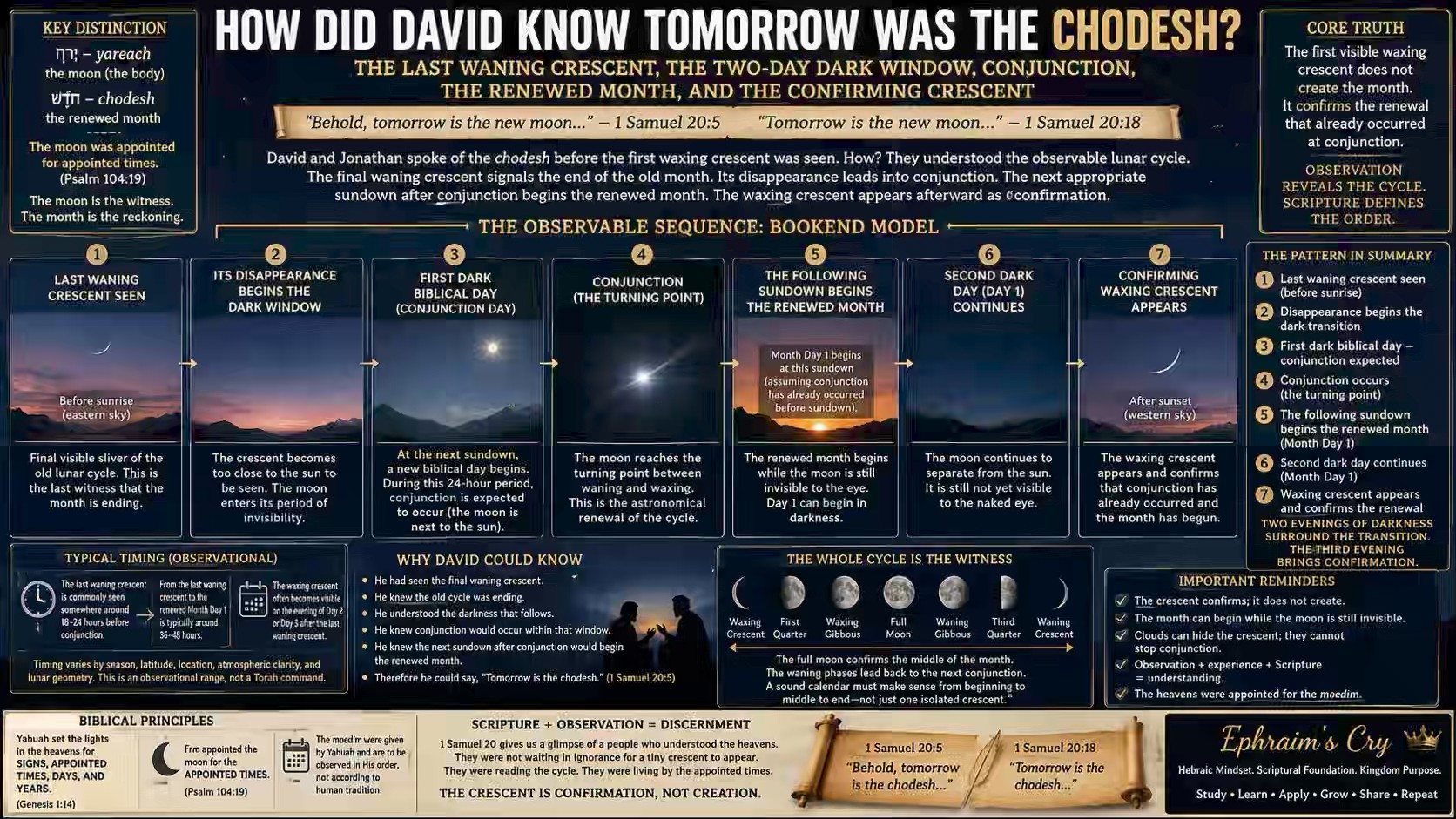
HOW DID DAVID KNOW TOMORROW WAS THE CHODESH?
The Last Waning Crescent, the Two-Day Dark Window, Conjunction, the Renewed Month, and the Confirming Crescent
Greg Witter | Ephraim’s Cry
Hebraic Mindset Study Series
Study • Learn • Apply • Grow • Share ☆ Repeat
If the first visible waxing crescent creates the month, how could David know the chodesh was coming before that crescent had even been sighted?
There is a question sitting quietly inside 1 Samuel 20 that deserves far more attention than it normally receives. David tells Jonathan, “Behold, tomorrow is the new moon…” (1 Samuel 20:5). Later Jonathan tells David, “Tomorrow is the new moon…” (1 Samuel 20:18). The Hebrew word translated “new moon” is חֹדֶשׁ — chodesh.
Now stop and consider what the text actually says. David does not say, “Tomorrow might be the chodesh.” Jonathan does not say, “If someone sees the crescent tonight, tomorrow will be the chodesh.” They speak of it as something known. That immediately raises a very important question: How did they know?
If the beginning of every biblical month depended entirely upon somebody first seeing a tiny waxing crescent in the western sky after sunset, how could David and Jonathan know in advance that the next day was the chodesh? That question does not by itself prove every detail of a conjunction-based calendar, but it does establish something important: the approaching chodesh was sufficiently predictable that David and Jonathan could speak of it beforehand as a known event.
The first distinction we need to establish is between the moon itself and the renewed month. The ordinary Hebrew word for the physical moon is יָרֵחַ — yareach. Psalm 104:19 says, “He appointed the moon for appointed times.” The word translated “moon” there is yareach. The word used in 1 Samuel 20 is different: חֹדֶשׁ — chodesh. Chodesh is associated with renewal and is commonly used in Scripture for the month, the beginning of the month, and what many English translations call a “new moon.”
So we should not flatten the Hebrew language and pretend that yareach and chodesh are simply interchangeable words. They are not. A useful distinction is this: Yareach is the moon itself. Chodesh is the renewed monthly period or month. But the fact that the words are different does not mean the chodesh is disconnected from the moon. Psalm 104:19 specifically tells us that the yareach was appointed for the moedim, the appointed times. The moon is not the month itself, but it is the heavenly witness whose recurring cycle corresponds with the monthly reckoning.
Genesis 1:14 establishes the broader principle when Yahuah places the heavenly lights for signs, appointed times, days, and years. Psalm 104:19 then specifically identifies the moon as appointed for the appointed times. Scripture therefore gives us every reason to pay attention to the moon’s complete cycle rather than isolate one single phase and assume that phase alone creates the month.
One of the central mistakes in this discussion is confusing visibility with astronomical renewal. The first visible waxing crescent is an observable event, but it is not the same event as conjunction. At conjunction the moon reaches the turning point between its waning and waxing portions of the cycle. Before conjunction it is moving toward the sun from the waning side. After conjunction it begins separating from the sun on the waxing side.
So the sequence is not: waxing crescent, then conjunction, then renewal. The sequence is: waning crescent, disappearance, conjunction, renewal, and then the returning waxing crescent. That distinction matters tremendously. By the time someone sees the first young waxing crescent in the western sky after sunset, conjunction has already occurred. The moon is already moving away from conjunction. Therefore, the appearance of the waxing crescent cannot be what physically causes the lunar cycle to renew. It can mark something. It can witness something. It can confirm something. But the transition has already taken place.
This is why the entire lunar cycle needs to be considered. The moon progresses through an orderly and repeatable sequence: waxing crescent, first quarter, waxing gibbous, full moon, waning gibbous, third quarter, waning crescent, conjunction, and then waxing again. The synodic lunar cycle averages about 29½ days. Ancient people living beneath the heavens did not need modern computers to recognize that pattern. Shepherds, farmers, travelers, watchmen, and entire communities would have watched it month after month and year after year.
Near the end of the cycle, the final visible stage before conjunction is the thin waning crescent, seen before sunrise toward the eastern horizon. As conjunction approaches, that crescent becomes thinner and rises progressively closer to sunrise. Eventually it becomes too close to the sun to remain visible to the naked eye. That final sighting therefore tells the observer something important: the lunar cycle is approaching conjunction.
This is where the practical observational sequence becomes extremely important.
The final visible waning crescent is not merely an isolated sliver in the morning sky. It is the final visible witness of the outgoing lunar cycle. Once that last crescent has been observed and then disappears, the observer knows from repeated experience that he has entered the transition window.
Think about the sequence from the standpoint of someone actually living underneath the heavens rather than reading an astronomical chart.
On one morning, the final waning sliver is visible.
That is the last visible remnant of the old lunar cycle.
The sun rises.
That biblical day continues toward evening.
At sundown, another biblical day begins.
That next day is now the probable conjunction day, because the final waning crescent has disappeared and the moon has moved into the interval where conjunction is expected.
During that biblical day—between that sundown and the following sundown—the conjunction can occur.
The observer does not need to know the exact hour.
He knows where he is in the sequence.
He knows the final crescent has disappeared.
He knows the moon is now in the invisible transition.
He knows conjunction is imminent.
And he knows that the biblical day following that transition is approaching.
This is the part that helps us understand how David could say:
“Tomorrow is the chodesh.”
He did not need to wait for the new waxing crescent to tell him something he had already been observing for several days.
The cycle itself had been announcing what was coming.
The last waning crescent was the warning.
Its disappearance marked entry into the dark interval.
The expected conjunction lay inside that interval.
The next biblical sundown after the conjunction would then begin the renewed month.
That gives us a very practical observational framework.
We can describe it in three stages.
Stage One: The final waning crescent is seen.
This is the final visible sliver of the outgoing cycle. It is normally seen in the eastern sky before sunrise. Once this sliver disappears, the observer knows he has entered the final transition toward conjunction.
Stage Two: The dark transition begins.
At the next sundown, a new biblical day begins. This is the period during which conjunction is expected to occur. The moon is no longer visibly presenting the old waning crescent, but the new waxing crescent has not yet emerged. The moon is effectively hidden in the solar glare surrounding conjunction.
Stage Three: The renewed month begins.
Once conjunction has occurred, the next appropriate sundown begins Month Day 1 under this reckoning. The moon has already passed its astronomical turning point even though the returning waxing crescent may not yet be visible.
Then comes the next stage:
The confirming crescent.
After Month Day 1 has begun, the moon continues separating from the sun. As sufficient separation develops, the first waxing crescent becomes visible after sundown. That crescent does not initiate the month. It confirms visually that the moon has already passed through conjunction and is now waxing again.
This is the cycle that needs to be understood.
The final waning sliver is seen.
Then comes the first dark biblical day.
Within that period, conjunction is expected.
Then the following sundown begins the renewed month.
During that renewed Month Day 1, the moon may still remain invisible because it has not yet developed sufficient separation from the sun for the waxing crescent to be seen.
Then, commonly on the following favorable evening, the waxing crescent becomes visible.
So from the perspective of naked-eye observation, the observer may experience what appears to be approximately two evenings of darkness surrounding the transition before the waxing crescent becomes visible.
That is important.
When I speak of two days of darkness, I am not saying the moon has somehow ceased reflecting light for exactly forty-eight mathematical hours every month. I am describing the practical naked-eye observational experience surrounding conjunction.
There is typically a period before conjunction when the final waning crescent can no longer be seen.
There is conjunction itself.
There is then a period after conjunction during which the young waxing crescent may still be too close to the sun to see.
From the standpoint of the observer, this produces a dark transition window between the disappearance of the old crescent and the reappearance of the new crescent.
That dark interval can span portions of two biblical days.
This is exactly why the sequence is so important.
The old crescent disappears before the new crescent appears.
Between the two visible crescents lies the hidden turning of the cycle.
The first crescent is the final witness of what is ending.
The second crescent is the first visible witness of what has already begun.
And conjunction stands between them.
This gives us a genuine bookend model.
The last waning crescent is one bookend.
The first waxing crescent is the other bookend.
The conjunction is between them.
The old visible moon disappears.
The new visible moon returns.
The observer may not see the exact instantaneous conjunction, but he sees what leads directly into it and what emerges directly out of it.
That is not ignorance of the cycle.
That is observation of the cycle.
This is why saying, “Conjunction cannot be observed” does not settle the question. The exact mathematical instant may not be visible, but the transition surrounding conjunction is unmistakably observable.
The observer watches the old moon die away.
He watches the sky become empty of the crescent.
He knows from repeated experience that conjunction occurs within that hidden interval.
Then he watches the renewed waxing crescent return.
That returning crescent confirms where the invisible turning occurred.
This is not fundamentally different from many other observational processes. You may not see the exact instant a seed germinates underground, but you can observe the conditions before germination and the shoot that emerges afterward. The hidden event lies between visible witnesses.
In the same way, the conjunction lies between visible lunar bookends.
Now let us put actual biblical days around that process.
Suppose the final waning crescent is seen before sunrise on what we will call the final visible-crescent morning.
That crescent disappears into daylight.
That evening at sundown begins the next biblical day.
During that biblical day, the observer expects the conjunction.
If conjunction occurs during that period before the following sundown, then at the next sundown, Month Day 1 begins.
The moon may still be invisible that evening because only a relatively short period has passed since conjunction.
Now we are in the first day of the renewed month even though the waxing crescent has not necessarily become visible.
At the end of that first biblical day, another sundown arrives.
By then the moon has had additional time to separate from the sun.
Under typical favorable circumstances, this is when the returning waxing crescent becomes much more likely to be visible.
That visible crescent then confirms:
The conjunction occurred.
The moon renewed.
The month has already begun.
This is the distinction that has been largely lost in the modern crescent debate.
The crescent is not announcing:
“The month begins now because you finally saw me.”
Rather, under this model, it is announcing:
“The renewal already occurred, the month has already begun, and now you can see the evidence.”
That is a radically different understanding.
It also explains why the pattern can naturally appear as:
Day of final waning crescent → dark conjunction interval → renewed Month Day 1 → confirming waxing crescent.
Depending upon exactly when the final old crescent was visible and exactly when conjunction occurs relative to sundown, the observer may experience approximately two days during which no crescent is visible.
Then what we might call the third observational day brings the returning crescent.
Again, the word “third” here must be understood observationally rather than turned into an absolute mathematical law.
We are describing the normal sequence:
Last visible old crescent.
First period of darkness.
Conjunction and continued invisibility.
Renewed month begins.
Then the visible waxing crescent appears and confirms the renewal.
That is the critical pattern.
This also explains the approximately 36–48 hour framework much more clearly.
If the final waning crescent is seen in the morning, and conjunction follows somewhere around the next day, then the renewed biblical month can begin at the qualifying sundown after conjunction.
From the final morning crescent to that sundown, you may be dealing with roughly a day and a half to two days depending upon the exact lunar geometry and timing.
That is why the old observers did not have to remain completely ignorant until the western crescent appeared.
The entire closing phase of the month had already been telling them what was happening.
The last sliver told them:
We are near the end.
Its disappearance told them:
We are entering the conjunction interval.
The invisible interval told them:
The transition is taking place.
The biblical sundown after conjunction told them:
The renewed month begins.
The returning crescent told them:
The renewal has been confirmed.
That is a coherent observational system.
Now we need precision concerning the frequently mentioned 18–24 hour window. The statement that the final waning crescent may be seen somewhere around 18–24 hours before conjunction is useful as a general observational approximation, but it must not be turned into an absolute rule. The last crescent is not always visible exactly eighteen, twenty, or twenty-four hours before conjunction. Visibility varies according to the moon’s angular separation from the sun, its orbital position, latitude, season, horizon conditions, atmospheric clarity, and the observer’s eyesight and experience.
Therefore, the proper statement is this: the last naked-eye waning crescent commonly disappears within roughly the final day or so before conjunction, and an 18–24 hour interval can occur, but it is an observational range, not a Torah command and not an astronomical constant.
We are not replacing a first-crescent rule with an eighteen-hour rule. Torah never says, “See the last waning crescent and count eighteen hours.” That would simply create another human regulation. The point is much simpler: when experienced observers see an extremely thin waning crescent near the end of the approximately 29½-day lunar cycle, they understand that the old cycle is ending and conjunction is approaching.
This helps explain how ancient people could know what was coming. Imagine watching the cycle every month for years. You watch the moon become full. Then you watch it wane. You see third quarter. Then the crescent becomes thinner every morning. You know from experience that after the final morning crescent disappears there will be a brief interval of invisibility. You also know that afterward a renewed waxing crescent will eventually appear in the western evening sky.
After enough cycles, the sequence is no mystery:
last waning crescent → disappearance → conjunction window → renewed month → returning waxing crescent.
The observer learns the rhythm.
And once that rhythm is understood, David’s statement becomes much easier to understand.
He does not need somebody to run into the royal court after sunset yelling:
“We saw the crescent! Now we finally know!”
The evidence leading into the transition was already present.
The cycle was already communicating what was about to happen.
David could know where they stood in the lunar sequence.
Jonathan could know where they stood.
The court could prepare for the chodesh meal.
The event could be anticipated.
That is exactly what 1 Samuel 20 presents.
David says:
“Behold, tomorrow is the chodesh…” (1 Samuel 20:5).
Jonathan says:
“Tomorrow is the chodesh…” (1 Samuel 20:18).
Whatever exact procedural details were in use, the chodesh was predictable before it arrived.
That is the textual fact.
Now consider how naturally the observable bookend model explains that.
The final old crescent has already been seen.
The lunar cycle is near its end.
The old crescent disappears.
The conjunction window has begun.
The people understand where they are.
The following sundown after conjunction will begin the renewed month.
Therefore they can say beforehand:
“Tomorrow is the chodesh.”
They are not predicting something random.
They are reading an established cycle.
This does not require modern astronomy.
It requires familiarity with creation.
It requires repeated observation.
It requires remembering what happened last month.
And the month before that.
And the month before that.
Ancient Yisra’el did not begin every month with amnesia.
They had generations of accumulated observational knowledge.
This is where modern people often make the mistake of assuming ancient people were scientifically incapable because they lacked our technology.
Technology gives us greater numerical precision.
It does not give us the ability to recognize basic repetitive patterns.
A shepherd who watches the moon every night can understand the practical cycle extremely well without knowing the modern terminology of geocentric ecliptic longitude.
He knows:
The moon waxes.
It becomes full.
It wanes.
It becomes a morning crescent.
The crescent disappears.
There are dark nights.
Then the new crescent returns.
And the cycle repeats.
After witnessing that year after year, recognizing the approach of renewal would not be difficult.
This is also why the phrase two days of darkness must be understood correctly.
The darkness is not the absence of the moon from existence.
It is the absence of naked-eye crescent visibility surrounding conjunction.
The last waning crescent disappears because the moon has drawn too close to the sun’s apparent position.
Then conjunction occurs.
After conjunction, the moon has not immediately moved far enough away from the sun for the extremely thin waxing crescent to become easily visible.
Therefore there is an interval on both sides of conjunction in which the moon cannot normally be seen as a crescent.
The biblical days can therefore bracket that darkness very naturally.
The evening after the last visible waning crescent begins the conjunction-window day.
During that day the actual conjunction may occur.
The following evening, provided conjunction has already occurred, begins Month Day 1.
That first day of the renewed month may begin while the moon is still visually dark.
Then at the following evening the returning crescent may become visible.
That gives the observer:
The last crescent.
Darkness.
Renewed month beginning in darkness.
Then visible confirmation.
Now consider what this does to the common assumption that the first waxing crescent must be Day 1.
If the first visible waxing crescent comes after conjunction and after the appropriate sundown that has already begun the renewed month, then declaring the crescent evening itself to be the beginning of Day 1 can move the calendar one day later than the actual renewal under this model.
That becomes particularly important when you continue counting toward the middle of the month.
The full moon then becomes another witness.
The moon naturally progresses toward fullness approximately halfway through its synodic cycle. That matters when examining the 14th and 15th days of the biblical month, particularly Passover and Unleavened Bread (Exodus 12:6; Leviticus 23:5–6; Numbers 28:16–17).
Again, we should not create another rigid rule saying the moon must reach the exact astronomical instant of fullness at a particular second on the 15th day.
But if the monthly reckoning consistently aligns the central biblical dates with the central portion of the lunar cycle, that provides additional confirmation that the model is functioning naturally.
This is why I call it a bookend model, but in reality the model tests more than two points.
At the beginning we observe the waning crescent and conjunction transition.
In the middle we observe the moon moving toward fullness.
At the end we watch it return to the waning crescent.
Then the sequence starts again.
The month is not constructed from one crescent.
The entire lunar cycle is the witness.
That is why I believe a calendar model should be tested against the whole month.
Where is the final waning crescent?
When does conjunction occur?
When does Month Day 1 begin?
How long afterward does the waxing crescent appear?
Where is first quarter?
Where is fullness?
What does the moon look like around Days 14 and 15?
Where is third quarter?
When does the waning crescent return?
Does the model naturally lead back toward conjunction?
A sound model should make sense from beginning to middle to end.
This also raises a serious problem with making naked-eye first-crescent visibility the actual cause of Month Day 1. Suppose conjunction has occurred, the moon is waxing, but clouds cover Jerusalem. Has the moon failed to renew because nobody can see it? Obviously not. Suppose one observer sees the crescent from a clear location while another observer a few miles away is under clouds. Did the month begin for one but not the other?
The physical lunar cycle does not depend upon human eyesight.
Weather can obscure the witness.
Weather cannot stop conjunction.
Clouds can hide the confirmation.
Clouds cannot postpone the lunar turning point.
That distinction between event and evidence is essential.
This also changes how we should think about the command to observe.
Observation does not have to mean staring at one sliver.
The last waning crescent is observation.
Its progressive thinning is observation.
Its disappearance is observation.
The period of lunar invisibility is observable as an absence.
The returning waxing crescent is observation.
The full moon is observation.
The waning phases are observation.
The entire lunar cycle is observable.
Therefore saying that a conjunction model is somehow “not observational” simply because the exact instant of conjunction cannot be seen misunderstands what observation means.
You do not have to visually see an instantaneous event to know it occurred when the observable events immediately before and after it identify the transition.
This is precisely what the two bookends accomplish.
The old crescent says:
Conjunction is approaching.
The new crescent says:
Conjunction has passed.
Between those two witnesses lies the hidden turning point.
And the biblical day boundary allows the renewed month to be reckoned without waiting until the confirming crescent finally becomes visible.
Now return once again to 1 Samuel 20.
The text never says David was surprised by the chodesh.
It never portrays Jonathan waiting nervously for a crescent report.
Instead, the meal is anticipated.
David’s expected absence is discussed beforehand.
Saul is expected to notice.
A plan is established around the known timing.
David tells Jonathan:
“Behold, tomorrow is the chodesh…” (1 Samuel 20:5).
Jonathan later confirms:
“Tomorrow is the chodesh…” (1 Samuel 20:18).
This is not incidental.
The narrative assumes that tomorrow’s chodesh is known.
That fits beautifully with a people who understood the closing lunar sequence.
They had seen the last crescent.
They understood the darkness.
They understood conjunction was imminent.
They understood when the renewed day would begin.
They did not need to wait until after the fact to know what tomorrow was.
This is why the strongest argument is not:
“David had a conjunction calculator.”
That would be unnecessary and Scripturally unprovable.
The stronger argument is:
David lived among people who understood an observable, repeatable lunar cycle well enough to know when renewal was imminent.
That is all the text requires.
And the heavens themselves provide the mechanism that makes such knowledge entirely reasonable.
The moon does not behave randomly.
The final waning crescent does not suddenly appear anywhere in the month.
It appears at the end.
Its disappearance is not random.
It occurs as conjunction approaches.
The waxing crescent does not randomly appear before conjunction.
It appears afterward.
The full moon does not randomly occur three days after conjunction.
It occurs around the middle of the cycle.
The phases are ordered.
The ancient observer learned that order.
Therefore the question:
“How could David know tomorrow was the chodesh?”
has a straightforward answer.
Because the month did not sneak up on him.
The heavens had been announcing its approach for days.
The moon had waned.
The final crescent had appeared.
The old crescent had disappeared.
The conjunction interval had arrived.
The expected renewal was now within the known window.
The appropriate sundown would begin the renewed month.
And the returning waxing crescent afterward would confirm what they already understood had taken place.
This is the entire sequence:
THE LAST WANING CRESCENT ANNOUNCES THE END.
ITS DISAPPEARANCE ANNOUNCES THE CONJUNCTION WINDOW.
THE FIRST DARK BIBLICAL DAY CARRIES THE EXPECTED CONJUNCTION.
THE FOLLOWING SUNDOWN BEGINS THE RENEWED MONTH WHEN CONJUNCTION HAS ALREADY OCCURRED.
THE FIRST DAY OF THE MONTH MAY THEREFORE BEGIN WHILE THE MOON IS STILL NOT VISIBLY CRESCENT.
THE FOLLOWING FAVORABLE EVENING BRINGS THE RETURNING WAXING CRESCENT.
THAT CRESCENT CONFIRMS THE RENEWAL THAT HAS ALREADY OCCURRED.
That is the pattern.
And when the entire cycle is understood, the phrase:
“Tomorrow is the chodesh”
no longer presents a mystery.
It becomes exactly what we would expect from people who actually watched the heavens.
So the conclusion remains strong.
Yareach is the moon. Chodesh is the renewed month. The last waning crescent warns that the old cycle is ending. The dark interval surrounds conjunction. Conjunction marks the astronomical turning point. Sundown provides the biblical day boundary. The renewed month can begin while the young moon is still invisible. The waxing crescent appears afterward as confirmation. The full moon provides another midpoint witness. And the whole lunar cycle—not one isolated sliver—testifies to the order Yahuah placed in the heavens.
This is why we should stop treating ancient Yisra’el as though they were standing beneath the sky clueless until somebody happened to see a tiny western crescent.
They were observers.
They knew the cycle.
They knew what disappearance meant.
They knew what darkness meant.
They knew what the returning crescent meant.
And 1 Samuel 20 preserves a remarkably simple statement showing that knowledge in operation:
“Tomorrow is the chodesh.”
They knew because the heavens had already told them where they were in the cycle.
The first waxing crescent did not have to create the month.
It confirmed the month that had already begun.
#GregWitter#EphraimsCry#EphraimsCryAcademy#HebraicMindsetStudySeries#ReturnToCovenant#TorahStudents
#BibleStudents#HebrewStudents#BiblicalCalendarStudents#MoonObservers#TruthSeekers#CovenantSeekers
#BiblicalCalendar#Chodesh#Yareach#NewMoon#LunarCycle#Conjunction#WaningCrescent#WaxingCrescent
#FirstSamuel20#Psalm10419#Genesis114#Moedim#BookendModel#BiblicalMonth#EveningToEvening
#ConfirmationNotCreation#ObserveTheMoon#ScriptureFirst
