
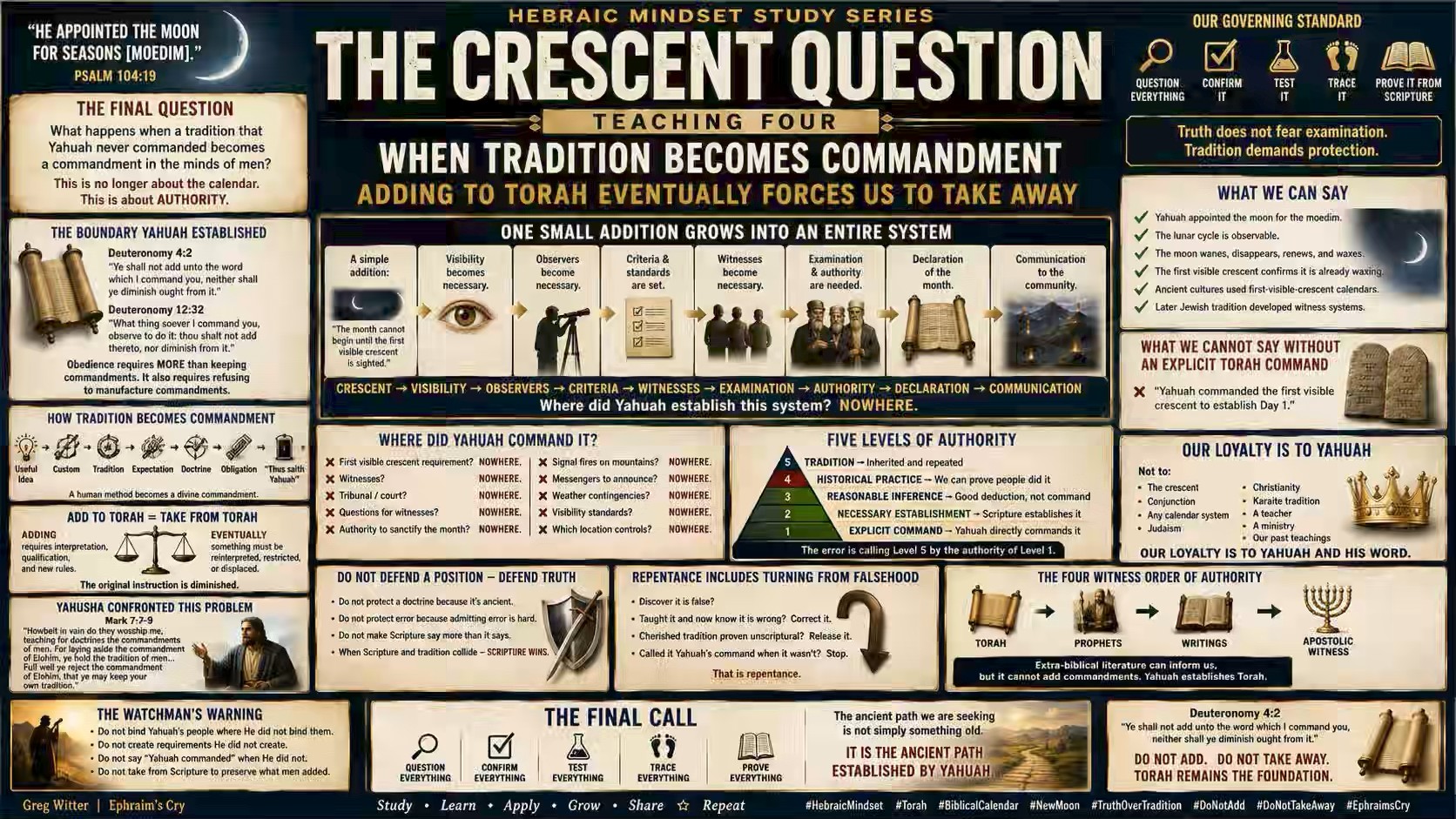
THE CRESCENT QUESTION
TEACHING FOUR — WHEN TRADITION BECOMES COMMANDMENT
Adding to Torah Eventually Forces Us to Take Away
We have reached the final teaching in this series, and this is where the issue becomes much larger than the calendar.
Teaching One established the standard:
Question everything. Confirm it. Test it. Trace it. Prove it from Scripture.
Greg Witter | Ephraim’s Cry
Hebraic Mindset Study Series
Study • Learn • Apply • Grow • Share ☆ Repeat
Teaching Two examined the astronomical question and demonstrated the necessary distinction between an observable witness and the event being witnessed:
THE CRESCENT CONFIRMS THE RENEWAL; IT DOES NOT CREATE THE RENEWAL.
Teaching Three followed the historical evidence. We distinguished what Torah actually commands from what ancient cultures practiced and what later Jewish administrative systems developed concerning witnesses, courts, declarations, signal fires, and messengers.
Now we arrive at the most serious question:
WHAT HAPPENS WHEN A TRADITION THAT YAHUAH NEVER COMMANDED BECOMES A COMMANDMENT IN THE MINDS OF MEN?
At that point, this is no longer merely an argument about astronomy.
It is an argument about authority.
THE BOUNDARY YAHUAH ESTABLISHED
Deuteronomy 4:2 says:
“Ye shall not add unto the word which I command you, neither shall ye diminish ought from it.”
Deuteronomy 12:32 repeats the warning:
“What thing soever I command you, observe to do it: thou shalt not add thereto, nor diminish from it.”
These two instructions establish boundaries around Torah.
Yahuah does not merely say:
“Do what I commanded.”
He also says:
“Do not add to what I commanded.”
And:
“Do not take away from what I commanded.”
That means obedience requires more than keeping commandments.
It also requires refusing to manufacture commandments.
That is critically important.
Most people recognize the danger of taking away from Scripture.
But adding can be equally destructive.
And frequently:
ADDING EVENTUALLY REQUIRES TAKING AWAY.
Why?
Because once something foreign is inserted into Yahuah’s instruction, the original instruction often has to be reinterpreted, restricted, supplemented, or displaced so the addition can fit.
That is exactly what we need to examine.
ONE SMALL ADDITION DOES NOT REMAIN SMALL
Consider the statement:
“The month cannot begin until the first visible waxing crescent is sighted.”
That sounds simple.
One sentence.
One requirement.
But now follow what happens.
If the month cannot begin until the crescent is seen, visibility becomes necessary.
If visibility is necessary, an observer becomes necessary.
If observers are necessary, you need criteria establishing what qualifies as a valid observation.
Now you need standards.
If standards exist, someone must determine whether those standards were met.
Now you need judgment.
If eyewitness testimony determines the month, you need witnesses.
If witnesses disagree, someone must decide between them.
Now you need authority.
If the authority determines the witnesses are valid, someone must formally recognize the result.
Now you need declaration.
If the declaration determines the calendar for everyone else, the decision must be distributed.
Now you need communication.
And suddenly our simple addition has become:
CRESCENT → VISIBILITY → OBSERVERS → CRITERIA → WITNESSES → EXAMINATION → AUTHORITY → DECLARATION → COMMUNICATION
That is an entire regulatory system.
And yet Moses never gives that system.
That should stop us in our tracks.
WHERE DID YAHUAH COMMAND IT?
Where does Torah establish the first-visible-crescent requirement?
Nowhere.
Where does Torah establish the witnesses?
Nowhere.
Where does Torah establish the tribunal?
Nowhere.
Where does Torah establish the questions witnesses must answer?
Nowhere.
Where does Torah establish the court’s authority to sanctify the month?
Nowhere.
Where does Torah establish signal fires?
Nowhere.
Where does Torah establish messengers to announce the declaration?
Nowhere.
Where does Torah establish cloudy-weather procedures?
Nowhere.
Where does Torah establish which geographical location controls visibility?
Nowhere.
Yet once the original addition is accepted, all these additional mechanisms become necessary.
That is how tradition grows.
HOW TRADITION BECOMES COMMANDMENT
Traditions rarely begin with someone announcing:
“Today I am going to add something to Torah.”
Usually the process is much more subtle.
First:
“This seems useful.”
Then:
“This is how we do it.”
Then:
“This is how our community has always done it.”
Then:
“This is how our fathers did it.”
Then:
“This must be the ancient way.”
Then:
“This must be the correct way.”
Then:
“Everyone should do it this way.”
And eventually:
“Yahuah commanded it this way.”
Do you see the progression?
A method becomes a custom.
A custom becomes a tradition.
A tradition becomes an expectation.
An expectation becomes doctrine.
Doctrine becomes obligation.
And obligation eventually becomes:
“Thus saith Yahuah.”
But somewhere during that progression, somebody forgot to ask:
WHERE DID YAHUAH ACTUALLY SAY IT?
YAHUSHA CONFRONTED THIS EXACT PROBLEM
This is not merely theoretical.
Yahusha confronted precisely this problem.
Mark 7:7–9 records:
“Howbeit in vain do they worship me, teaching for doctrines the commandments of men.”
Then Yahusha says:
“For laying aside the commandment of Elohim, ye hold the tradition of men…”
And then:
“Full well ye reject the commandment of Elohim, that ye may keep your own tradition.”
Notice the progression.
Tradition did not remain harmless tradition.
It became doctrine.
Then doctrine competed with Yahuah’s commandments.
Eventually the human tradition became so authoritative that Yahuah’s actual instruction had to move out of the way.
That is exactly how addition becomes subtraction.
The problem was not simply that people had traditions.
Every culture has traditions.
Every family has traditions.
Every community develops procedures.
The problem was that traditions had been elevated to the authority of commandments.
That is the line we cannot cross.
“THIS IS HOW WE DO IT” IS NOT “THUS SAITH YAHUAH”
There is an enormous difference between saying:
“This is how we choose to observe something.”
and saying:
“This is how Yahuah commanded everyone to observe it.”
The first statement acknowledges human judgment.
The second claims divine authority.
If I say:
“I find the visible crescent useful for confirming the lunar cycle,”
there is no problem.
If I say:
“I enjoy watching the moon and tracking its phases,”
there is no problem.
If a community says:
“For administrative purposes, this is the method we have chosen,”
at least they are being honest about what it is.
But if someone says:
“Yahuah commands the first visible crescent to establish Day 1,”
the standard immediately changes.
Now I need:
BOOK. CHAPTER. VERSE.
Because you are no longer telling me what you do.
You are telling me what Yahuah commands me to do.
That requires evidence.
THE PROBLEM IS NOT OBSERVING THE CRESCENT
This distinction must remain clear.
I am not condemning anyone for going outside and observing the crescent.
Observe it.
Study it.
Photograph it.
Track it.
Watch the entire lunar cycle.
The heavens declare Yahuah’s handiwork.
The problem is not observation.
THE PROBLEM IS TURNING OBSERVATION INTO LEGISLATION WITHOUT SCRIPTURAL AUTHORITY.
The crescent can be a witness.
The crescent can be confirmation.
The crescent can be useful.
But usefulness does not create a commandment.
ADDING CHANGES THE STANDARD
Now we reach the deeper issue.
Once first-visible-crescent sighting becomes mandatory, something else changes.
The moon itself is no longer sufficient.
Think carefully about that.
Psalm 104:19 says:
“He appointed the moon for seasons [moedim].”
But under a mandatory sighting system, the moon’s actual cycle is no longer enough.
The moon can complete its transition.
The moon can begin waxing.
The lunar cycle can continue exactly according to Yahuah’s established order.
But if humans do not see it, the religious calendar waits.
Now human visibility has become an additional authority.
That is significant.
Yahuah established the moon.
But now:
Moon + human sighting = month.
And once witnesses and courts become involved:
Moon + visibility + witnesses + court acceptance + declaration = month.
Where did Yahuah establish that equation?
That is the question.
CLOUDS NOW ACQUIRE CALENDAR AUTHORITY
Consider the consequences.
Suppose the lunar cycle has renewed, but clouds cover the Land.
Does cloud cover alter the moon’s cycle?
No.
Does cloud cover stop the moon?
No.
Does cloud cover alter the astronomical relationship between earth, moon, and sun?
No.
Yet under a strict first-visible-crescent requirement, clouds can prevent the required observation.
Now weather conditions can effectively delay the human declaration of the month.
Think about what has happened.
A weather condition Yahuah never identified as a calendar authority now affects when people say the month begins.
That should make us examine the assumption very carefully.
WHAT HAPPENS TO 1 SAMUEL 20:5?
Now consider David’s statement:
“Behold, tomorrow is the new moon.” — 1 Samuel 20:5
David speaks as though tomorrow’s New Moon is known.
The passage does not explain precisely how they knew it.
We have already acknowledged that.
But if our doctrine says:
“The New Moon cannot be known until somebody sees the first waxing crescent,”
then David’s statement becomes inconvenient.
And this is where we must watch ourselves.
What happens when Scripture becomes inconvenient to our system?
Do we reconsider the system?
Or do we immediately begin constructing explanations to protect it?
That is one of the most important questions in biblical study.
WHEN THE TEXT AND OUR SYSTEM COLLIDE, WHICH ONE MOVES?
The answer must always be:
OUR SYSTEM MOVES.
Scripture does not bend to protect our theology.
Our theology must bend to Scripture.
Tradition does not interpret Scripture by authority.
Scripture judges tradition.
THIS IS HOW ADDING FORCES TAKING AWAY
This is what Deuteronomy’s warning protects us from.
Once an added requirement becomes non-negotiable, Scripture must be interpreted through that requirement.
Now verses are filtered through the tradition.
Definitions are adjusted.
Historical assumptions are inserted.
Silence becomes evidence.
Eventually the added rule controls what Scripture is permitted to mean.
That is subtraction.
You may not physically remove words from the Bible.
But if your tradition prevents those words from carrying their natural meaning, you have functionally diminished them.
That is why adding and taking away are connected.
TRADITION CAN BECOME A LENS
Tradition is particularly dangerous when we no longer recognize it as tradition.
If I know I am wearing tinted glasses, I can compensate for them.
But if I believe the tint is the actual color of reality, I will defend what I see.
Religious tradition works the same way.
We inherit a system.
Then we read Scripture through the system.
Eventually we no longer see the system.
We simply say:
“That’s what Scripture says.”
But sometimes Scripture never said it.
Our tradition said it so many times that we began hearing the tradition when we read the text.
That is why we must continually return to:
WHAT DOES THE TEXT ACTUALLY SAY?
Not:
What have I always been told it means?
THIS STANDARD APPLIES TO EVERYONE
Nobody gets an exemption.
Not Christianity.
Not Judaism.
Not rabbinic Judaism.
Not Karaites.
Not Messianic Judaism.
Not Hebrew Roots.
Not Sacred Name groups.
Not calendar teachers.
Not pastors.
Not rabbis.
Not scholars.
Not Ephraim’s Cry.
And certainly not me.
If I teach something that cannot survive Scripture, reject what I taught.
Do not protect my teaching because you respect me.
Do not protect a ministry because it helped you.
Do not protect a doctrine because you have believed it for thirty years.
PROVE ALL THINGS.
That standard must apply equally to everyone.
Otherwise it is not a standard.
REPENTANCE INCLUDES TURNING FROM FALSEHOOD
This brings us to something much deeper.
Repentance is not limited to stopping immoral behavior.
Repentance means turning.
If I discover I have believed something false, what should I do?
Turn.
If I discover I have taught something Scripture does not support, what should I do?
Correct it.
If I discover that a cherished tradition came from assumptions rather than Torah, what should I do?
Release it.
If I discover that something I called Yahuah’s commandment was actually a human tradition, what should I do?
Stop calling it Yahuah’s commandment.
That is repentance.
THE HARDER THE INVESTMENT, THE HARDER THE REPENTANCE
This becomes difficult when we have invested years in a belief.
Maybe we taught it.
Maybe we wrote books about it.
Maybe we built ministries around it.
Maybe we separated from people over it.
Maybe we publicly corrected others concerning it.
Now new evidence appears.
What do we do?
Pride says:
“Defend the position.”
Truth says:
“Test the position.”
Pride says:
“You cannot admit you were wrong.”
Truth says:
“You cannot knowingly continue teaching what is wrong.”
The longer we have believed something, the more humility may be required to abandon it.
But longevity does not transform falsehood into truth.
OUR LOYALTY MUST BE TO YAHUAH
Our loyalty is not to the crescent.
Our loyalty is not to conjunction.
Our loyalty is not to a calendar system.
Our loyalty is not to Judaism.
Our loyalty is not to Karaite practice.
Our loyalty is not to Babylonian history.
Our loyalty is not to a teacher.
Our loyalty is not to a ministry.
Our loyalty is not to something we taught yesterday.
OUR LOYALTY IS TO YAHUAH AND HIS WORD.
That means we remain teachable.
It means we remain correctable.
It means Scripture always retains the right to overturn our assumptions.
THE FOUR WITNESSES MUST REMAIN IN ORDER
Our doctrinal standard remains:
TORAH → PROPHETS → WRITINGS → APOSTOLIC WITNESS
Torah establishes the foundation.
The Prophets must agree with Torah.
The Writings must remain consistent with that foundation.
The Apostolic Witness cannot overturn what Yahuah established.
And extra-biblical literature cannot become a fifth authority.
Enoch cannot add to Moses.
Jubilees cannot add to Moses.
The Mishnah cannot add to Moses.
The Talmud cannot add to Moses.
Josephus cannot add to Moses.
Karaite tradition cannot add to Moses.
Church tradition cannot add to Moses.
Modern astronomy cannot add to Moses.
And Greg Witter cannot add to Moses.
YAHUAH ALONE HAS AUTHORITY TO COMMAND.
That must remain settled.
SO WHAT DO WE DO WITH THE CRESCENT?
Put it back where it belongs.
Observe it.
Study it.
Appreciate it.
Recognize it as part of Yahuah’s magnificent lunar cycle.
Recognize that when the first waxing crescent becomes visible, the moon is already waxing.
Therefore it provides observable confirmation that renewal has occurred.
But do not make it something Scripture never makes it.
Do not turn:
“I can see the crescent”
into:
“Therefore Yahuah commands Day 1 to begin only now.”
Those statements are not equivalent.
WHAT WE CAN SAY
We can say:
Yahuah appointed the moon for the moedim.
We can say:
The lunar cycle is observable.
We can say:
The moon wanes, disappears, passes through an invisible transition, and waxes again.
We can say:
The first visible waxing crescent confirms that the moon is already waxing.
We can say:
Historical cultures used first-visible-crescent calendars.
We can say:
Later Jewish tradition developed or preserved witness-and-declaration procedures.
What we cannot say from an explicit Torah command is:
“Yahuah commanded the first visible crescent to establish Day 1.”
Until that command is produced, that claim exceeds the evidence.
THE FINAL TEST
So here is the final test for the entire series.
Whenever somebody says:
“Yahuah commands…”
ask:
WHERE?
Whenever somebody says:
“This is the biblical way…”
ask:
SHOW ME.
Whenever somebody says:
“This is how ancient Yisra’el did it…”
ask:
WHAT IS THE EVIDENCE?
Whenever somebody says:
“Everyone knows…”
ask:
DOES TORAH SAY IT?
Whenever tradition and Scripture disagree:
SCRIPTURE WINS.
Whenever history and Scripture are confused:
SEPARATE THEM.
Whenever our doctrine exceeds our evidence:
REDUCE THE CLAIM.
Whenever truth exposes falsehood:
REPENT AND TURN.
That is how we protect ourselves from religious deception.
THE WATCHMAN’S WARNING
There is a difference between being mistaken and knowingly defending something after it has been demonstrated false.
We all make mistakes.
We all inherit traditions.
We all carry assumptions into Scripture.
That is why we study.
That is why we grow.
That is why we correct ourselves.
But once we discover that something cannot be established from Yahuah’s Word, we must not continue placing His name upon it.
That is where the warning becomes serious.
Do not say:
“Yahuah commanded”
when Yahuah did not command.
Do not bind His people where He did not bind them.
Do not create requirements He did not create.
Do not defend tradition simply because it is ancient.
Do not protect error simply because admitting error is uncomfortable.
And do not take from Scripture in order to preserve what men added to it.
THE ANCIENT PATH IS NOT EVERY ANCIENT PATH
Jeremiah 6:16 says:
“Stand ye in the ways, and see, and ask for the old paths, where is the good way, and walk therein.”
Notice that Scripture does not say:
“Every old path is good.”
It says:
“WHERE IS THE GOOD WAY?”
Babylon has ancient paths.
Egypt has ancient paths.
Canaan has ancient paths.
Rabbinic Judaism has ancient traditions.
Christianity has ancient traditions.
Age does not determine truth.
We are looking for:
THE ANCIENT PATH ESTABLISHED BY YAHUAH
That is the distinction.
We are not searching for something merely because it is old.
We are searching for the ancient path established by Yahuah.
That path must be identifiable from His Word.
That path must agree with Torah.
That path must survive the Prophets.
That path must agree with the Writings.
That path must remain consistent with the Apostolic Witness.
Ancient Babylonian practice does not become the ancient path simply because Babylon is ancient.
Later Jewish tradition does not become the ancient path simply because generations practiced it.
Christian tradition does not become the ancient path simply because churches have practiced it for centuries.
Karaite tradition does not become the ancient path simply because it rejects rabbinic Oral Torah.
The ancient path is the path Yahuah established.
That is what we are trying to recover.
RETURN DOES NOT MEAN RETURNING TO EVERY OLD TRADITION
This distinction is essential to the restoration movement.
Many people awaken to errors in Christianity and begin searching backward.
That is good.
But there is a danger.
Sometimes people leave one system of inherited traditions only to enter another system of inherited traditions.
They discover that Christianity departed from Torah.
Then they begin looking toward Judaism.
They discover ancient Jewish practices.
Those practices feel older.
They feel more Hebrew.
They feel closer to the biblical world.
And therefore they are assumed to be biblical.
But older does not automatically mean original.
Hebrew does not automatically mean Torah.
Jewish does not automatically mean commanded.
Ancient does not automatically mean Yahuah.
We cannot escape Christian tradition only to become enslaved to Jewish tradition.
We cannot reject church authority and then surrender the same authority to rabbis.
We cannot reject denominational commandments of men and then adopt different commandments of men simply because they have Hebrew terminology attached to them.
The standard never changes:
WHAT DID YAHUAH COMMAND?
RESTORATION REQUIRES REMOVING ACCUMULATED LAYERS
True restoration is not simply adding Hebrew things to our existing religious framework.
Restoration means returning to the foundation.
Sometimes that requires removing layers.
Centuries of interpretation.
Centuries of institutional authority.
Centuries of customs.
Centuries of assumptions.
Centuries of theological systems.
Centuries of calendar traditions.
We peel those layers back until we reach:
TORAH.
Then we ask:
What did Yahuah actually say?
What did He actually command?
What did He actually establish?
Only then can we begin rebuilding.
Otherwise, we are merely renovating tradition.
THE COMMAND NOT TO ADD PROTECTS THE ANCIENT PATH
Now Deuteronomy 4:2 becomes even more important:
“Ye shall not add unto the word which I command you, neither shall ye diminish ought from it.”
Why would Yahuah give that warning?
Because He knew men would be tempted to improve His instructions.
Clarify them.
Protect them.
Expand them.
Institutionalize them.
Add safeguards around them.
And eventually those safeguards would become commandments themselves.
The command against adding protects Torah from religious improvement.
Yahuah does not need us to improve His instructions.
He needs us to obey them.
THE SAME THING HAPPENED WITH OTHER COMMANDMENTS
This principle extends far beyond the calendar.
Religious systems frequently build fences around commandments.
The fence begins as:
“This will help us avoid breaking the commandment.”
Eventually:
“Everyone should follow this fence.”
Then:
“A righteous person follows this fence.”
Then:
“Breaking the fence is disobedience.”
Eventually the fence carries the same authority as the commandment.
Now people can violate Yahuah’s actual command while carefully maintaining the fence.
That is exactly the kind of religious inversion Yahusha confronted.
The mechanism is always similar:
COMMAND → INTERPRETATION → PROCEDURE → TRADITION → OBLIGATION → HUMAN COMMANDMENT
That progression must be watched carefully.
THE CRESCENT QUESTION EXPOSES THE PROCESS
Now bring that principle back to the calendar.
Torah says Yahuah established the heavenly lights for signs, moedim, days, and years.
Psalm 104:19 says He appointed the moon for the moedim.
Then human beings observe the moon.
So far, there is no problem.
Then a method develops:
“We will use the first visible crescent.”
Still, a community can choose an administrative method.
Then:
“We need witnesses.”
Then:
“We need authorities to examine the witnesses.”
Then:
“The authorities must declare the month.”
Then:
“Everyone must accept the declaration.”
Eventually:
“This is how Yahuah commanded the month to begin.”
There is the transition.
A human method has become a divine commandment.
But where did Yahuah make that transition?
He didn’t.
Men did.
That is precisely what we must identify.
THERE IS A DIFFERENCE BETWEEN ORDER AND AUTHORITY
Human beings need order.
There is nothing inherently wrong with organization.
There is nothing inherently wrong with establishing procedures.
But procedure and divine authority are not the same thing.
Suppose a congregation says:
“We will meet at 7:00 PM for Sabbath study.”
That is perfectly legitimate.
But nobody should say:
“Yahuah commanded Sabbath study to begin at 7:00 PM.”
The meeting time is administrative.
The Sabbath is commanded.
Confusing those categories creates false doctrine.
The same principle applies to calendar administration.
A community may develop a method for observation.
But the community must not elevate its method above what Scripture actually commands.
WE MUST DISTINGUISH FIVE LEVELS OF AUTHORITY
This gives us a useful framework for studying any doctrine.
LEVEL ONE — EXPLICIT COMMAND
Yahuah directly commands something.
This carries full authority.
LEVEL TWO — NECESSARY SCRIPTURAL ESTABLISHMENT
The conclusion is necessarily established by Scripture even though it may not appear as one isolated sentence.
This also carries strong biblical authority.
LEVEL THREE — REASONABLE INFERENCE
Evidence points toward a conclusion, but Scripture does not explicitly establish every detail.
We must identify it honestly as inference.
LEVEL FOUR — HISTORICAL PRACTICE
We can demonstrate that people practiced something historically.
That tells us what people did.
It does not automatically tell us what Yahuah commanded.
LEVEL FIVE — TRADITION
A practice has been inherited and repeated.
Tradition may be useful, harmless, mistaken, or destructive.
It must always remain subordinate to Scripture.
The error occurs when Level Five is presented as Level One.
That is exactly what we must guard against.
“YAHUAH SAID” IS A SERIOUS CLAIM
We should become much more careful with those words.
“Yahuah commanded…”
That is not casual language.
When we say those words, we are claiming divine authority.
We are telling another human being that the Creator requires something from them.
Therefore we had better be able to establish it.
If Scripture says it, proclaim it boldly.
If Scripture necessarily establishes it, teach it carefully.
If it is inference, call it inference.
If it is history, call it history.
If it is tradition, call it tradition.
But never upgrade the authority level because we want our position to sound stronger.
That is how false doctrine develops.
WHAT IF I HAVE TAUGHT IT?
Then correct it.
That applies to me as much as anyone.
If tomorrow someone demonstrates from Scripture that something I teach is wrong, my responsibility is not to protect yesterday’s teaching.
My responsibility is to correct it.
That is what Study • Learn • Apply • Grow • Share ☆ Repeat actually means.
Study.
Learn.
Apply what you learn.
Grow because of it.
Share what is true.
Then repeat the process because none of us has arrived.
If our study never permits correction, we are not studying.
We are defending.
There is a difference.
TRUTH DOES NOT FEAR EXAMINATION
Truth can survive questions.
Truth can survive investigation.
Truth can survive historical examination.
Truth can survive linguistic examination.
Truth can survive astronomy.
Truth can survive context.
Truth can survive all Four Witnesses.
Falsehood requires protection.
Falsehood requires selective evidence.
Falsehood requires ignored passages.
Falsehood requires assumptions to remain unquestioned.
That is why we must never fear someone asking:
“Where does Scripture say that?”
That question should be welcomed.
If the doctrine is true, Scripture will establish it.
If the doctrine cannot survive the question, we needed the question.
DO NOT DEFEND A POSITION — DEFEND TRUTH
There is another trap in doctrinal discussions.
We begin defending our position instead of seeking truth.
Once that happens, every new piece of evidence becomes either ammunition or a threat.
We stop asking:
“Is this true?”
and begin asking:
“How do I defeat this argument?”
That is dangerous.
Our goal is not to win the crescent debate.
Our goal is to understand Yahuah’s calendar.
If conjunction is wrong, abandon it.
If crescent sighting is wrong, abandon it.
If something we currently believe needs refinement, refine it.
Truth is the objective.
Not winning.
Not protecting a ministry.
Not protecting our reputation.
Not proving another teacher wrong.
Truth.
THE WATCHMAN MUST WARN HIMSELF FIRST
A watchman who only warns everyone else is dangerous.
Before sounding the alarm outward, the watchman must examine his own walls.
Am I adding?
Am I assuming?
Am I defending tradition?
Am I making Scripture say more than it says?
Am I confusing historical evidence with Torah authority?
Am I rejecting evidence because it threatens something I teach?
Those questions must be asked continually.
Otherwise the watchman becomes another religious gatekeeper protecting a system.
That is not what we are called to be.
RETURN TO THE FOUNDATION
So where does this four-part study leave us?
Back where we started.
TORAH.
Genesis establishes the heavenly lights.
Psalm 104 confirms the moon’s relationship to the moedim.
Scripture recognizes New Moons.
Scripture gives Yahuah’s appointed times.
But Torah never gives the formal command:
“You shall wait for the first visible waxing crescent before beginning Day 1.”
That matters.
It does not answer every astronomical question by itself.
But it establishes the boundary of what we may honestly call a commandment.
And we must respect that boundary.
THE CRESCENT HAS A PLACE
I am not throwing the crescent away.
I am putting it back in its proper place.
It is a witness.
It is observable.
It is useful.
It confirms that the moon is waxing.
It provides evidence concerning the lunar cycle.
But:
THE CRESCENT CONFIRMS THE RENEWAL.
IT DOES NOT CREATE THE RENEWAL.
And human eyesight does not possess authority to make the moon new.
Yahuah established the celestial order.
The moon follows that order.
We observe it.
YAHUAH ESTABLISHES.
CREATION OBEYS.
WE OBSERVE.
Keep that order intact.
THE FINAL WARNING
Do not add to Torah.
Do not take from Torah.
Do not transform historical practice into divine commandment.
Do not transform tradition into Torah.
Do not transform inference into explicit instruction.
Do not allow a teacher to do your studying for you.
Do not allow Judaism to replace Scripture.
Do not allow Christianity to replace Scripture.
Do not allow Karaite tradition to replace Scripture.
Do not allow Enoch or Jubilees to replace Scripture.
Do not allow modern astronomy to replace Scripture.
And do not allow me to replace Scripture.
Test everything.
THE FINAL CALL
The call of this series is not:
“Follow Greg’s calendar.”
The call is:
RETURN TO YAHUAH’S INSTRUCTIONS.
Question everything.
Confirm everything.
Test everything.
Trace everything.
Prove everything.
Separate commandment from inference.
Separate observation from legislation.
Separate history from Torah.
Separate tradition from authority.
When you find truth:
HOLD FAST.
When you find error:
ABANDON IT.
When you discover something you believed was false:
REPENT AND TURN.
When Scripture corrects tradition:
SCRIPTURE WINS.
When Torah and human authority collide:
TORAH WINS.
When the evidence stops:
OUR CLAIMS MUST STOP.
And when someone says:
“Yahuah commanded this,”
never be afraid to ask:
WHERE?
Book.
Chapter.
Verse.
Context.
Instruction.
Because the ancient path we are seeking is not simply something old.
IT IS THE ANCIENT PATH ESTABLISHED BY YAHUAH.
That is the path worth returning to.
That is the path worth defending.
And that is the path worth walking.
#HebraicMindset#Torah#BiblicalCalendar#NewMoon#CrescentMoon#FirstVisibleCrescent#Conjunction#Moedim
#Yahuah#ScriptureFirst#TorahFirst#AncientPaths#ReturnToTheAncientPath#QuestionEverything#TestEverything
#ProveAllThings#TruthOverTradition#TraditionsOfMen#DoNotAdd#DoNotTakeAway#Deuteronomy4#Deuteronomy12
#Mark7#FourWitnesses#Covenant#BiblicalAstronomy#CalendarTruth#RepentAndReturn#Watchman#EphraimsCry
