
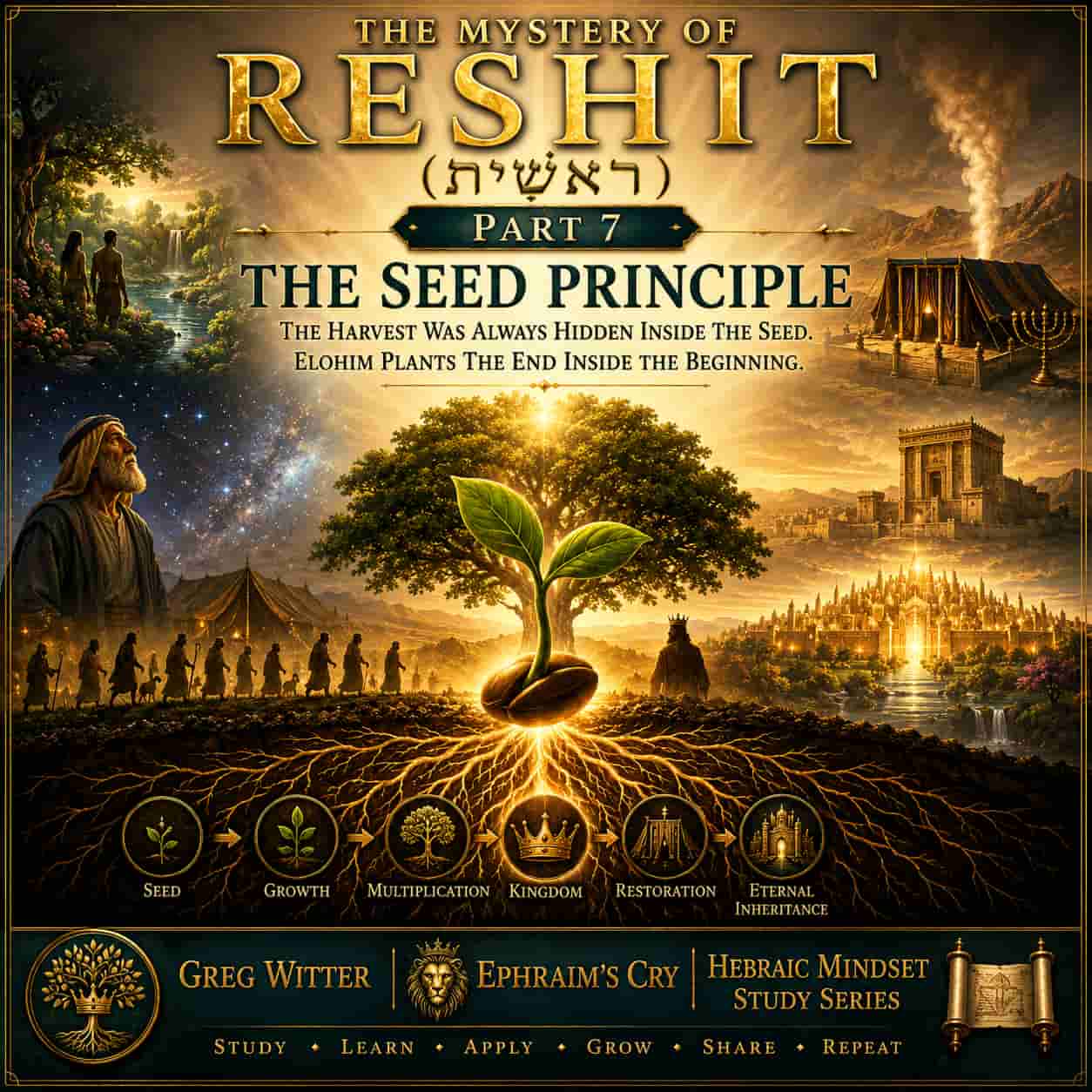
THE MYSTERY OF RESHIT (רֵאשִׁית)
PART 7
THE SEED PRINCIPLE
Discovering the Divine Blueprint of the Gospel of the Kingdom Hidden in the Beginning
Declaring the End from the Beginning Through the Whole Counsel of Elohim
The Harvest Was Always Hidden Inside The Seed.
Elohim Plants The End Inside The Beginning.
Greg Witter | Ephraim’s Cry
Hebraic Mindset Study Series
Study • Learn • Apply • Grow • Share • Repeat
Perhaps one of the greatest reasons we struggle to understand Scripture is because we have been trained to look for completed things while Elohim teaches through beginnings. We are often fascinated by the harvest, yet Elohim constantly draws our attention back to the seed. We become captivated by the finished product, while Elohim repeatedly says, “Go back to the beginning.”
That should not surprise us anymore, because that is exactly what we have been discovering throughout this journey. Elohim does not simply reveal endings. He establishes beginnings. He does not merely reveal fulfillments. He plants patterns. He does not merely announce destinations. He establishes blueprints.
And perhaps nowhere is that more visible than in the principle of the seed.
The seed principle may be one of the most overlooked principles in all of Scripture, yet once you see it, you will begin seeing it everywhere. Suddenly, the Bible will stop feeling fragmented, and you will begin seeing one continuous story unfolding before your eyes.
Think about how Elohim created the world itself.
He could have created fully mature forests that never reproduced. He could have created a world that simply existed in a perpetual state of completion. But that is not what He did. Instead, He built His creation around a principle that would teach us something about Himself.
Genesis 1:11 says:
“And Elohim said, Let the earth bring forth grass, the herb yielding seed, and the fruit tree yielding fruit after his kind, whose seed is in itself, upon the earth: and it was so.”
Read that slowly.
Whose seed is in itself.
That is not simply agricultural language.
That is Kingdom language.
The harvest was already inside the seed.
The future was already inside the beginning.
The ending was already embedded in the start.
That is how Elohim teaches.
That is how Elohim governs.
That is how Elohim reveals His Kingdom.
Perhaps we have been so busy looking for spectacular revelations that we have missed the simplicity of Elohim’s design. He repeatedly takes enormous Kingdom truths and hides them inside ordinary things. A seed becomes one of His greatest teachers.
Every seed carries identity.
Every seed carries purpose.
Every seed carries potential.
Every seed carries multiplication.
Every seed carries a future harvest.
And every seed reproduces according to its kind.
That last statement may be one of the most important statements in all of Scripture.
According to its kind.
That phrase appears repeatedly in Genesis 1. It establishes boundaries. It establishes identity. It establishes order. It establishes continuity. It establishes that Elohim is not the author of chaos.
What He establishes remains connected to its source.
Then something extraordinary begins to happen throughout the rest of Scripture. Elohim starts using this same principle over and over again.
The seed principle becomes a Kingdom principle.
Abraham receives a seed promise.
David receives a seed promise.
The prophets speak of a coming seed.
The Kingdom itself begins like a seed.
And perhaps the very first messianic promise ever given is also a seed promise.
Genesis 3:15 says:
“And I will put enmity between thee and the woman, and between thy seed and her seed; it shall bruise thy head, and thou shalt bruise his heel.”
Look at what just happened.
Immediately after rebellion enters the story, Elohim introduces a seed.
Why?
Because restoration always begins with a seed.
The story of redemption is not introduced with an army.
It is not introduced with a government.
It is not introduced with a religion.
It is introduced with a seed.
Then that seed begins to move throughout history.
The seed moves through Noah.
The seed moves through Abraham.
The seed moves through Isaac.
The seed moves through Jacob.
The seed moves through Judah.
The seed moves through David.
And eventually, the fullness of that promise is revealed in Messiah.
Again, not because we inserted Him into the story.
Because He was always the destination of the story.
But the seed principle is even bigger than that.
The entire Bible is a seed story.
The Garden is a seed.
The Tabernacle is a seed.
The Temple is a seed.
The feasts are seeds.
The Sabbath is a seed.
The covenants are seeds.
The Kingdom is a seed.
The assembly itself is a seed.
Even New Jerusalem is the fullness of a seed planted at the beginning.
Perhaps this is why Yahusha taught so often in agricultural language.
He was speaking Hebraically.
He was speaking Kingdom language.
He was speaking the language of patterns.
Matthew 13:31-32 says:
“The kingdom of heaven is like to a grain of mustard seed, which a man took, and sowed in his field: Which indeed is the least of all seeds: but when it is grown, it is the greatest among herbs…”
Do you see it?
Even the Kingdom arrives as a seed.
Because Elohim rarely begins with fullness.
He begins with beginnings.
He begins with patterns.
He begins with seeds.
Perhaps that is one of the greatest mistakes modern believers make. We want immediate completion. We want instant understanding. We want all the answers at once.
But Elohim says, “Watch the seed.”
Watch how it grows.
Watch how it develops.
Watch how it multiplies.
Watch how it matures.
Watch how the blueprint unfolds.
Perhaps that is exactly what we have been doing throughout this entire series without even realizing it. Every teaching has been another seed. Every discovery has been another seed. Every pattern has been another seed.
And all of those seeds are beginning to grow into one magnificent picture.
The Kingdom.
This is also why the beginning matters so much. The beginning contains the DNA of everything that follows. If we lose the beginning, we lose the blueprint. If we lose the blueprint, we lose the story. And if we lose the story, we begin inventing stories Elohim never wrote.
That is precisely why B’reshit matters.
The beginning already contains the harvest.
The seed already contains the tree.
The promise already contains the fulfillment.
The blueprint already contains the Kingdom.
The ending was never hidden.
It was planted.
Perhaps that is why Elohim chose seeds as one of His greatest teachers.
Because every seed whispers the same message.
What you are looking at today is not the fullness.
It is only the beginning.
And perhaps that is exactly what B’reshit has been trying to tell us all along.
The Kingdom was always there.
The restoration was always there.
The King was always there.
The harvest was always there.
The blueprint was always there.
It was simply planted in seed form.
Key Takeaways
• Elohim teaches through seeds before harvests.
• The ending is planted inside the beginning.
• The seed principle governs much of Scripture.
• Genesis 3:15 introduces the restoration seed.
• The Kingdom itself grows from seed to fullness.
• The beginning contains the DNA of everything that follows.
• The whole counsel reveals one continuous Kingdom story.
• The ending was not hidden; it was planted.
#TheMysteryOfReshit #Bereshit #Reshit #TheGospelOfTheKingdom #WholeCounselOfElohim #FourWitnesses
#PatternRecognition #Genesis #Firstfruits #Firstborn #Messiah #KingdomOfElohim #HebraicMindset
#EphraimsCry #StudyLearnApplyGrowShareRepeat
