
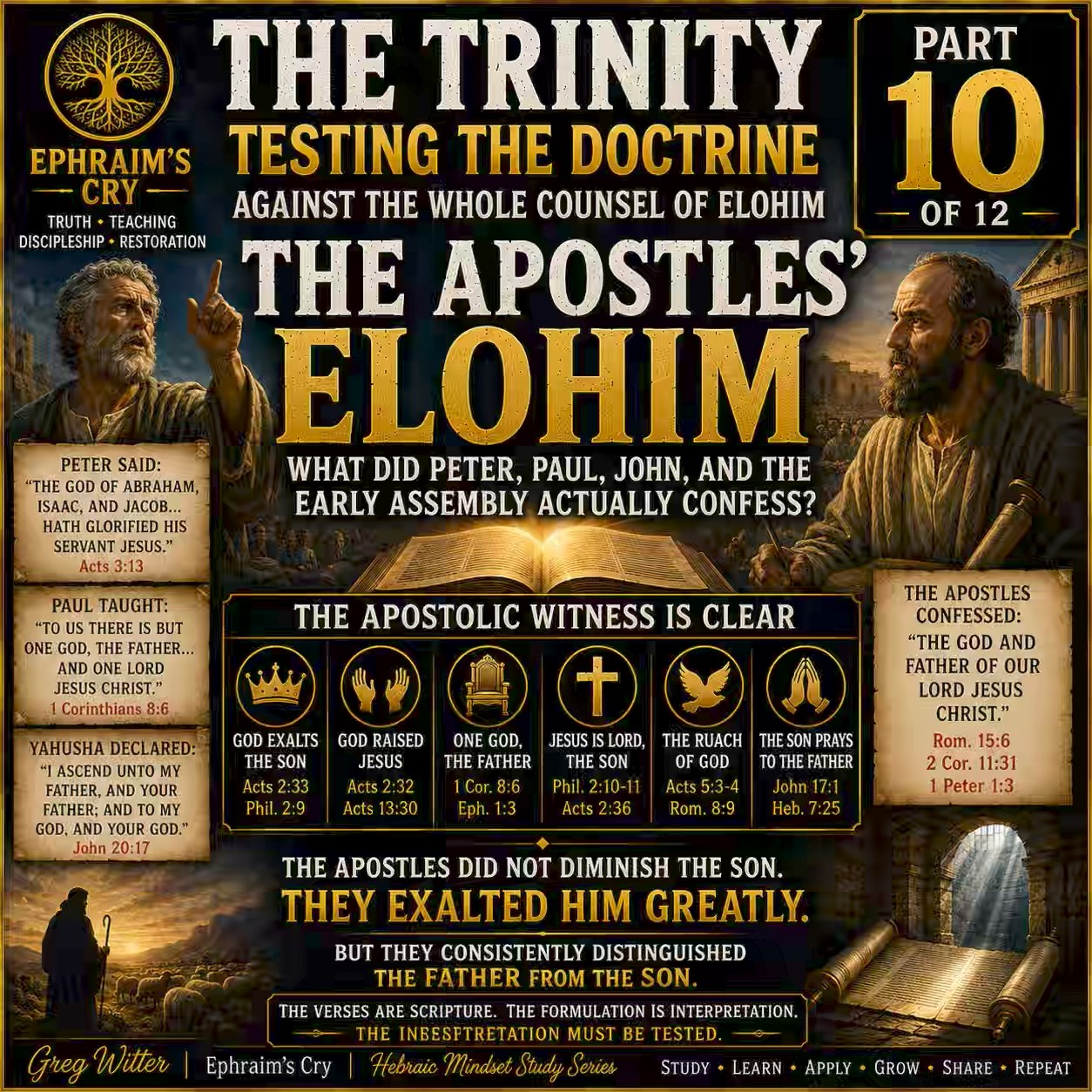
THE TRINITY — TESTING THE DOCTRINE AGAINST THE WHOLE COUNSEL OF ELOHIM
PART 10 — THE APOSTLES’ ELOHIM
What Did Peter, Paul, John, and the Early Assembly Actually Confess?
Greg Witter | Ephraim’s Cry
Hebraic Mindset Study Series
Study • Learn • Apply • Grow • Share ☆ Repeat
THE TRINITY — TESTING THE DOCTRINE AGAINST THE WHOLE COUNSEL OF ELOHIM
PART 10 — THE APOSTLES’ ELOHIM
What Did Peter, Paul, John, and the Early Assembly Actually Confess?
For nine teachings we have examined what Scripture actually says about Yahuah, Yahusha, and the Ruach ha’Qodesh. We have deliberately refused to diminish Yahusha merely to defeat Trinitarian arguments, and we have equally refused to allow later theological terminology to be inserted into passages where the terminology itself does not appear.
Now we arrive at a decisive historical and biblical question:
WHAT DID THE APOSTLES ACTUALLY CONFESS?
If the doctrine later formulated as the Trinity represents the essential identity of Elohim, we should expect the Apostolic Witness to provide a clear foundation for it.
So let us ask Peter.
Let us ask Paul.
Let us ask John.
Let us examine Acts.
Let us examine the letters.
And instead of beginning with fourth-century creeds and working backward, let the earliest proclamation following Yahusha’s resurrection speak for itself.
PETER’S PENTECOST PROCLAMATION
Acts 2 records Peter’s public proclamation immediately after the outpouring of the Ruach.
This is an extraordinary opportunity.
If the central revelation following Yahusha’s resurrection was that Yahusha is actually Yahuah Himself or one co-equal person within a triune Elohim, Peter had the perfect opportunity to announce it.
What does he say?
“Yahusha of Nazareth, A MAN APPROVED OF GOD among you by miracles and wonders and signs, WHICH GOD DID BY HIM” (Acts 2:22).
Notice the distinction:
ELOHIM.
YAHUSHA.
ELOHIM performs works THROUGH Yahusha.
Peter continues:
“This Jesus HATH GOD RAISED UP” (Acts 2:32).
Then:
“Therefore being by the RIGHT HAND OF GOD EXALTED, and having RECEIVED OF THE FATHER the promise of the Holy Ghost, HE hath shed forth this” (Acts 2:33).
The order is unmistakable:
THE FATHER.
YAHUSHA.
THE RUACH.
Yahusha is exalted.
Yahusha receives from the Father.
Yahusha pours out the Ruach.
Peter concludes:
“GOD HATH MADE that same Jesus… BOTH LORD AND CHRIST” (Acts 2:36).
This is apostolic proclamation.
“GOD RAISED HIM FROM THE DEAD”
This language occurs repeatedly throughout Acts.
Acts 3:15:
“Whom GOD HATH RAISED FROM THE DEAD.”
Acts 4:10:
“Jesus Christ of Nazareth… WHOM GOD RAISED FROM THE DEAD.”
Acts 5:30:
“THE GOD OF OUR FATHERS RAISED UP JESUS.”
Acts 10:40:
“HIM GOD RAISED UP the third day.”
Acts 13:30:
“BUT GOD RAISED HIM FROM THE DEAD.”
This is not accidental wording.
The Apostolic Witness consistently distinguishes:
THE ELOHIM WHO RAISES.
THE MESSIAH WHO IS RAISED.
That distinction continues after the resurrection.
THE ELOHIM OF ABRAHAM GLORIFIED HIS SERVANT
Acts 3:13 is especially important:
“The God of Abraham, and of Isaac, and of Jacob, THE GOD OF OUR FATHERS, hath GLORIFIED HIS SERVANT JESUS.”
Peter identifies the One acting:
THE ELOHIM OF ABRAHAM, ISAAC, AND JACOB.
And then identifies Yahusha in relationship to Him:
HIS SERVANT.
The Greek παῖς — pais — can mean servant or child depending upon context. Here it echoes the Servant language of Isaiah.
The point remains:
THE ELOHIM OF THE FATHERS GLORIFIES YAHUSHA.
This is not Peter abandoning Israel’s Elohim for a new theological definition.
He roots Yahusha directly within Israel’s existing covenant story.
PETER DOES NOT PREACH A NEW ELOHIM
Acts 5:30 again says:
“THE GOD OF OUR FATHERS raised up Jesus.”
The apostles did not announce:
“We have discovered that the Elohim of Abraham was actually three co-equal persons.”
They proclaimed that the Elohim Israel already knew had acted decisively THROUGH His Messiah.
That does not diminish Yahusha.
It identifies him according to the apostolic proclamation.
PAUL — ONE ELOHIM, THE FATHER
Now let Paul speak.
First Corinthians 8:6 is one of the clearest confessional statements in the Apostolic Writings:
“But to us there is but ONE GOD, THE FATHER, OF WHOM ARE ALL THINGS, and we in him; and ONE LORD JESUS CHRIST, BY WHOM ARE ALL THINGS, and we by him.”
Read it carefully.
ONE GOD — THE FATHER.
ONE LORD — YAHUSHA MESSIAH.
Paul does not say:
“One God—Father, Son, and Holy Spirit.”
He explicitly identifies the one Elohim as:
THE FATHER.
Yet Paul simultaneously gives Yahusha an extraordinary position:
“BY WHOM ARE ALL THINGS.”
Again we see what has governed this entire series:
DO NOT DIMINISH THE SON.
DO NOT ERASE THE FATHER.
PAUL AND THE SHEMA
First Corinthians 8:6 almost certainly resonates with Israel’s Shema:
“Hear, O Israel: Yahuah our Elohim is one Yahuah” (Deuteronomy 6:4).
Paul speaks of:
ONE ELOHIM.
ONE LORD.
Some scholars argue that Paul is deliberately incorporating Yahusha into the language of the Shema.
That argument deserves serious consideration.
But even if Paul is reformulating or expanding the Shema christologically, notice that he still explicitly distinguishes:
THE FATHER — OF WHOM ARE ALL THINGS.
YAHUSHA — BY WHOM ARE ALL THINGS.
The distinction remains inside the confession itself.
“THE GOD AND FATHER OF OUR LORD”
Paul repeatedly uses another expression that deserves far more attention.
Romans 15:6:
“The GOD AND FATHER of our Lord Jesus Christ.”
Second Corinthians 1:3:
“Blessed be GOD, even THE FATHER OF OUR LORD JESUS CHRIST.”
Second Corinthians 11:31:
“The GOD AND FATHER OF OUR LORD JESUS CHRIST.”
Ephesians 1:3:
“Blessed be the GOD AND FATHER OF OUR LORD JESUS CHRIST.”
Ephesians 1:17:
“The GOD OF OUR LORD JESUS CHRIST, THE FATHER OF GLORY.”
These are not pre-resurrection statements spoken during Yahusha’s earthly humiliation.
These are apostolic letters written concerning the resurrected and exalted Messiah.
Paul still says Yahusha has an Elohim.
PETER SAYS THE SAME THING
First Peter 1:3:
“Blessed be THE GOD AND FATHER OF OUR LORD JESUS CHRIST.”
Peter and Paul agree.
THE FATHER IS THE ELOHIM OF YAHUSHA.
That is not a theological embarrassment.
It is apostolic doctrine.
JOHN SAYS THE SAME THING
Second John 3 distinguishes:
“GOD THE FATHER, AND FROM THE LORD JESUS CHRIST, THE SON OF THE FATHER.”
Notice John’s terminology:
GOD THE FATHER.
JESUS CHRIST.
THE SON OF THE FATHER.
Again, relationship and distinction.
John’s letters do not suddenly erase the Father-Son structure established throughout his Gospel.
YAHUSHA’S OWN CONFESSION AFTER THE RESURRECTION
John 20:17 remains decisive.
After Yahusha has risen, he tells Mary:
“I ascend unto MY FATHER, and your Father; and to MY GOD, and your God.”
AFTER THE RESURRECTION.
MY FATHER.
MY GOD.
If someone claims Yahusha’s references to the Father as his Elohim apply only to his mortal humiliation, John 20:17 creates an immediate problem.
The resurrected Messiah still says:
MY GOD.
THE GLORIFIED YAHUSHA STILL SAYS “MY GOD”
Revelation makes the evidence even stronger.
Revelation 3:12 records the glorified Yahusha saying:
“Him that overcometh will I make a pillar in the temple of MY GOD… and I will write upon him the name of MY GOD… the city of MY GOD… which cometh down out of heaven from MY GOD.”
Four times.
MY GOD.
MY GOD.
MY GOD.
MY GOD.
This is the exalted Messiah speaking from heaven.
The Father remains Yahusha’s Elohim.
Any doctrine of Father and Son must account honestly for that.
THE HEAD OF MESSIAH IS ELOHIM
Paul writes in 1 Corinthians 11:3:
“The head of every man is Christ; and the head of the woman is the man; and THE HEAD OF CHRIST IS GOD.”
Again:
ORDER.
AUTHORITY.
RELATIONSHIP.
Messiah has a Head.
Paul identifies that Head as Elohim.
This agrees perfectly with everything Yahusha taught concerning submission to the Father.
THE SON WILL REMAIN SUBJECT
First Corinthians 15:24–28 takes us beyond the resurrection and beyond the present age to the consummation of Messiah’s reign.
Yahusha reigns until every enemy is defeated.
Then:
“He shall have DELIVERED UP THE KINGDOM TO GOD, EVEN THE FATHER.”
And finally:
“Then shall THE SON ALSO HIMSELF BE SUBJECT unto him that put all things under him, THAT GOD MAY BE ALL IN ALL.”
This cannot be dismissed as temporary earthly humiliation.
This is the END OF MESSIAH’S KINGDOM MISSION.
And the Son remains subject to the Father.
ONE ELOHIM AND ONE MEDIATOR
First Timothy 2:5 declares:
“For there is ONE GOD, and ONE MEDIATOR BETWEEN GOD AND MEN, THE MAN CHRIST JESUS.”
The structure is straightforward:
ONE ELOHIM.
HUMANITY.
ONE MEDIATOR BETWEEN THEM.
YAHUSHA MESSIAH.
A mediator is not meaningless if he is simply the same party to whom he mediates.
Yahusha stands uniquely between Elohim and humanity.
Again, this does not diminish him.
NO OTHER HUMAN OCCUPIES THIS POSITION.
YAHUSHA IS HIGH PRIEST BEFORE ELOHIM
Hebrews likewise presents Yahusha as High Priest.
Hebrews 7:25 says Yahusha:
“Ever liveth to MAKE INTERCESSION for them.”
Before whom does the High Priest intercede?
ELOHIM.
Hebrews 9:24 says Messiah entered heaven:
“Now to appear in the presence of GOD FOR US.”
Again:
MEDIATOR.
HIGH PRIEST.
INTERCESSOR.
These are extraordinary offices.
But they require relationship between Yahusha and the One before whom he ministers.
ELOHIM EXALTED YAHUSHA
Philippians 2:9:
“Wherefore GOD ALSO HATH HIGHLY EXALTED HIM.”
Acts 5:31:
“HIM HATH GOD EXALTED with his right hand to be a Prince and a Saviour.”
Hebrews 5:5:
“Christ GLORIFIED NOT HIMSELF to be made an high priest.”
The pattern remains:
YAHUAH EXALTS.
YAHUSHA IS EXALTED.
YAHUAH APPOINTS.
YAHUSHA IS APPOINTED.
YAHUAH GIVES.
YAHUSHA RECEIVES.
BUT THE APOSTLES GIVE YAHUSHA EXTRAORDINARY HONOR
Now we must guard against the opposite error.
The apostles do NOT present Yahusha as merely another human teacher.
Philippians 2 says every knee will bow at his name.
Colossians 1 says creation came through him.
Hebrews 1 places him above the angels.
Revelation 5 gives the Lamb extraordinary heavenly honor.
Thomas says:
“My Lord and my God.”
The Word is described as theos in John 1:1.
Yahusha is the image of the invisible Elohim.
The apostles proclaim him Lord.
Messiah.
Son.
King.
Judge.
High Priest.
Mediator.
The one through whom all things came.
THE APOSTOLIC YAHUSHA IS ENORMOUSLY EXALTED.
We will not reduce him merely because later Trinitarianism goes beyond what we believe the text establishes.
THE APOSTOLIC GREETINGS ARE REVEALING
Paul repeatedly writes greetings such as:
“Grace to you and peace FROM GOD OUR FATHER, AND THE LORD JESUS CHRIST.”
Romans 1:7.
First Corinthians 1:3.
Second Corinthians 1:2.
Galatians 1:3.
Ephesians 1:2.
Philippians 1:2.
The pattern is remarkably stable:
ELOHIM OUR FATHER.
YAHUSHA OUR LORD.
Paul does not ordinarily say:
“From God the Father, God the Son, and God the Holy Spirit.”
That later formula is simply not Paul’s normal vocabulary.
That observation does not by itself disprove Trinitarian theology.
But it absolutely matters when reconstructing THE APOSTLES’ OWN CONFESSIONAL LANGUAGE.
WHERE IS “GOD THE SON”?
This question deserves to be asked carefully.
Scripture repeatedly says:
SON OF GOD.
Yet the exact title:
“GOD THE SON”
does not occur as a biblical phrase.
That does NOT automatically mean Yahusha cannot bear theos-language. He clearly does in significant passages we have already examined.
But:
“SON OF GOD”
and:
“GOD THE SON”
are not grammatically identical statements.
One is explicit biblical language.
The other is later theological terminology designed to summarize a doctrinal conclusion.
We must distinguish them.
THE VERSE IS SCRIPTURE.
THE FORMULA IS INTERPRETATION.
WHERE IS “GOD THE HOLY SPIRIT”?
The same issue arises with the Ruach.
Scripture repeatedly says:
SPIRIT OF GOD.
SPIRIT OF YAHUAH.
HOLY SPIRIT.
SPIRIT OF THE FATHER.
But “God the Holy Spirit” is not the normal biblical title.
Again, Acts 5 strongly connects lying to the Ruach with lying to Elohim, and the Ruach performs personal actions.
Those witnesses must stand.
But later terminology must still be identified honestly as theological formulation rather than quotation.
WHAT ABOUT MATTHEW 28:19?
Father.
Son.
Holy Spirit.
All three are there.
But association does not automatically define metaphysical identity.
The Apostolic Witness must interpret the relationship.
And when it does, we repeatedly find:
THE FATHER SENDS.
THE SON IS SENT.
THE RUACH IS SENT.
THE FATHER GIVES.
THE SON RECEIVES.
THE SON POURS OUT THE RUACH.
THE RUACH GLORIFIES THE SON.
THE SON GLORIFIES THE FATHER.
ORDER WITHOUT CONFUSION.
UNITY WITHOUT COLLAPSE.
THE EARLY ASSEMBLY PRAYS TO YAHUAH ABOUT YAHUSHA
Acts 4 provides an extraordinary glimpse into the prayer life of the earliest assembly.
They pray:
“Lord, thou art God, which hast made heaven, and earth…”
Then speak of:
“THY HOLY CHILD [SERVANT] JESUS, WHOM THOU HAST ANOINTED” (Acts 4:27).
And again:
“Signs and wonders may be done by the name of THY HOLY CHILD [SERVANT] JESUS” (Acts 4:30).
The earliest assembly distinguishes:
THE ELOHIM THEY ADDRESS.
HIS ANOINTED SERVANT/SON YAHUSHA.
That is important historical evidence from within Acts itself.
THE MYSTERY DOES NOT CREATE ANOTHER ELOHIM
Paul’s revelation of the mystery does not introduce another Elohim.
Ephesians 3:6 identifies the mystery as Gentiles becoming:
“FELLOWHEIRS, and of the SAME BODY, and PARTAKERS OF HIS PROMISE in Christ by the gospel.”
The mystery concerns inclusion and inheritance through Messiah.
It does not announce a newly discovered triune identity of Elohim.
Paul’s Elohim remains:
“THE GOD AND FATHER OF OUR LORD JESUS CHRIST.”
THE APOSTOLIC CONFESSION
When we allow the Apostolic Witness to speak in its own vocabulary, a consistent pattern emerges:
ONE ELOHIM — THE FATHER.
ONE LORD — YAHUSHA MESSIAH.
YAHUSHA — THE SON OF ELOHIM.
THE FATHER — THE ELOHIM OF YAHUSHA.
YAHUSHA — SENT BY THE FATHER.
YAHUSHA — RAISED BY ELOHIM.
YAHUSHA — EXALTED BY ELOHIM.
YAHUSHA — GIVEN AUTHORITY BY ELOHIM.
YAHUSHA — MEDIATOR BETWEEN ELOHIM AND HUMANITY.
YAHUSHA — HIGH PRIEST BEFORE ELOHIM.
YAHUSHA — THE ONE THROUGH WHOM ELOHIM CREATED.
YAHUSHA — THE IMAGE OF THE INVISIBLE ELOHIM.
YAHUSHA — THE KING APPOINTED BY ELOHIM.
YAHUSHA — THE JUDGE APPOINTED BY ELOHIM.
YAHUSHA — THE ONE BEFORE WHOM EVERY KNEE WILL BOW.
And:
THE RUACH — THE SPIRIT OF ELOHIM, THE SPIRIT OF THE FATHER, SENT AND POURED OUT THROUGH THE EXALTED SON.
That is an enormous biblical confession.
We do not need to diminish a single part of it.
THE WATCHMAN’S WARNING
Do not replace apostolic vocabulary with later theological vocabulary and then pretend they are identical.
“SON OF GOD” is Scripture.
“GOD THE SON” is theological formulation.
“SPIRIT OF GOD” is Scripture.
“GOD THE HOLY SPIRIT” is theological formulation.
“ONE GOD, THE FATHER” is Scripture.
“ONE GOD IN THREE CO-EQUAL PERSONS” is theological formulation.
Again:
A theological formulation may be defended as an attempted synthesis of Scripture.
But it must be acknowledged AS A SYNTHESIS.
Then it must be tested.
That is exactly what we are doing.
THE FOUNDATION OF PART 10
What did Peter, Paul, John, and the earliest assembly actually confess?
They did not diminish Yahusha.
THEY EXALTED HIM BEYOND EVERY ORDINARY PROPHET, PRIEST, KING, OR MESSENGER.
But they consistently distinguished him from:
THE ELOHIM WHO SENT HIM.
THE ELOHIM WHO RAISED HIM.
THE ELOHIM WHO EXALTED HIM.
THE ELOHIM WHO GAVE HIM AUTHORITY.
THE ELOHIM BEFORE WHOM HE INTERCEDES.
THE ELOHIM TO WHOM HE DELIVERS THE KINGDOM.
And Paul identifies that One explicitly:
“ONE GOD, THE FATHER.”
That is apostolic vocabulary.
Before accepting any later creed, we should ask whether that creed faithfully preserves ALL of these apostolic distinctions or whether it requires us to reinterpret them through terminology the apostles themselves never used.
We are not asking whether later theologians were intelligent.
We are not asking whether they were sincere.
We are asking something far more fundamental:
DOES THEIR FORMULATION ACCURATELY REPRESENT THE WHOLE COUNSEL OF ELOHIM?
Because apostolic doctrine—not later ecclesiastical authority—is the standard.
THE APOSTLES DID NOT ABANDON THE SHEMA
This point cannot be overstated.
Yahusha affirmed the Shema:
“Hear, O Israel; Yahuah our Elohim is one Yahuah” (Mark 12:29; Deuteronomy 6:4).
Paul did not announce that this confession had been replaced.
Instead, he writes:
“To us there is but ONE GOD, THE FATHER… and ONE LORD JESUS CHRIST” (1 Corinthians 8:6).
The Apostolic Witness therefore does not move from:
YAHUAH IS ONE
to:
YAHUAH IS NOW THREE.
It reveals the extraordinary identity, authority, glory, and agency of Yahuah’s Son while continuing to identify the Father as the one Elohim.
That distinction must remain on the table.
THE APOSTLES PREACHED YAHUSHA AS MESSIAH AND SON
Look at the actual apostolic proclamation.
Acts 9:20 says Paul:
“Preached Christ in the synagogues, that HE IS THE SON OF GOD.”
Acts 17:3 records Paul reasoning from Scripture:
“This Jesus, whom I preach unto you, IS CHRIST.”
Acts 18:5 says Paul testified:
“that Jesus was Christ.”
Acts 18:28 says Apollos demonstrated from Scripture:
“that Jesus was Christ.”
John states his purpose:
“These are written, that ye might believe that Jesus is THE CHRIST, THE SON OF GOD” (John 20:31).
That confession is everywhere.
YAHUSHA IS THE MESSIAH.
YAHUSHA IS THE SON OF ELOHIM.
That is not a lesser confession needing improvement by later philosophical terminology.
That is the apostolic confession.
THE SON’S EXALTATION GLORIFIES THE FATHER
Philippians 2:9–11 is frequently used to establish Yahusha’s extraordinary status—and rightly so.
Elohim highly exalts him.
Every knee bows.
Every tongue confesses:
“Jesus Christ is Lord.”
But where does Paul’s declaration end?
“TO THE GLORY OF GOD THE FATHER.”
Yahusha’s exaltation does not compete with the Father.
It glorifies the Father.
The Father exalts the Son.
The creation honors the Son.
The Son’s Lordship glorifies the Father.
This is ordered unity.
REVELATION PRESERVES BOTH DISTINCTION AND GLORY
Revelation does not collapse Father and Son either.
Revelation 5 presents:
“HIM THAT SAT ON THE THRONE.”
And:
“THE LAMB.”
The Lamb approaches the One sitting upon the throne and receives the scroll.
Yet the Lamb then receives extraordinary heavenly honor:
“Worthy is the Lamb that was slain to receive power, and riches, and wisdom, and strength, and honour, and glory, and blessing.”
Then Revelation 5:13 declares blessing and honor:
“UNTO HIM THAT SITTETH UPON THE THRONE, AND UNTO THE LAMB.”
Do not diminish the Lamb.
And do not erase the One upon the throne.
SCRIPTURE DOES NEITHER.
ONE THRONE DOES NOT REQUIRE ONE PERSON
Revelation 22:1 speaks of:
“The throne of God AND OF THE LAMB.”
Verse 3 repeats:
“The throne of God and of the Lamb.”
Some immediately argue that one throne proves one being.
But Scripture repeatedly uses shared royal authority without requiring identity of person.
Yahusha himself says in Revelation 3:21:
“I… am set down WITH MY FATHER IN HIS THRONE.”
Again:
MY FATHER.
HIS THRONE.
YAHUSHA WITH HIM.
The Son participates in the Father’s royal authority because the Father has exalted him.
That is exactly what Daniel 7 anticipated.
DANIEL SAW THE PATTERN BEFORE THE APOSTLES
Daniel 7:13–14 describes:
THE ANCIENT OF DAYS.
And:
ONE LIKE THE SON OF MAN.
The Son of Man approaches the Ancient of Days.
Then:
“There was GIVEN HIM dominion, and glory, and a kingdom.”
This prophetic pattern becomes the apostolic proclamation.
YAHUAH GIVES.
MESSIAH RECEIVES.
MESSIAH REIGNS.
THE NATIONS SERVE HIM.
HIS KINGDOM ENDURES.
Nothing about receiving authority diminishes the recipient.
It establishes the legitimacy of his authority.
THE APOSTOLIC WITNESS IS NOT CONFUSED
The apostles had no difficulty holding together truths that later theological debates often force into opposing camps.
They could say:
ONE ELOHIM — THE FATHER.
And simultaneously:
YAHUSHA IS LORD.
They could say:
YAHUSHA HAS AN ELOHIM.
And simultaneously:
EVERY KNEE WILL BOW TO YAHUSHA.
They could say:
YAHUSHA IS THE SON.
And simultaneously:
ALL THINGS CAME THROUGH HIM.
They could say:
YAHUSHA WAS SENT.
And simultaneously:
HE EXISTED BEFORE ABRAHAM.
They could say:
THE FATHER IS GREATER.
And simultaneously:
HONOR THE SON.
They could say:
THE SON WILL BE SUBJECT TO THE FATHER.
And simultaneously:
THE SON WILL REIGN FOREVER.
Why can they do this?
Because Scripture does not require us to choose between the Father and the Son.
It requires us to understand their relationship correctly.
DO NOT CREATE A FALSE CHOICE
This series rejects the false choice:
Either accept the complete later Trinitarian formula OR diminish Yahusha.
NO.
There is another possibility:
BELIEVE EVERYTHING THE APOSTLES ACTUALLY SAID.
Likewise, we reject the opposite false choice:
Either reject the Trinity OR reduce Yahusha to merely an ordinary human prophet.
NO.
The Apostolic Witness will not permit that either.
Yahusha’s preexistence, unique Sonship, role in creation, glory, authority, kingship, judgment, mediation, and exaltation must remain intact.
THE WHOLE COUNSEL MEANS THE WHOLE COUNSEL.
THE QUESTION THAT NOW MUST BE ASKED
If the apostles consistently speak of:
ONE ELOHIM — THE FATHER,
ONE LORD — YAHUSHA MESSIAH,
and:
THE RUACH OF ELOHIM,
then when did Christianity begin using the technical language:
ONE ESSENCE.
THREE PERSONS.
CO-EQUAL.
CO-ETERNAL.
GOD THE SON.
GOD THE HOLY SPIRIT.
CONSUBSTANTIAL.
And why?
Did those expressions merely protect what Scripture already taught?
Were they necessary responses to theological controversies?
Did Greek philosophical terminology influence how biblical categories were expressed?
Were the formulations immediate apostolic doctrine—or the product of centuries of theological development?
Those are HISTORICAL questions.
And historical claims require historical evidence.
We will not repeat internet myths.
We will not claim Constantine “invented the Trinity.”
He did not.
We will not pretend Nicaea settled the complete doctrine of the Trinity in A.D. 325.
It did not.
We will not pretend the debates began at Nicaea.
They did not.
If we are going to expose later doctrinal development, we must expose it ACCURATELY.
Truth does not need bad history.
THE WATCHMAN’S CONCLUSION
Before somebody tells you what you “must believe” about the Trinity to be considered orthodox, ask a simpler question:
WHAT DID THE APOSTLES ACTUALLY CONFESS?
Peter preached:
THE ELOHIM OF ABRAHAM, ISAAC, AND JACOB GLORIFIED HIS SERVANT/SON YAHUSHA.
Paul confessed:
“ONE GOD, THE FATHER.”
John confessed:
YAHUSHA IS THE MESSIAH, THE SON OF ELOHIM.
The resurrected Yahusha declared:
“MY FATHER… MY GOD.”
The glorified Yahusha still declared:
“MY GOD.”
Paul said:
“THE HEAD OF CHRIST IS GOD.”
And at the consummation:
“THE SON ALSO HIMSELF” will be subject to the One who subjected everything to him.
Yet these same apostles proclaimed Yahusha as the preexistent Son, the Word made flesh, the image of the invisible Elohim, the One through whom creation came, the exalted Lord, the Messiah, the King, the High Priest, the Mediator, the Judge, and the Lamb worthy of extraordinary heavenly honor.
THAT IS THE APOSTOLIC BALANCE.
Do not diminish the Son.
Do not erase the Father.
Do not silence the Ruach.
Do not collapse what Scripture distinguishes.
Do not separate what Scripture joins.
And do not substitute later theological vocabulary for apostolic vocabulary and then pretend the two are automatically identical.
THE VERSES ARE SCRIPTURE.
THE THEOLOGICAL FORMULATION IS INTERPRETATION.
THE INTERPRETATION MUST BE TESTED.
And now we are finally prepared to follow the historical trail.
How did the language move from:
“ONE GOD, THE FATHER, AND ONE LORD JESUS CHRIST”
to:
“ONE GOD IN THREE PERSONS”?
When did ousia and hypostasis become central terminology?
What actually happened at Nicaea in 325?
What happened at Constantinople in 381?
What did early believers before those councils actually say?
And how much of the later doctrine represents biblical clarification—and how much represents theological development?
NEXT — PART 11
FROM SCRIPTURE TO CREED
How Trinitarian Doctrine Developed
Greg Witter | Ephraim’s Cry
Hebraic Mindset Study Series
Study • Learn • Apply • Grow • Share ☆ Repeat
#GregWitter, #EphraimsCry, #EphraimsCryAcademy, #HebraicMindsetStudySeries, #TheTrinitySeries, #TestingTheTrinity, #HebraicMindset, #HebraicBibleStudy, #BibleStudy, #BibleTeaching, #ScriptureStudy, #StudentsOfScripture, #DisciplesOfYahusha, #TorahObservant, #RemnantOfIsrael, #WholeCounselOfElohim, #FourWitnesses, #TheApostlesElohim, #ApostolicWitness, #OneGodTheFather, #OneLordYahusha, #SonOfElohim, #Yahuah, #Yahusha, #RuachHaQodesh, #FatherAndSon, #ApostolicDoctrine, #TestAllThings, #TruthOverTradition, #ReturnToScripture
For nine teachings we have examined what Scripture actually says about Yahuah, Yahusha, and the Ruach ha’Qodesh. We have deliberately refused to diminish Yahusha merely to defeat Trinitarian arguments, and we have equally refused to allow later theological terminology to be inserted into passages where the terminology itself does not appear.
Now we arrive at a decisive historical and biblical question:
WHAT DID THE APOSTLES ACTUALLY CONFESS?
If the doctrine later formulated as the Trinity represents the essential identity of Elohim, we should expect the Apostolic Witness to provide a clear foundation for it.
So let us ask Peter.
Let us ask Paul.
Let us ask John.
Let us examine Acts.
Let us examine the letters.
And instead of beginning with fourth-century creeds and working backward, let the earliest proclamation following Yahusha’s resurrection speak for itself.
PETER’S PENTECOST PROCLAMATION
Acts 2 records Peter’s public proclamation immediately after the outpouring of the Ruach.
This is an extraordinary opportunity.
If the central revelation following Yahusha’s resurrection was that Yahusha is actually Yahuah Himself or one co-equal person within a triune Elohim, Peter had the perfect opportunity to announce it.
What does he say?
“Yahusha of Nazareth, A MAN APPROVED OF GOD among you by miracles and wonders and signs, WHICH GOD DID BY HIM” (Acts 2:22).
Notice the distinction:
ELOHIM.
YAHUSHA.
ELOHIM performs works THROUGH Yahusha.
Peter continues:
“This Jesus HATH GOD RAISED UP” (Acts 2:32).
Then:
“Therefore being by the RIGHT HAND OF GOD EXALTED, and having RECEIVED OF THE FATHER the promise of the Holy Ghost, HE hath shed forth this” (Acts 2:33).
The order is unmistakable:
THE FATHER.
YAHUSHA.
THE RUACH.
Yahusha is exalted.
Yahusha receives from the Father.
Yahusha pours out the Ruach.
Peter concludes:
“GOD HATH MADE that same Jesus… BOTH LORD AND CHRIST” (Acts 2:36).
This is apostolic proclamation.
“GOD RAISED HIM FROM THE DEAD”
This language occurs repeatedly throughout Acts.
Acts 3:15:
“Whom GOD HATH RAISED FROM THE DEAD.”
Acts 4:10:
“Jesus Christ of Nazareth… WHOM GOD RAISED FROM THE DEAD.”
Acts 5:30:
“THE GOD OF OUR FATHERS RAISED UP JESUS.”
Acts 10:40:
“HIM GOD RAISED UP the third day.”
Acts 13:30:
“BUT GOD RAISED HIM FROM THE DEAD.”
This is not accidental wording.
The Apostolic Witness consistently distinguishes:
THE ELOHIM WHO RAISES.
THE MESSIAH WHO IS RAISED.
That distinction continues after the resurrection.
THE ELOHIM OF ABRAHAM GLORIFIED HIS SERVANT
Acts 3:13 is especially important:
“The God of Abraham, and of Isaac, and of Jacob, THE GOD OF OUR FATHERS, hath GLORIFIED HIS SERVANT JESUS.”
Peter identifies the One acting:
THE ELOHIM OF ABRAHAM, ISAAC, AND JACOB.
And then identifies Yahusha in relationship to Him:
HIS SERVANT.
The Greek παῖς — pais — can mean servant or child depending upon context. Here it echoes the Servant language of Isaiah.
The point remains:
THE ELOHIM OF THE FATHERS GLORIFIES YAHUSHA.
This is not Peter abandoning Israel’s Elohim for a new theological definition.
He roots Yahusha directly within Israel’s existing covenant story.
PETER DOES NOT PREACH A NEW ELOHIM
Acts 5:30 again says:
“THE GOD OF OUR FATHERS raised up Jesus.”
The apostles did not announce:
“We have discovered that the Elohim of Abraham was actually three co-equal persons.”
They proclaimed that the Elohim Israel already knew had acted decisively THROUGH His Messiah.
That does not diminish Yahusha.
It identifies him according to the apostolic proclamation.
PAUL — ONE ELOHIM, THE FATHER
Now let Paul speak.
First Corinthians 8:6 is one of the clearest confessional statements in the Apostolic Writings:
“But to us there is but ONE GOD, THE FATHER, OF WHOM ARE ALL THINGS, and we in him; and ONE LORD JESUS CHRIST, BY WHOM ARE ALL THINGS, and we by him.”
Read it carefully.
ONE GOD — THE FATHER.
ONE LORD — YAHUSHA MESSIAH.
Paul does not say:
“One God—Father, Son, and Holy Spirit.”
He explicitly identifies the one Elohim as:
THE FATHER.
Yet Paul simultaneously gives Yahusha an extraordinary position:
“BY WHOM ARE ALL THINGS.”
Again we see what has governed this entire series:
DO NOT DIMINISH THE SON.
DO NOT ERASE THE FATHER.
PAUL AND THE SHEMA
First Corinthians 8:6 almost certainly resonates with Israel’s Shema:
“Hear, O Israel: Yahuah our Elohim is one Yahuah” (Deuteronomy 6:4).
Paul speaks of:
ONE ELOHIM.
ONE LORD.
Some scholars argue that Paul is deliberately incorporating Yahusha into the language of the Shema.
That argument deserves serious consideration.
But even if Paul is reformulating or expanding the Shema christologically, notice that he still explicitly distinguishes:
THE FATHER — OF WHOM ARE ALL THINGS.
YAHUSHA — BY WHOM ARE ALL THINGS.
The distinction remains inside the confession itself.
“THE GOD AND FATHER OF OUR LORD”
Paul repeatedly uses another expression that deserves far more attention.
Romans 15:6:
“The GOD AND FATHER of our Lord Jesus Christ.”
Second Corinthians 1:3:
“Blessed be GOD, even THE FATHER OF OUR LORD JESUS CHRIST.”
Second Corinthians 11:31:
“The GOD AND FATHER OF OUR LORD JESUS CHRIST.”
Ephesians 1:3:
“Blessed be the GOD AND FATHER OF OUR LORD JESUS CHRIST.”
Ephesians 1:17:
“The GOD OF OUR LORD JESUS CHRIST, THE FATHER OF GLORY.”
These are not pre-resurrection statements spoken during Yahusha’s earthly humiliation.
These are apostolic letters written concerning the resurrected and exalted Messiah.
Paul still says Yahusha has an Elohim.
PETER SAYS THE SAME THING
First Peter 1:3:
“Blessed be THE GOD AND FATHER OF OUR LORD JESUS CHRIST.”
Peter and Paul agree.
THE FATHER IS THE ELOHIM OF YAHUSHA.
That is not a theological embarrassment.
It is apostolic doctrine.
JOHN SAYS THE SAME THING
Second John 3 distinguishes:
“GOD THE FATHER, AND FROM THE LORD JESUS CHRIST, THE SON OF THE FATHER.”
Notice John’s terminology:
GOD THE FATHER.
JESUS CHRIST.
THE SON OF THE FATHER.
Again, relationship and distinction.
John’s letters do not suddenly erase the Father-Son structure established throughout his Gospel.
YAHUSHA’S OWN CONFESSION AFTER THE RESURRECTION
John 20:17 remains decisive.
After Yahusha has risen, he tells Mary:
“I ascend unto MY FATHER, and your Father; and to MY GOD, and your God.”
AFTER THE RESURRECTION.
MY FATHER.
MY GOD.
If someone claims Yahusha’s references to the Father as his Elohim apply only to his mortal humiliation, John 20:17 creates an immediate problem.
The resurrected Messiah still says:
MY GOD.
THE GLORIFIED YAHUSHA STILL SAYS “MY GOD”
Revelation makes the evidence even stronger.
Revelation 3:12 records the glorified Yahusha saying:
“Him that overcometh will I make a pillar in the temple of MY GOD… and I will write upon him the name of MY GOD… the city of MY GOD… which cometh down out of heaven from MY GOD.”
Four times.
MY GOD.
MY GOD.
MY GOD.
MY GOD.
This is the exalted Messiah speaking from heaven.
The Father remains Yahusha’s Elohim.
Any doctrine of Father and Son must account honestly for that.
THE HEAD OF MESSIAH IS ELOHIM
Paul writes in 1 Corinthians 11:3:
“The head of every man is Christ; and the head of the woman is the man; and THE HEAD OF CHRIST IS GOD.”
Again:
ORDER.
AUTHORITY.
RELATIONSHIP.
Messiah has a Head.
Paul identifies that Head as Elohim.
This agrees perfectly with everything Yahusha taught concerning submission to the Father.
THE SON WILL REMAIN SUBJECT
First Corinthians 15:24–28 takes us beyond the resurrection and beyond the present age to the consummation of Messiah’s reign.
Yahusha reigns until every enemy is defeated.
Then:
“He shall have DELIVERED UP THE KINGDOM TO GOD, EVEN THE FATHER.”
And finally:
“Then shall THE SON ALSO HIMSELF BE SUBJECT unto him that put all things under him, THAT GOD MAY BE ALL IN ALL.”
This cannot be dismissed as temporary earthly humiliation.
This is the END OF MESSIAH’S KINGDOM MISSION.
And the Son remains subject to the Father.
ONE ELOHIM AND ONE MEDIATOR
First Timothy 2:5 declares:
“For there is ONE GOD, and ONE MEDIATOR BETWEEN GOD AND MEN, THE MAN CHRIST JESUS.”
The structure is straightforward:
ONE ELOHIM.
HUMANITY.
ONE MEDIATOR BETWEEN THEM.
YAHUSHA MESSIAH.
A mediator is not meaningless if he is simply the same party to whom he mediates.
Yahusha stands uniquely between Elohim and humanity.
Again, this does not diminish him.
NO OTHER HUMAN OCCUPIES THIS POSITION.
YAHUSHA IS HIGH PRIEST BEFORE ELOHIM
Hebrews likewise presents Yahusha as High Priest.
Hebrews 7:25 says Yahusha:
“Ever liveth to MAKE INTERCESSION for them.”
Before whom does the High Priest intercede?
ELOHIM.
Hebrews 9:24 says Messiah entered heaven:
“Now to appear in the presence of GOD FOR US.”
Again:
MEDIATOR.
HIGH PRIEST.
INTERCESSOR.
These are extraordinary offices.
But they require relationship between Yahusha and the One before whom he ministers.
ELOHIM EXALTED YAHUSHA
Philippians 2:9:
“Wherefore GOD ALSO HATH HIGHLY EXALTED HIM.”
Acts 5:31:
“HIM HATH GOD EXALTED with his right hand to be a Prince and a Saviour.”
Hebrews 5:5:
“Christ GLORIFIED NOT HIMSELF to be made an high priest.”
The pattern remains:
YAHUAH EXALTS.
YAHUSHA IS EXALTED.
YAHUAH APPOINTS.
YAHUSHA IS APPOINTED.
YAHUAH GIVES.
YAHUSHA RECEIVES.
BUT THE APOSTLES GIVE YAHUSHA EXTRAORDINARY HONOR
Now we must guard against the opposite error.
The apostles do NOT present Yahusha as merely another human teacher.
Philippians 2 says every knee will bow at his name.
Colossians 1 says creation came through him.
Hebrews 1 places him above the angels.
Revelation 5 gives the Lamb extraordinary heavenly honor.
Thomas says:
“My Lord and my God.”
The Word is described as theos in John 1:1.
Yahusha is the image of the invisible Elohim.
The apostles proclaim him Lord.
Messiah.
Son.
King.
Judge.
High Priest.
Mediator.
The one through whom all things came.
THE APOSTOLIC YAHUSHA IS ENORMOUSLY EXALTED.
We will not reduce him merely because later Trinitarianism goes beyond what we believe the text establishes.
THE APOSTOLIC GREETINGS ARE REVEALING
Paul repeatedly writes greetings such as:
“Grace to you and peace FROM GOD OUR FATHER, AND THE LORD JESUS CHRIST.”
Romans 1:7.
First Corinthians 1:3.
Second Corinthians 1:2.
Galatians 1:3.
Ephesians 1:2.
Philippians 1:2.
The pattern is remarkably stable:
ELOHIM OUR FATHER.
YAHUSHA OUR LORD.
Paul does not ordinarily say:
“From God the Father, God the Son, and God the Holy Spirit.”
That later formula is simply not Paul’s normal vocabulary.
That observation does not by itself disprove Trinitarian theology.
But it absolutely matters when reconstructing THE APOSTLES’ OWN CONFESSIONAL LANGUAGE.
WHERE IS “GOD THE SON”?
This question deserves to be asked carefully.
Scripture repeatedly says:
SON OF GOD.
Yet the exact title:
“GOD THE SON”
does not occur as a biblical phrase.
That does NOT automatically mean Yahusha cannot bear theos-language. He clearly does in significant passages we have already examined.
But:
“SON OF GOD”
and:
“GOD THE SON”
are not grammatically identical statements.
One is explicit biblical language.
The other is later theological terminology designed to summarize a doctrinal conclusion.
We must distinguish them.
THE VERSE IS SCRIPTURE.
THE FORMULA IS INTERPRETATION.
WHERE IS “GOD THE HOLY SPIRIT”?
The same issue arises with the Ruach.
Scripture repeatedly says:
SPIRIT OF GOD.
SPIRIT OF YAHUAH.
HOLY SPIRIT.
SPIRIT OF THE FATHER.
But “God the Holy Spirit” is not the normal biblical title.
Again, Acts 5 strongly connects lying to the Ruach with lying to Elohim, and the Ruach performs personal actions.
Those witnesses must stand.
But later terminology must still be identified honestly as theological formulation rather than quotation.
WHAT ABOUT MATTHEW 28:19?
Father.
Son.
Holy Spirit.
All three are there.
But association does not automatically define metaphysical identity.
The Apostolic Witness must interpret the relationship.
And when it does, we repeatedly find:
THE FATHER SENDS.
THE SON IS SENT.
THE RUACH IS SENT.
THE FATHER GIVES.
THE SON RECEIVES.
THE SON POURS OUT THE RUACH.
THE RUACH GLORIFIES THE SON.
THE SON GLORIFIES THE FATHER.
ORDER WITHOUT CONFUSION.
UNITY WITHOUT COLLAPSE.
THE EARLY ASSEMBLY PRAYS TO YAHUAH ABOUT YAHUSHA
Acts 4 provides an extraordinary glimpse into the prayer life of the earliest assembly.
They pray:
“Lord, thou art God, which hast made heaven, and earth…”
Then speak of:
“THY HOLY CHILD [SERVANT] JESUS, WHOM THOU HAST ANOINTED” (Acts 4:27).
And again:
“Signs and wonders may be done by the name of THY HOLY CHILD [SERVANT] JESUS” (Acts 4:30).
The earliest assembly distinguishes:
THE ELOHIM THEY ADDRESS.
HIS ANOINTED SERVANT/SON YAHUSHA.
That is important historical evidence from within Acts itself.
THE MYSTERY DOES NOT CREATE ANOTHER ELOHIM
Paul’s revelation of the mystery does not introduce another Elohim.
Ephesians 3:6 identifies the mystery as Gentiles becoming:
“FELLOWHEIRS, and of the SAME BODY, and PARTAKERS OF HIS PROMISE in Christ by the gospel.”
The mystery concerns inclusion and inheritance through Messiah.
It does not announce a newly discovered triune identity of Elohim.
Paul’s Elohim remains:
“THE GOD AND FATHER OF OUR LORD JESUS CHRIST.”
THE APOSTOLIC CONFESSION
When we allow the Apostolic Witness to speak in its own vocabulary, a consistent pattern emerges:
ONE ELOHIM — THE FATHER.
ONE LORD — YAHUSHA MESSIAH.
YAHUSHA — THE SON OF ELOHIM.
THE FATHER — THE ELOHIM OF YAHUSHA.
YAHUSHA — SENT BY THE FATHER.
YAHUSHA — RAISED BY ELOHIM.
YAHUSHA — EXALTED BY ELOHIM.
YAHUSHA — GIVEN AUTHORITY BY ELOHIM.
YAHUSHA — MEDIATOR BETWEEN ELOHIM AND HUMANITY.
YAHUSHA — HIGH PRIEST BEFORE ELOHIM.
YAHUSHA — THE ONE THROUGH WHOM ELOHIM CREATED.
YAHUSHA — THE IMAGE OF THE INVISIBLE ELOHIM.
YAHUSHA — THE KING APPOINTED BY ELOHIM.
YAHUSHA — THE JUDGE APPOINTED BY ELOHIM.
YAHUSHA — THE ONE BEFORE WHOM EVERY KNEE WILL BOW.
And:
THE RUACH — THE SPIRIT OF ELOHIM, THE SPIRIT OF THE FATHER, SENT AND POURED OUT THROUGH THE EXALTED SON.
That is an enormous biblical confession.
We do not need to diminish a single part of it.
THE WATCHMAN’S WARNING
Do not replace apostolic vocabulary with later theological vocabulary and then pretend they are identical.
“SON OF GOD” is Scripture.
“GOD THE SON” is theological formulation.
“SPIRIT OF GOD” is Scripture.
“GOD THE HOLY SPIRIT” is theological formulation.
“ONE GOD, THE FATHER” is Scripture.
“ONE GOD IN THREE CO-EQUAL PERSONS” is theological formulation.
Again:
A theological formulation may be defended as an attempted synthesis of Scripture.
But it must be acknowledged AS A SYNTHESIS.
Then it must be tested.
That is exactly what we are doing.
THE FOUNDATION OF PART 10
What did Peter, Paul, John, and the earliest assembly actually confess?
They did not diminish Yahusha.
THEY EXALTED HIM BEYOND EVERY ORDINARY PROPHET, PRIEST, KING, OR MESSENGER.
But they consistently distinguished him from:
THE ELOHIM WHO SENT HIM.
THE ELOHIM WHO RAISED HIM.
THE ELOHIM WHO EXALTED HIM.
THE ELOHIM WHO GAVE HIM AUTHORITY.
THE ELOHIM BEFORE WHOM HE INTERCEDES.
THE ELOHIM TO WHOM HE DELIVERS THE KINGDOM.
And Paul identifies that One explicitly:
“ONE GOD, THE FATHER.”
That is apostolic vocabulary.
Before accepting any later creed, we should ask whether that creed faithfully preserves ALL of these apostolic distinctions or whether it requires us to reinterpret them through terminology the apostles themselves never used.
We are not asking whether later theologians were intelligent.
We are not asking whether they were sincere.
We are asking something far more fundamental:
DOES THEIR FORMULATION ACCURATELY REPRESENT THE WHOLE COUNSEL OF ELOHIM?
Because apostolic doctrine—not later ecclesiastical authority—is the standard.
THE APOSTLES DID NOT ABANDON THE SHEMA
This point cannot be overstated.
Yahusha affirmed the Shema:
“Hear, O Israel; Yahuah our Elohim is one Yahuah” (Mark 12:29; Deuteronomy 6:4).
Paul did not announce that this confession had been replaced.
Instead, he writes:
“To us there is but ONE GOD, THE FATHER… and ONE LORD JESUS CHRIST” (1 Corinthians 8:6).
The Apostolic Witness therefore does not move from:
YAHUAH IS ONE
to:
YAHUAH IS NOW THREE.
It reveals the extraordinary identity, authority, glory, and agency of Yahuah’s Son while continuing to identify the Father as the one Elohim.
That distinction must remain on the table.
THE APOSTLES PREACHED YAHUSHA AS MESSIAH AND SON
Look at the actual apostolic proclamation.
Acts 9:20 says Paul:
“Preached Christ in the synagogues, that HE IS THE SON OF GOD.”
Acts 17:3 records Paul reasoning from Scripture:
“This Jesus, whom I preach unto you, IS CHRIST.”
Acts 18:5 says Paul testified:
“that Jesus was Christ.”
Acts 18:28 says Apollos demonstrated from Scripture:
“that Jesus was Christ.”
John states his purpose:
“These are written, that ye might believe that Jesus is THE CHRIST, THE SON OF GOD” (John 20:31).
That confession is everywhere.
YAHUSHA IS THE MESSIAH.
YAHUSHA IS THE SON OF ELOHIM.
That is not a lesser confession needing improvement by later philosophical terminology.
That is the apostolic confession.
THE SON’S EXALTATION GLORIFIES THE FATHER
Philippians 2:9–11 is frequently used to establish Yahusha’s extraordinary status—and rightly so.
Elohim highly exalts him.
Every knee bows.
Every tongue confesses:
“Jesus Christ is Lord.”
But where does Paul’s declaration end?
“TO THE GLORY OF GOD THE FATHER.”
Yahusha’s exaltation does not compete with the Father.
It glorifies the Father.
The Father exalts the Son.
The creation honors the Son.
The Son’s Lordship glorifies the Father.
This is ordered unity.
REVELATION PRESERVES BOTH DISTINCTION AND GLORY
Revelation does not collapse Father and Son either.
Revelation 5 presents:
“HIM THAT SAT ON THE THRONE.”
And:
“THE LAMB.”
The Lamb approaches the One sitting upon the throne and receives the scroll.
Yet the Lamb then receives extraordinary heavenly honor:
“Worthy is the Lamb that was slain to receive power, and riches, and wisdom, and strength, and honour, and glory, and blessing.”
Then Revelation 5:13 declares blessing and honor:
“UNTO HIM THAT SITTETH UPON THE THRONE, AND UNTO THE LAMB.”
Do not diminish the Lamb.
And do not erase the One upon the throne.
SCRIPTURE DOES NEITHER.
ONE THRONE DOES NOT REQUIRE ONE PERSON
Revelation 22:1 speaks of:
“The throne of God AND OF THE LAMB.”
Verse 3 repeats:
“The throne of God and of the Lamb.”
Some immediately argue that one throne proves one being.
But Scripture repeatedly uses shared royal authority without requiring identity of person.
Yahusha himself says in Revelation 3:21:
“I… am set down WITH MY FATHER IN HIS THRONE.”
Again:
MY FATHER.
HIS THRONE.
YAHUSHA WITH HIM.
The Son participates in the Father’s royal authority because the Father has exalted him.
That is exactly what Daniel 7 anticipated.
DANIEL SAW THE PATTERN BEFORE THE APOSTLES
Daniel 7:13–14 describes:
THE ANCIENT OF DAYS.
And:
ONE LIKE THE SON OF MAN.
The Son of Man approaches the Ancient of Days.
Then:
“There was GIVEN HIM dominion, and glory, and a kingdom.”
This prophetic pattern becomes the apostolic proclamation.
YAHUAH GIVES.
MESSIAH RECEIVES.
MESSIAH REIGNS.
THE NATIONS SERVE HIM.
HIS KINGDOM ENDURES.
Nothing about receiving authority diminishes the recipient.
It establishes the legitimacy of his authority.
THE APOSTOLIC WITNESS IS NOT CONFUSED
The apostles had no difficulty holding together truths that later theological debates often force into opposing camps.
They could say:
ONE ELOHIM — THE FATHER.
And simultaneously:
YAHUSHA IS LORD.
They could say:
YAHUSHA HAS AN ELOHIM.
And simultaneously:
EVERY KNEE WILL BOW TO YAHUSHA.
They could say:
YAHUSHA IS THE SON.
And simultaneously:
ALL THINGS CAME THROUGH HIM.
They could say:
YAHUSHA WAS SENT.
And simultaneously:
HE EXISTED BEFORE ABRAHAM.
They could say:
THE FATHER IS GREATER.
And simultaneously:
HONOR THE SON.
They could say:
THE SON WILL BE SUBJECT TO THE FATHER.
And simultaneously:
THE SON WILL REIGN FOREVER.
Why can they do this?
Because Scripture does not require us to choose between the Father and the Son.
It requires us to understand their relationship correctly.
DO NOT CREATE A FALSE CHOICE
This series rejects the false choice:
Either accept the complete later Trinitarian formula OR diminish Yahusha.
NO.
There is another possibility:
BELIEVE EVERYTHING THE APOSTLES ACTUALLY SAID.
Likewise, we reject the opposite false choice:
Either reject the Trinity OR reduce Yahusha to merely an ordinary human prophet.
NO.
The Apostolic Witness will not permit that either.
Yahusha’s preexistence, unique Sonship, role in creation, glory, authority, kingship, judgment, mediation, and exaltation must remain intact.
THE WHOLE COUNSEL MEANS THE WHOLE COUNSEL.
THE QUESTION THAT NOW MUST BE ASKED
If the apostles consistently speak of:
ONE ELOHIM — THE FATHER,
ONE LORD — YAHUSHA MESSIAH,
and:
THE RUACH OF ELOHIM,
then when did Christianity begin using the technical language:
ONE ESSENCE.
THREE PERSONS.
CO-EQUAL.
CO-ETERNAL.
GOD THE SON.
GOD THE HOLY SPIRIT.
CONSUBSTANTIAL.
And why?
Did those expressions merely protect what Scripture already taught?
Were they necessary responses to theological controversies?
Did Greek philosophical terminology influence how biblical categories were expressed?
Were the formulations immediate apostolic doctrine—or the product of centuries of theological development?
Those are HISTORICAL questions.
And historical claims require historical evidence.
We will not repeat internet myths.
We will not claim Constantine “invented the Trinity.”
He did not.
We will not pretend Nicaea settled the complete doctrine of the Trinity in A.D. 325.
It did not.
We will not pretend the debates began at Nicaea.
They did not.
If we are going to expose later doctrinal development, we must expose it ACCURATELY.
Truth does not need bad history.
THE WATCHMAN’S CONCLUSION
Before somebody tells you what you “must believe” about the Trinity to be considered orthodox, ask a simpler question:
WHAT DID THE APOSTLES ACTUALLY CONFESS?
Peter preached:
THE ELOHIM OF ABRAHAM, ISAAC, AND JACOB GLORIFIED HIS SERVANT/SON YAHUSHA.
Paul confessed:
“ONE GOD, THE FATHER.”
John confessed:
YAHUSHA IS THE MESSIAH, THE SON OF ELOHIM.
The resurrected Yahusha declared:
“MY FATHER… MY GOD.”
The glorified Yahusha still declared:
“MY GOD.”
Paul said:
“THE HEAD OF CHRIST IS GOD.”
And at the consummation:
“THE SON ALSO HIMSELF” will be subject to the One who subjected everything to him.
Yet these same apostles proclaimed Yahusha as the preexistent Son, the Word made flesh, the image of the invisible Elohim, the One through whom creation came, the exalted Lord, the Messiah, the King, the High Priest, the Mediator, the Judge, and the Lamb worthy of extraordinary heavenly honor.
THAT IS THE APOSTOLIC BALANCE.
Do not diminish the Son.
Do not erase the Father.
Do not silence the Ruach.
Do not collapse what Scripture distinguishes.
Do not separate what Scripture joins.
And do not substitute later theological vocabulary for apostolic vocabulary and then pretend the two are automatically identical.
THE VERSES ARE SCRIPTURE.
THE THEOLOGICAL FORMULATION IS INTERPRETATION.
THE INTERPRETATION MUST BE TESTED.
And now we are finally prepared to follow the historical trail.
How did the language move from:
“ONE GOD, THE FATHER, AND ONE LORD JESUS CHRIST”
to:
“ONE GOD IN THREE PERSONS”?
When did ousia and hypostasis become central terminology?
What actually happened at Nicaea in 325?
What happened at Constantinople in 381?
What did early believers before those councils actually say?
And how much of the later doctrine represents biblical clarification—and how much represents theological development?
NEXT — PART 11
FROM SCRIPTURE TO CREED
How Trinitarian Doctrine Developed
#GregWitter, #EphraimsCry, #EphraimsCryAcademy, #HebraicMindsetStudySeries, #TheTrinitySeries,
#TestingTheTrinity, #HebraicMindset, #HebraicBibleStudy, #BibleStudy, #BibleTeaching, #ScriptureStudy,
#StudentsOfScripture, #DisciplesOfYahusha, #TorahObservant, #RemnantOfIsrael, #WholeCounselOfElohim,
#FourWitnesses, #TheApostlesElohim, #ApostolicWitness, #OneGodTheFather, #OneLordYahusha,
#SonOfElohim, #Yahuah, #Yahusha, #RuachHaQodesh, #FatherAndSon, #ApostolicDoctrine, #TestAllThings,
#TruthOverTradition, #ReturnToScripture
