
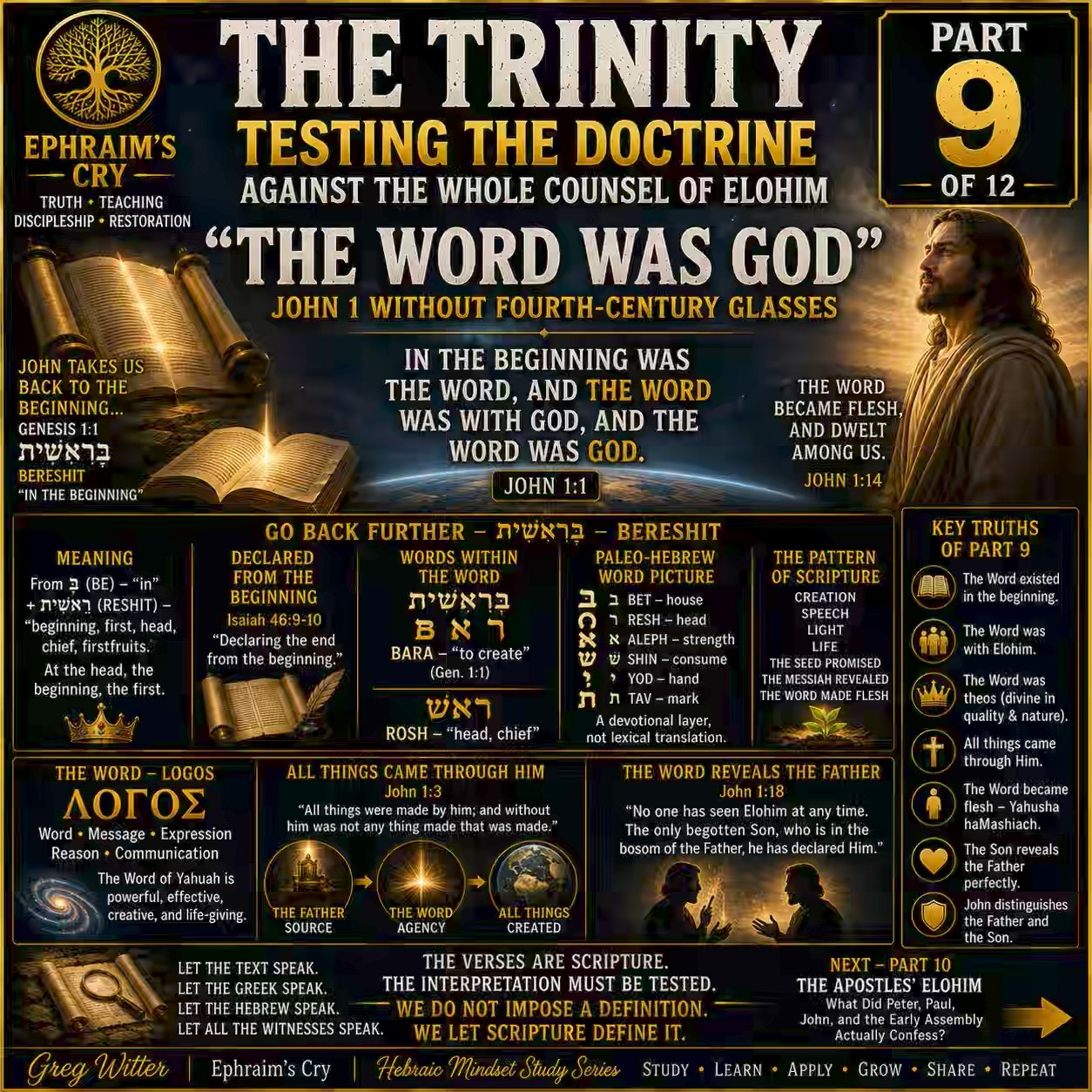
THE TRINITY — TESTING THE DOCTRINE AGAINST THE WHOLE COUNSEL OF ELOHIM
PART 9 — “THE WORD WAS GOD”
John 1 Without Fourth-Century Glasses
Greg Witter | Ephraim’s Cry
Hebraic Mindset Study Series
Study • Learn • Apply • Grow • Share ☆ Repeat
John 1:1 is probably the single most quoted verse in the entire debate over the identity of Yahusha:
“In the beginning was the Word, and the Word was with God, and the Word was God.”
For centuries, readers have been told that this verse settles the Trinity almost by itself.
But John did not write at Nicaea.
John was not explaining fourth-century terminology such as “one essence,” “three persons,” “co-equal,” or “consubstantial.”
John was a first-century Hebrew-minded disciple writing about the identity of Yahusha within the scriptural world of Genesis, Torah, the Prophets, Wisdom, the Word of Yahuah, creation, agency, revelation, and Messiah.
Therefore the question is not:
“What did later creeds teach us to see in John 1?”
The question is:
WHAT DID JOHN ACTUALLY WRITE, AND WHAT DID HIS WORDS MEAN WITHIN THE SCRIPTURAL WORLD HE INHABITED?
“IN THE BEGINNING”
John deliberately opens with:
Ἐν ἀρχῇ — en archē.
“In the beginning.”
That immediately takes the reader back to Genesis 1:1:
“In the beginning Elohim created the heavens and the earth.”
John is not beginning Yahusha’s story in Bethlehem.
He is taking us back before Abraham, before Moses, before Israel, before creation itself.
This agrees with what we established in Part 8.
Yahusha’s existence cannot responsibly be reduced to beginning at his human birth.
John places the Word at THE BEGINNING.
GO BACK FURTHER — בְּרֵאשִׁית — BERESHIT
John begins:
Ἐν ἀρχῇ — En archē.
“In the beginning.”
But John is deliberately reaching backward to the opening words of Torah:
בְּרֵאשִׁית בָּרָא אֱלֹהִים
Bereshit bara Elohim.
“In the beginning Elohim created…”
Before we move forward into Logos, we need to go backward into BERESHIT, because John’s opening declaration is anchored in Genesis before it is expressed in Greek.
The Hebrew בְּרֵאשִׁית — bereshit — is built from the preposition בְּ — be, meaning “in,” “at,” or “with,” joined to רֵאשִׁית — reshit, meaning “beginning,” “first,” “firstfruits,” “chief,” or the commencement of something.
Reshit itself is related to רֹאשׁ — rosh:
HEAD.
FIRST.
CHIEF.
BEGINNING.
So BERESHIT is not merely a timestamp.
It places us at THE HEAD, THE FIRST, THE BEGINNING OF THE ORDERED WORK OF CREATION.
And this becomes enormously important when John deliberately begins his Gospel with the equivalent expression:
“IN THE BEGINNING.”
John is telling his Hebrew-minded reader:
GO BACK TO GENESIS.
Go back before Abraham.
Before Sinai.
Before Israel.
Before flesh.
Before the created order.
Go back to BERESHIT.
And there we encounter Elohim speaking.
“DECLARED FROM THE BEGINNING”
This pattern extends far beyond Genesis.
Isaiah 46:9–10 records Yahuah declaring:
“I am El, and there is none else; I am Elohim, and there is none like me, DECLARING THE END FROM THE BEGINNING, and from ancient times the things that are not yet done.”
Yahuah establishes His purposes from the beginning.
What unfolds later is not an improvised rescue operation.
The Seed.
The Messiah.
The Kingdom.
Redemption.
Restoration.
All are rooted in what Yahuah purposed from the beginning.
That gives John’s opening enormous theological weight:
“In the beginning was the Word.”
John is not introducing a new Elohim.
He is revealing the One through whom the purpose of the ONE ELOHIM was expressed and ultimately manifested in flesh.
BERESHIT AND THE WORDS WITHIN THE LETTER SEQUENCE
There are also striking letter sequences inside בְּרֵאשִׁית that are worth noticing, but we must handle them honestly.
The opening letters are:
ברא — B-R-A.
Those are also the consonants of the Hebrew root ברא — bara, “to create,” the very verb immediately following bereshit in Genesis 1:1:
בְּרֵאשִׁית בָּרָא אֱלֹהִים
BERESHIT BARA ELOHIM.
“In the beginning ELOHIM CREATED.”
We should not claim that bara is grammatically “encoded” inside bereshit as a separate word. That would go beyond normal Hebrew morphology.
But the visual relationship is nevertheless striking:
BERESHIT begins with the same three consonants that immediately appear as BARA—CREATED.
Then within bereshit we also see the consonants:
ראש — R-O-SH / ROSH.
HEAD.
CHIEF.
BEGINNING.
That relationship is linguistically genuine because reshit belongs to the same word family as rosh.
There is another popular observation involving:
בר — BAR.
In Aramaic, bar means “son.”
That observation appears frequently in teachings claiming that “Son” is hidden inside bereshit.
But we need to be precise: bar is Aramaic for son; the ordinary Hebrew word for son is בֵּן — ben.
Therefore I would NOT teach that Hebrew grammar proves “Son” is encoded inside bereshit.
Our standard is too high for that.
Yahusha does not need questionable wordplay to establish his identity.
John gives us plenty of explicit evidence.
THE PALEO-HEBREW WORD-PICTURE LAYER
Now we can look at the older pictographic associations traditionally connected with the consonants:
ב — BET — house, tent, household.
ר — RESH — head, chief, first.
א — ALEPH — ox, strength, leader.
ש — SHIN — teeth, consume, press, destroy.
י — YOD — hand, work, deed.
ת — TAV — mark, sign, covenant marker.
Taken devotionally as a pictographic progression, these associations create a striking meditation:
HOUSE.
HEAD.
STRENGTH.
CONSUMING / COMPLETING.
HAND.
MARK / COVENANT.
And when read through the complete biblical revelation, those images naturally cause us to think about Yahuah’s household, His appointed Head, His strength manifested through His work, covenant, sacrifice, and ultimately Messiah.
But here we must draw an important boundary.
PALEO-HEBREW LETTER PICTURES ARE NOT A SUBSTITUTE FOR HEBREW GRAMMAR, LEXICON, OR CONTEXT.
Ancient alphabetic letters developed historically from pictographic forms, but biblical Hebrew words were not constructed as sentences by adding the meanings of individual letter pictures together.
Therefore we should not say:
“Bereshit literally translates as ‘the Son will be destroyed by His own hand on a stake.’”
IT DOES NOT.
That may be used as a later devotional illustration by arranging proposed pictographic meanings, but it is not the lexical translation of בְּרֵאשִׁית.
That distinction protects the truth instead of weakening it.
We do not need to manufacture prophecy from pictographs.
THE PROPHECY IS ALREADY IN THE TEXT.
THE REAL PROPHETIC POWER OF “BERESHIT”
The real power is considerably stronger.
From BERESHIT forward, Scripture begins revealing a unified story.
In the beginning:
YAHUAH CREATES.
YAHUAH SPEAKS.
LIGHT ENTERS DARKNESS.
LIFE APPEARS.
HUMANITY IS MADE IN HIS IMAGE.
SIN ENTERS.
THE SEED IS PROMISED.
Genesis 3:15 already announces conflict between the serpent and the Seed.
The rest of Scripture progressively identifies that promised Seed.
Abraham receives the promise.
Judah receives the scepter.
David receives the Kingdom promise.
The Prophets announce the coming Servant, Son, King, and Messiah.
Then John deliberately returns us to the first words of Torah:
“IN THE BEGINNING…”
And declares:
“In the beginning was THE WORD.”
The prophetic story did not begin in Matthew.
It did not begin in Bethlehem.
It did not begin with Rome.
It did not begin with Christianity.
IT BEGAN IN BERESHIT.
THE WORD WAS THERE AT BERESHIT
John 1:1–3 therefore becomes even stronger when placed against Genesis:
Genesis:
BERESHIT.
ELOHIM.
SPEECH.
CREATION.
LIGHT.
LIFE.
John:
IN THE BEGINNING.
ELOHIM.
THE WORD.
CREATION THROUGH THE WORD.
LIFE.
LIGHT.
That parallel is deliberate.
Genesis 1 says:
“Elohim SAID…”
John says:
“In the beginning was THE WORD.”
Genesis says:
“Let there be LIGHT.”
John says:
“In him was LIFE; and the life was THE LIGHT of men.”
Genesis describes the first creation.
John introduces the ONE THROUGH WHOM YAHUAH BRINGS NEW CREATION.
This is not fourth-century Greek philosophy being imposed upon Genesis.
This is a Hebrew disciple intentionally reopening Torah and telling us:
THE STORY OF YAHUSHA BELONGS TO THE STORY THAT BEGAN AT BERESHIT.
FROM BERESHIT TO THE WORD MADE FLESH
This gives us the progression:
BERESHIT — IN THE BEGINNING.
DABAR — YAHUAH’S WORD.
LOGOS — THE WORD.
CREATION THROUGH THE WORD.
THE WORD WITH ELOHIM.
THE WORD BEARING THEOS-QUALITY.
THE WORD ENTERING THE WORLD.
THE WORD BECOMING FLESH.
THE SON REVEALING THE FATHER.
John is not severing Yahusha from Israel’s Scriptures.
He is doing exactly the opposite.
HE IS ROOTING YAHUSHA IN BERESHIT.
And that is why we must not begin with Nicaea to understand John 1.
We begin with:
בְּרֵאשִׁית.
BERESHIT.
THE BEGINNING.
Then Torah.
Then Prophets.
Then Writings.
Then John.
Only after allowing that entire scriptural foundation to speak are we prepared to discuss what later theologians concluded about it.
Because the declaration begins long before the creeds:
IN THE BEGINNING.
And from the beginning Yahuah was already revealing the pattern that would ultimately reach its fullness when:
“THE WORD BECAME FLESH, AND DWELT AMONG US.”
THE WORD — LOGOS
John writes:
“In the beginning was ὁ λόγος — ho logos — THE WORD.”
Logos can mean word, message, expression, reason, statement, or communication depending upon context.
But John did not invent the idea of Elohim’s Word.
The Hebrew Scriptures are saturated with it.
Genesis 1 repeatedly says:
“And Elohim SAID…”
Creation follows Yahuah’s spoken command.
Psalm 33:6 declares:
“By the WORD OF YAHUAH were the heavens made.”
Psalm 107:20:
“He SENT HIS WORD, and healed them.”
Isaiah 55:11 says Yahuah’s word goes forth from His mouth and accomplishes what He purposes.
Throughout the Prophets we repeatedly encounter:
“The WORD OF YAHUAH came unto…”
John therefore begins within an established biblical category:
YAHUAH CREATES, REVEALS, COMMANDS, JUDGES, SAVES, AND ACCOMPLISHES HIS PURPOSE THROUGH HIS WORD.
THE HEBREW DABAR
The Hebrew word דָּבָר — dabar — can mean word, speech, matter, thing, or event.
That is important because Hebrew thought does not separate “word” from action as sharply as modern Western thought often does.
When Yahuah speaks, His word accomplishes.
His word is effective.
His word creates reality.
Isaiah 55:11 says His word:
“shall not return unto me void, but it shall accomplish that which I please.”
Therefore when John speaks of the Logos, we should hear the echoes of Yahuah’s powerful, effective, creative Word.
“THE WORD WAS WITH GOD”
John continues:
καὶ ὁ λόγος ἦν πρὸς τὸν θεόν
kai ho logos ēn pros ton theon.
“And the Word was WITH God.”
The phrase πρὸς τὸν θεόν — pros ton theon — communicates relationship and orientation.
Whatever else John means, he immediately establishes distinction.
THE WORD WAS WITH ELOHIM.
The Word is not presented simply as another name for the Father in this clause.
Someone is WITH someone.
This distinction continues throughout John’s Gospel.
The Father sends.
The Son is sent.
The Father loves the Son.
The Son loves the Father.
The Father gives.
The Son receives.
The Son returns to the Father.
The Son has glory WITH the Father before the world existed.
John 17:5:
“Glorify thou me with thine own self with the glory which I had WITH THEE before the world was.”
That fits John 1 perfectly.
RELATIONSHIP.
DISTINCTION.
PREEXISTENCE.
THEN COMES THE CONTROVERSIAL CLAUSE
καὶ θεὸς ἦν ὁ λόγος
kai theos ēn ho logos.
Traditionally:
“And the Word was God.”
This clause has generated enormous theological debate.
But before interpreting it, we need to understand the Greek construction.
The subject is:
ὁ λόγος — THE WORD.
The predicate is:
θεός — THEOS.
John places theos before the verb:
θεὸς ἦν ὁ λόγος.
Theos here does not carry the article.
John did NOT write:
ὁ θεὸς ἦν ὁ λόγος
ho theos ēn ho logos.
That distinction matters.
THE ABSENCE OF THE ARTICLE DOES NOT MEAN “A GOD”
We need to correct a common mistake from the other direction.
Because theos lacks the article in this clause, some argue John must mean:
“The Word was A god.”
Greek does not work that mechanically.
Ancient Greek does not have an indefinite article equivalent to English “a.”
An anarthrous noun—one without the article—may be definite, indefinite, or qualitative depending upon grammar and context.
Therefore:
NO ARTICLE ≠ AUTOMATICALLY “A GOD.”
That translation cannot simply be demanded from the absence of the article.
BUT JOHN ALSO DOES NOT IDENTIFY THE WORD AS THE FATHER
The opposite theological mistake must also be rejected.
The previous clause has already said:
“The Word was WITH ton theon.”
Then John says:
“theos was the Word.”
If John had written the Word simply WAS ho theos in an interchangeable identity sense, he would create an immediate problem with the distinction he had just established.
John appears to be doing something more precise.
He distinguishes WHO the Word is from the Father while saying something extraordinary about WHAT the Word is or the quality/nature associated with the Word.
This is why many Greek scholars describe the predicate theos here as carrying a strong QUALITATIVE force.
John is not merely saying the Word was “divine” in the weak sense of godlike.
Nor is he saying the Word and the Father are the same person.
He attributes theos-quality to the Logos while maintaining the Logos’ distinction from “the God” with whom he was.
That is considerably more nuanced than either slogan:
“Jesus is the Father.”
or:
“Jesus was merely a lesser god.”
JOHN 1:2 REPEATS THE DISTINCTION
John immediately says:
“The same was in the beginning WITH GOD.”
Again:
WITH.
Why repeat it?
Because relationship matters.
The Word exists in the beginning.
The Word is with Elohim.
The Word bears theos-language.
John refuses both separation and collapse.
That is the pattern we have seen throughout this series.
THROUGH THE WORD ALL THINGS CAME TO BE
John 1:3 declares:
“All things were made BY HIM; and without him was not any thing made that was made.”
The Greek speaks of all things coming into existence δι’ αὐτοῦ — di’ autou — THROUGH HIM.
This parallels Paul’s language in 1 Corinthians 8:6:
“One God, THE FATHER, OF WHOM are all things… and one Lord Jesus Christ, BY WHOM are all things.”
Again:
THE FATHER — SOURCE.
THE SON/WORD — AGENCY.
That does not reduce Yahusha to an ordinary messenger.
Creation itself is said to come THROUGH him.
That is extraordinary.
But “through” language simultaneously preserves relationship and agency.
PROVERBS 8 AND THE WISDOM BACKGROUND
John’s Jewish audience also lived within a scriptural wisdom tradition.
Proverbs 8 poetically personifies Wisdom as present with Yahuah in connection with creation.
Wisdom calls.
Wisdom speaks.
Wisdom stands beside Yahuah in the creative ordering of the world.
Later Jewish wisdom literature developed these themes further.
We should be cautious about claiming John merely copied Jewish Wisdom theology.
He did not.
But the conceptual world matters.
WORD.
WISDOM.
CREATION.
REVELATION.
LIGHT.
LIFE.
John draws together themes already deeply embedded in Israel’s Scriptures.
THE WORD CONTAINS LIFE
John 1:4:
“In him was life; and the life was the light of men.”
Again, this is not ordinary prophetic language.
John associates the Logos with:
CREATION.
LIFE.
LIGHT.
Then verse 5:
“The light shineth in darkness.”
This immediately recalls Genesis.
Darkness.
Light.
Creation.
The beginning.
John is constructing a creation/new-creation framework around Yahusha.
THE WORD ENTERS THE WORLD
John 1:9 describes the true Light coming into the world.
Verse 10 says:
“He was in the world, and the world was made by him, and the world knew him not.”
Again:
The one entering the world is connected with the world’s creation.
That alone destroys any theology reducing Yahusha to merely an ordinary human prophet whose existence began in Mary’s womb.
John will not permit that conclusion.
“THE WORD BECAME FLESH”
Then John 1:14 gives the decisive movement:
“And THE WORD WAS MADE FLESH, and dwelt among us.”
Greek:
καὶ ὁ λόγος σὰρξ ἐγένετο
kai ho logos sarx egeneto.
The Logos BECAME flesh.
John does not say merely:
“A human being received God’s word.”
He says:
THE WORD BECAME FLESH.
This is incarnation language in the broad biblical sense: the preexistent Logos enters genuine human existence.
John then says:
“We beheld HIS GLORY.”
And identifies that glory in relation to:
“the uniquely begotten from the Father.”
Again:
WORD.
FLESH.
SON.
FATHER.
GLORY.
DISTINCTION.
YAHUSHA IS THE UNIQUE REVELATION OF THE FATHER
John 1:18 is textually complex in its manuscript tradition, but its central point is unmistakable.
No one has seen Elohim in the ultimate sense.
The unique Son, who is in the bosom of the Father, makes Him known.
The Greek verb ἐξηγήσατο — exēgēsato — carries the idea of explaining, making known, declaring.
This is where we get the concept behind “exegesis.”
Yahusha EXEGETES THE FATHER.
He makes the invisible Elohim known.
John 14:9 later expresses the same reality:
“He that hath seen me hath seen the Father.”
Why?
Because Yahusha perfectly reveals Him.
THE IMAGE AND THE WORD FIT TOGETHER
Paul calls Yahusha:
“The image of the invisible God” (Colossians 1:15).
Hebrews calls him:
“The brightness of his glory, and the express image of his substance” (Hebrews 1:3).
John calls him:
THE WORD MADE FLESH.
These are complementary images.
THE WORD expresses.
THE IMAGE reveals.
THE SON represents.
THE MESSIAH executes.
Yahusha is Yahuah’s ultimate self-revelation to humanity.
That is far stronger than calling him merely another prophet.
DOES “THE WORD WAS GOD” MEAN THE WORD WAS THE FATHER?
NO.
The text itself prevents that.
“The Word was WITH God.”
John 1:18 distinguishes Father and Son.
John 3 distinguishes Sender and Sent One.
John 5 distinguishes Father and Son.
John 8 distinguishes Father and Son.
John 10 distinguishes Father and Son.
John 14 distinguishes Father and Son.
John 17 distinguishes Father and Son repeatedly.
John 20:17 records the resurrected Yahusha saying:
“MY FATHER… MY GOD.”
Therefore whatever John means by “the Word was theos,” he does not mean:
“Yahusha IS the Father.”
That conclusion contradicts the Gospel’s entire relational structure.
DOES JOHN 1:1 PROVE THREE PERSONS?
NO.
John 1:1 mentions:
THE WORD.
AND:
THEOS.
The Ruach ha’Qodesh is not part of the statement.
Therefore John 1:1 cannot by itself establish the complete doctrine of:
THREE PERSONS.
ONE ESSENCE.
CO-EQUALITY.
CO-ETERNITY.
CONSUBSTANTIALITY.
John 1:1 contributes powerfully to the identity of Yahusha.
But it does not contain the fourth-century Trinitarian formula.
That distinction matters.
WHAT DOES “THEOS” MEAN?
The Greek word θεός — theos — is commonly translated “God,” but biblical usage must be interpreted contextually.
The Septuagint can use theos for the Hebrew אֱלֹהִים — elohim.
And elohim is not exclusively applied to Yahuah in every grammatical occurrence.
Moses can function as elohim to Pharaoh.
Judges or heavenly beings can receive elohim-language depending upon the passage.
Psalm 82 uses elohim-language.
Therefore theos is not a magic lexical word meaning:
“the one identical person Yahuah the Father.”
Context determines referent and force.
This does not weaken John 1:1.
It simply means lexical shortcuts cannot replace exegesis.
JOHN’S MONOTHEISM DOES NOT DISAPPEAR
John was not abandoning Israel’s confession concerning Yahuah.
Yahusha himself affirms the Shema.
And John 17:3 records Yahusha praying to the Father:
“That they might know THEE THE ONLY TRUE GOD, and Jesus Christ, whom thou hast sent.”
Those words are in the SAME Gospel as John 1:1.
Therefore our interpretation of John 1 must accommodate John 17.
Not erase it.
John says:
THE WORD WAS THEOS.
Yahusha says:
THE FATHER IS THE ONLY TRUE GOD.
Yahusha is:
THE ONE THE FATHER SENT.
A responsible theology must allow ALL THREE statements to stand together.
JOHN 20:28 MUST ALSO STAND
Thomas later says to Yahusha:
“My Lord and my God.”
Again, we do not run from that.
But only eleven verses earlier Yahusha speaks of:
“MY GOD.”
John is deliberately comfortable using exalted theos-language concerning Yahusha while still distinguishing Yahusha from the Father whom Yahusha identifies as his Elohim.
That should warn us against oversimplification.
THE HEBRAIC PRINCIPLE OF AGENCY REMAINS RELEVANT
Part 4 established that Yahuah’s authorized representative may carry His name, words, authority, and works.
Yahusha is not merely an ordinary shaliach.
He is uniquely the preexistent Son and Word.
But agency helps explain why Yahusha can reveal Yahuah so perfectly without being the Father Himself.
Yahusha says:
“My doctrine is not mine, but his that sent me.”
“The words that I speak… I speak not of myself.”
“The Father that dwelleth in me, he doeth the works.”
“He that hath seen me hath seen the Father.”
This is ultimate representation.
“WITHOUT FOURTH-CENTURY GLASSES” DOES NOT MEAN IGNORING HISTORY
We are not claiming early believers had no theological reflection concerning Yahusha.
They clearly did.
Nor are we saying every conclusion reached at Nicaea was invented out of thin air.
The historical development was far more complex than that.
Part 11 will examine that carefully.
But John 1 must first be interpreted in JOHN’S WORLD before later terminology is used to systematize it.
Otherwise we commit anachronism:
We read a later doctrinal formula backward into an earlier text and then announce that the earlier author explicitly taught the later formula.
That is methodologically backward.
WHAT JOHN 1 ACTUALLY ESTABLISHES
Let us state the evidence strongly.
THE WORD EXISTED IN THE BEGINNING.
THE WORD WAS WITH ELOHIM.
THE WORD BEARS THEOS-LANGUAGE.
ALL THINGS CAME INTO EXISTENCE THROUGH THE WORD.
LIFE WAS IN HIM.
THE WORD ENTERED THE WORLD.
THE WORD BECAME FLESH.
THE WORD REVEALS THE FATHER.
YAHUSHA’S EXISTENCE DID NOT BEGIN IN BETHLEHEM.
YAHUSHA IS NOT MERELY AN ORDINARY PROPHET.
YAHUSHA UNIQUELY REVEALS THE INVISIBLE ELOHIM.
Those are enormous claims.
WE DO NOT DIMINISH THEM.
BUT JOHN ALSO ESTABLISHES DISTINCTION
THE WORD WAS WITH ELOHIM.
THE SON COMES FROM THE FATHER.
THE SON IS SENT BY THE FATHER.
THE SON RECEIVES FROM THE FATHER.
THE SON PRAYS TO THE FATHER.
THE SON RETURNS TO THE FATHER.
THE SON CALLS THE FATHER “MY GOD.”
THE FATHER IS IDENTIFIED AS “THE ONLY TRUE GOD.”
Therefore John does not collapse Father and Son.
Neither should we.
THE TWO FALSE EXTREMES
One extreme says:
“John 1:1 proves Yahusha is literally the same person as Yahuah the Father.”
FALSE.
The Gospel repeatedly distinguishes them.
The opposite extreme says:
“John 1:1 merely calls Yahusha a created lesser god or ordinary man.”
THAT ALSO FAILS.
John places the Logos in the beginning, with Elohim, involved in creation, possessing life, becoming flesh, and uniquely revealing the Father.
Neither simplistic extreme survives the text.
THE WATCHMAN’S WARNING
Never allow an English translation to become more authoritative than the Greek beneath it.
And never allow Greek grammar to become a weapon for forcing a predetermined theology either.
“The Word was God” is Scripture.
“Therefore the Word and Father are the same person” is interpretation.
“Therefore the Word is merely a lesser created god” is interpretation.
“Therefore this single clause proves three co-equal persons in one essence” is interpretation.
THE INTERPRETATION MUST BE TESTED.
John did not invite us to choose between church tradition and reaction against church tradition.
He invited us to behold the Word made flesh.
THE FOUNDATION OF PART 9
John’s testimony is profound:
IN THE BEGINNING WAS THE WORD.
THE WORD WAS WITH ELOHIM.
THE WORD WAS THEOS.
ALL THINGS CAME THROUGH HIM.
THE WORD BECAME FLESH.
THE SON REVEALED THE FATHER.
That gives Yahusha extraordinary identity, preexistence, glory, and function.
But the same John preserves distinction from beginning to end.
YAHUSHA IS NOT THE FATHER.
HE IS THE WORD WHO WAS WITH THE FATHER.
THE SON SENT FROM THE FATHER.
THE IMAGE REVEALING THE FATHER.
THE MESSIAH WHO OBEYS THE FATHER.
THE KING EXALTED BY THE FATHER.
THE ONE WHO RETURNS TO THE FATHER.
And according to John’s own stated purpose:
“These are written, that ye might believe that Jesus is THE CHRIST, THE SON OF GOD.”
Do not make Yahusha less than John reveals.
But do not make John say what John never wrote.
LET THE TEXT SPEAK.
LET THE GREEK SPEAK.
LET THE HEBRAIC SCRIPTURAL WORLD SPEAK.
LET JOHN’S ENTIRE GOSPEL SPEAK.
Because now we move from John’s testimony to the confession of the broader Apostolic Witness.
What did Peter actually preach?
What did Paul actually confess?
How did John describe Father and Son?
What did the earliest apostolic proclamation identify as the one Elohim?
NEXT — PART 10
THE APOSTLES’ ELOHIM
What Did Peter, Paul, John, and the Early Assembly Actually Confess?
#GregWitter, #EphraimsCry, #EphraimsCryAcademy, #HebraicMindsetStudySeries, #TheTrinitySeries,
#TestingTheTrinity, #HebraicMindset, #HebraicBibleStudy, #BibleStudy, #BibleTeaching, #ScriptureStudy,
#StudentsOfScripture, #DisciplesOfYahusha, #TorahObservant, #RemnantOfIsrael, #WholeCounselOfElohim,
#FourWitnesses, #TheWordWasGod, #John1, #Logos, #DabarYahuah, #WordMadeFlesh, #Yahuah, #Yahusha,
#SonOfElohim, #PreexistentSon, #FatherAndSon, #TestAllThings, #TruthOverTradition, #ReturnToScripture,
#ScriptureInterpretsScripture

One Response
Good evening, Greg: I am at Chapter 9 going into 10. Posting each one as I go. No one is responding or commenting on them, no clue as to why not.
I have been asked a question I have no answer for – WHERE DID YAHUAH come from?
I’ve wondered this myself! Blessings