
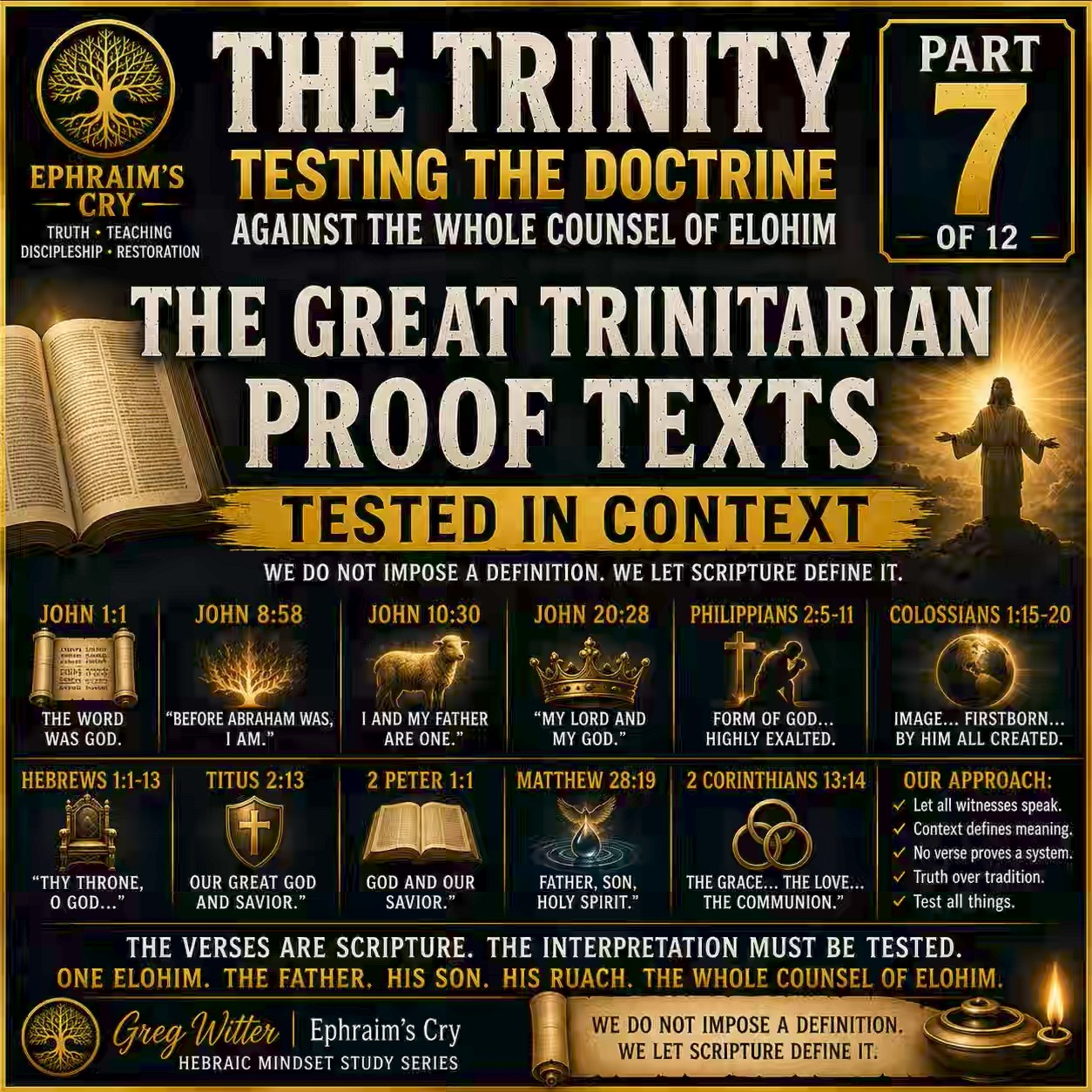
THE TRINITY — TESTING THE DOCTRINE AGAINST THE WHOLE COUNSEL OF ELOHIM
PART 7 — THE GREAT TRINITARIAN PROOF TEXTS
Tested in Context
Greg Witter | Ephraim’s Cry
Hebraic Mindset Study Series
Study • Learn • Apply • Grow • Share ☆ Repeat
For six teachings we have deliberately refused to begin with a denominational conclusion. We established Yahuah as the one Elohim—the Father. We distinguished the Father from His Son without diminishing Yahusha. We examined Yahusha as Son, Messiah, Word, Image, King, High Priest, Mediator, and Judge. We established the Hebraic principle of agency. We examined the Ruach ha’Qodesh from Scripture. And we demonstrated that biblical oneness does not automatically mean identity of person or philosophical sameness of essence.
Now we come directly to the passages most often presented as proof of the Trinity.
We will not avoid them.
We will not weaken them.
But neither will we permit conclusions to be inserted into them and then called Scripture.
THE VERSES ARE SCRIPTURE.
THE INTERPRETATION OF THOSE VERSES MUST BE TESTED.
JOHN 1:1 — “THE WORD WAS GOD”
“In the beginning was the Word, and the Word was with God, and the Word was God.”
This is unquestionably one of the strongest texts in the discussion. But notice what the verse itself establishes before theology begins explaining it.
“The Word was WITH God.”
Greek: πρὸς τὸν θεόν — pros ton theon.
Relationship and distinction are already present. The Word is “with” Elohim.
Then John says:
“καὶ θεὸς ἦν ὁ λόγος” — kai theos ēn ho logos.
“And the Word was theos.”
This is significant language and must not be weakened. But John does not say, “The Word was the Father.” In fact, the preceding clause distinguishes the Word from the One with whom the Word was.
John 1:14 then says:
“The Word was made flesh.”
And John 1:18 distinguishes the Son from the Father while presenting him as the unique revealer of the Father.
John 1 therefore gives us something far richer than the slogan “Jesus is God, therefore Trinity.”
WORD.
ELOHIM.
RELATIONSHIP.
DISTINCTION.
INCARNATION.
REVELATION.
We will devote Part 9 entirely to John 1 because one verse should not be forced to carry an entire theological system without examining its grammar, Jewish background, Logos/Wisdom concepts, and John’s own purpose.
JOHN 8:58 — “BEFORE ABRAHAM WAS, I AM”
Yahusha says:
“Before Abraham was, I am.”
Greek:
πρὶν Ἀβραὰμ γενέσθαι ἐγώ εἰμι.
Prin Abraam genesthai, egō eimi.
This passage clearly presents a profound claim concerning Yahusha’s relationship to Abraham and preexistence.
Do not diminish it.
But the common argument immediately jumps from “egō eimi” to Exodus 3:14 and declares:
“Yahusha just pronounced the divine name and therefore declared himself Yahuah.”
That conclusion requires demonstration.
The Greek ἐγώ εἰμι — egō eimi — ordinarily means “I am” or “I am he.” The expression occurs in contexts where nobody is claiming to be Yahuah.
Even the man healed of blindness says:
ἐγώ εἰμι — “I am he” (John 9:9).
Therefore the Greek words themselves are not a secret pronunciation of the divine name.
Does John 8:58 reveal extraordinary preexistence?
YES.
Does the phrase itself automatically prove Yahusha said, “I am Yahuah”?
NO.
Part 8 will examine this passage together with Exodus 3 in detail.
JOHN 10:30 — “I AND MY FATHER ARE ONE”
Part 6 addressed this directly.
Greek:
ἐγὼ καὶ ὁ πατὴρ ἕν ἐσμεν.
“I and the Father are one.”
The word “one”—ἕν, hen—is neuter, while “we are”—ἐσμεν, esmen—is plural.
I.
THE FATHER.
WE ARE.
ONE.
The statement simultaneously contains distinction and unity.
John 10:27–29 establishes the immediate context: Father and Son are united in preserving the sheep.
John 17 then gives the decisive parallel:
“That they all may be ONE; as thou, Father, art in me, and I in thee.”
Yahusha prays that his disciples share a comparable oneness.
Therefore John 10:30 cannot simply be translated theologically into:
“We are two persons of one divine essence.”
Yahusha never says that.
JOHN 20:28 — “MY LORD AND MY GOD”
Thomas responds to the resurrected Yahusha:
“My Lord and my God.”
Greek:
ὁ κύριός μου καὶ ὁ θεός μου.
Ho kyrios mou kai ho theos mou.
This is another powerful passage that must not be explained away.
Thomas addresses Yahusha with extremely exalted language.
But again, the question is not whether the verse exists.
The question is how John intends us to understand it within his entire Gospel.
Only verses earlier Yahusha told Mary:
“I ascend unto MY FATHER, and your Father; and to MY GOD, and your God” (John 20:17).
Therefore John’s Gospel contains BOTH statements:
Yahusha speaks of “MY GOD.”
Thomas addresses Yahusha as “MY GOD.”
A responsible theology must account for BOTH without deleting either one.
Then John tells us why he wrote:
“These are written, that ye might believe that Jesus is THE CHRIST, THE SON OF GOD” (John 20:31).
John’s stated conclusion matters.
We must not replace John’s stated purpose with a theological conclusion he did not state there.
PHILIPPIANS 2:5–11 — “FORM OF GOD”
Paul writes that Yahusha:
“Being in the form of God, thought it not robbery to be equal with God.”
This passage is frequently treated as a complete Trinitarian creed.
But keep reading.
Yahusha humbles himself.
He becomes obedient unto death.
Then:
“WHEREFORE GOD ALSO HATH HIGHLY EXALTED HIM.”
And:
“GIVEN HIM a name which is above every name.”
Who exalts Yahusha?
ELOHIM.
Who gives Yahusha the name?
ELOHIM.
And where does every knee bowing and every tongue confessing Yahusha as Lord ultimately lead?
“TO THE GLORY OF GOD THE FATHER.”
Whatever “form of God” means, the passage preserves distinction and ordered relationship throughout.
Yahusha’s extraordinary exaltation must stand.
So must the fact that THE FATHER EXALTS HIM.
COLOSSIANS 1:15–20 — IMAGE, FIRSTBORN, CREATION
Paul calls Yahusha:
“The IMAGE OF THE INVISIBLE GOD.”
“The FIRSTBORN OF EVERY CREATURE.”
Then:
“By him were all things created.”
This is enormously exalted language.
But “image” is not the same word as “the one imaged.”
An image reveals and represents.
And “firstborn” must be interpreted Hebraically. Psalm 89:27 calls David Yahuah’s “firstborn,” then explains it as being “higher than the kings of the earth.” David was not Jesse’s first biological son.
Firstborn can communicate RANK, INHERITANCE, and PREEMINENCE.
Colossians itself gives the interpretive emphasis:
“That in all things HE MIGHT HAVE THE PREEMINENCE” (Colossians 1:18).
And Colossians 1:19 says:
“It pleased THE FATHER that in him should all fulness dwell.”
Again:
THE FATHER.
THE SON.
THE FATHER’S PURPOSE ACCOMPLISHED THROUGH THE SON.
HEBREWS 1 — “THY THRONE, O GOD”
Hebrews 1 is another passage that must receive its full force.
The Son is greater than the angels.
He is the brightness of Elohim’s glory.
He is the express image of His substance.
Through him the ages were made.
And Hebrews 1:8 says concerning the Son:
“Thy throne, O God, is for ever and ever.”
Powerful language.
But read the NEXT VERSE:
“Therefore GOD, EVEN THY GOD, hath anointed thee with the oil of gladness above thy fellows” (Hebrews 1:9).
Do not stop at verse 8.
The one addressed as theos in verse 8 has an Elohim in verse 9.
Again the text refuses simplistic categories.
Exalted Sonship does not erase the Father’s supremacy.
Part 11 will return to the development of later creedal conclusions, but Hebrews itself must first be allowed to maintain its own distinctions.
TITUS 2:13 — “OUR GREAT GOD AND SAVIOR”
Titus 2:13 is often translated:
“Our great God and Savior Jesus Christ.”
There is a legitimate grammatical argument that both titles refer to Yahusha.
We should acknowledge that rather than pretending the passage cannot possibly read that way.
But even if Titus 2:13 directly calls Yahusha “our great God and Savior,” that does not independently establish:
THREE PERSONS.
CO-EQUALITY.
CO-ETERNITY.
ONE ESSENCE.
The identity and function of theos language applied to Yahusha still must be understood within Paul’s broader theology, including:
“To us there is but ONE GOD, THE FATHER” (1 Corinthians 8:6).
One verse cannot be made to erase another.
2 PETER 1:1 — “GOD AND OUR SAVIOR”
Second Peter 1:1 presents a similar grammatical question:
“the righteousness of our God and Saviour Jesus Christ.”
Again, it may grammatically identify Yahusha with both titles.
We need not fear that possibility.
The question remains:
WHAT DOES THAT ESTABLISH?
Calling Yahusha theos in a particular context does not automatically establish the complete later doctrine of the Trinity.
We must distinguish between:
WHAT A VERSE SAYS.
AND EVERYTHING A THEOLOGICAL SYSTEM CLAIMS THE VERSE PROVES.
Those are not necessarily identical.
MATTHEW 28:19 — FATHER, SON, HOLY SPIRIT
Yahusha commands:
“Baptizing them in the name of the Father, and of the Son, and of the Holy Ghost.”
Here all three appear together.
That is significant.
We should not minimize it.
But listing three does not define the metaphysical relationship between the three.
Matthew 28:19 does not say:
“The Father, Son, and Holy Spirit are three co-equal, co-eternal persons sharing one indivisible divine essence.”
Those words are not there.
And immediately before this command Yahusha says:
“ALL AUTHORITY HAS BEEN GIVEN UNTO ME.”
Again:
GIVEN.
The verse presenting Yahusha’s universal authority simultaneously tells us that authority was RECEIVED.
The Sender and Sent One remain distinguishable.
2 CORINTHIANS 13:14 — THE THREEFOLD BLESSING
Paul closes:
“The grace of the Lord Jesus Christ, and the love of God, and the communion of the Holy Ghost, be with you all.”
Again:
YAHUSHA.
ELOHIM.
RUACH.
Three are referenced.
But mentioning three together proves that three are involved.
It does not by itself define them as:
ONE ESSENCE.
THREE CO-EQUAL PERSONS.
CO-ETERNAL.
CONSUBSTANTIAL.
Those conclusions must be established elsewhere.
Association is not definition.
WHAT ABOUT “LET US MAKE MAN”?
Genesis 1:26 says:
“Let US make man in OUR image.”
This is routinely presented as the Trinity speaking internally.
But where does Genesis say the “us” means Father, Son, and Holy Spirit?
It doesn’t.
Various explanations have been offered: divine council language, heavenly court imagery, deliberative language, or plurality within Elohim.
Whatever position someone takes, the verse itself does not identify three persons.
Then Genesis 1:27 returns to singular language:
“ELOHIM created man in HIS own image.”
Therefore Genesis 1:26 cannot legitimately be presented as a straightforward explicit statement of the Trinity.
WHAT ABOUT ISAIAH 48:16?
Another increasingly common proof text is:
“And now the Lord GOD, and his Spirit, hath sent me.”
Again, we have:
SENDER.
SPIRIT.
SENT ONE.
Interesting?
Absolutely.
Worth examining?
Certainly.
An explicit statement of three co-equal persons sharing one divine essence?
NO.
The theological conclusion goes beyond the words themselves.
WHAT THE PROOF TEXTS ACTUALLY ESTABLISH
After examining these passages, we should not pretend they say nothing extraordinary about Yahusha.
They do.
YAHUSHA PREEXISTS ABRAHAM.
THE WORD EXISTS IN THE BEGINNING.
THE WORD BECOMES FLESH.
THOMAS ADDRESSES YAHUSHA WITH EXALTED THEOS LANGUAGE.
YAHUSHA EXISTS IN THE FORM OF ELOHIM.
ALL THINGS ARE CREATED THROUGH HIM.
HE IS THE IMAGE OF THE INVISIBLE ELOHIM.
HE IS HIGHLY EXALTED.
EVERY KNEE WILL BOW.
HE RECEIVES EXTRAORDINARY HONOR.
THE FATHER, SON, AND RUACH ARE REPEATEDLY ASSOCIATED.
WE WILL NOT DIMINISH ANY OF THAT.
But these same passages also establish:
THE WORD IS WITH ELOHIM.
THE FATHER SENDS THE SON.
THE FATHER GIVES AUTHORITY.
THE FATHER EXALTS YAHUSHA.
YAHUSHA HAS AN ELOHIM.
YAHUSHA CALLS THE FATHER “MY GOD.”
YAHUSHA IS THE IMAGE OF THE INVISIBLE ELOHIM.
YAHUSHA IS THE SON OF ELOHIM.
THE FATHER IS IDENTIFIED AS THE ONE ELOHIM.
THE RUACH PROCEEDS FROM THE FATHER.
Again:
LET ALL THE WITNESSES SPEAK.
THE CENTRAL PROBLEM WITH PROOF-TEXT THEOLOGY
A theological system is often built first.
Then individual verses are recruited afterward.
John 1:1 becomes “Trinity.”
John 8:58 becomes “Trinity.”
John 10:30 becomes “Trinity.”
Matthew 28:19 becomes “Trinity.”
But none of those verses contains the word Trinity.
More importantly, none individually states the later creedal formula.
That does NOT automatically make the later doctrine false.
But it means the doctrine is an INTERPRETIVE CONSTRUCTION assembled from multiple passages.
Once that is acknowledged, the construction itself becomes subject to examination.
Does it account for ALL the evidence?
Or does it privilege certain verses while explaining away others?
That is the question.
DO NOT REPLACE ONE PROOF-TEXT SYSTEM WITH ANOTHER
Anti-Trinitarians can commit exactly the same error.
“My Father is greater than I.”
“One God, the Father.”
“The head of Christ is God.”
“The Son shall be subject.”
Those verses are true.
But they cannot be used to erase:
“The Word was theos.”
“Before Abraham was, I am.”
“Glorify me with the glory I had with thee before the world was.”
“By him were all things created.”
“Every knee should bow.”
“Thy throne, O God.”
TRUTH DOES NOT NEED SELECTIVE SCRIPTURE.
If your doctrine survives only by hiding half the evidence, your doctrine is not secure.
THE WATCHMAN’S WARNING
Do not confuse confidence with proof.
Do not confuse repetition with exegesis.
Do not confuse a creed with Scripture.
And do not confuse your interpretation of a verse with the verse itself.
There is a profound difference between saying:
“Matthew 28:19 mentions Father, Son, and Ruach.”
and saying:
“Matthew 28:19 teaches three co-equal, co-eternal persons within one divine essence.”
The first statement is TEXT.
The second is INTERPRETATION.
Likewise:
“John 10:30 says Father and Son are one.”
TEXT.
“Therefore they are one metaphysical substance.”
INTERPRETATION.
Interpretation may ultimately prove correct or incorrect.
But it must be PROVED.
THE FOUNDATION OF PART 7
The great Trinitarian proof texts do not disappear under examination.
They become MORE IMPORTANT.
They reveal Yahusha as far greater than an ordinary human prophet.
They establish preexistence.
Glory.
Agency in creation.
Unique Sonship.
Exaltation.
Authority.
Representation.
Kingship.
Extraordinary honor.
And profound unity with the Father.
But they simultaneously preserve distinction between:
THE ONE WHO SENDS AND THE ONE SENT.
THE ONE WHO GIVES AND THE ONE WHO RECEIVES.
THE ONE WHO EXALTS AND THE ONE EXALTED.
THE FATHER AND HIS SON.
So we will neither run from these passages nor allow later theological language to be silently inserted into them.
THE TEXT IS THE STANDARD.
And now we take one of the most famous claims of all and examine it under the microscope:
“BEFORE ABRAHAM WAS, I AM.”
Did Yahusha actually claim the divine name of Exodus 3:14?
What does אֶהְיֶה אֲשֶׁר אֶהְיֶה mean?
What does ἐγώ εἰμι mean?
What does the Septuagint actually say in Exodus 3:14?
And what does John 8 say IN CONTEXT?
NEXT — PART 8
“BEFORE ABRAHAM WAS, I AM”
Does Yahusha Claim to Be Yahuah?
#GregWitter, #EphraimsCry, #EphraimsCryAcademy, #HebraicMindsetStudySeries, #TheTrinitySeries,
#TestingTheTrinity, #HebraicMindset, #HebraicBibleStudy, #BibleStudy, #BibleTeaching, #ScriptureStudy,
#StudentsOfScripture, #DisciplesOfYahusha, #TorahObservant, #RemnantOfIsrael, #WholeCounselOfElohim,
#FourWitnesses, #TrinitarianProofTexts, #TestedInContext, #Yahuah, #Yahusha, #FatherAndSon, #John1, #John8,
#John10, #John20, #Philippians2, #Hebrews1, #TestAllThings, #TruthOverTradition, #ReturnToScripture
