
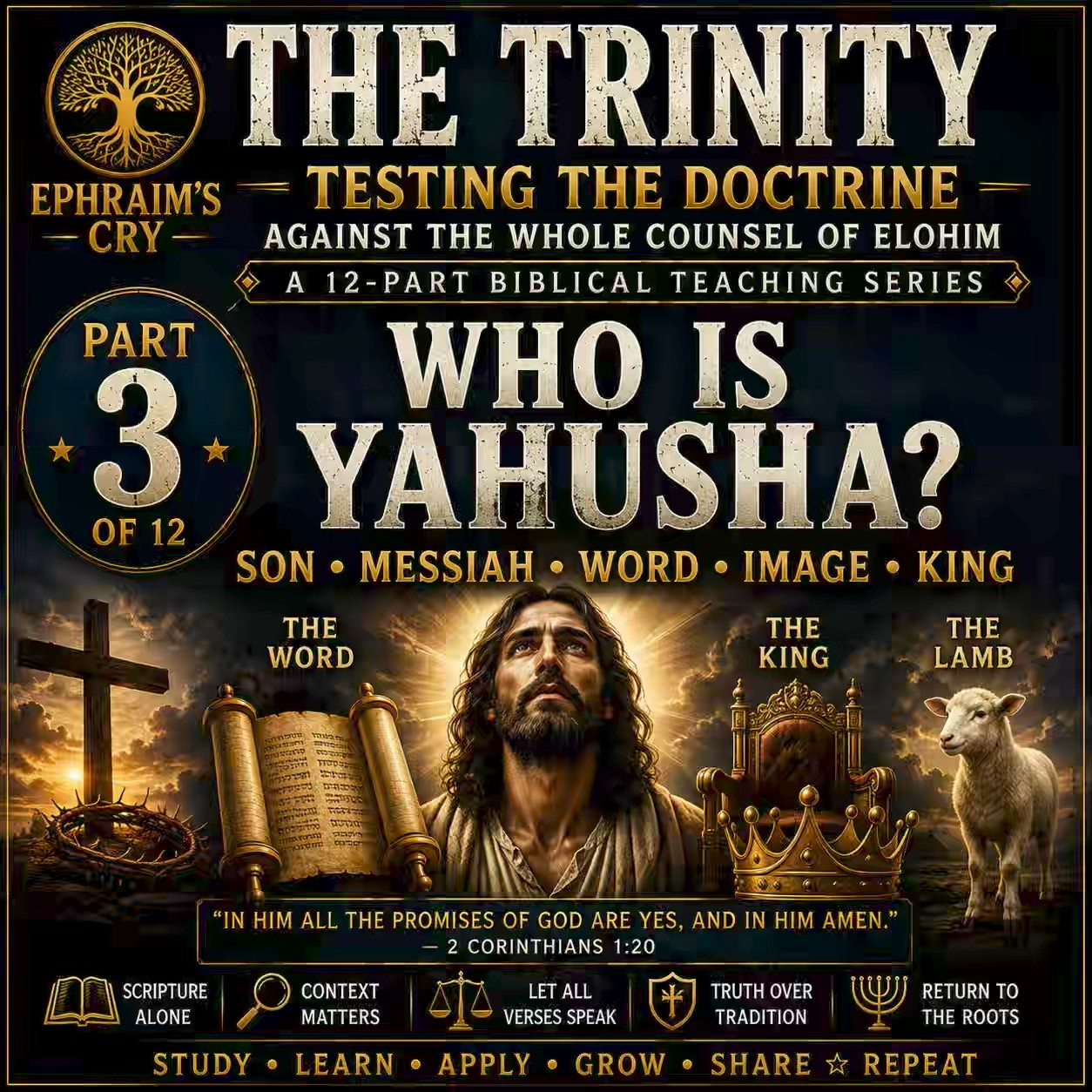
THE TRINITY — TESTING THE DOCTRINE AGAINST THE WHOLE COUNSEL OF ELOHIM
PART 3 — WHO IS YAHUSHA?
Son • Messiah • Word • Image • King
Greg Witter | Ephraim’s Cry
Hebraic Mindset Study Series
Study • Learn • Apply • Grow • Share ☆ Repeat
Parts 1 and 2 established two foundations that must remain together. Scripture identifies Yahuah as the one Elohim—the Father—and Scripture repeatedly distinguishes the Father from His Son. But now we must confront an equally important question:
WHO, THEN, IS YAHUSHA?
This is where many arguments against Trinitarian doctrine become just as unbalanced as the doctrine they are attempting to refute. Some correctly recognize the distinction between Father and Son and then go too far, reducing Yahusha to merely an ordinary man, merely another prophet, or merely a human teacher whom Elohim later elevated.
SCRIPTURE WILL NOT ALLOW THAT.
We will not dismantle one theological system by constructing another system that requires us to ignore Scripture.
Yahusha is not the Father.
But Yahusha is also unlike every ordinary prophet, priest, king, or messenger who came before him.
The whole counsel of Elohim must determine who he is.
THE SON OF ELOHIM
At Yahusha’s immersion, the voice from heaven declares:
“This is my beloved Son, in whom I am well pleased” (Matthew 3:17).
Notice again the distinction established in Part 2.
The Father SPEAKS.
The Son is PRESENT.
The Ruach descends.
The Son does not announce himself as the Father. The Father identifies him:
“MY BELOVED SON.”
Peter later confesses:
“Thou art the Messiah, THE SON OF THE LIVING ELOHIM” (Matthew 16:16).
Yahusha does not correct Peter.
He says:
“Blessed art thou, Simon Barjona: for flesh and blood hath not revealed it unto thee, but MY FATHER which is in heaven” (Matthew 16:17).
What was Peter’s revealed confession?
Not “You are the Father.”
Not “You are one-third of Elohim.”
Not “You are merely another prophet.”
“YOU ARE THE MESSIAH, THE SON OF THE LIVING ELOHIM.”
That confession must be allowed to stand.
THE PROMISED MESSIAH
Yahusha did not suddenly appear disconnected from everything Yahuah had previously revealed.
He stands at the culmination of the prophetic promises.
The Hebrew term מָשִׁיחַ — mashiach — means “anointed one.”
Kings were anointed.
Priests were anointed.
Yet Scripture anticipates a unique coming Anointed One through whom Yahuah would accomplish His Kingdom purpose.
Psalm 2 brings Sonship and kingship together:
“Yahuah hath said unto me, Thou art my Son.”
The nations become his inheritance.
Isaiah speaks of the coming ruler upon whose shoulder government rests (Isaiah 9:6–7).
Micah identifies the ruler coming from Bethlehem (Micah 5:2).
Daniel sees the Son of Man receiving dominion, glory, and a kingdom from the Ancient of Days (Daniel 7:13–14).
Yahusha is therefore not merely another teacher explaining Torah.
HE IS THE PROMISED KING.
THE SON OF MAN
Yahusha repeatedly calls himself “the Son of Man.”
That expression certainly identifies his humanity, but reducing it merely to “I am human” misses its prophetic significance.
Daniel 7:13–14 describes “one like the Son of man” approaching the Ancient of Days.
And what happens?
“There was GIVEN him dominion, and glory, and a kingdom.”
The nations serve him.
His dominion is everlasting.
His Kingdom will not be destroyed.
Yahusha deliberately adopts this title.
At his trial he tells the high priest:
“Hereafter shall ye see the Son of man sitting on the right hand of power, and coming in the clouds of heaven” (Matthew 26:64).
That is Daniel 7 language.
Yahusha is identifying himself with the promised Son of Man who receives the everlasting Kingdom.
Again, notice the distinction:
The Ancient of Days GIVES.
The Son of Man RECEIVES.
Yet what he receives is extraordinary.
THE WORD
John takes us even deeper:
“In the beginning was the Word, and the Word was with God, and the Word was God” (John 1:1).
Then:
“All things were made by him” (John 1:3).
And:
“The Word was made flesh, and dwelt among us” (John 1:14).
These verses cannot simply be brushed aside because they complicate an anti-Trinitarian argument.
Nor should they be treated as though they automatically prove every later Trinitarian formulation.
THEY MUST BE EXAMINED.
John deliberately takes us back to Genesis:
“IN THE BEGINNING.”
Yahuah speaks.
Creation occurs.
Psalm 33:6 declares:
“By the WORD OF YAHUAH were the heavens made.”
The Word is associated with Yahuah’s creative action, revelation, wisdom, and purpose.
John announces that this Word became flesh.
That is an enormous claim.
We will devote Part 9 specifically to John 1 because this passage deserves far more attention than a few theological slogans.
For now, we establish the witness:
Yahusha cannot be reduced to a man whose existence simply began in Bethlehem without confronting John’s testimony concerning the Word.
YAHUSHA SPEAKS OF PREEXISTENCE
John 6:38:
“I came down from heaven.”
John 8:42:
“I proceeded forth and came from God.”
John 17:5:
“And now, O Father, glorify thou me with thine own self with THE GLORY WHICH I HAD WITH THEE BEFORE THE WORLD WAS.”
That statement demands serious attention.
Yahusha speaks of glory he possessed WITH THE FATHER before the world existed.
Whatever conclusions we eventually reach concerning the nature of that preexistence, we cannot honestly pretend the passage is not there.
John 17 simultaneously gives us:
PREEXISTENCE.
GLORY.
RELATIONSHIP.
DISTINCTION.
The Son had glory WITH the Father.
Again, Scripture refuses simplistic categories.
THE IMAGE OF THE INVISIBLE ELOHIM
Colossians 1:15 calls Yahusha:
“The IMAGE OF THE INVISIBLE GOD.”
The Greek word is εἰκών — eikōn: image, representation, likeness.
An image reveals the one represented.
This fits Yahusha’s words:
“He that hath seen me hath seen the Father” (John 14:9).
Does that mean Yahusha is literally the Father?
No.
The same chapter repeatedly distinguishes them.
Yahusha immediately says:
“The words that I speak unto you I speak NOT OF MYSELF: but the Father that dwelleth in me, he doeth the works” (John 14:10).
Yahusha reveals the Father so perfectly that seeing the Son is seeing the Father’s character, works, authority, and purpose manifested through His appointed representative.
Hebrews 1:3 likewise describes the Son as:
“The brightness of his glory, and the express image of his person.”
That is extraordinary language.
Do not diminish it.
But notice again:
An image represents someone.
The Son perfectly reveals the Father.
THE FIRSTBORN
Colossians 1:15 calls Yahusha:
“The firstborn of every creature.”
This passage is abused from opposite directions.
Some use “firstborn” to argue Yahusha must simply be the first thing Elohim created.
Others treat “firstborn” as though it has no meaningful connection to order whatsoever.
The Hebraic concept of firstborn includes far more than biological birth order.
The firstborn carries rank, inheritance, authority, and preeminence.
Psalm 89:27 says concerning David:
“I will make him MY FIRSTBORN, HIGHER THAN THE KINGS OF THE EARTH.”
David was not Jesse’s first biological son.
“Firstborn” here describes STATUS AND PREEMINENCE.
Colossians itself explains Yahusha’s position:
“That in all things HE MIGHT HAVE THE PREEMINENCE” (Colossians 1:18).
Therefore we must allow the biblical concept to define the term rather than forcing either Trinitarian or anti-Trinitarian assumptions into it.
THROUGH HIM ALL THINGS WERE CREATED
Colossians 1:16 says:
“For BY HIM were all things created.”
John 1:3 similarly declares:
“All things were made BY HIM.”
Hebrews 1:2 says Elohim made the worlds “BY” His Son.
First Corinthians 8:6 provides an essential distinction:
“One God, THE FATHER, OF WHOM are all things… and one Lord Jesus Christ, BY WHOM are all things.”
Notice the pattern.
OF WHOM — THE FATHER.
BY WHOM — YAHUSHA.
SOURCE and AGENCY.
This distinction is foundational to understanding Yahusha’s role without either collapsing him into the Father or reducing him to an ordinary human messenger.
Part 4 will examine this Hebraic principle of agency directly.
THE APPOINTED HEIR
Hebrews 1:2 identifies Yahusha as the One whom Elohim:
“Hath APPOINTED HEIR OF ALL THINGS.”
Again, magnificent authority.
And again, authority received.
The Father APPOINTS.
The Son is APPOINTED.
The Father GIVES.
The Son INHERITS.
Sonship and inheritance belong together.
Romans 8:17 even describes believers as:
“Heirs of God, and JOINT-HEIRS WITH CHRIST.”
But Yahusha’s position remains unique.
He is the appointed heir through whom the Father’s Kingdom purpose reaches its culmination.
THE KING
Yahusha is not merely Savior in the reduced modern sense of someone who gets people into heaven.
HE IS KING.
Gabriel declares concerning Yahusha:
“Yahuah Elohim shall give unto him THE THRONE OF HIS FATHER DAVID” (Luke 1:32).
“And he shall reign over the house of Jacob for ever; and of his kingdom there shall be no end” (Luke 1:33).
Notice again:
Yahuah GIVES.
Yahusha RECEIVES.
Yahusha REIGNS.
Revelation ultimately identifies him as:
“KING OF KINGS, AND LORD OF LORDS” (Revelation 19:16).
The Gospel is inseparable from the Kingdom.
And Yahusha is the appointed King.
THE HIGH PRIEST
Yahusha is also our High Priest.
Hebrews repeatedly establishes this.
But a priest necessarily serves before another.
Hebrews 5:5 declares:
“Christ glorified not himself to be made an high priest; but HE THAT SAID UNTO HIM, Thou art my Son.”
Hebrews 7 identifies Yahusha’s priesthood according to the order of Melchizedek.
This again preserves distinction.
The Son ministers as High Priest before Elohim.
And because he lives continually, his priesthood does not pass to another.
Hebrews 7:25 says:
“He ever liveth to make intercession for them.”
Intercession itself demonstrates relationship.
Yahusha intercedes BEFORE THE FATHER.
THE MEDIATOR
First Timothy 2:5 gives an extraordinarily clear statement:
“For there is ONE GOD, and ONE MEDIATOR between God and men, the man Christ Jesus.”
ONE ELOHIM.
ONE MEDIATOR.
A mediator stands between parties.
Yahusha reconciles humanity to the Father.
Hebrews 9:15 calls him:
“The mediator of the new covenant.”
Again, this does not diminish Yahusha.
IT MAGNIFIES HIS UNIQUE ROLE.
No ordinary prophet occupies this position.
THE JUDGE
Acts 17:31 declares that Elohim:
“Hath appointed a day, in the which HE WILL JUDGE THE WORLD in righteousness BY THAT MAN WHOM HE HATH ORDAINED.”
Acts 10:42 says Yahusha was:
“ORDAINED OF GOD to be the Judge of quick and dead.”
John 5 says the Father has committed all judgment to the Son.
Therefore Yahusha will judge humanity with authority delegated by the Father.
Again:
APPOINTMENT.
AUTHORITY.
AGENCY.
EXALTATION.
EVERY KNEE WILL BOW
Philippians 2:9–11 contains one of the strongest exaltation passages in Scripture.
“God also hath HIGHLY EXALTED HIM.”
“And GIVEN HIM a name which is above every name.”
“That at the name of Jesus EVERY KNEE SHOULD BOW.”
“And that every tongue should confess that Jesus Christ is Lord.”
But notice where the passage ends:
“TO THE GLORY OF GOD THE FATHER.”
The exaltation of Yahusha ultimately glorifies THE FATHER.
This is not competition.
It is ordered unity.
DO WE WORSHIP AND HONOR YAHUSHA?
This question must not be avoided.
Matthew 14:33 records the disciples bowing before Yahusha and declaring:
“Of a truth thou art the Son of God.”
John 5:23 says all should:
“HONOUR THE SON, EVEN AS THEY HONOUR THE FATHER.”
Philippians 2 says every knee will bow and every tongue confess Yahusha as Lord.
Revelation 5 depicts extraordinary honor given to the Lamb.
We will not weaken these passages.
But neither will we use them to erase the distinction Scripture simultaneously maintains between the Lamb and “Him that sitteth upon the throne.”
Both truths must stand.
THE LAMB AND THE ONE UPON THE THRONE
Revelation gives us one of Scripture’s most powerful pictures.
Revelation 5 describes:
THE ONE SITTING UPON THE THRONE.
And:
THE LAMB.
The Lamb approaches and takes the scroll from the One sitting upon the throne.
The heavenly assembly praises the Lamb because he was slain and redeemed people by his blood.
Then blessing and honor are proclaimed:
“Unto HIM THAT SITTETH UPON THE THRONE, AND UNTO THE LAMB” (Revelation 5:13).
Two are distinguished.
Both receive extraordinary honor.
Scripture does not appear embarrassed by this.
Neither should we be.
WHAT WE MUST NOT DO
We must not begin with the Trinity and force Yahusha into it.
We must not begin with Unitarianism and force Yahusha into it.
We must not begin with Oneness and collapse Father and Son.
And we must not begin with reactionary anti-Trinitarianism and reduce Yahusha to something less than Scripture reveals.
THE TEXT SETS THE BOUNDARIES.
When Yahusha says the Father sent him:
BELIEVE HIM.
When Yahusha says he had glory with the Father before the world existed:
BELIEVE HIM.
When Scripture calls him the Son:
BELIEVE IT.
When Scripture calls him the image of the invisible Elohim:
BELIEVE IT.
When Scripture says creation came through him:
BELIEVE IT.
When Scripture says the Father gave him authority:
BELIEVE IT.
When Scripture says every knee will bow:
BELIEVE IT.
When Scripture says he ultimately subjects himself to the Father:
BELIEVE THAT TOO.
Truth does not fear all the witnesses speaking simultaneously.
THE WATCHMAN’S WARNING
There is a dangerous tendency in theological warfare to think that defeating the opponent requires minimizing the passages the opponent uses.
NO.
If your doctrine requires you to explain away Scripture, your doctrine needs correction.
Trinitarians must confront the genuine distinction, submission, receiving, sending, and Father-Son relationship throughout Scripture.
Oneness teachers must confront the same evidence.
But anti-Trinitarians must confront John 1, John 17:5, Colossians 1, Hebrews 1, Philippians 2, Revelation 5, and every other passage presenting Yahusha with extraordinary preexistence, glory, authority, and honor.
WE WILL NOT WIN AN ARGUMENT BY LOSING YAHUSHA.
We are not trying to make Yahusha smaller.
WE ARE TRYING TO SEE HIM AS SCRIPTURE REVEALS HIM.
THE FOUNDATION OF PART 3
Who is Yahusha?
HE IS THE SON OF ELOHIM.
THE PROMISED MESSIAH.
THE SON OF MAN.
THE WORD MADE FLESH.
THE IMAGE OF THE INVISIBLE ELOHIM.
THE FIRSTBORN WITH PREEMINENCE.
THE ONE THROUGH WHOM YAHUAH CREATED.
THE APPOINTED HEIR.
THE DAVIDIC KING.
THE HIGH PRIEST.
THE MEDIATOR OF THE RENEWED COVENANT.
THE APPOINTED JUDGE.
THE EXALTED LORD.
THE LAMB.
THE ONE BEFORE WHOM EVERY KNEE WILL BOW.
And yet:
HE IS NOT THE FATHER.
HE IS SENT BY THE FATHER.
HE RECEIVES FROM THE FATHER.
HE OBEYS THE FATHER.
HE REPRESENTS THE FATHER.
HE REVEALS THE FATHER.
HE IS EXALTED BY THE FATHER.
AND HIS KINGDOM ULTIMATELY GLORIFIES THE FATHER.
Do not diminish him.
Do not collapse him into the Father.
Do not redefine him according to later theological systems.
LET SCRIPTURE REVEAL HIM.
Because the next question becomes unavoidable:
How can Yahusha speak the Father’s words, perform the Father’s works, carry the Father’s authority, reveal the Father so perfectly, and even act in ways Scripture attributes to Yahuah—while still distinguishing himself from the Father who sent him?
The Hebraic Scriptures already provide the framework.
NEXT — PART 4
THE HEBRAIC PRINCIPLE OF AGENCY
The Sent One Represents the Sender
#GregWitter, #EphraimsCry, #EphraimsCryAcademy, #HebraicMindsetStudySeries, #TheTrinitySeries,
#TestingTheTrinity, #HebraicMindset, #HebraicBibleStudy, #BibleStudy, #BibleTeaching, #ScriptureStudy,
#StudentsOfScripture, #DisciplesOfYahusha, #TorahObservant, #RemnantOfIsrael, #WholeCounselOfElohim,
#FourWitnesses, #WhoIsYahusha, #Yahuah, #Yahusha, #SonOfElohim, #Messiah, #SonOfMan, #WordMadeFlesh,
#ImageOfElohim, #KingOfKings, #TruthOverTradition, #ReturnToScripture
