
HEBRAIC MINDSET STUDY SERIES
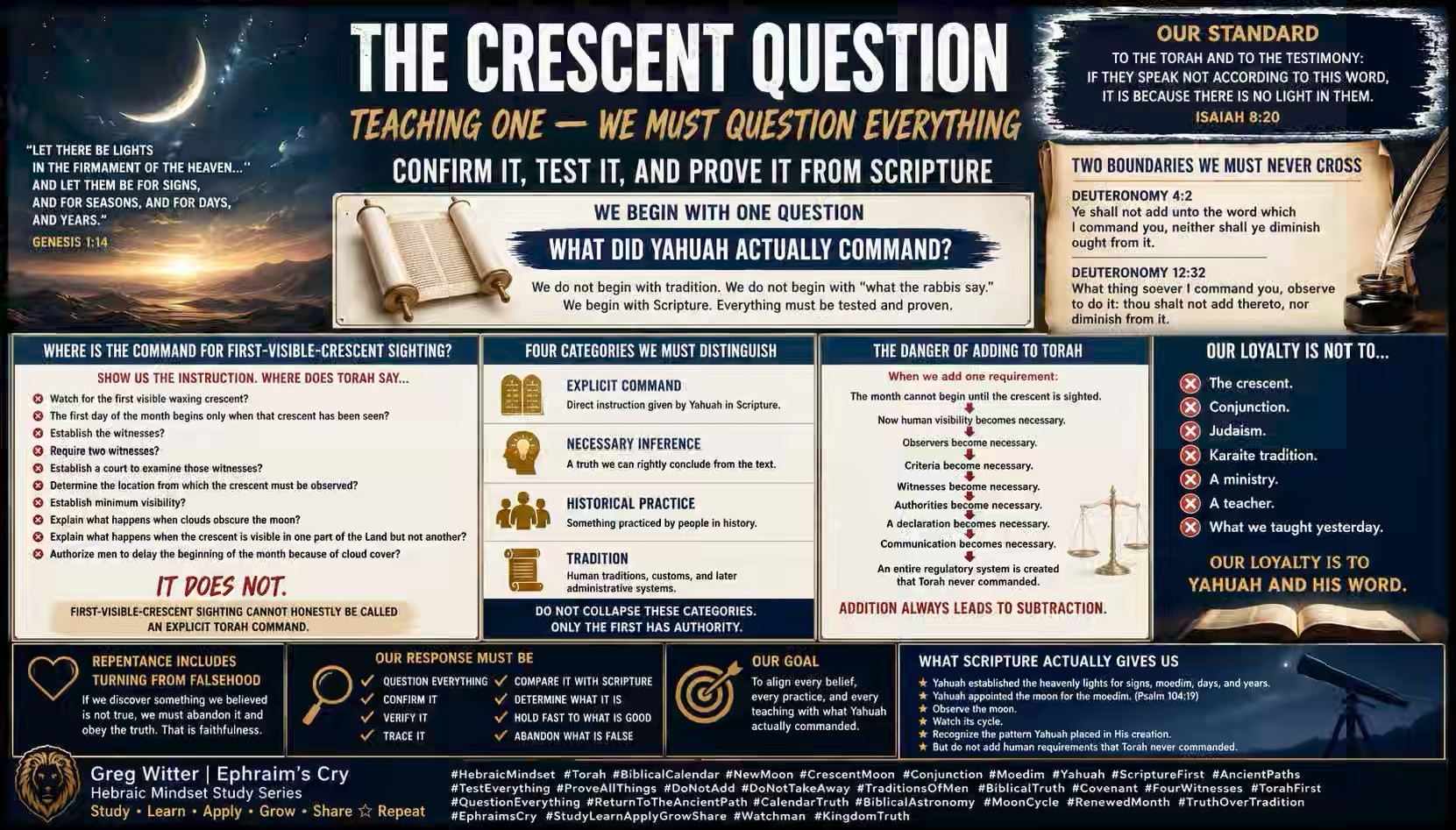
THE CRESCENT QUESTION
TEACHING ONE — WE MUST QUESTION EVERYTHING
Greg Witter | Ephraim’s Cry
Hebraic Mindset Study Series
Study • Learn • Apply • Grow • Share ☆ Repeat
Confirm It, Test It, and Prove It From Scripture
We must begin with a principle that applies far beyond the calendar discussion:
We must question everything.
That does not mean becoming cynical, suspicious of everyone, or unwilling to learn. It means refusing to surrender our responsibility to test every doctrine, every tradition, every inherited practice, and every claimed commandment against Scripture.
Paul writes:
“Prove all things; hold fast that which is good.” — 1 Thessalonians 5:21
Isaiah gives us the same standard:
“To the Torah and to the testimony: if they speak not according to this word, it is because there is no light in them.” — Isaiah 8:20
That immediately establishes our method.
We do not begin with, “What do the rabbis say?” We do not begin with, “What do the Karaites say?” We do not begin with Christianity, Judaism, Enoch, Jubilees, inherited custom, historical reconstruction, or what people have practiced for generations.
We begin with one question:
WHAT DID YAHUAH ACTUALLY COMMAND?
That question is especially important because Torah itself gives us a warning concerning additions and subtractions.
Deuteronomy 4:2 says:
“Ye shall not add unto the word which I command you, neither shall ye diminish ought from it.”
Deuteronomy 12:32 repeats:
“What thing soever I command you, observe to do it: thou shalt not add thereto, nor diminish from it.”
These are not suggestions. They are boundaries.
Whenever someone tells us, “Yahuah commands this,” we have both the right and the responsibility to ask:
Where?
Book.
Chapter.
Verse.
Instruction.
Context.
If the command exists, we submit to it. If the command does not exist, we have no authority to manufacture it and place it into Yahuah’s mouth.
That is precisely where the first-visible-crescent question must begin.
The claim commonly made is:
“The biblical month begins when the first visible waxing crescent is sighted.”
Very well.
Where is that instruction?
Where does Torah say, “Watch for the first visible waxing crescent”?
Where does Torah say, “The first day of the month begins only when that crescent has been seen”?
Where does Torah establish the witnesses?
Where does Torah require two witnesses?
Where does Torah establish a court to examine those witnesses?
Where does Torah determine the location from which the crescent must be observed?
Where does Torah establish minimum visibility?
Where does Torah explain what happens when clouds obscure the moon?
Where does Torah tell us what happens when the crescent is visible in one part of the Land but not another?
Where does Torah authorize men to delay the beginning of the month because the atmosphere prevented them from seeing the moon?
It does not.
That does not automatically prove every alternative calendar method correct. We must test those methods too. But it establishes something extremely important:
FIRST-VISIBLE-CRESCENT SIGHTING CANNOT HONESTLY BE CALLED AN EXPLICIT TORAH COMMAND.
That distinction must be maintained.
Scripture unquestionably establishes the heavenly lights.
Genesis 1:14 says:
“Let there be lights in the firmament of the heaven… and let them be for signs, and for seasons, and for days, and years.”
Psalm 104:19 says:
“He appointed the moon for seasons.”
The moon therefore has a genuine role in Yahuah’s appointed-time system.
That is not under dispute.
The question is not whether the moon matters.
The question is:
WHAT DID YAHUAH SAY ABOUT HOW THE BEGINNING OF THE MONTH IS IDENTIFIED?
Genesis 1:14 says the lights are for signs, moedim, days, and years.
It does not say:
“Human eyesight establishes the month.”
It does not say:
“The first visible crescent creates Day 1.”
It does not say:
“The month waits for witnesses.”
That distinction is foundational.
We therefore have to learn to distinguish between at least four categories when studying Scripture:
Explicit command.
Necessary inference from the text.
Historical practice.
Tradition.
Those categories cannot simply be collapsed into each other.
Something may have been practiced historically without being commanded.
Something may be useful without being Torah.
Something may be a legitimate observational tool without being legislation.
Something may even be ancient without being biblical.
That last point is critical.
Ancient does not equal true.
Ancient does not equal Torah.
Jewish does not automatically equal Torah.
Hebrew does not automatically equal Torah.
Karaite does not automatically equal Torah.
Rabbinic does not automatically equal Torah.
And something being practiced for two thousand years does not transform it into a commandment Yahuah never gave.
Once we determine that an alleged command cannot actually be found in Torah, we must ask another question:
WHERE DID THE PRACTICE COME FROM?
That is not an irrelevant historical question.
It is essential.
Where does the practice first appear?
Who practiced it?
When did it become formalized?
Were administrative rules eventually added around it?
Did surrounding cultures practice something similar?
Did Yisra’el encounter those practices during exile or foreign domination?
Did a historical practice eventually become interpreted as though Moses himself commanded it?
Those questions are not hostile.
They are responsible.
Because Torah already warned us:
Do not add.
And Yahusha later confronted this exact danger.
Mark 7 records religious leaders enforcing inherited traditions and treating those traditions with divine authority.
Yahusha says:
“Full well ye reject the commandment of Elohim, that ye may keep your own tradition.”
That is the danger.
Tradition is not automatically evil.
Communities develop procedures. Families develop customs. Governments develop administrative systems. Historical traditions may even preserve useful information.
The danger begins when we stop saying:
“This is our practice.”
and begin saying:
“Yahuah commanded this.”
Those are two completely different claims.
If someone says:
“I prefer to observe the first visible crescent as part of studying the lunar cycle,”
that is one discussion.
But if someone says:
“Yahuah requires every person to wait for the visible crescent before Day 1 can begin,”
that is no longer merely observation.
That is legislation.
And legislation requires authority.
Once an added requirement becomes authoritative, something else usually has to be adjusted to make room for it.
That is why adding so often leads to taking away.
Consider what happens when we add just one statement:
“The month cannot begin until the first crescent has been sighted.”
Now human visibility becomes necessary.
If visibility is necessary, observers become necessary.
If observers are necessary, criteria become necessary.
If criteria are necessary, somebody must judge whether the observation meets those criteria.
Now witnesses are needed.
Then authorities.
Then a declaration.
Then communication of the declaration.
Then rules for clouds.
Rules for disagreement.
Rules for distant communities.
Rules governing which location controls the month.
One apparently small addition begins creating an entire regulatory system.
And where did Moses command that system?
He didn’t.
That should make us stop.
This is how religious traditions frequently develop.
At first someone says:
“This seems useful.”
Then:
“This is how we do it.”
Then:
“This is how our fathers did it.”
Then:
“This is the correct way.”
Then:
“Everyone should do it this way.”
Finally:
“Yahuah commanded it.”
And within several generations, almost nobody remembers where the practice actually originated.
Now the tradition has inherited authority simply because it is old.
Then someone comes along and asks:
“Where is the command?”
And instead of producing Torah, people become angry because the tradition is being questioned.
That is exactly backwards.
Our traditions should always remain subject to Scripture.
Scripture must never become subject to our traditions.
And this brings us to another essential Hebraic principle:
Repentance is not only turning from immoral behavior.
Repentance also means turning from falsehood.
If I discover that something I believed for twenty years is false, what should I do?
Defend the twenty years?
Or obey the truth?
If I taught something and later discover that I cannot establish it from Scripture, what should I do?
Protect my reputation?
Or correct my teaching?
If I inherit a tradition from people I respect and then discover that the tradition cannot survive scriptural examination, what should I do?
Remain loyal to the people?
Or remain loyal to Yahuah?
Those are real tests.
There comes a point when continuing in known error becomes something different from simply having been mistaken.
Once truth is established, we have a responsibility to respond to it.
That is why we must be willing to say:
“I believed this. I practiced this. I may even have taught this. But now I cannot establish it from Scripture. Therefore I must abandon the claim.”
That is not weakness.
That is repentance.
That is growth.
That is faithfulness.
Our loyalty is not to the crescent.
Our loyalty is not to conjunction.
Our loyalty is not to Judaism.
Our loyalty is not to Karaite tradition.
Our loyalty is not to a ministry.
Our loyalty is not to a teacher.
Our loyalty is not even to what we ourselves taught yesterday.
Our loyalty is to Yahuah and His Word.
This is why I continually return to the Four Witnesses:
TORAH → PROPHETS → WRITINGS → APOSTOLIC WITNESS
Torah is the foundation.
The Prophets cannot overturn Torah.
The Writings cannot overthrow the foundation.
The Apostolic Witness cannot contradict what came before.
And extra-biblical writings certainly cannot add commandments that Torah never gives.
Everything must remain in alignment.
If a doctrine requires Torah to be supplemented before the doctrine can exist, examine it carefully.
If a doctrine requires later tradition to supply the missing instructions, examine it carefully.
If a doctrine requires assumptions to become commandments, examine it carefully.
If someone responds to “Where is the command?” by producing everything except the command, examine it very carefully.
That is the standard.
Question everything.
Not because everything is false.
But because everything must be tested.
Confirm it.
Verify it.
Trace it.
Compare it with Scripture.
Determine whether it is commandment, inference, practice, or tradition.
If it is true, hold fast to it.
If it is false, abandon it.
If it is merely tradition, call it tradition.
If it is merely a useful method, call it a method.
But never take something Yahuah did not command and announce:
“Thus saith Yahuah.”
And so the first question governing this entire study remains unchanged:
WHERE IS THE COMMAND?
If Yahuah commanded first-visible-crescent sighting, show it.
If He did not command it, then we have no authority to bind His people to it.
Before crescent.
Before conjunction.
Before astronomy.
Before history.
Before tradition.
TORAH FIRST
#HebraicMindset#Torah#BiblicalCalendar#NewMoon#CrescentMoon#Conjunction#Moedim#Yahuah#ScriptureFirst
#AncientPaths#TestEverything#ProveAllThings#DoNotAdd#DoNotTakeAway#TraditionsOfMen#BiblicalTruth#Covenan
t#FourWitnesses#TorahFirst#QuestionEverything#ReturnToTheAncientPath#CalendarTruth#BiblicalAstronomy#MoonCycle
#RenewedMonth#TruthOverTradition#EphraimsCry#StudyLearnApplyGrowShare#Watchman#KingdomTruth
