
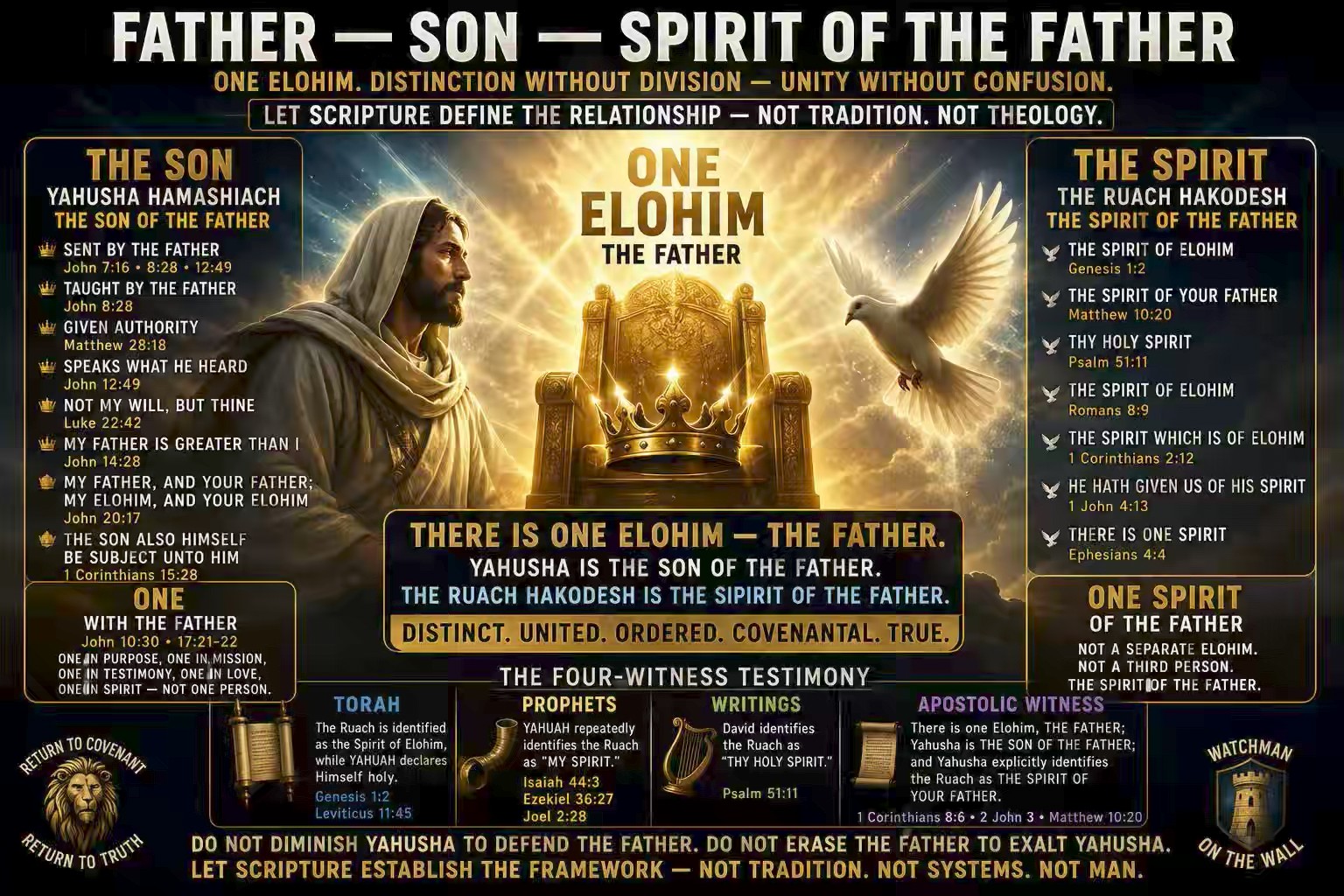
FATHER — SON — SPIRIT OF THE FATHER
Let Scripture Define the Relationship
One Elohim. One Father. His Ruach. His Son. Distinction Without Division — Unity Without Confusion.
Greg Witter | Ephraim’s Cry
Hebraic Mindset Study Series
Study • Learn • Apply • Grow • Share ☆ Repeat
There is enormous confusion concerning the Father, the Son, and the Ruach HaKodesh because people are repeatedly presented with a false choice: accept traditional Trinitarian doctrine, or accept Oneness doctrine and declare that Father, Son, and Ruach HaKodesh are merely different manifestations of one person. Scripture requires neither theological system. Our responsibility is not to defend creeds, councils, denominations, or philosophical formulas. Our responsibility is to establish what is written through the whole counsel of Scripture: Torah, Prophets, Writings, and Apostolic Witness.
We must not diminish 𐤏𐤔𐤅𐤄𐤉 (Yahusha) to defend the Father. We must not erase the Father in an attempt to exalt His Son. We must not manufacture a separate Elohim where Scripture repeatedly identifies the Ruach as the Spirit of the Father. And we must not collapse Father and Son into the same personage when Scripture repeatedly distinguishes them. The question is not, “Are you Trinitarian or Oneness?” The question is: WHAT DOES SCRIPTURE ACTUALLY ESTABLISH?
ONE ELOHIM — THE FATHER
Paul gives us an extraordinarily clear foundation in 1 Corinthians 8:6: “But to us there is but one God, the Father, of whom are all things… and one Lord Jesus Christ, by whom are all things…” The English translation uses “God” and “Jesus Christ”; using our terminology, the structure is unmistakable: ONE ELOHIM — THE FATHER, OF WHOM ARE ALL THINGS; AND ONE MASTER — YAHUSHA HAMASHIACH, BY WHOM ARE ALL THINGS.
Notice the distinction: OF WHOM and BY WHOM. There is order, relationship, authority, and agency. The Father is presented as the ultimate Source; Yahusha is the uniquely appointed Agent through whom the Father’s purposes are accomplished. This is consistent with Hebraic agency. An authorized agent represents the sender, speaks the sender’s words, exercises delegated authority, and accomplishes the sender’s purpose without becoming the one who sent him.
YAHUAH IS SPIRIT — AND HIS SPIRIT IS HOLY
Yahusha declares in John 4:24 that Elohim is Spirit. Torah establishes the holiness of 𐤄𐤅𐤄𐤉 (Yahuah): “Ye shall therefore be holy, for I am holy” (Leviticus 11:45). Therefore Yahuah is Spirit, and Yahuah is holy. But biblical precision matters.
Ephesians 4:30 speaks of “the holy Spirit OF God.” Using consistent terminology: THE HOLY SPIRIT OF ELOHIM. That is what the text says. It does not say, “Elohim is the Holy Spirit.” Those are different statements. We cannot condemn one theological system for inserting words into Scripture and then permit another system to do exactly the same thing.
WHOSE SPIRIT IS THE RUACH HAKODESH?
Scripture answers repeatedly. Genesis 1:2 identifies the Ruach as the Spirit of Elohim. David cries, “Take not thy holy spirit from me” (Psalm 51:11). Romans 8:9 speaks of the Spirit of Elohim. First Corinthians 2:12 speaks of the Spirit which is of Elohim. First John 4:13 says He has given us of His Spirit.
But Yahusha gives one of the clearest identifications anywhere in Scripture: “For it is not ye that speak, but THE SPIRIT OF YOUR FATHER which speaketh in you” (Matthew 10:20). Do not rush past those words. Yahusha identifies the Ruach as THE SPIRIT OF YOUR FATHER.
Paul reinforces this in 1 Corinthians 2:11: “For what man knoweth the things of a man, save the spirit of man which is in him? even so the things of God knoweth no man, but the Spirit of God.” Paul deliberately compares the spirit of man with the Spirit of Elohim. Your spirit is not another human being standing beside you; it is your spirit. Likewise Scripture continually describes the Ruach as His Spirit, Thy Spirit, the Spirit of Elohim, and the Spirit of your Father. Ephesians 4:4 then declares: “There is ONE SPIRIT.”
That creates a serious problem for any theological system requiring the Ruach HaKodesh to be understood as a separate third Elohim-person alongside the Father. But recognizing this does NOT prove Oneness theology.
THE FATHER IS NOT THE SON
Here is where the opposite error begins. Someone recognizes that the Ruach is the Father’s Spirit and constructs an equation: Father = Ruach HaKodesh; Ruach HaKodesh = Yahusha; therefore Father = Yahusha; therefore Father, Son, and Ruach are one person.
Where does Scripture give us that equation? It does not.
Second John 3 identifies Yahusha as “THE SON OF THE FATHER.” Using consistent terminology, the passage distinguishes ELOHIM THE FATHER from YAHUSHA HAMASHIACH, THE SON OF THE FATHER.
That language is not difficult. There is THE FATHER, and there is THE SON OF THE FATHER. Yahusha is not His own Father.
THE FATHER SENT THE SON
Yahusha repeatedly identifies Himself as the One sent by His Father. “My doctrine is not mine, but HIS THAT SENT ME” (John 7:16). “I do nothing of myself; but as MY FATHER HATH TAUGHT ME, I speak these things” (John 8:28). “The Father which sent me, HE GAVE ME A COMMANDMENT, what I should say, and what I should speak” (John 12:49). Then Yahusha declares, “My Father is greater than I” (John 14:28).
There is a Sender and One sent. There is One teaching and One taught. There is One giving the commandment and One faithfully speaking what He received. There is the Father and there is His Son. This is not division. This is Scriptural order and Hebraic agency.
“NOT MY WILL, BUT THINE”
Gethsemane creates an enormous problem for the claim that Father and Son are merely different manifestations of one person. Yahusha prayed, “Father… nevertheless NOT MY WILL, BUT THINE, be done” (Luke 22:42).
Notice the distinction: MY WILL — THINE. Yahusha is not rebelling against His Father. He demonstrates perfect covenant obedience by submitting His will to His Father’s will. Calling this “one person talking to Himself” does not explain the passage. It forces a theological system over the words Yahusha actually spoke.
THE DISTINCTION CONTINUES AFTER THE RESURRECTION
The argument that Father/Son distinction existed merely because Elohim temporarily manifested Himself in human flesh collapses after Yahusha’s resurrection. Yahusha declares: “I ascend unto MY FATHER, and your Father; and to MY GOD, and your God” (John 20:17). Using consistent terminology: MY FATHER — MY ELOHIM.
Yahusha has already been resurrected, yet He still identifies another as MY FATHER and MY ELOHIM. The glorified Messiah continues this language in Revelation 3:12, repeatedly speaking of “MY ELOHIM.” Therefore Father/Son distinction cannot be dismissed as merely a temporary consequence of mortal flesh.
THE SON REMAINS SUBJECT TO THE FATHER
The relationship continues to the consummation of the Kingdom. First Corinthians 15:24 says Messiah ultimately delivers the Kingdom “TO GOD, EVEN THE FATHER.” Using consistent terminology: TO ELOHIM, EVEN THE FATHER. Verse 28 then declares: “THE SON ALSO HIMSELF BE SUBJECT UNTO HIM.”
Who is “HIM”? The Father. If Father and Son are literally the same personage, who is subject to whom? The passage requires no theological gymnastics when Scripture is allowed to speak naturally. The Father is the Father. The Son is His Son. The Son faithfully operates under His Father’s authority.
“I AND MY FATHER ARE ONE”
What then did Yahusha mean when He said, “I and my Father are ONE” (John 10:30)? Exactly what He said. They are ONE. But Yahusha did NOT say, “I and my Father are ONE PERSON.” The word “person” has been inserted by the theological system attempting to prove itself.
Yahusha provides the interpretive guardrail in John 17:21–22. He prays that His disciples “all may be one; as thou, Father, art in me, and I in thee,” and then says, “that they may be one, EVEN AS WE ARE ONE.” Did Yahusha pray for all His disciples to become one human person? Obviously not. Therefore ONE DOES NOT AUTOMATICALLY MEAN ONE PERSON. Father and Son possess perfect unity of purpose, testimony, mission, covenant, authority, love, work, and Spirit without becoming the same personage.
THE FOUR-WITNESS TESTIMONY
TORAH: The Ruach is identified as the Spirit of Elohim, while Yahuah declares Himself holy (Genesis 1:2; Leviticus 11:45).
PROPHETS: Yahuah repeatedly identifies the Ruach as “MY SPIRIT” (Isaiah 44:3; Ezekiel 36:27; Joel 2:28).
WRITINGS: David identifies the Ruach as “THY HOLY SPIRIT” (Psalm 51:11).
APOSTOLIC WITNESS: There is one Elohim, THE FATHER; Yahusha is THE SON OF THE FATHER; and Yahusha explicitly identifies the Ruach as THE SPIRIT OF YOUR FATHER (1 Corinthians 8:6; 2 John 3; Matthew 10:20).
Four Witnesses. One continuous testimony. No philosophical overlay is required.
THE SCRIPTURAL FRAMEWORK
There is ONE ELOHIM — THE FATHER. Yahuah is Spirit. His Spirit is holy. The Ruach HaKodesh is repeatedly identified as the Spirit OF YAHUAH, the Spirit OF ELOHIM, and the Spirit OF THE FATHER. Yahusha is THE SON OF THE FATHER.
The Father sent Him. The Father taught Him. The Father gave Him authority. The Father gave Him the words to speak. The Father works through Him. The Son obeys His Father. The Son submits to His Father. The resurrected and glorified Son continues acknowledging the Father as “MY ELOHIM.”
Father and Son are perfectly ONE without being the same personage.
Therefore we do not need to force Scripture into either later Trinitarian philosophical formulations or Oneness formulations. Both systems must submit to the written testimony. Let Scripture establish its own framework:
FATHER — SON — SPIRIT OF THE FATHER.
Do not diminish Yahusha to defend the Father. Do not erase the Father in an attempt to exalt Yahusha. Do not manufacture a separate Elohim where Scripture repeatedly says “His Spirit.” Do not make Father and Son one person when Scripture continually presents one as THE FATHER and the other as HIS SON.
And do not condemn someone else for inserting words into Scripture while inserting your own words when Scripture refuses to fit your theological system. If we demand chapter and verse from everyone else, then we must submit ourselves to precisely the same standard.
SCRIPTURE DEFINES THE DOCTRINE. DOCTRINE DOES NOT REDEFINE SCRIPTURE.
We do not correct Scripture with theology. We correct theology with Scripture. Do not make Scripture say more than Scripture says. Do not build doctrine from conclusions inserted between verses. Test the doctrine against Torah, confirm it through the Prophets, establish the witness through the Writings, and verify it through the Apostolic Witness.
When all Four Witnesses speak, theological tradition must become silent.
FATHER — SON — SPIRIT OF THE FATHER.
That is the framework the text establishes.
#EphraimsCry#HebraicMindset#HebraicMindsetStudySeries#Yahuah#Yahusha#RuachHaKodesh#OneElohim
#SpiritOfTheFather#SonOfTheFather#FatherAndSon#FourWitnesses#WholeCounselOfElohim#Torah#Covenant
#BiblicalAgency#ScriptureInterpretsScripture#TestEverything#ReturnToCovenant#AncientPaths#WalkInTruth
