
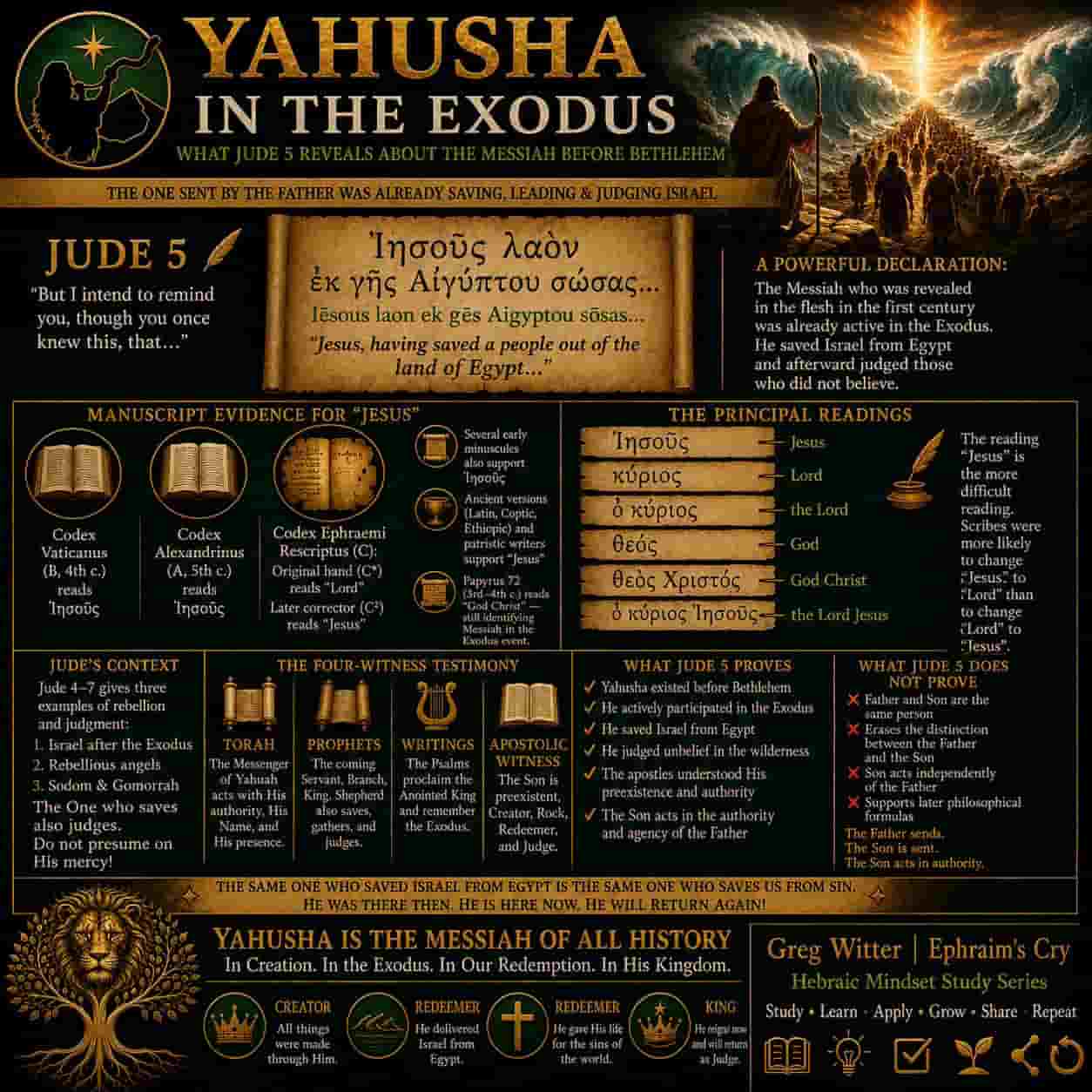
YAHUSHA IN THE EXODUS
What Jude 5 Reveals About the Messiah Before Bethlehem
The One Sent by the Father Was Already Saving, Leading, and Judging Israel
Greg Witter | Ephraim’s Cry
Hebraic Mindset Study Series
Study • Learn • Apply • Grow • Share • Repeat
The letter of Jude contains one of the most striking statements in the entire Apostolic Witness.
Most English readers pass over it without ever realizing that a major textual question stands behind the translation. Some Bibles say that “the Lord” saved a people out of Egypt. Others say that “Jesus” saved a people out of Egypt.
That difference is not minor.
It directly concerns the identity, preexistence, authority, and activity of Yahusha before His birth in Bethlehem.
The Greek text printed in the Nestle-Aland 28th Edition and the United Bible Societies’ Fifth Edition reads:
Ἰησοῦς λαὸν ἐκ γῆς Αἰγύπτου σώσας…
Literally:
“Jesus, having saved a people out of the land of Egypt…”
For this teaching, we will use the restored name Yahusha when referring to the Son. However, the Greek manuscripts themselves contain the form Ἰησοῦς—Iēsous, conventionally rendered “Jesus.”
THE TEXT OF JUDE 5
Jude writes:
“But I intend to remind you, though you once knew this, that Yahusha, having saved a people out of the land of Egypt, afterward destroyed those who did not believe.”
That reading makes a direct and powerful declaration:
The Messiah who was revealed in the flesh in the first century was already active in the Exodus.
He was not merely anticipated by the Exodus.
He was not merely symbolized by the Exodus.
According to this reading, He participated in saving Israel from Egypt and afterward judging the unbelieving among them.
WHY THIS QUESTION MATTERS
The question is not whether Yahuah delivered Israel from Egypt.
Torah plainly declares that Yahuah brought Israel out of bondage.
The question is how the Apostolic Witness understood the Son’s participation in that work.
Did the apostles believe Yahusha began to exist at Bethlehem?
Or did they understand Him as the preexistent Son, Word, Messenger, and appointed agent through whom the Father created, revealed, redeemed, led, and judged?
Jude 5 belongs directly within that larger biblical question.
THE PRINCIPAL TEXTUAL READINGS
The surviving Greek manuscript tradition contains several readings at Jude 5.
The major forms include:
Ἰησοῦς — Jesus
κύριος — Lord
ὁ κύριος — the Lord
θεός — God
θεὸς Χριστός — God Christ
ὁ κύριος Ἰησοῦς — the Lord Jesus
This variation shows that ancient scribes encountered difficulty at precisely this point.
The action is clear.
Someone saved the people out of Egypt and later destroyed those who did not believe.
The textual question concerns the identity of that subject.
Was Jude’s original word Jesus, Lord, or God?
THE MANUSCRIPT SUPPORT FOR “JESUS”
The reading Ἰησοῦς—Jesus is supported by important ancient witnesses.
Codex Vaticanus, a major fourth-century Greek manuscript containing Jude, supports the reading “Jesus.”
Codex Alexandrinus, from the fifth century, also supports the reading “Jesus.”
A number of later Greek witnesses preserve the same reading.
Codex Ephraemi Rescriptus must be described carefully. The original hand is generally cited in support of “Lord,” while a later corrector supports “Jesus.” Therefore, it is inaccurate to say without qualification that Codex Ephraemi simply reads “Jesus.”
The earliest surviving manuscript containing Jude, Papyrus 72, does not preserve the simple reading “Jesus.” It contains an unusual Christological form generally reported as “God Christ” or a closely related arrangement. Even this witness connects Messiah directly with the Exodus event, though it cannot be cited as straightforward evidence for the single word “Jesus.”
The manuscript evidence is therefore complex, but the reading “Jesus” is neither late, isolated, nor invented by modern translators. It is an ancient and substantial reading.
WHY THE READING “JESUS” IS SO SIGNIFICANT
The reading “Jesus” is more difficult than the reading “Lord.”
That matters.
Scribes were more likely to soften a startling statement than to create one unnecessarily.
The Torah clearly says Yahuah delivered Israel from Egypt.
A scribe encountering the statement that “Jesus saved a people out of Egypt” might be tempted to replace “Jesus” with the more expected title “Lord.”
That would make the text easier to understand.
It would also make the wording conform more closely to the familiar language of the Exodus account.
The reverse is harder to explain.
Why would multiple scribes change the familiar and expected title “Lord” into the much more startling name “Jesus”?
The reading “Jesus” naturally explains why the other forms developed.
Some scribes may have replaced it with Lord.
Others may have replaced it with God.
Others may have expanded it to Lord Jesus.
Still others may have produced a combined form such as God Christ.
The variety of readings strongly suggests that the original wording created theological discomfort.
JUDE’S IMMEDIATE CONTEXT
Jude does not introduce this statement randomly.
In verse 4, he warns about men who had crept in unnoticed and denied:
“our only Master and Lord, Yahusha Messiah.”
He then says he wants to remind his readers of truths they already knew.
He presents three examples of rebellion and judgment:
The unbelieving Israelites after the Exodus.
The rebellious heavenly messengers who abandoned their proper place.
Sodom and Gomorrah, which gave themselves over to sexual immorality and rebellion.
Jude’s purpose is warning.
The same One who saves also judges rebellion.
The same Messiah who rescues His people does not overlook unbelief, lawlessness, or covenant betrayal.
If Yahusha is the subject of verse 5, Jude is showing continuity between the Messiah who saved Israel from Egypt and the Messiah whom false teachers now denied.
The warning is severe:
Do not presume upon the mercy of the One who delivered you.
YAHUSHA DID NOT BEGIN AT BETHLEHEM
The birth of Yahusha in Bethlehem was not the beginning of His existence.
It was His entrance into human flesh.
The Apostolic Witness repeatedly presents Him as existing before His earthly birth.
Yoḥanan writes that the Word was in the beginning with Elohim and that all things came into being through Him.
Yahusha declared that He existed before Abraham.
Sha’ul teaches that Israel drank from the spiritual Rock and that the Rock was Messiah.
The letter to the Hebrews presents the Son as the One through whom the ages were made.
Jude 5 fits within this same testimony.
The Son was not a late addition to the plan of redemption.
He was active from the beginning.
THE EXODUS WAS ALREADY MESSIANIC
The Exodus is not merely an ancient national deliverance.
It is a pattern of redemption.
Israel was enslaved under a cruel master.
Yahuah heard their cry.
The Passover lamb was slain.
Blood marked the covenant household.
The people were delivered from bondage.
They passed through the waters.
They were led into covenant.
They were tested in the wilderness.
The unbelieving generation fell under judgment.
Every element points forward to the greater work of redemption through Yahusha.
But Jude 5 goes beyond saying that the Exodus merely pointed toward Messiah.
It identifies Messiah as active within the Exodus itself.
The pattern was Messianic because the Messiah was already involved.
SAVING AND JUDGING
Jude places two actions together:
Yahusha saved a people out of Egypt.
Afterward He destroyed those who did not believe.
Modern religion often separates salvation from judgment.
Scripture does not.
The Redeemer is also Judge.
Deliverance does not excuse rebellion.
Being brought out of Egypt does not guarantee entrance into the inheritance.
The generation that experienced miracles still fell because of unbelief and disobedience.
This warning remains.
A person may experience deliverance and still turn back.
A person may be brought near and still refuse covenant faithfulness.
A person may confess Messiah and still deny Him through rebellion.
Jude’s warning is not merely historical.
It is covenantal.
THE FOUR-WITNESS TESTIMONY
TORAH
Torah declares that Yahuah delivered Israel from Egypt.
It also repeatedly introduces the Messenger of Yahuah as bearing the authority, Name, presence, and speech of Yahuah.
The Messenger speaks as Yahuah.
The Messenger acts in the authority of Yahuah.
The Name of Yahuah is in Him.
The people are warned to obey His voice.
This establishes the Hebraic framework of agency.
PROPHETS
The Prophets speak of the coming Branch, Servant, King, Shepherd, and Redeemer.
They also present Yahuah as the One who saves, gathers, shepherds, and judges Israel.
The Apostolic Witness reveals that these works are carried out through the appointed Son.
WRITINGS
The Psalms speak of Yahuah’s Anointed King.
They call the nations to submit to the Son.
They present the King as ruling by the authority of Yahuah.
They also repeatedly remember the Exodus as the great act of covenant redemption.
APOSTOLIC WITNESS
The Apostolic Writings identify Yahusha as the preexistent Word, the spiritual Rock, the appointed Judge, the image of the invisible Elohim, and the One through whom creation came into being.
Jude 5 therefore does not stand alone.
It confirms a pattern already established across the whole counsel of Scripture.
THE PRINCIPLE OF AGENCY
This passage must not be used to erase the distinction between the Father and the Son.
The Father is not the Son.
The Son is not the Father.
The Father sends.
The Son is sent.
The Father gives authority.
The Son acts in that authority.
The Father accomplishes His work through His appointed agent.
In the Hebraic world, the authorized messenger could speak and act in the name of the one who sent him.
The act of the agent was counted as the act of the sender.
This principle explains how Torah can say Yahuah delivered Israel while Jude can identify Yahusha as active in that same deliverance.
There is no contradiction.
Yahuah saved Israel through His appointed Son and Messenger.
The Son did not act independently.
He acted in complete unity with the will, authority, and purpose of the Father.
WHAT JUDE 5 PROVES
Jude 5 strongly supports the preexistence of Yahusha.
It supports His active participation in the Exodus.
It identifies Him with the work of saving and judging Israel.
It demonstrates that the Apostolic Witness did not view Yahusha as beginning at Bethlehem.
It confirms that the Son acted in the authority and agency of Yahuah before His incarnation.
It shows that the history of Israel cannot be separated from the Messiah.
WHAT JUDE 5 DOES NOT PROVE
Jude 5 does not prove that the Father and Son are the same person.
It does not erase the relationship between sender and sent one.
It does not require later philosophical language imposed upon the text.
It does not permit us to ignore the consistent distinction between the Father and the Son.
It does not teach that the Son acts independently from the Father.
The text must be read within the Hebraic framework of agency, authority, representation, and covenant mission.
WHY SOME TRANSLATIONS STILL SAY “LORD”
Many English translations were produced from editions of the Greek text that printed “Lord” in Jude 5.
Others followed a manuscript tradition that favored “Lord.”
Some translators also considered “Lord” easier because it agrees directly with the wording of the Exodus accounts.
That does not mean those translations were dishonest.
It means they followed a different textual judgment.
However, readers should be informed that “Jesus” is an ancient reading supported by major manuscripts and printed in the current standard critical Greek text.
The difference should not be hidden.
THE WARNING TO THE ASSEMBLY
Jude’s purpose is not merely to give us information about textual criticism.
His purpose is to warn the assembly.
The One who saved Israel also judged unbelief.
The One who redeems also demands faithfulness.
The One who shows mercy also exposes rebellion.
Grace is not permission to return to Egypt.
Deliverance is not permission to reject covenant.
Salvation is not permission to deny the Master who bought us.
The wilderness generation saw the works of Yahuah, yet their hearts turned back.
Jude warns us not to repeat their rebellion.
THE GOSPEL OF THE KINGDOM IN THE EXODUS
The Exodus reveals the pattern of the Gospel of the Kingdom.
Repentance begins the turning.
The blood of the lamb marks redemption.
Bondage is broken.
The slave master loses his claim.
The people are brought through the waters.
They are led to covenant.
They are instructed in the ways of the King.
They are called to faithful obedience.
They are prepared to inherit the Kingdom.
Yahusha is not merely present at the end of that pattern.
He is active within it.
He is the appointed Kinsman Redeemer.
He delivers from the slave master of sin.
He saves from the curse of death.
He restores the redeemed to covenant relationship with the Father.
He leads His people toward the Kingdom.
THE FINAL TRUTH
The Messiah did not suddenly appear in the first century as though He had no part in the history of Israel.
He was already there.
He was active in creation.
He was present in the covenant story.
He was involved in the deliverance from Egypt.
He sustained the people in the wilderness.
He judged unbelief.
He appeared in the fullness of time in human flesh.
He gave His life as the Lamb.
He rose from the dead.
He now reigns at the right hand of the Father.
He will return as King and Judge.
Jude 5 tears down the false idea that Yahusha belongs only to the Apostolic Writings.
He is woven throughout the entire testimony of Scripture.
The Exodus was His work under the authority of the Father.
The wilderness judgment was His work under the authority of the Father.
The redemption accomplished at the stake was His work under the authority of the Father.
The coming restoration of the Kingdom will be His work under the authority of the Father.
The One who saved Israel from Egypt is the same One who saves His people from sin.
The One who judged unbelief in the wilderness is the same One before whom every person will stand.
Yahusha did not begin at Bethlehem.
Bethlehem revealed in flesh the One who had already been active in the redemptive work of Yahuah.
The Messiah was in the Exodus.
The Messiah was in the wilderness.
The Messiah was in the covenant story.
And the Messiah is still calling His people out of bondage and into covenant faithfulness today.
#EphraimsCry#GregWitter#HebraicMindsetStudySeries#EphraimsCryAcademy#ReturnToCovenant#TorahCommunity
#MessianicBelievers#BibleStudents#BibleTeachers#ScriptureStudy#HebraicMindset#KingdomBelievers#CovenantCommunity
#TruthSeekers#FollowersOfYahusha#YahushaInTheExodus#Jude5#TextualCriticism#GreekNewTestament#BiblicalManuscripts
#PreexistenceOfMessiah#MessengerOfYahuah#HebraicAgency#Exodus#Passover#WildernessGeneration#MessiahInTorah
#FourWitnesses
