
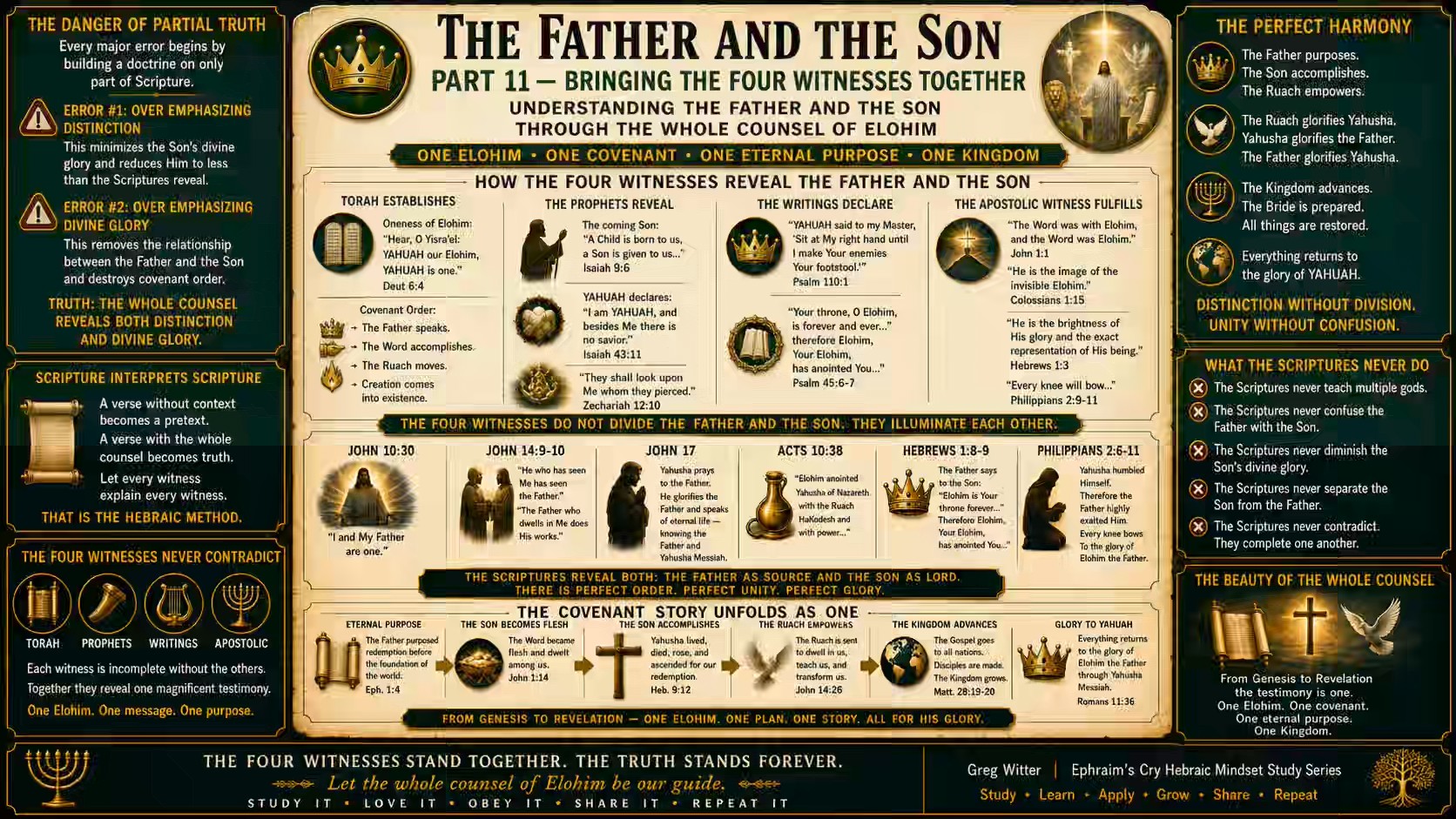
THE FATHER AND THE SON
PART 11 — BRINGING THE FOUR WITNESSES TOGETHER
Understanding the Father and the Son Through the Whole Counsel of Elohim
Every major theological error begins the same way. Someone builds an entire doctrine upon one group of passages while neglecting another. One person emphasizes the passages that distinguish the Father and the Sonuntil the Son is reduced to something less than the Scriptures reveal. Another emphasizes the passages that reveal Yahusha’s divine glory until the relationship between the Father and the Son disappears. Both errors occur because the whole counsel of Elohim has not been allowed to speak.
The Scriptures were never intended to be interpreted in isolated fragments. Torah lays the foundation. The Prophets build upon that foundation. The Writings provide wisdom, history, worship, and practical covenant life. The Apostolic Witness confirms and fulfills everything that came before it through the life, death, resurrection, ascension, and reign of Yahusha the Messiah. Each witness is incomplete without the others. Together they reveal one magnificent testimony.
Torah establishes the absolute oneness of Elohim.
“Hear, O Yisra’el: Yahuah our Elohim, Yahuah is one.” (Deuteronomy 6:4)
This declaration is never abandoned anywhere in Scripture. Neither Yahusha nor the Apostles ever suggest the existence of multiple gods. The Father, the Son, and the Ruach HaKodesh never compete for glory because there is only one Elohim carrying out one eternal plan.
Torah also establishes covenant order.
The Father speaks.
The Word accomplishes.
The Ruach moves.
Creation comes into existence.
The same covenant order that appears in Genesis continues throughout the Scriptures and reaches its fullest revelation in Messiah.
The Prophets continue revealing this same pattern.
Isaiah speaks of the coming Son.
“A Child is born to us, a Son is given to us…” (Isaiah 9:6)
The same prophet records Yahuah saying,
“I am Yahuah, and besides Me there is no savior.” (Isaiah 43:11)
Later the Apostolic Witness identifies Yahusha as Savior.
Rather than contradicting one another, the witnesses complement one another.
The Father saves through the Son.
The Son perfectly accomplishes the Father’s salvation.
Zechariah records Yahuah declaring,
“They shall look upon Me whom they pierced.” (Zechariah 12:10)
John applies this prophecy to Yahusha.
The Prophets reveal the mystery.
The Apostolic Witness reveals its fulfillment.
The Writings continue the same testimony.
David writes,
“Yahuah said to my Master, ‘Sit at My right hand until I make Your enemies Your footstool.'” (Psalm 110:1)
Yahusha Himself applies this passage to the Messiah.
The Father speaks.
The Son is exalted.
The relationship remains perfectly intact.
Psalm 45 likewise declares,
“Your throne, O Elohim, is forever and ever… therefore Elohim, Your Elohim, has anointed You…” (Psalm 45:6–7)
Hebrews directly applies these verses to Yahusha.
Again the pattern remains.
The Son is addressed with divine language.
The Father anoints Him.
Distinction and divine glory stand together.
The Apostolic Witness then gathers everything together.
John declares,
“The Word was with Elohim, and the Word was Elohim.” (John 1:1)
Paul declares,
“He is the image of the invisible Elohim.” (Colossians 1:15)
Hebrews declares,
“He is the brightness of His glory and the exact representation of His being.” (Hebrews 1:3)
Philippians declares that every knee will bow before Yahusha to the glory of Elohim the Father (Philippians 2:9–11).
None of these passages deny the Father.
None diminish the Son.
None separate the Father from the Son.
Instead, they reveal perfect covenant harmony.
This is why the Four-Witness method is so important.
If we read only John 10, we may misunderstand what Yahusha means by saying,
“I and My Father are one.”
John 17 explains John 10.
If we read only Acts 10, we may misunderstand the meaning of the Father’s anointing.
Psalm 45 and Hebrews 1 explain Acts 10.
If we read only John 14:9,
“He who has seen Me has seen the Father,”
we might conclude that Yahusha is saying He is the Father.
The very next verse explains the statement.
“The Father who dwells in Me does His works.”
Scripture continually interprets Scripture.
The Four Witnesses never contradict.
They illuminate one another.
This also exposes the weakness of theological systems that depend upon isolated proof texts.
The Oneness position emphasizes passages that reveal Yahusha’s divine identity while minimizing or reinterpreting the passages revealing His relationship with the Father.
The Arian position emphasizes passages describing Yahusha’s submission while minimizing those revealing His divine glory.
Neither system allows every witness to stand.
The Scriptures do.
The Scriptures never force us to choose between distinction and unity.
They reveal both.
The Scriptures never force us to choose between divine glory and covenant order.
They reveal both.
The Scriptures never force us to choose between the Father’s supremacy within the redemptive plan and the Son’s full authority as the Messiah.
They reveal both.
This is why the Hebraic method differs from philosophical theology.
Instead of beginning with a theological system, it begins with the written Word.
Instead of forcing every passage into one predetermined framework, it allows every witness to contribute to the complete picture.
Instead of asking,
“Which verses support my doctrine?”
it asks,
“What is every witness saying together?”
When we do that, the harmony becomes unmistakable.
The Father purposes.
The Son accomplishes.
The Ruach HaKodesh empowers.
The Kingdom advances.
The Bride is prepared.
The Father is glorified.
The Son is glorified.
The Ruach glorifies the Son.
Everything moves toward the restoration of all things under the Kingdom of Elohim.
The Four Witnesses never divide the Father from the Son.
Neither do they confuse Them.
The Father remains the Father.
The Son remains the Son.
The Ruach remains the Ruach.
One Elohim.
One covenant.
One eternal purpose.
One Kingdom.
One magnificent testimony from Genesis to Revelation.
This is the strength of the whole counsel of Elohim.
When every witness is allowed to speak, truth stands firmly upon an unshakable foundation.
Greg Witter | Ephraim’s Cry Hebraic Mindset Study Series
Study • Learn • Apply • Grow • Share • Repeat
#EphraimsCry #GregWitter #HebraicMindset #HebraicMindsetStudySeries
#FourWitnesses #WholeCounselOfElohim #FatherAndSon #OneElohim
#Torah #Prophets #Writings #ApostolicWitness #John1 #John10 #John14
#John17 #Psalm45 #Psalm110 #Isaiah43 #Philippians2 #Hebrews1
#KingdomOfElohim #GospelOfTheKingdom #ScriptureInterpretsScripture
#TruthMatters #BibleStudy #Discernment #StudyLearnApplyGrowShareRepeat
