
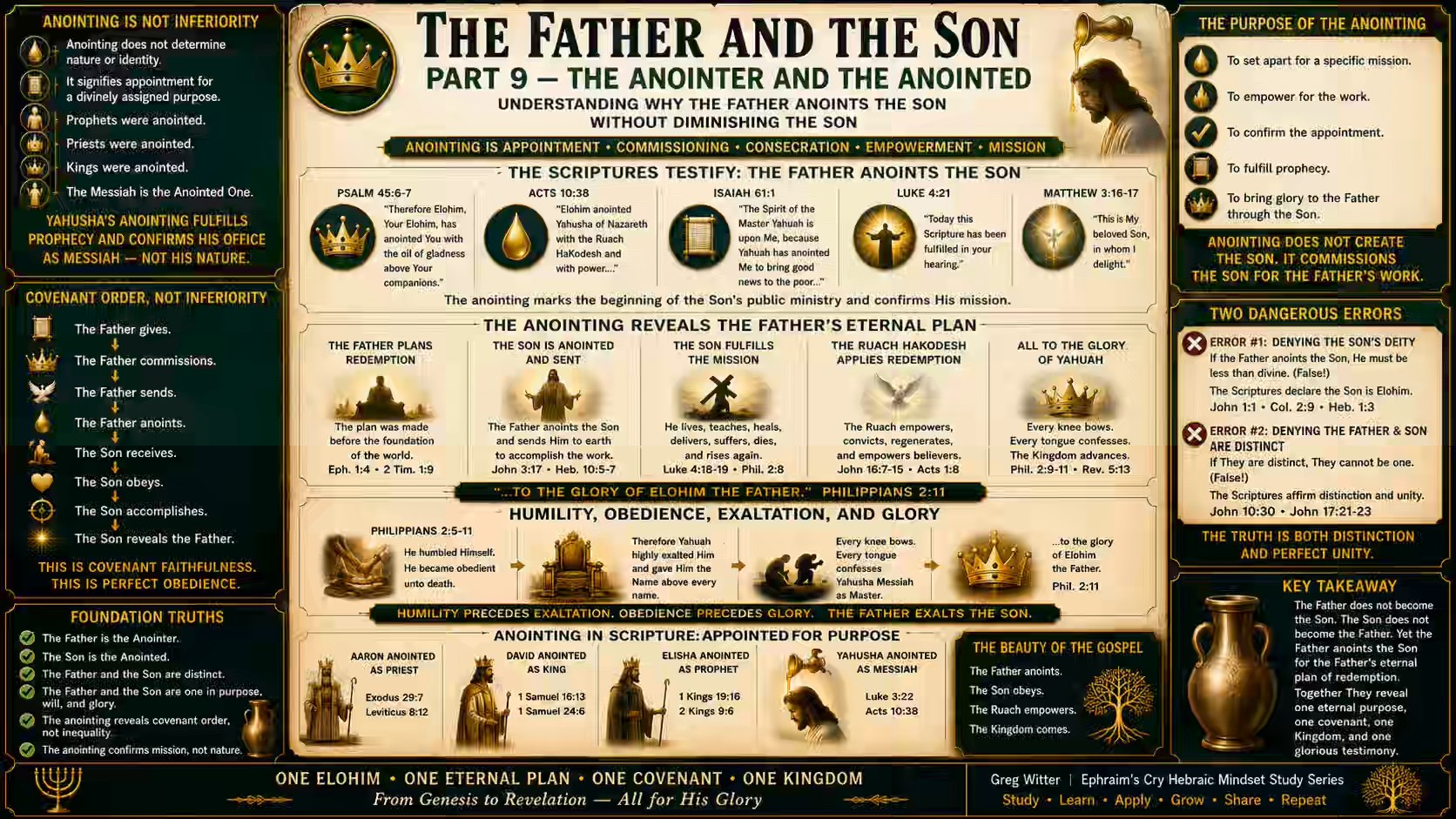
THE FATHER AND THE SON
PART 9 — THE ANOINTER AND THE ANOINTED
Understanding Why the Father Anoints the Son Without Diminishing the Son
One of the most common arguments used against the divine identity of Yahusha is that He was anointed by the Father. The argument usually goes something like this: “If Yahusha is truly Yahuah, then who anointed Him? Surely the anointer must be greater than the one being anointed.” At first glance, that argument appears persuasive. However, it is built upon an assumption that the Scriptures themselves never make. It assumes that being anointed determines one’s nature or identity. The Scriptures teach no such thing.
The Bible never presents anointing as proof of superiority or inferiority. Rather, anointing is always connected with appointment, commissioning, consecration, empowerment, and the carrying out of a specific mission. Throughout the Scriptures, prophets were anointed. Priests were anointed. Kings were anointed. None of them were anointed because they were less human than the one doing the anointing. They were anointed because they were being set apart for a divinely appointed purpose.
The same principle applies to the Messiah.
The very title “Messiah” means “Anointed One.”
Likewise, the Greek title “Christ” means “Anointed One.”
If Yahusha were never anointed, He could not properly be called the Messiah.
His anointing is not evidence against Him.
It is evidence that He is exactly who the Scriptures promised He would be.
David foresaw this in Tehillim (Psalm) 45:6–7.
“Your throne, O Elohim, is forever and ever… therefore Elohim, Your Elohim, has anointed You with the oil of gladness above Your companions.”
This passage is remarkable because it reveals both truths simultaneously.
The One being addressed is called “Elohim.”
Yet that same One is anointed by “Your Elohim.”
The writer of Hebrews directly applies this passage to the Son (Hebrews 1:8–9).
Notice carefully what the writer does not do.
He does not explain the tension away.
He does not deny the Son’s divine glory.
He simply allows both truths to stand.
The Son is addressed with divine language.
The Son is also the One whom the Father anoints.
The Four Witnesses remain perfectly consistent.
Acts 10:38 continues the same testimony.
“How Elohim anointed Yahusha of Nazareth with the Ruach HaKodesh and with power…”
Again, what is the purpose of the anointing?
It is not to create the Son.
It is not to make Him divine.
It is not to elevate Him from creature to deity.
It is to commission Him publicly for the earthly ministry the Father sent Him to accomplish.
The Father’s anointing marks the beginning of Messiah’s public ministry.
Immediately following His baptism, the Ruach descends upon Him, and the Father’s voice declares,
“This is My beloved Son, in whom I delight.” (Matthew 3:16–17)
Notice the harmony.
The Father speaks.
The Son stands in obedience.
The Ruach descends.
The Messiah is publicly commissioned.
Everything unfolds exactly according to the Father’s eternal plan.
The anointing reveals covenant order.
It does not redefine the Son’s identity.
Isaiah had already prophesied this moment.
“The Spirit of the Master Yahuah is upon Me, because Yahuah has anointed Me to bring good news to the poor…” (Isaiah 61:1)
Yahusha read this very passage in the synagogue at Nazareth and declared,
“Today this Scripture has been fulfilled in your hearing.” (Luke 4:21)
Again, His anointing fulfilled prophecy.
It confirmed His office.
It confirmed His mission.
It confirmed His appointment as Messiah.
It did not deny His glory.
Throughout Scripture, every anointing has a purpose.
Aaron was anointed to serve as high priest.
David was anointed to rule as king.
Elisha was anointed as prophet.
None of these anointings changed their nature.
They marked their calling.
Likewise, Yahusha’s anointing marks His messianic mission.
One of the greatest mistakes made by those opposing Yahusha’s divine identity is confusing function with nature.
The Son’s function within the Father’s redemptive plan does not determine His nature.
Throughout the Gospel accounts, Yahusha willingly submits Himself to the Father.
He comes because the Father sends Him.
He obeys because the Father commissions Him.
He accomplishes because the Father gives Him the work.
He glorifies because the Father glorifies Him.
This is covenant order.
It is not inferiority.
Philippians 2 illustrates this beautifully.
Yahusha humbles Himself.
He becomes obedient unto death.
Therefore the Father highly exalts Him.
Notice the order.
Humility precedes exaltation.
Obedience precedes glory.
The Father exalts the Son.
The Son receives the exaltation.
Every knee bows before the Son.
Every tongue confesses Yahusha Messiah as Master.
And Paul concludes with these remarkable words:
“…to the glory of Elohim the Father.” (Philippians 2:11)
The Son’s exaltation glorifies the Father.
The Father’s plan glorifies the Son.
There is no competition.
There is no conflict.
There is perfect covenant harmony.
This same relationship continues throughout Revelation.
The Lamb approaches the One seated upon the throne.
The Lamb receives the scroll.
All heaven worships.
The Father is glorified.
The Son is glorified.
The Kingdom advances.
The Father’s eternal purpose is fulfilled through the Son.
One of the greatest misunderstandings in modern theology is assuming that if the Father anoints the Son, the Son must therefore be something less than fully divine.
The Scriptures never draw that conclusion.
Instead, they reveal that the Father appoints.
The Father commissions.
The Father sends.
The Father anoints.
The Son willingly receives.
The Son perfectly obeys.
The Son perfectly accomplishes.
The Son perfectly reveals the Father.
This is not weakness.
This is perfect obedience.
This is not inferiority.
This is covenant faithfulness.
This is not contradiction.
This is the Gospel of the Kingdom unfolding exactly as the Father ordained before the foundation of the world.
The Father is the Anointer.
The Son is the Anointed.
That relationship is real.
It is beautiful.
It is biblical.
It reveals perfect order without diminishing either the Father or the Son.
The Father is not the Son.
The Son is not the Father.
Yet together They reveal one eternal plan of redemption, one covenant, one Kingdom, one purpose, and one glorious testimony from Genesis to Revelation.
That is the witness of the whole counsel of Elohim.
Greg Witter | Ephraim’s Cry Hebraic Mindset Study Series
Study • Learn • Apply • Grow • Share • Repeat
#EphraimsCry #GregWitter #HebraicMindset #HebraicMindsetStudySeries #FatherAndSon
#TheAnointer #TheAnointed #Messiah #Yahusha #Psalm45 #Acts10 #Isaiah61 #Luke4
#Hebrews1 #Philippians2 #WholeCounselOfElohim #Torah #Prophets #Writings
#ApostolicWitness #KingdomOfElohim #GospelOfTheKingdom
#ScriptureInterpretsScripture #TruthMatters #Covenant #BibleStudy #Discernment
#StudyLearnApplyGrowShareRepeat
